
Labour Party leader David Shearer has told an Australian business forum that a single economic market between New Zealand and Australia deserves further analysis, as the two countries' productivity commissions look for ways to further integrate the two economies.
In a speech to the Australian NZ Leadership Forum, the New Zealand Opposition leader said while the economies shared similarities, there was a growing differential between the two as higher Australian wages enticed educated New Zealanders across the Tasman.
New Zealand was not able to replicate the wealth effect caused by the Australian mining boom, which meant it needed to innovate in differect ways off the back of its clean, green image. Relying on the agriculture sector alone would not see New Zealand catch up with Australian economic dominance.
Shearer said Labour welcomed foreign investment which helped New Zealand to grow. But policy makers here should not underestimate fears New Zealanders had about loss of economic sovereignty and identity. Rules to tighten the rights of foreigners to own New Zealand farmland needed to be more explicit and transparent, he said.
'Let's join forces'
A single economic market between New Zealand and Australisa was an aspiration that deserved further analysis, Shearer told the forum.
"For my part, the future of our on-going economic relationship cannot be separated from New Zealand’s economic future. Our trade relationship with Australia is strong. Australia is our largest trading partner. New Zealand is Australia’s fifth largest," he said.
In the job-rich manufacturing exports, there is a closer symmetry with New Zealand as Australia’s largest market and Australia as New Zealand's. But a growing economic differential was having a real impact on New Zealand.
"In particular, many of our highly educated young people are attracted by higher wages and better economic opportunities in Australia, whether that is in business, science or academia. We have a world class education system in NZ, but exporting our talent is clearly not in our longer term interests and presents a real challenge for how we respond," Shearer said.
Leverage off clean and green
While Australia’s vast mineral wealth was part of its current and future success, New Zealand could not directly replicate that.
"Instead our challenge is to design a future where we harness our talent and innovation the way that other like-sized countries have done," Shearer said.
"Singapore, Denmark, Finland, and Israel do not have the advantages of New Zealand’s land mass, resources and climate, yet they are world leaders in innovations based on their education systems. Our competitive advantage lies in our clean green image – that includes the way our agriculture is produced, marketed and sold to increasingly discerning international consumers," he said.
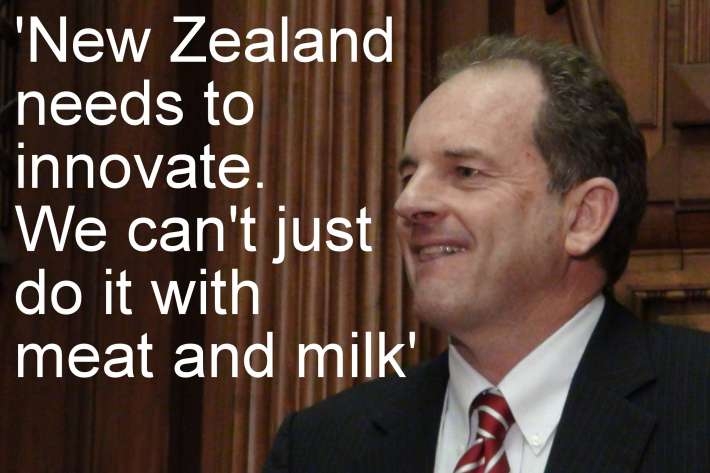
"But as good as New Zealand is at it, there’s a ceiling on how much butter and beef, meat and milk you can make off New Zealand grass. You hit the limit a long time before you get to be as prosperous as Australia."
New Zealand therefore needed to look for new opportunities.
"We have to leverage off our existing natural advantages. But we also need to seize opportunities that will not only keep our talent onshore, but create a place where talent wants to live," Shearer said.
"I believe that our economic viability is linked directly to our ability to produce new and innovative products and solutions. That type of economy in turn will better generate the jobs that will keep our young and talented people in New Zealand," he said.
'Answer's not ag vs high tech; It's both'
"It’s not a question of either agriculture ‘or’ high-tech. We should be and can be doing both. We are having some real success with the top 200 high-tech companies which generate $6.5 billion, nearly 80% exported and growing at around 4%. But we must do much better at commercialising ideas and ensuring the value stays in New Zealand," Shearer said.
"In this light, trade with Australia has frequently been important for the growth of many smaller innovative companies. NZ’s small size means new companies have a limited local market in which to test ideas before taking them to export in order to grow and Australia has been an extension of a more familiar environment. We need to preserve and expand those opportunities for New Zealand companies," he said.
'We want foreign investment if it helps
Turning to Asian investment, which has become a contentious issue in New Zealand due to the ongoing Crafar Farms saga, Shearer noted demand from Asia for Kiwi and Australian products sheltered the two economies from the global financial crisis.
Global economic dominance was moving from the west to the east.
"Such a historical and fundamental shift opens new opportunities for those nimble and astute enough to seize them. New Zealand has moved quickly with free trade agreements – in particular with China and we are now negotiating with India. It is, again, an area of bipartisan endeavour. Those agreements have opened doors for New Zealand products and have grown our trade throughout Asia," Shearer said.
"At the same time, issues about land ownership, or general ownership of the economy, immigration, national identity, cultural links and heritage are increasingly coming to the fore," he said.
The purchase of the 16 Crafar farms by Chinese conglomerate Shanghai Pengxin had caused anxiety in New Zealand, which was compounded when the High Court upheld a challenge from a rival group of bidders for the farms who claimed the Overseas Investment Office had not reviewed Pengxin's application correctly.
Is NZ sovereignty being undermined?
The partial sale of four government-owned energy companies, the absence of details around the Trans-Pacific Partnership Trade deal and other events raised fears that New Zealand's sovereignty was being undermined, Shearer said.
"Of course New Zealand needs foreign investment. We welcome investment that helps build our country and develop our economy," he said.
"For me, the overriding principle of that foreign investment is that we have to be sure that it brings real benefit to our country. That is particularly the case around profitable farmland which New Zealanders are sensitive about. There needs to be certainty around investment rules. The rules to tighten the ownership of farmland, for example, need to be explicit and set out the conditions under which foreign investment might succeed.
There also needs to be – to the fullest extent possible – transparency and communication around agreements and their negotiation."
Policy makers should not underestimate the fears some New Zealanders had about loss of identity and sovereignty.
"And in New Zealand where our environment and agricultural land is so essential to us, this will always be the case. The fact that this anxiety coincides with the global financial crisis should not come as a surprise," Shearer said.
An Australian government White Paper looking at how their economy would deal with what is being tipped as the Asian century was a valuable exercise.
"Turning a blind eye to these pressures will cause longer-term headaches. If we don’t discuss these challenges openly and on our own terms, they will be forced on to us," Shearer said.
"If we fail to consider these possibilities they will eventually bubble to the surface in increasingly unpredictable and uncontrollable ways. That is in no one’s best interest. I am convinced that New Zealand must preserve its historic and competitive advantage, at the same time as expanding our opportunities," he said.
New Zealand's economic viability was directly linked to preserving ownership of its assets and natural advantages.
"In fact you could say that the issue around farm land ownership in New Zealand is symptomatic of a broader concern about economic sovereignty," Shearer said.
"New Zealand and Australia are engaging with Asia in slightly different ways. The challenge will be whether the closeness we have experienced under CER can be adapted to serving our increasing engagement with Asia," he said.
We welcome your comments below. If you are not already registered, please register to comment
Remember we welcome robust, respectful and insightful debate. We don't welcome abusive or defamatory comments and will de-register those repeatedly making such comments. Our current comment policy is here.