
By Alex Tarrant
Economists say New Zealand is still vulnerable to the "whims of its creditors" after figures released today showed its current account deficit was heading back to the "danger zone" where credit ratings agencies would start to worry about the state of the country's external accounts.
Figures released today by Statistics New Zealand showed the annual current account deficit was NZ$9.7 billion in the year to March 2012, equivalent to 4.8% of Gross Domestic Product. This was the largest deficit as a proportion of GDP since the year to June 2009.
Economist polls conducted by Reuters, Bloomberg and Dow Jones all showed an expected deficit of 4.6% of GDP for the year. Treasury had expected a deficit of 4.2% of GDP in its May Budget, while the Reserve Bank’s more recent June Monetary Policy Statement forecast a deficit of 4.7% of GDP.
The annual gap - recording New Zealand’s transactions with the rest of the world - was up from a revised deficit of 3.7% of GDP (initially 3.6%) in the year to March 2011, and a deficit of 4.3% of GDP in the year to December 2011.
The New Zealand dollar had fallen about 20 basis points against the US dollar on the news, which was released at 10:45am, by 3:20 pm on Wednesday to 79.5 US cents. The dollar opened the day around 79.8 US cents, and began falling at 10am.
Danger zone, whims of creditors, ratings agencies to start worrying
ANZ chief economist Cameron Bagrie said the fact the current account balance deteriorated more than expected and was rapidly approaching 5 percent of GDP - "a level often seen as a tipping point" - meant the trajectory of the current account deficit would become more of a focus.
"Despite favourable revaluations, our external debt levels remain high and the current account deficit is moving back towards the 5 percent plus danger zone," Bagrie said.
"While the June MPS and the Budget 2012 forecasts have the current account deficit heading north of 6 percent of GDP by 2014 we continue to expect future deficits to be capped at around 5 percent of GDP, given private and public sector deleveraging. This depends crucially on borrowers continuing to show restraint and deleverage, consumer spending making way to facilitate the Canterbury rebuild, and export commodity prices starting to find a floor," he said.
BNZ's Head of Research Stephen Toplis said the deficit readings were going from "bad to worse," and begged the question as to just how much pressure the external accounts might put on the currency.
"Our medium term view for the NZD is that it will drift lower. Our current account expectations suggest that the risk to this forecast might be significantly to the downside, especially if our current account deterioration coincides with the expected recovery in the US economy," Toplis said.
"As things stand, the annual current account balance has already climbed from a trough of 1.9% of GDP back in March 2010 to its current reading. Our forecasts see the deficit climbing to 7.0% of GDP by year’s end and then further still to a peak at 8.3% of GDP by end 2013," he said.
"Not only is this a direct threat to the NZD but it is also a very clear risk for NZ’s credit rating with Standard & Poor’s, in particular, having recently placed great emphasis on the current account’s progress."
ASB chief economist Nick Tuffley said the recent relatively sharp decline in key export commodity prices would constrain overall export incomes, at a time when domestic demand growth (including earthquake reconstruction) would be lifting imports and profits of foreign-owned companies.
"Consequently, we expect the current account deficit to widen appreciably more than looked the case late last year (when commodity prices were firmer), with the deficit now forecast to peak above 6.5% of GDP around mid-2013. Further out, recovery in commodity prices will help constrain the deficit, and there are tentative signs that the prices are stabilising," Tuffley said.
"NZ’s net foreign liability position will continue to increase over the next few years (and it has been artificially lowered in the short term by earthquake insurance obligations of foreign insurers that have yet to be paid). Consequently, NZ is still vulnerable to the whims of its creditors," he said.
"Encouragingly, signs of gradual rebalancing continue. Private sector reliance on foreign savings is reducing, and eventual stabilisation of the Government’s debt levels will further contribute in time."
Aussie bank profits
“The year-end deficit increase to NZ$9.7 billion was mainly due to higher profits earned by foreign-owned banks and increased imports of petroleum and petroleum products,” Stats NZ said. See Gareth Vaughan's May 2012 article on record bank profits here.
“Services imports and transfer payments to overseas also increased over this time, due to the rising costs of reinsurance in the latest year,” it said.
Quarterly figures showed a current account deficit of NZ$2.8 billion in the March 2012 quarter. That was NZ$0.6 billion larger than in the December 2011 quarter.
“The quarterly deficit increase to NZ$2.8 billion was mainly caused by a turnaround in New Zealand’s international trade in goods and services, which was a deficit for the first time since the December 2008 quarter,” Stats NZ said.
“The value of dairy exports fell despite an increase in volumes, as dairy prices fell for the third quarter in a row,” balance of payments manager John Morris said.
Spending by visitors to New Zealand also fell in the March 2012 quarter, as visitor numbers dropped following the Rugby World Cup. Expenditure by British and other European travellers continued to fall, Stats NZ said.
Profits earned by foreign-owned companies in New Zealand fell in the March 2012 quarter, partly offsetting the falls in exports of goods and services.
“Despite the fall in profits, earnings reinvested in New Zealand by these companies increased NZ$0.4 billion this quarter. In contrast dividends paid to overseas investors by these companies fell NZ$0.8 billion, to their lowest level in over seven years,” Stats NZ said.
Despite the wider current account deficit in the March 2012 quarter, New Zealand’s net international liabilities actually fell to NZ$143.2 billion (70.9% of GDP) from NZ$146.3 billion (72.9% of GDP) at December 31, 2011.
“The fall in net international liabilities was due to changes in the value of New Zealand’s overseas assets and liabilities. Overseas investment transactions had little impact,” Stats NZ said.
“An appreciating exchange rate decreased the value of New Zealand’s overseas liabilities, and rising overseas share prices increased the value of New Zealand’s overseas assets during the quarter,” it said.
Reinsurance claims up
Meanwhile, Stats NZ said total reinsurance claims from all Canterbury earthquakes were now estimated at NZ$15.7 billion, up by NZ$0.4 billion from previously published estimates.
“At March 31, 2012, a total of NZ$3.8 billion of these claims had been settled with overseas reinsurers, leaving NZ$11.9 billion of claims outstanding,” Stats NZ said.
Chart of the day
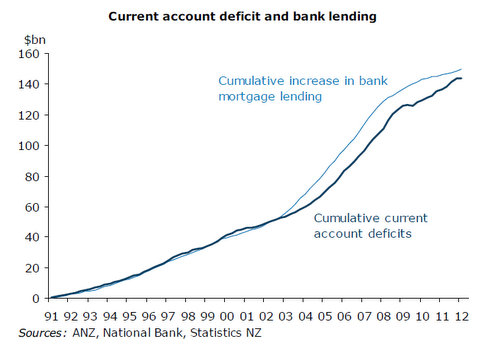
ANZ's Bagrie included this chart in his current account commentary:
Economist Reaction
ASB chief economist Nick Tuffley
Summary
The quarterly current account deficit, at $1.31bn, was close to expectations (market $1.145bn, ASB $1.43bn). In seasonally-adjusted terms the deficit widened slightly, and that trend was also reflected in the lift in the annual deficit to 4.8% of GDP.
The International Investment Position narrowed to 70.9% of GDP due to asset revaluation impacts.
Trade as expected
The goods and services trade balances were close to our expectations. Dairy prices have fallen substantially since late last year and contributed to slightly weaker export receipts compared to a year earlier, compounded by weaker oil export volumes. Meanwhile the cost of imports was lifted by the spike in oil prices earlier this year.
The Services balanced weakened in the wake of the Rugby World Cup, reflecting the drop back to more normal seasonal tourist earnings and a lift in New Zealanders’ travel abroad after they remained homebound during the RWC. The lift in imports of services was mitigated by the absence of various RWC-related hosting fees and broadcasting rights paid in 2011.
Investment Income, Transfers
The investment income deficit was substantially smaller than we expected, though is a notoriously volatile component. A $470mn dip in the outflow of income attributable to foreign investors, relative to Q4, was the main cause of the lower income deficit. The decline in income was concentrated in direct investments in NZ (i.e. where a controlling interest is held). In contrast to the fall in income, direct investors increased the amount of profit reinvested into the local companies. The income NZ earned from its foreign investments edged down fractionally.
The Transfers balance, in contrast, registered a larger than expected deficit through increased foreign aid payments and a smaller tax take from non-residents.
Earthquake insurance settlements
Statistics NZ gains estimates of outstanding foreign insurance claims and includes these as NZ’s foreign assets in the International Investment Position, given they are a claim that NZ households and companies have on foreigners. The current estimate is that $11.9bn of foreign insurance claims remain outstanding after payments to date of $3.8bn (total foreign claims estimated at $15.7bn, against damage estimates of $20-30bn). Payouts will likely take years, so will provide a degree of background demand for the NZ dollar. However, the implications for NZD flows are uncertain given that some of the outstanding claims could have already been converted to NZD or the NZD exposure hedged.
The increase in reinsurance premiums in the wake of the Canterbury earthquakes have meant a $390 million increase in service and transfer payments to overseas insurance companies for the year to March 2012, relative to the previous year.
International Investment Position
NZ’s net international liabilities fell to $143.2 billion in Q1, from $146.3 billion in the previous quarter. This decline was largely driven by valuation changes, reflecting the appreciation in the NZ dollar and rising share prices. Relative to GDP the IIP has reduced to 70.9% from 72.9% in 2011Q4. If the outstanding earthquake reinsurance claims were excluded the IIP would be 76.8% of GDP.
There was a net investment outflow of $0.2 billion in the March quarter, reflecting investment in both overseas assets and liabilities. StatsNZ attributes the discrepancy between a net investment outflow and a current account deficit in Q1 to the non-measurement of some transactions in the financial account, such as in financial derivatives.
Implications
The current account deficit has been gradually widening since early 2010 but we expect the pace to pick up over the next year. The relatively sharp decline in key export commodity prices will constrain overall export incomes, at a time when domestic demand growth (including earthquake reconstruction) will be lifting imports and profits of foreign-owned companies. Consequently, we expect the current account deficit to widen appreciably more than looked the case late last year (when commodity prices were firmer), with the deficit now forecast to peak above 6.5% of GDP around mid-2013. Further out, recovery in commodity prices will help constrain the deficit, and there are tentative signs that the prices are stabilising.
NZ’s net foreign liability position will continue to increase over the next few years (and it has been artificially lowered in the short term by earthquake insurance obligations of foreign insurers that have yet to be paid). Consequently, NZ is still vulnerable to the whims of its creditors. Encouragingly, signs of gradual rebalancing continue. Private sector reliance on foreign savings is reducing, and eventual stabilisation of the Government’s debt levels will further contribute in time.
ANZ's Cameron Bagrie:
IMPLICATIONS
Today’s current account deficit was worse than market expectations and the June MPS pick. There are limited immediate market implications from today’s release, However, the fact that the current account balance deteriorated more than expected and is rapidly approaching 5 percent of GDP (a level often seen as a tipping point), means that the trajectory of the current account deficit will become more of a focus. Over the past few years, a positive goods balance has tended to counteract the large invisibles deficit, but the camouflage appears to be wearing thin given the terms of trade are now past their peaks, the higher import intensity of (recovering) investment and there is limited margin to boost primary production in the short-term.
Despite favourable revaluations, our external debt levels remain high and the current account deficit is moving back towards the 5 percent plus danger zone. While the June MPS and the Budget 2012 forecasts have the current account deficit heading north of 6 percent of GDP by 2014 we continue to expect future deficits to be capped at around 5 percent of GDP, given private and public sector deleveraging. This depends crucially on borrowers continuing to show restraint and deleverage, consumer spending making way to facilitate the Canterbury rebuild, and export commodity prices starting to find a floor.
Strengthening property market activity will provide a test to this first assumption, and credit growth figures will provide early warning signs. While some slippage in export prices is likely, the last two GlobalDairyTrade auctions have been encouraging, and suggest demand may provide more of a floor to export prices and a ceiling in the current account deficit. This will help, but improving export sector performance will depend on trading partner demand holding up, and the lower NZD acting as a safety valve. Historically low interest rates are likely to help mitigate our debt servicing burden and help at the margin.
Tomorrow’s Q1 GDP is the last major local data print for the March 2012 quarter. Today’s numbers suggest a slightly more negative net trade position than underlying our Q1 +0.5 percent GDP pick. However, what matters for the degree of capacity pressures and medium term inflation is the level of GDP. Today’s data suggest a higher level of nominal GDP than what we had expected. If this translates into a higher level of real production-based GDP it suggests a less benign capacity starting point than earlier assumed by the RBNZ.
BNZ's Stephen Toplis:
The New Zealand dollar lost ground immediately following the release of today’s current account data which showed the country’s annual deficit with the rest of the world climbing to 4.8% of GDP from 4.2% a quarter earlier.
It was a tad higher than market expectations of a 4.6% reading. This begs the question as to just how much pressure the external accounts might impart on the currency going forward as these deficit readings are almost definitely going to go from bad to worse.
Our medium term view for the NZD is that it will drift lower. Our current account expectations suggest that the risk to this forecast might be significantly to the downside, especially if our current account deterioration coincides with the expected recovery in the US economy.
As things stand, the annual current account balance has already climbed from a trough of 1.9% of GDP back in March 2010 to its current reading. Our forecasts see the deficit climbing to 7.0% of GDP by year’s end and then further still to a peak at 8.3% of GDP by end 2013. Not only is this a direct threat to the NZD but it is also a very clear risk for NZ’s credit rating with Standard & Poor’s, in particular, having recently placed great emphasis on the current account’s progress.
The most significant driver of future current account deterioration will come through the Goods and Services balance. A balance that is already under some pressure.
Alas, the growth that we are forecasting for the New Zealand economy will largely be domestic demand driven. In the first instance this should be due to a rapid increase in residential construction activity. But this is also likely to be accompanied by an increase in consumer spending, assisted by recent past increases in the household savings ratio and low interest rates. An increase in domestic demand is invariably accompanied by increasing imports.
The eventual payment by insurance companies to New Zealand policy holders will promote this domestic spending. Statistics New Zealand estimates that as at the end of March offshore reinsurers had only paid out $3.8 billion of claims and still had $11.9 billion to go.
When this money hits New Zealand not only will it boost domestic spending but it will widen the economy’s already parlous net international investment position as the unpaid claims currently count as an asset on New Zealand’s balance sheet.
Simultaneous with the pick up in imports, export receipts, which already appear to have peaked, will be adversely affected by relatively weak global demand and, in time, the impact of the recent and expected drop in commodity prices. As if this isn’t problematic enough, primary sector export volume growth will be compromised because of the high base we are starting from thanks to the spectacular growing conditions that we have experienced over the last twelve months.
Currently, we have a goods surplus of 1.4% of GDP. That surplus is likely to be gone by year’s end and for a deficit to grow to around 2.5% of GDP by late 2014.
At the same time the country’s travel balance seems to be under some pressure with visitor spending struggling to strengthen while, concurrently, New Zealanders remain encouraged to spend offshore thanks to the favourable exchange rate.
It is notable that the travel surplus in the year to March 2012 was just $2.4 billion. This was the lowest annual travel surplus, in dollar terms, since September 2001 – despite the fact that these data include the spending of overseas visitors during the Rugby World Cup.
We think there is a very real risk that the current account deficit grows to a level greater than we are forecasting. In part this is because we have taken a very conservative view on the investment income balance which we have flat-lining at current levels. The risk is that that the conditions which create the deterioration in the trade balance also result in a modest deterioration in the net investment balance.
As is oft the case, one of the ironies of the way the current account works is that an outperformance of the domestic economy can cause deterioration in the investment balance. Symptomatic of this is the fact that any improvement in the stability, and hence profitability, of the New Zealand banking sector will have a negative impact on this balance. Realistically, this should be seen as a positive for the economy but this positive is, implicitly, turned into a negative by the way these data are constructed.
More immediately, today’s data suggest a slightly worse net export contribution to Q1 GDP growth than we had anticipated. Indeed, when we poke this data into our GDP estimates it delivers us an expenditure based measure of activity growth of just 0.3% for the quarter. Our published estimate of GDP (as measured on a production basis) is 0.6%. We’ll stick with this but, clearly, the current account figures suggest some downside risk to our pick. Q1 GDP is due for release tomorrow morning.
The Achilles heel of the New Zealand economy’s prospective growth story has almost always been the impact that growth might have on our already poor external accounts position. This remains the case. Accordingly, it also remains the case that policy makers, businesses and individuals alike need to do what they can to raise New Zealand’s saving ratio.
Householders have done their bit so far with the household savings ratio moving from markedly negative to an estimated mild positive. Further progress would be helpful but won’t occur if recent enthusiasm for the housing market gains too much more momentum.
Businesses seem to be obliging as well but if they are to oblige much more than is already the case this could act as a nasty constraint on investment activity, which is probably not in the best interests of the economy medium term.
What the data do say, with absolute certainty, is that the Government must remain hell-bent on achieving surpluses so that the rating agencies do not have the excuse of twin deficits to downgrade our sovereign debt.
And for the Reserve Bank, there is a clear message that it must not let domestic demand growth become overly excited through the availability of cheap credit.
We welcome your comments below. If you are not already registered, please register to comment
Remember we welcome robust, respectful and insightful debate. We don't welcome abusive or defamatory comments and will de-register those repeatedly making such comments. Our current comment policy is here.