
By Gareth Vaughan
ASB's parent Commonwealth Bank of Australia (CBA) is now so big it's worth as much as Credit Suisse, Standard Chartered and Singapore's DBS combined, Sydney-based UBS analysts point out.
In a research note entitled One bank for the price of three issued after CBA's annual financial results in which the bank posted record annual profit of A$7.1 billion, UBS point's out CBA is now one of the most expensive banks in the world.
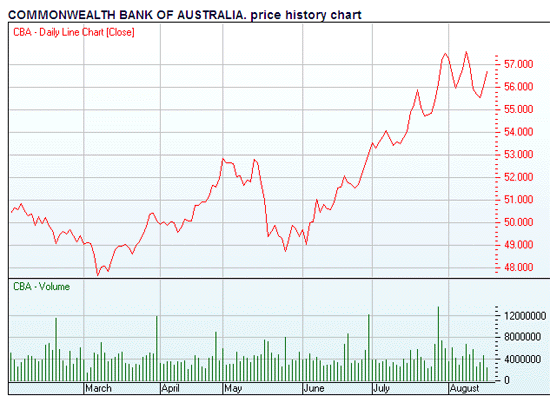
"CBA’s share price has risen sharply over the last quarter driven by its 'defensive' earnings and a global chase for yield," UBS' Jonathan Mott, Chris Williams, and Adam Lee wrote.
"However, at 3.0x NTA (net tangible assets) and 12.8x PE (price to earnings) it is one of the most expensive banks in the developed world. CBA’s market cap has now hit US$94 billion (a shade under A$90 billion or about NZ$116.5 billion), for which you could buy Standard Chartered, Credit Suisse and DBS."
With a market capitalisation of that magnitude, CBA is valued at almost twice as much as the entire market capitalisation of the New Zealand sharemarket, with the NZX's total value at NZ$59.5 billion. By another measure, Australasia's biggest bank is valued at about 57% of New Zealand's most recent annual nominal Gross Domestic Product of NZ$202 billion.
With a value hovering above US$90 billion, CBA has a bigger market capitalisation than the likes of Citigroup, Bank of America, Goldman Sachs or Deutsche Bank. However, despite their size and dominance of the banking industry in Australasia none of CBA, ANZ, BNZ's parent National Australia Bank nor Westpac, have made the international bank regulatory body's list of global systemically important financial institutions, or too big to fail banks. The Basel, Switzerland based Financial Stability Board has a list of 29 too big to fail banks. See the full list here.
'A function of the environment' for bank 'safer than British & US counterparts' due to higher home loan exposure
In a briefing following CBA's annual results, CEO Ian Narev, a New Zealander who played Davie in the 1979 television series Children of Fire Mountain, said: "We’re a $90 billion company. We’re in the top 10 banks in the world by market cap which is a function of the environment."
In its analysts' presentation CBA argued its assets are safer than comparable British and American banks because 52% of its balance sheet stems from home loans, which are "stable and long-term", versus 19% at British banks and 13% at US banks. On the other side of the ledger CBA said 59% of its combined liabilities and equity stem from deposits compared with 50% at British banks and 52% at US banks. And it said its balance sheet was less volatile due to a lower portion - 19% - of fair value assets, compared with 56% at the British banks and 59% at the US banks. The balance comprises assets at amortised cost.
Meanwhile, CBA also argued an "orderly adjustment" had occurred in the Australian housing market post the global financial crisis, with prices undergoing a "modest correction", and argues the characteristics typical of a housing market bubble aren't present in Australia.
'Valuation appears stretched'
For their part, the UBS analysts note CBA's forecast dividend yield of 9.1% given the bank's policy to pay out between 70% and 80% of profit in dividends. For the June 2012 year it's paying out A$3.34 per share, or 75% of profit. Nonetheless, UBS downgraded its rating on CBA shares to "neutral" from "buy" with a 12-month price target of A$55. It closed at A$57.05 yesterday.
"We continue to see CBA as a high quality bank delivering solid returns," Mott, Williams and Lee wrote. "It may continue to be supported if asset allocation and fund flows continue to be put towards stable higher yielding stocks. However, its fundament valuation multiples now appear stretched."
This article was first published in our email for paid subscribers this morning. See here for more details and to subscribe.
We welcome your comments below. If you are not already registered, please register to comment
Remember we welcome robust, respectful and insightful debate. We don't welcome abusive or defamatory comments and will de-register those repeatedly making such comments. Our current comment policy is here.