
By Bernard Hickey
Prime Minister John Key has agreed with Housing Minister Nick Smith that Auckland home owners should expect flatter house price inflation for some time as the house price to income multiple measure of affordability improves from a multiple of around seven now to the Government's new target of around four.
Key rejected the idea that the improvement in affordability could come through a fall in prices.
Smith revealed the target for an affordability multiple of four on the Q+A programme yesterday. The REINZ Median House price for Auckland was a record high NZ$637,000 in March, implying an household income of about NZ$91,000 if the multiple was seven as stated by the Minister. To get that multiple back to four would imply house prices remaining flat in Auckland for 19 years with average annual wages growth of 3%, as is currently the case. Or it would imply house prices dropping 43% for the multiple to be rectified, or a combination of both.
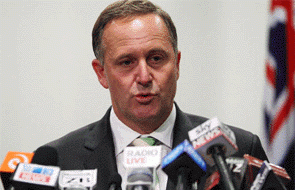
"It's unlikely there'll be falling prices. In my view what you're likely to see is a flattening out of those increases. The Government's view is a modest increase in house prices makes sense. Rapidly escalating prices are not good for anyone," Key told his weekly post-cabinet news conference.
"They're not good for existing home owners because in the end they're likely to create a bubble. They're certainly not good for those wanting to get into the market," Key said.
Key said Labour Leader David Cunliffe had been disingenuous when talking about taxing rental property investors, given the Inland Revenue Department had already ramped up its efforts in recent years to tax the trading income of property traders. He said the IRD had collected hundreds of millions of dollars extra in tax from property speculators.
Key repeated his comments from last week in saying foreign buying of homes could be less than 2% of total buying and may actually be zero once sales by non-residents were taken into account. He repeated previous comments that Australia's house prices were rising in line or faster than New Zealand's price, even though Australia already had a broader capital gains tax than the one proposed by Labour and restrictions on non-resident buying.
"Those things don't fix the problem. In the end it's a supply side problem, not a demand side issue."
Key also downplayed the prospect of more investment in New Zealand property by investors from China once China eased its capital controls to allow more foreign investment by individuals.
"They may over time look to invest more, but there's arguably plenty of places they'd rather invest than necessarily New Zealand. You'll see some investment from overseas in residential property, but I don't think it's extreme by any stretch of the imagination at this point," he said.
Key said those who argued better data was needed on non-resident ownership of property were making a credible argument.
"It's not strait-forward. It depends on the structure that someone's buying that property with. It dpends on their intentions. On the best data we can see, much of which is anecdotal, the majority of offshore buyers who buy a property in New Zealand buy it because there is a fairly close connection in New Zealand. They intend to emigrate here. There is a family member living here. All of which boosts the economy in lots of other forms," he said.
"The big driving factor in Auckland is the number of consented properties has been far too small relative to the demand and Auckland's population is rising, both because of external and internal migration."
'Bring it on'
Asked if he sensed National's position on housing affordability was weak, Key said he was not bothered if the Opposition chose to focus on housing during the election campaign.
"I'd be more than happy to remind people that house prices doubled under Labour, interest rates went through the roof under Labour, they failed to reform the system under Labour, they allowed large development contributions under Labour, they didn't actually change the building regulations to make it more streamlined under Labour, they never had special housing accords as we did and they're opposed to the RMA (reforms)," he said.
"If David Cunliffe wants to have a bit of a chat on nationwide TV about it, I'd be more than happy to do so."
Meanwhile, New Zealand First leader Winston Peters issued his own challenge to Key for a debate on foreign ownership of housing and land.
“Any time, any place,” Peters said.
“Bring it on," he said.
New Council taxes downplayed
Key was then asked about Local Government New Zealand's launch last week of a review of how Councils raised funds, and whether they should have the power to tax sales or incomes, as well as property through rates.
"Generally speaking we're opposed to that. Our view is that it's the purview of central Government to be able to raise taxes in those forms and the local government can raise its revenue, either through rates or where there's a special levy that's appropriately applied like a development contribution," he said.
"My concern would be if you started to seeing ad-hoc bed taxes and sales taxes being applied by local government, they would naturally add cost to the economy and make us less competitive, and we'd need to see a really good justification for why they need so much extra revenue that they can't currently raise through the rating base."
Asked about the justification given by LGNZ that ratepayers were ageing and would be asset rich, but income poor and therefore unable or unwilling to pay for the higher costs of new infrastructure through rates, Key said: "I think that's a bit rich. At the end of the day there are plenty of mechanisms for dealing with that. They can have a lien against property. They could defer taking their rates. They could have reverse mortgages. There are plenty of ways they could extract their pound of flesh at a time when cashflow is not such a problem."
(Updated with Peters' challenge to Key for a debate on foreign ownership.)
We welcome your comments below. If you are not already registered, please register to comment
Remember we welcome robust, respectful and insightful debate. We don't welcome abusive or defamatory comments and will de-register those repeatedly making such comments. Our current comment policy is here.