

Recently, ship owners have been complaining about low freight rates.
Not only are bulk carriers doing it tough, but the sea-going container trade is seeing lower rates as well.
Part of their pain is being offset by lower bunker oil costs.
Part is offset by huge new ships that allow lower unit costs. These are putting real pressure on ship owners who don't have such new equipment.
But the impression is that this is a sympton of 'struggling world trade'.
However, this is only a view for those who are looking backwards.
World trade is actually growing in value.
We are trading higher value goods. And those goods are physically smaller, requiring less freight space.
They also require less raw material which also affects transportation demand.
And much more is transported by air these days, reducing total gross sea-freight volumes.
In fact, this drive for smaller, more efficient products is affecting shipping container rates as well. The volume and value of products that can be shipped in one container is racing higher.
That is putting heavy pressure on traditional freight rates; the Baltic Dry index is near record lows, containerised shipping rates are also low.
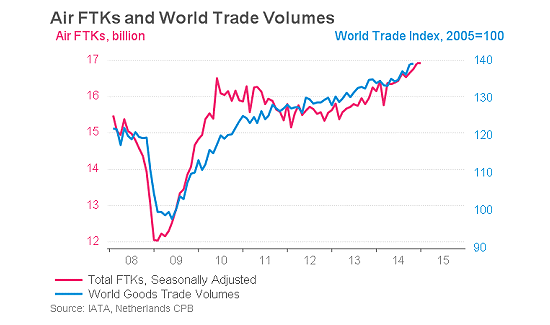
But airfreight volumes are rising proportionately, tracking the rise in world trade. Freight tonne kilometres (FTKs) expanded +4.5% in 2014 compared to 2013; a significant improvement on growth of just +1.4% in 2013 versus 2012.
As trade body the International Air Transport Association notes, "Concerns have been rising about the health of the global economy at the start of 2015, and business confidence has weakened. But there was no sign of weakness in the December air freight data. Growth in air freight volumes reflects acceleration in world trade activity in mid-2014. In fact, the 4.9% rise in FTKs in December compared to a year ago is above the growth trend for the year overall."
And of course, the really big values in world trade are in 'services' many of which require virtually no 'shipping' in the traditional sense.
Even though it was required reading a decade ago, tracking the Baltic Dry Index is now fairly pointless if you want to keep track of early signals in world trade direction. Even tracking container sea freight rates can give faulty signals.
Airfreight volumes still command following. But as products get smaller and 'softer' and 'services' rise we will need to look for new early markers for world trade trends.
Technology is changing our world faster and in more fundamental ways than many realise.

We welcome your comments below. If you are not already registered, please register to comment
Remember we welcome robust, respectful and insightful debate. We don't welcome abusive or defamatory comments and will de-register those repeatedly making such comments. Our current comment policy is here.