

New Zealand workers apparently face less risk of losing their jobs to machines than workers in 31 other Organisation for Economic Co-operation and Development (OECD) countries.
This is a conclusion from an OECD working paper entitled 'Automation, skills use and training' by Ljubica Nedelkoska and Glenda Quintini. Their study focuses on the risk of automation and its interaction with training and the use of skills at work. It shows New Zealand workers facing the lowest risk of automation, along with those from Norway, Finland and the United States.
"New Zealand is an interesting case. Ethnically it is dominated by Europeans, especially Europeans of British origin (74% according to the 2013 Census), and it trades intensively with other countries of Anglo-Saxon origin (Australia, United States, UK), and with Asian countries (China, Japan, Singapore). These relations may drive the similarities that we see with other Anglo-Saxon countries," the OECD working paper says.
"Another interesting observation that may explain this pattern is that New Zealand, more than other OECD countries, experienced a sharp rise in occupations that specialise in cognitive jobs: professionals since the early 1990s and managerial occupations since 2010. At the other end of the automatability distribution are the countries of South and Eastern Europe, but also Slovakia, Germany and Japan. The higher risk of automatability does not only arise from the fact that these countries have relatively larger share of manufacturing jobs, but also from differences in the job content within nominally similar industries and occupations."
Cross-country variation in job automatability
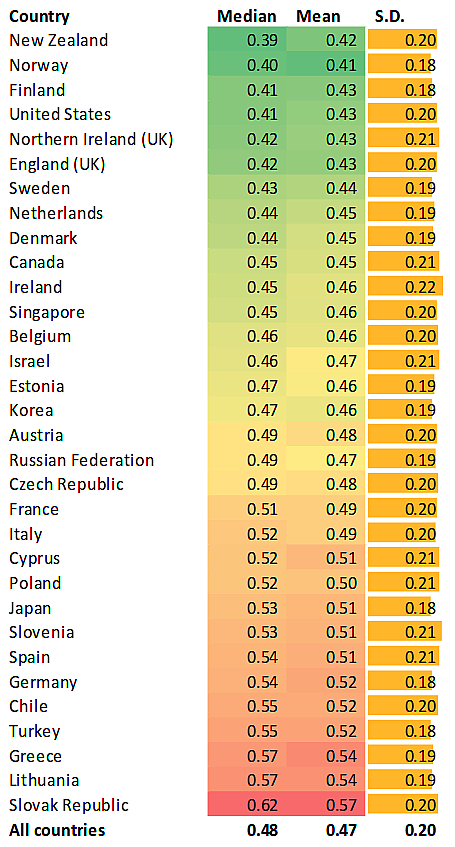
For the overall sample of 32 countries, the median job is estimated to have 48% probability of being automated with a large variation in the degree of automatability across countries.
"In New Zealand and Norway, for instance, the median worker has 39% and 40% probability of being automated, respectively. This is about half a standard deviation less than the median automatability for all 32 countries. At the other extreme, the median worker in Slovakia has 62% probability of being automated and in Greece and Lithuania the median worker has 57% chance of being automated," Nedelkoska and Quintini say.
The working paper estimates the risk of automation for the 32 OECD countries that have participated in a Survey of Adult Skills (PIAAC). Beyond the share of jobs likely to be significantly disrupted by automation of production and services, an emphasis is placed on the characteristics of these jobs and the characteristics of the workers doing them. Risk is also assessed against the use of information and communications technology and the role of training in helping workers adapt to new career opportunities.
"Across the 32 countries, close to one in two jobs are likely to be significantly affected by automation, based on the tasks they involve. But the degree of risk varies," the authors say.
Nedelkoska and Quintini also point out technology will create many new jobs and there are upside and downside risks to their figures.
"On the upside, it is important to keep in mind that these estimates refer to technological possibilities, abstracting from the speed of diffusion and likelihood of adoption of such technologies. Adoption, in particular, could be influenced by several factors, including regulations on workers dismissal, unit labour costs or social preferences with regard to automation. In addition, technology will without doubt also bring about many new jobs."
"For instance, several analysts have found an association between automation and job growth in the service sector in parallel to job destruction primarily in manufacturing. Also, PIAAC does not include information on some key social intelligence tasks such as caring for and assisting others and this would bias the risk of automation upwards somewhat. But there are risks on the downside too. First, the estimates are based on the fact that, given the current state of knowledge, tasks related to social intelligence, cognitive intelligence and perception and manipulation cannot be automated. However, progress is being made very rapidly, particularly in the latter two categories," say Nedelkoska and Quintini.
Perhaps obviously, they note the risk of automation is not distributed equally among workers with jobs requiring higher levels of education facing lower danger of automation.
"Automation is found to mainly affect jobs in the manufacturing industry and agriculture, although a number of service sectors, such as postal and courier services, land transport and food services are also found to be highly automatable. The occupations with the highest estimated automatability typically only require basic to low level of education. At the other end of the spectrum, the least automatable occupations almost all require professional training and/or tertiary education."
Another obvious point made is that young workers tend to face the highest prospect of losing their jobs through automation.
"A striking novel finding is that the risk of automation is the highest among teenage jobs. The relationship between automation and age is U-shaped, but the peak in automatability among youth jobs is far more pronounced than the peak among senior workers. In this sense, automation is much more likely to result in youth unemployment, than in early retirements," the authors say.
"This unequal distribution of the risk of automation raises the stakes involved in policies to prepare workers for the new job requirements. In this context, adult learning is a crucial policy instrument for the re-training and up-skilling of workers whose jobs are being affected by technology. Unfortunately, evidence from this study suggests that a lot needs to be done to facilitate participation by the groups most affected by automation. The odds of participating in any type of training, on-the-job and outside the job, are found to be significantly lower among workers in jobs at risk of being automated. Workers in fully automatable jobs are more than three times less likely to have participated in on-the-job training, over a 12-months period, than workers in non-automatable jobs."
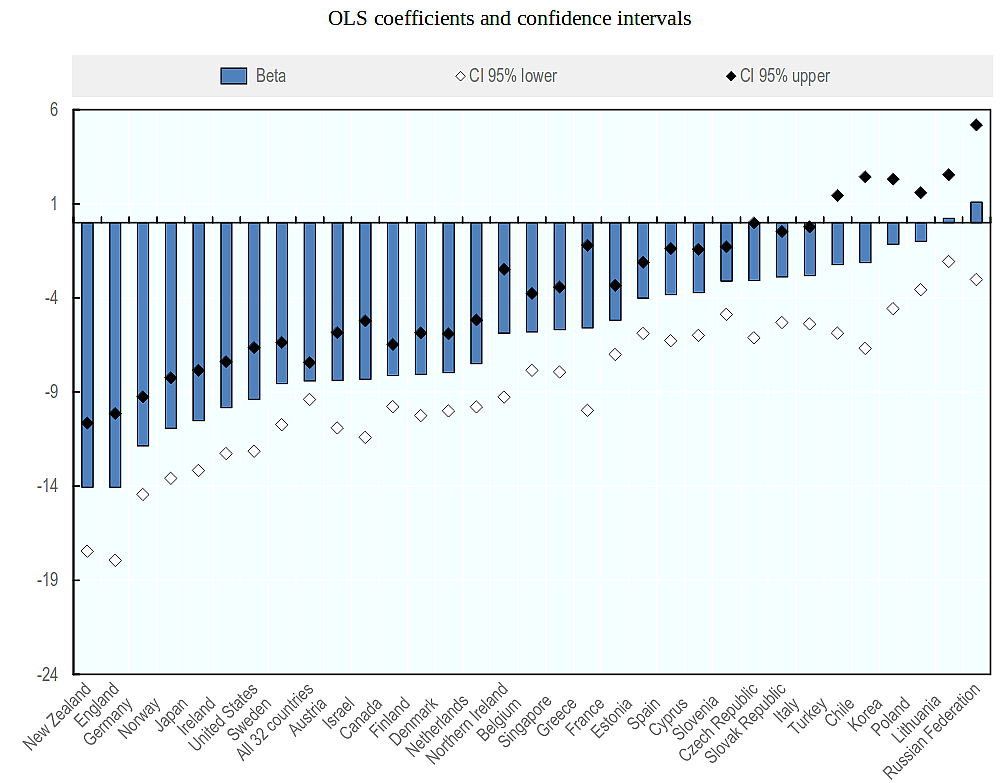
Country-specific partial correlations between working hours and automatability
*This article was first published in our email for paying subscribers early on Friday morning. See here for more details and how to subscribe.
We welcome your comments below. If you are not already registered, please register to comment
Remember we welcome robust, respectful and insightful debate. We don't welcome abusive or defamatory comments and will de-register those repeatedly making such comments. Our current comment policy is here.