
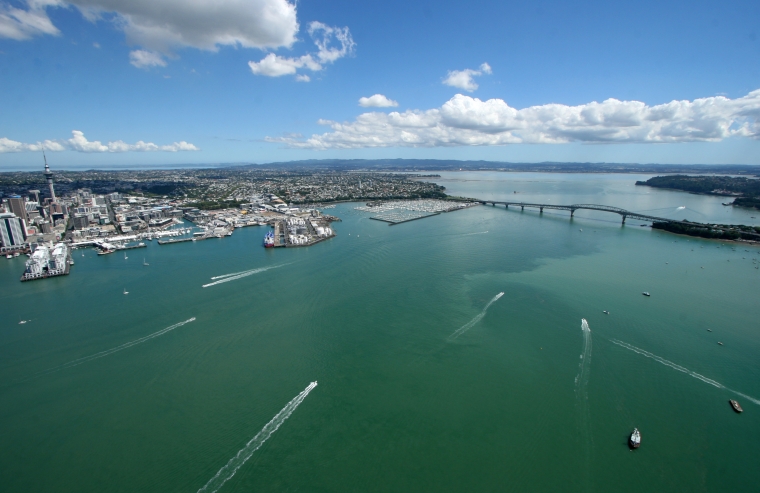
A newly released report by Auckland Council spells out how different areas in the Auckland region will be affected by climate change and how likely they will be to adapt to the changes.
Titled: An assessment of vulnerability to climate change in Auckland, the report was authored by Mario Andres Fernandez and Nancy E. Golubiewski for the Auckland Council’s Research and Evaluation Unit (RIMU).
It is one of eight climate change risk assessment reports looking at the key risks from climate change, including the threats to the vulnerability of people, society and the natural environment. It states:
“Planning for climate change impacts is complex. Auckland will face major challenges brought about by coastal inundation, heat stress, precipitation, wind and humidity changes. In addition, Auckland is the economic hub of New Zealand and its linkages with all economic sectors require that it takes the lead on developing responses to climate change."
It says such assessments are a key factor in producing climate policies because the research they produce can be used to formulate relevant policy responses.
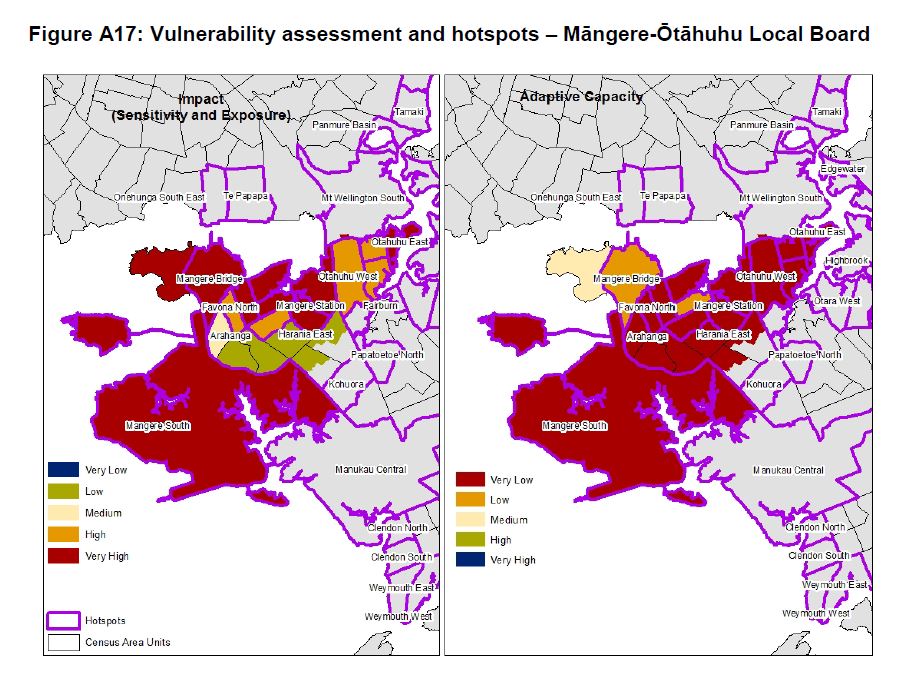
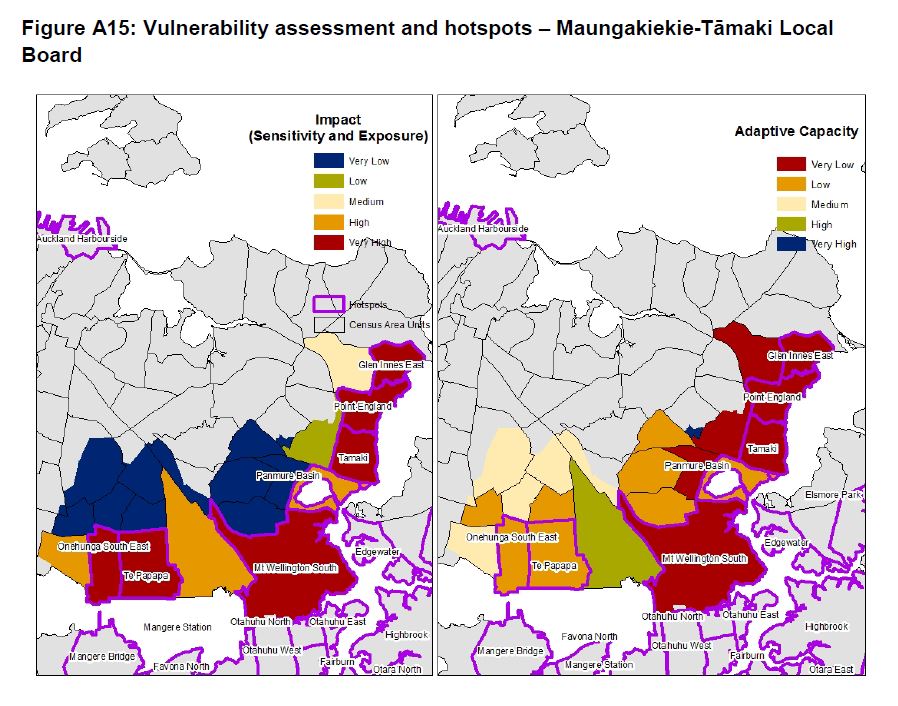
The paper looks at the impact of climate change on particular areas, broken down by their local board boundaries, and their ability to adapt to deal with such changes. The ability for an area to adapt takes into account a number of elements, including socio-economic, demographic and climatic factors. Vulnerability hotspots are those defined as assessed as being likely to suffer from high levels of climate change impact and have low capacities to adapt.
Auckland Council Environment and Community Committee chairwoman Penny Hulse says the latest report is being used to create an Auckland Climate Action Plan (ACAP) which is still a work in progress.
But she says she hopes to have a draft report by mid-2019, which will then go out for public consultation before the election in October.
Hulse says the assessment highlights the fact that some communities will be affected more by climate change than others and their abilities to adapt to it will also vary greatly.
“Thinking about where all of these matters intersect, it’s really about the impact of climate change on our most vulnerable communities. They don’t have the choices other communities have and that as a council should be our focus point.”
Five areas in the report were identified as being highly vulnerable to the effects of climate change and their ability to adapt to the changes was poor. They were Otara West, Point England, Ōtara North, Māngere Station and Wymondley.
The report states that almost all the areas in Māngere-Ōtāhuhu Local Board are vulnerability hotspots. It says this is because very high impact occurs in coastal areas. It says the area’s ability to adapt to such change is also very low. It includes Mangere Bridge, Mangere, Otahuhu and Favona.
Similar results are also seen in the Maungakiekie-Tāmaki Local Board area, which includes Glen Innes, Point England, Tamaki and Mount Wellington South.
“All these areas are categorised as vulnerability hotspots. Similarly, Howick shows high impact levels in coastal areas in the north and western shares of the board.”
Other areas that will feel the effects of climate change include the Orakei Local Board area, some sections of the CBD, including the port and waterfront, and parts of west Auckland, including New Lynn, Henderson and Massey.
Hulse says dealing with the effects of climate change won’t be cheap or easy.
“We have to make some hard spending decisions. And we need to look at how we structure our planning and how we fund future investment. But if we look at building better housing in the right places it will be a better city for everyone. We have to look to the future.”
Hulse says it's important that the council has a co-ordinated approach to dealing with climate change.
“I think back to the leaky buildings crisis and that wasn’t handled well.”
Hulse says councils were often left picking up the costs as the other parties involved, such as developers, were no longer in business when legal action was taken.
“We can’t afford to be in the same situation with climate change where councils end up being the last man standing and have to fork out millions.”
She says during the consultation process for the Auckland Council’s Our Water Future strategy it’s been obvious that climate change isn’t something people know a lot about.
“It’s clear that this is a big discussion that Aucklanders haven’t had,” Hulse says.
But she says public education is vital to addressing climate change.
“We need to provide information for people and take it out of the academic and council reports so people can understand the issues.”
Hulse says she totally agrees with Local Government New Zealand’s calls for the establishment of a National Climate Change Adaptation Fund to deal with the costs of rising sea levels and a Local Government Risk Agency to help councils understand and factor in the risk of climate change into their decision-making.
But she says creating a political stoush between central and local government won’t address the real problem - climate change.
“It’s easy for us to say central government should do this. But I think we should move beyond that and say what is New Zealand looking to do about climate change? We need to act with our communities so we can be more resilient. And we need to stop debating the science.”
She says she’s sick of hearing people questioning the validity of climate change.
“Things are changing, you only have to ask the insurance companies. While you might want to deny it you will see it in your insurance bills.”
Local Government New Zealand (LGNZ) released a report in late January titled Vulnerable: The quantum of local government infrastructure exposed to sea level rise.
It looks at the cost to councils from rising sea levels and says up to $14 billion of local government infrastructure is at risk. The report calls on central government to urgently develop policies to help minimise the impact of climate change on New Zealand communities.
The LGNZ report calls for the establishment of a National Climate Change Adaptation Fund to deal with the costs of rising sea levels and a Local Government Risk Agency to help councils understand and factor in the risk of climate change into their planning and decision-making.
President Dave Cull said many councils were already experiencing the impact of rising sea levels, most notably in the Bay of Plenty, West Coast, South Dunedin and Hawke’s Bay. Cull said central government had been dragging the chain for too long on the issue and it was now time for government to act.
We welcome your comments below. If you are not already registered, please register to comment
Remember we welcome robust, respectful and insightful debate. We don't welcome abusive or defamatory comments and will de-register those repeatedly making such comments. Our current comment policy is here.