

How much do you owe on your credit cards? How much for other personal loans (that is, not for housing)?
All up, we owe banks and other financial lenders $16.7 bln for these types of high-interest loans.
And given there are only 3.2 mln adults between the ages of 15 and 64, this works out at an average per person of $5,191. For those that have this type of debt it will be a lot more of course, because many people won't have any.
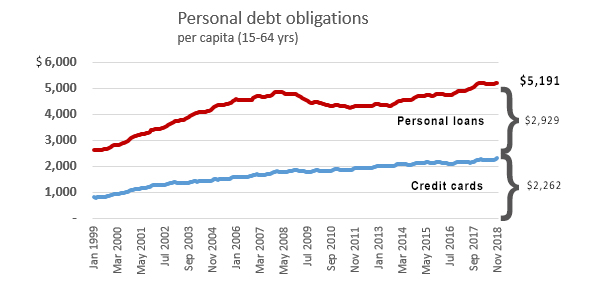
Of that $16.7 bln, the four big Australian-owned banks are owed $9 bln, and probably the bulk of this is because they are the big credit card issuers.
But they aren't the only ones. Other big issuers like Latitude (Gem) and Flexi Card (Q) are active as well. Incidentally, they are also Australian.
But you might be surprised to learn that some of our smaller Kiwi-owned banks have heavy positions in personal lending too.
Here is where all those obligations flow back to:
| RBNZ reference | H1 | F1 | H2+H3 | H5 | H6 | H7 | ||
| Total loans |
share of all loans |
Total non-perform |
Non-perform ratio |
Individual provisions |
Collective provisions |
|||
| September 2018 | ||||||||
| $ mln | % | $ mln | % | $ mln | $ mln | |||
| ANZ | 3,573.9 | 2.8% | 34.4 | 1.0% | 6.0 | 63.5 | ||
| ASB | 2,004.7 | 2.4% | 12.6 | 0.6% | - | 80.3 | ||
| BNZ | 1,417.4 | 1.7% | 11.3 | 0.8% | 0.4 | 27.3 | ||
| Kiwibank | 403.9 | 2.1% | 0.5 | 0.1% | 0.1 | 8.6 | ||
| Westpac | 2,043.6 | 2.5% | 12.9 | 0.6% | - | 79.9 | ||
| -------- | -------- | -------- | -------- | -------- | -------- | |||
| All main banks | $9,443.5 | 2.4% | 71.7 | 0.8% | 6.5 | 259.6 | ||
| Cooperative Bank | 183.9 | 7.7% | 0.3 | 0.1% | - | 3.4 | ||
| Heartland Bank | 984.1 | 24.1% | 25.2 | 2.6% | 2.0 | 27.2 | ||
| Rabobank | 10.9 | 0.1% | - | 0.0% | - | - | ||
| SBS Bank | 504.9 | 13.1% | 2.1 | 0.4% | - | 16.6 | ||
| TSB | 82.0 | 1.5% | 1.5 | 1.8% | - | 6.9 | ||
| -------- | -------- | -------- | -------- | -------- | -------- | |||
| Challenger banks | 1,765.8 | 6.7% | 29.1 | 1.6% | 2.0 | 54.1 | ||
| -------- | -------- | -------- | -------- | -------- | -------- | |||
| All retail banks | $11,209 | 2.7% | 100.8 | 0.9% | 8.5 | 313.7 | ||
| All other banks | 7.7 | … | ||||||
| All non-banks | 5,437 | 43.3% | ||||||
| ====== | ----- | |||||||
| Total (C5) | $16,654 | 3.7% | ||||||
| Credit cards (C12) | 7,257 | 1.6% | ||||||
| Personal lending | 9,397 | 2.1% |
All this data is sourced from the RBNZ, mainly the Dashboard series, also C5, C12, and Stats NZ
Heartland Bank's Marac division, and SBS Bank's Finance Now division are both significant within each of those institutions. Both have larger personal loan ledgers than Kiwibank.
Most banks have significant provisions booked for the likelihood some of this high-risk debt goes bad. The main banks have provisions in place exceeding three times the current level of non-performing loans. For the Cooperative Bank and SBS bank, this cover is more like ten times. But the Heartland Bank provisioning stands out in these comparatives as low.
Financial institutions are attracted to this type of lending because the margins are high. High interest rates charged are bolstered by high fee levels. Fees are ubiquitous here and considered 'normal' even though for most other types of lending (housing, business, rural) large chunks of their operating costs in those sectors are covered by the interest earned. But not for personal lending, where even the CCCFA and regulators accept that fees can cover 'reasonable costs'. This gives these lenders considerable latitude (pun not intended) to bulk up their net margins in a way that they just don't do elsewhere. It also attracts a wide range of non-bank lenders into the field.
Because 'everyone does it' there is no market pressure available to borrowers to make shopping around effective. Fees are often only disclosed formally at the point where you know you want to buy the goods involved, or at least, borrowers seem to ignore the online disclosures elsewhere. Disclosure isn't very effective.
Lenders do have the option to use positive credit reporting to offer sharper, competitive interest rates to borrowers with exemplary credit histories. But again, there is no real evidence any institution is doing that - and even if they did, the fees are still likely to apply. There may be as few as 200 banks and finance companies offering personal loans to customers nationwide. But there are probably more than 1 mln people who use these services (credit cards and personal loans). Because loan balances are relatively small (~$10,000 or so) no one customer has any negotiating leverage to remedy the imbalance in what is offered. That is up to the regulators and even now there is no official energy trying to square up the power ledger here.
We welcome your comments below. If you are not already registered, please register to comment
Remember we welcome robust, respectful and insightful debate. We don't welcome abusive or defamatory comments and will de-register those repeatedly making such comments. Our current comment policy is here.