
New Zealand and the United States have two things in common this Fall (or Spring, depending on which side of the equator you’re sitting on): Both countries will have elections, and the Covid-19 pandemic will play an outsized role in the contests on each side of the Pacific. But the terms of the debate over Covid-19 and the likely resonance of proposed policies are vastly different.
In New Zealand, the debate between the incumbent Labour and opposition National parties on Covid-19 is occurring within very narrow bounds.
The virus was (initially) eliminated from the country after the government imposed a quarantine regime for arrivals. Labour is running on that record, promising voters it will impose measures to eliminate the current outbreak in Auckland and optimize the quarantine regime to prevent further outbreaks in the future.
The National party is criticizing the government’s handling of the quarantine and promising to implement an even more stringent control on those entering the country, thus preventing further outbreaks.
Kiwi voters can choose which improved Covid-19 quarantine measures they prefer.
There is no secret behind the lack of variation in these policy platforms: Surveys in New Zealand, and Victoria, show large majorities supporting strict policies that restrict travel, business operations and individuals’ activities to prevent the spread of the virus.
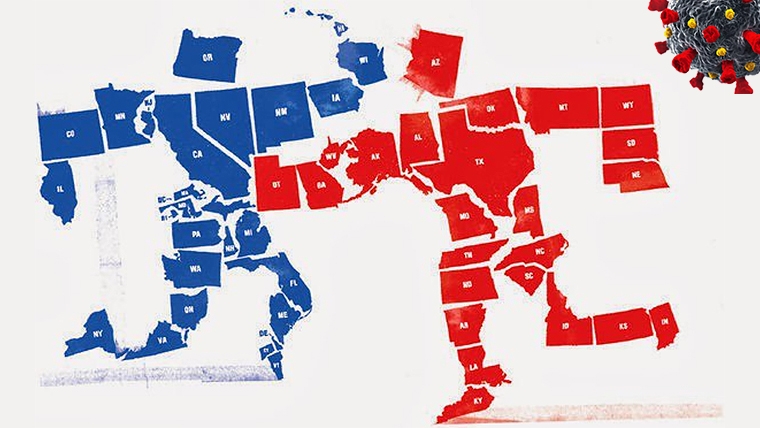
In the United States, party conventions over the past two weeks have shown a much broader debate over Covid-19 and its implications for the country.
Nominating conventions have long been a feature of US presidential politics. It is at the convention that each party’s state delegates formally nominate their candidate for president. Today, the nominee is usually clear before the convention because delegates are pledged to support nominees after the primaries and caucuses that occur through the Winter and Spring. But primaries are a relatively recent (post-1970s) development and conventions used to be much more important. The populist William Jennings Bryan became the youngest ever presidential nominee on the strength of a barnstorming speech railing against the Gold Standard at the 1896 Democratic National Convention. (It is somehow hard to imagine contemporary populists making hay out of such a technical issue.)
This year there were no barnstorming speeches or surprises of any kind because the nominees are uncontested and the conventions have been held virtually, making them chillingly reminiscent of a Zoom faculty meeting, online corporate compliance training session, or in the memorable words of Marianne Williamson, “like binge watching a Marriott commercial.”
Readers, in a profound manifestation of my commitment to you, I subjected myself to several minutes of both the Democratic and Republican conventions to be fully informed before writing this column. (I then watched the most important speeches on YouTube where, blessedly, you can skip the boring bits – or perhaps it is more accurate to say, pause for the snippets of useful information.)
The Democratic Party held its convention first, last week. Amidst the attacks on Donald Trump, the Covid-19 pandemic emerged as a major theme of the party’s presidential campaign. All the Democrats’ events were fully virtual, mostly one person speaking into a camera in an empty room, showing that participants were masked and following social distancing protocols. A response to the virus was the first policy issue that nominee Joe Biden mentioned in his speech. He has called for a nationwide mask mandate and in a recent interview promised that he would shut down the economy to prevent the virus’s spread, if this was recommended by experts.
The ongoing Republican Party convention is a stark contrast. Each day has been held in a different location, some of which were outdoors, but at all there has been some kind of audience in attendance. They have been seated somewhat apart but only very few have been wearing masks. Speakers are accompanied to their podiums by their spouses, in some cases. In short, the optics of the Republican convention are a lot closer to those of a normal convention, if still very far removed.
Covid-19 plays a much smaller role in the GOP’s policy pitch for the 2020 presidential election. Like the Labour party in New Zealand, the Trump-Pence ticket is running on their response to the virus so far – arguing, for example, that although there was severe shortage of ventilators in early April, government procurement programs quickly alleviated this problem.
Unlike the Ardern government, Trump does not want to focus on what he will do to combat the virus in the future. His message is: The economy was doing great before March of this year, let me “make it great again”. For this administration, the Covid-19 pandemic is a thing of the past.
It is unclear whether the Democratic or Republican strategy is better in this pandemic environment. In some parts of the country – such as New York, New Jersey and Arizona – Covid-19 diagnoses and deaths are only a tiny fraction of what they were a few months ago. But in others, including key battleground states such as Michigan, North Carolina and Pennsylvania, infection rates remain stubbornly high.
If the spread and lethality of Covid-19 continue to decline between now and November, Joe Biden could appear to be fighting yesterday’s battle as voters’ focus moves from combating the virus to rebuilding the economy. But if the virus is resurgent, Trump’s approval and chances for reelection could plunge to the depths seen at the height of the pandemic earlier this year.
The US presidential election campaign remains unpredictable and promises a much broader and more contentious debate about the necessary and appropriate response to Covid-19 than Kiwis will see before their own election in October.
Henry Thomson is originally from Amberley, North Canterbury and is now an Assistant Professor of Political Economy at Arizona State University. His research focuses on the political economy of authoritarian rule and transitions to democracy. You can read more about his research here and follow him on Twitter @HenryRThomson. His earlier letters are here.
We welcome your comments below. If you are not already registered, please register to comment
Remember we welcome robust, respectful and insightful debate. We don't welcome abusive or defamatory comments and will de-register those repeatedly making such comments. Our current comment policy is here.