
This guest Top 5 comes from Motu research analysts Sophie Hale, Dom White, Shakked Noy and Livvy Mitchel. Motu is an economics and public policy researcher.
As always, we welcome your additions in the comments below or via email to david.chaston@interest.co.nz.
And if you're interested in contributing the occasional Top 5 yourself, contact gareth.vaughan@interest.co.nz.
1. American healthcare - it's complicated.

When the Affordable Care Act was introduced in the United States in 2010, it contained three key provisions, each of which economists believed was essential. First, it provided subsidies to enable low-income people to purchase health insurance. Second, it introduced rules that prevented insurers from denying coverage to individuals with pre-existing health conditions. Third, it contained an “individual mandate” that required everyone to purchase health insurance. The latter two provisions aimed to make health insurance accessible to people with pre-existing conditions while avoiding a collapse of the insurance market due to “adverse selection.” Economists believed that the individual mandate was essential, because otherwise individuals with pre-existing conditions would be much more likely to select into health insurance, resulting in premiums spiralling out of control.
However, Republicans repealed the individual mandate in 2017, and – nothing happened. The evidence now suggests that the individual mandate, despite being a topic of intense political controversy and a focal point of opposition to the Affordable Care Act, didn’t have much of an effect. This is despite the fact that both theory and the (scant) empirical evidence available in 2010 suggested that it would be essential. This story is therefore a cautionary tale about how complicated the world (or maybe just the American healthcare system) really is.
2. It's true - poor people don't eat their greens.
A new study is one of the first to show the relationship between income inequality and fruit and vegetable consumption among US adults empirically. It shows women’s health is more likely to be detrimentally affected when living in a state with higher income inequality.
Horino et al. used cross-sectional data on 270,612 adults from the US. 2013 Behavioral Risk Factor Surveillance System. Their analyses controlled for sex, age, total household income, race/ethnicity and marital status. They found that among women only, a standard deviation increase in Gini coefficient (a measure of income inequality) was associated with a decreased likelihood in meeting daily recommended levels of both fruits and vegetables. In other words, women were significantly less likely to meet fruit and vegetable recommendations if they live in a more unequal state.
3. Is there life floating in the clouds of Venus?

This explores the possibility of life on Venus after the discovery of Phosphine in the atmosphere. Phosphine is associated with life on Earth and is found in microbes living in the guts of penguins and in oxygen poor environments like swamps. Dr William Bains, affiliated with the Massachusetts Institute of Technology, has mentioned that for life to survive the atmosphere on Venus, it would need to have some currently unknown biochemistry or have developed a kind of armour. Scientists are cautious and intrigued by the discovery of Phosphine, with further research and hopefully even more exciting insights to follow.
4. The climate clock is ticking.
A new digital clock recently unveiled in Manhattan’s Union Square promises to tell you — down to the very second - How long the world has left to act before an irreversible climate emergency alters human existence as we know it. The Climate Clock was unveiled by artists Gan Golan and Andrew Boyd in Manhattan’s Union Square on Monday the 21st of September. When unveiled, the clock specified that there were 7 years, 101 days, 17 hours, 29 minutes and 22 seconds until Earth’s carbon budget is depleted. This estimate is based on current global greenhouse gas emission rates. If swift action isn’t taken to keep the global temperature within 1.5 degrees Celsius above preindustrial temperatures, the planet will suffer more flooding, more wildfires, increasing famine and extensive human displacement. The second figure associated with the Climate Clock is labelled a “lifeline” and displays the percentage of available energy supplied from renewable sources. The artists have expressed the hope that the “lifeline” reaches 100% before the clock reaches zero.
5. Hydrogen the saviour of air travel - again.
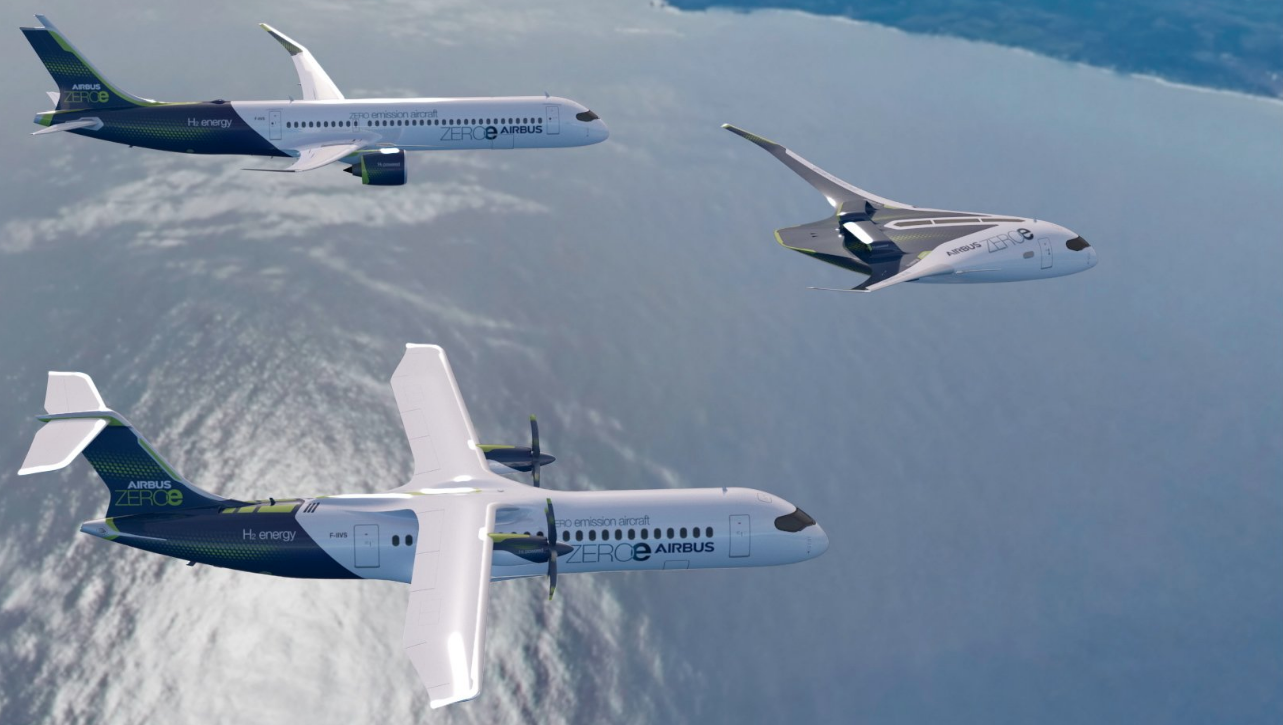
What will it take to reduce the impact of aviation on climate change? Airbus is aiming for the first ever commercial zero-emissions aircraft. Liquid hydrogen-fuelled aircraft were first explored in the early 21st century through an EU-funded Cryoplan project, but the idea soon after lost traction. Now, Airbus is planning on having hydrogen-fuelled passenger planes up and running by 2035. Given many countries have already committed to achieving net-zero carbon emissions by 2050 (following the recommendations from the Intergovernmental Panel on Climate Change in 2018), this invention could play a significant role in reducing aviation’s climate impact.
Analysts acknowledge, however, that this technology doesn’t come without a significant cost. In addition to the actual funding of the aircraft, airports around the world would need to make large investments into improving infrastructure to accommodate these new planes. The challenge of scaling up renewable energy to achieve sustainable flying therefore requires commitment and support from government and industry partners.
We welcome your comments below. If you are not already registered, please register to comment
Remember we welcome robust, respectful and insightful debate. We don't welcome abusive or defamatory comments and will de-register those repeatedly making such comments. Our current comment policy is here.