
By Chris Trotter*
There is a scene in the 1982 movie Missing which has remained with me for nearly 40 years. Directed by the Greek-French movie-maker, Costa-Gavras, Missing chronicles the efforts made to discover the fate of Charles Horman, a young American journalist caught up in the Chilean coup d’état of September 1973. The scene in question depicts the wild celebration of the coup’s success by a seething crowd of upper-class men and women in a down-town Santiago hotel. Raucously and raunchily the crowd are yelling along to Chuck Berry’s suggestive 1972 novelty hit “My Ding-a-Ling”.
What prompted my recall this scene was Julian Borger’s Guardian article “Insurrection Day: When White-Supremacist Terror Came To The US Capitol”. This is how he described Team Trumps’ reaction to the televised assault on the Capitol Building:
“A smartphone video of Donald Trump Jr filmed inside the marquee backstage showed him and his girlfriend, Kimberly Guilfoyle, giddy with excitement. Guilfoyle breaks into a hip-thrusting dance and then shouts into the camera: “Have the courage to do the right thing! Fight!”
It was Borger’s reference to Guilfoyle’s “hip-thrusting dance” that sealed the connection with Costa-Gavras. That almost obscene combination of raw sex and raw power which both the movie and the video evoke and capture. Sigmund Freud discoursed at length on the phenomenon: this palpable psychic link between Eros and Thanatos – Desire and Death. His disciple, Eric Fromm, in his grim study The Anatomy of Human Destructiveness extends the connection to the excesses of extremist politics: noting the ecstatic battle-cry of General Franco’s murderous fascist militiamen: “Long Live Death!”
It wasn’t just the associations evoked by the memory of Costa-Gavras’ scene from Missing, and Borger’s description of Team Trump’s right-wing raunchiness that had me reviewing – and then reviewing again – the extraordinary images captured by photo-journalists and videographers in and around the US Capitol Building on 6 January 2021. There was something about the way the protesters conducted themselves; something in the expressions on their faces; that rang a very distinct historical bell. I’d seen that look, that stance, somewhere before – but where?
And then, with a sickening jolt, it dawned on me. I was referencing the terrible photographs taken of crowds gathered to observe the all-too-frequent lynchings of African-Americans in the 1920s and 30s.
There are scores of these photographs because, as the Equal Justice Initiative (EJI) points out on their website: “Photographs of the brutal lynching, featuring members of the crowd proudly posed beneath the hanging corpses, were widely shared, but local authorities claimed no one could be identified.” The brutal lynching referred to took place in Marion, Indiana, on 7 August 1930. A mob stormed the Grant County Jail and seized Thomas Shipp and Abram Smith, two young African-Americans accused of raping a white woman and murdering a white man. In the words of the EJI:
“The brutalized bodies of Mr. Shipp and Mr. Smith were hung from trees in the courthouse yard and kept there for hours as a crowd of white men, women, and children grew by the thousands. Public spectacle lynchings, in which large crowds of white people, often numbering in the thousands, gathered to witness and participate in pre-planned heinous killings that featured prolonged torture, mutilation, dismemberment and/or burning of the victim, were common during this time. When the sheriff eventually cut the ropes off the corpses, the crowd rushed forward to take parts of the men’s bodies as souvenirs.”
It is this willingness to be photographed in circumstances of extreme violence and depraved criminality that links the lynching photographs with the images gathered during last week’s storming of the Capitol Building.
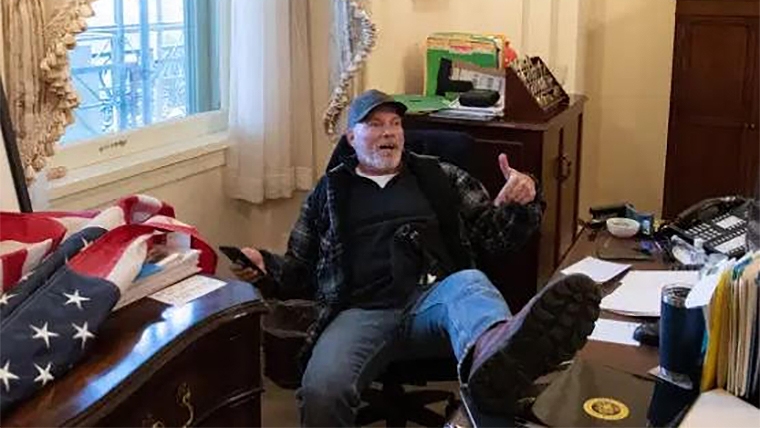
People around the world have shaken their heads in disbelief at the evident stupidity of the insurrectionists: “Why would they allow themselves to be photographed like that?”, they ask. Why, like the good ole boy from Arkansas who posed for the camera with his work boot firmly planted on House Speaker Nancy Pelosi’s desk, would anyone engage in an act of such definitive self-incrimination?
The chilling answer? Because the insurrectionists, like the men and women snapped beneath the suspended bodies of Shipp and Smith in 1930, found it near-impossible to grasp that what they were doing was wrong. In their faces there is no shame, no pity, and certainly no fear of being held accountable. Rather, there is a disturbing combination of excitement and pride. Or, even more alarming, a complete absence of affect – a blankness. As though standing just inches away from two mutilated bodies was the most normal thing in the world.
It takes an enormous amount of ideological effort to produce this aura of invulnerability. The sense of entitlement: whether it be to take the lives of two 19-year-old boys; or to smash your way into the citadel of American democracy; has to be huge. Likewise, the certitude (so clearly evident in the faces of both historical groups) that, first, they are in the right; and second, that they are engaged in delivering a much-needed message about the power of white supremacy.
Crucial to the success of the latter was (and is) the belief that the official guardians of the law will not hinder the delivery of such “messages”. Shipp and Smith could be dragged from their jail cells and murdered in front of thousands of witnesses – many of whom, as we have seen, allowed themselves to be photographed – because it was simply understood that no one in authority would lift a finger to either stop or punish the perpetrators. (Significantly, in light of our earlier Freudian references, the vast majority of “message lynchings” were motivated by White Americans’ deep-seated neuroses about inter-racial sex.)
It is not difficult to understand how the tens-of-thousands of white supremacists who invaded the Capitol might have been gripped by a similar sense of invulnerability. They had, when all is said and done, been sent on their way with the blessings of the President of the United States! Their confidence could only have been boosted, however, by the absurdly lax security measures taken to protect the Capitol complex. If the federal authorities had wanted to stop them, then surely they would have deployed the same sort of massive force that the mere rumour of a Black Lives Matter assault was able to mobilise. How difficult it must have been for Trump’s stormtroopers to interpret the absence of such force as anything other than an open invitation for them to smash their way in – as well as a rock-solid guarantee that they would suffer no serious legal consequences for doing so.
Just how unexpected was the Capitol Police’s valiant defence of House of Representatives and the Senate is readily apparent from the tone of shock and incredulity in the voice of a woman tear-gassed by the building’s defenders. “They maced me!”, she cries indignantly, “They maced me!” It was as if the lynch-mob that broke into the Grant County Jail had been cut down by a volley of deputy-sheriffs’ bullets.
Perhaps, if that had been the fate of those white supremacists on 7 August 1930, then the astonishing events of 6 January 2021 would never have taken place.
*Chris Trotter has been writing and commenting professionally about New Zealand politics for more than 30 years. He writes a weekly column for interest.co.nz. His work may also be found at http://bowalleyroad.blogspot.com.
We welcome your comments below. If you are not already registered, please register to comment
Remember we welcome robust, respectful and insightful debate. We don't welcome abusive or defamatory comments and will de-register those repeatedly making such comments. Our current comment policy is here.