
Hi all, here's my politico-economic blogroll on Christmas Eve. It's been a great few months starting back at interest.co and finding my feet in Parliament, helped by the fact the politics stories on the site are being well-read and commented on.
Cheers for your ideas on questions to ask the pollies and your feedback. That's the great thing about our community here. Keep it rolling in next year.
If anyone's up at Karekare over the break then might catch you on the beach. Merry Christmas all, and a happy new year.
And a Merry Christmas to all those who have featured on this post in the last few weeks. There have been some great pieces on the blogs, Cheers.
From the left
1. Double-dip gloat - MartyG at The Standard has this gloating piece about how he picked the double-dip. You won't be getting any lollies out of that dip though Marty. Budget 2011 is shaping up to have to be a tough budget. But...it's an election year so don't get too excited. A theme of 'savings and investment' could mean just about anything.
Looking ahead, there’s more bad news still to come: higher oil and food prices next year, a credit rating downgrade now almost certain, and government cuts to pay for tax cuts that will further strangle the economy and put more workers out of a job. The Rugby World Cup will be a blip against these larger trends.
It’s time to accept that GDP per capita peaked along with oil some time in the past couple of years. Now, the central question of politics becomes how we divide a shrinking pie. The elite are already aware that this the fight we’re fighting, and they’re taking all they can for themselves with tax cuts, removal of work rights, lower wages, and privatisation.
2. Insured privatisation. Idiot/Savant isn't too happy with the ACC privatisation news this week:
More controversial policy dumped just before Xmas so it can be buried in the holiday "silly season": the government is planning to privatise ACC by opening the workforce market to competition from foreign insurance companies. A 2008 report from PricewaterhouseCoopers (since sanitised from ACC's website, but you can read it here) found that there would be absolutely no benefit to New Zealanders from this move.
But Australian insurers (including John Key's old firm, Merrill Lynch) will benefit by an estimated $200 million. That's $200 million in pure wealth transfer, in the form of higher premiums, denied claims and worse service, that we will pay for the benefit of John Key's rich mates. And people wonder why I regard privatisations as inherently corrupt...
3. Should Landcorp buy the Crafar farms? Now the OIO has rejected Natural Dairy's bid for the 16 Crafar farms, Labour MP Trevor Mallard muses on Redalert whether Landcorp should buy them. It seemed like Landcorp had ruled itself out of the running, but news today that it might launch a bid with Tainui puts them back in the game.
Good that Natural Dairy bid for Crafar farms rejected. Inevitable.
Now room for Landcorp to buy, develop and sell in an orderly manner to Kiwis.
Maybe they could even involve share milkers and give young hardworking people a chance.
4. We're directing the economy behind the blindfold of falsehoods. Bomber at Tumeke isn't too convinced that the economy will just get better. Aw come on Bomber, She'll be right mate, Bill English said so.
Thank God the ASB Chief Economist expects things to get better, that will make the ratings agencies sleep easier at night. Could I venture that since this is a unique crises of capitalism in the exact same way the 1929 crash was a unique crises of capitalism that the old Free Market models that the ASB Chief Economist, the treasury, the Reserve Bank Governor, the National Party, ACT etc etc etc don't work? That the same old tired ideologically driven brain farts won't be enough to avoid the societal damage this recession will cause and that perhaps a reevaluation of the growth uber allas consumer culture may in fact be timely alongside a genuine look at welfare.
The faith that these oracles of money are putting into this supposed magical turn around in the second half of next year looks almost like a meth induced state of psychosis, pick anyone of the following global tumors that could turn to cancer in 2011; China property market bubble, sovereign debt collapse, banking crisis or Euro disintegration.
The first half of 2011 is predicted to be worse than what we are seeing now, and then magically rise like a phoenix, I however would suggest that anyone of those global threats would have a very low trigger value after such a prolonged recession and that anyone of those events would be enough to spiral the Global economy down worse than these optimistic domestic predictions making any recovery at the end of 2011 simply a falsehood.
We are directing the economy behind the blindfold of falsehoods.
Bomber also has this fantastic Economist cover:

From the right
5. It's not privatisation. David Farrar at Kiwiblog says the government's ACC move was not privatisation.
But best of all is the decision in principle to restore choice for workplace accident insurance. This was flagged in the 2008 manifesto and it is not privatisation. It is allowing other providers of workplace insurance to compete with ACC.
National was looking hestitant on bringing back competition, but this is where it is useful to have ACT in Parliament. They put the pressure on for choice and competition to occur in the work account, as an unofficial quid pro quo for the previous levy increases.
6. Landcorp shouldn't buy the Crafar farms. Homepaddock doesn't think Landcorp should buy the 16 farms. He She also supports putting them up for sale separately.
The company [Landcorp] makes a pitiful return on the capital it already has invested in farms, it shouldn’t take on any more, not even to sort them out then on-sell them individually.
That would mean the state taking on the risk and passing on the benefit to individuals.
Federated Farmers president Don Nicolson wants the farms back on the market to be sold individually. A view which Adolf has been promoting from the start.
That would increase the number of likely buyers and could well result in a better total price than if the farms were sold as a unit.
Make your own brekky, lunch and dinner.
Clean your own toilet.
Do the dishes by hand .
Turn off the spa pool.
Shop at Pak and Save
Take the bus.
Sell all the clothes you dont wear on Trademe - in fact any spare stuff - like breitling watches, your missus sparklers, would be good.
Get your missus to dye her own hair at home.
You could do her brazilian and pluck her chin hairs.
Shampoo the dog your self.
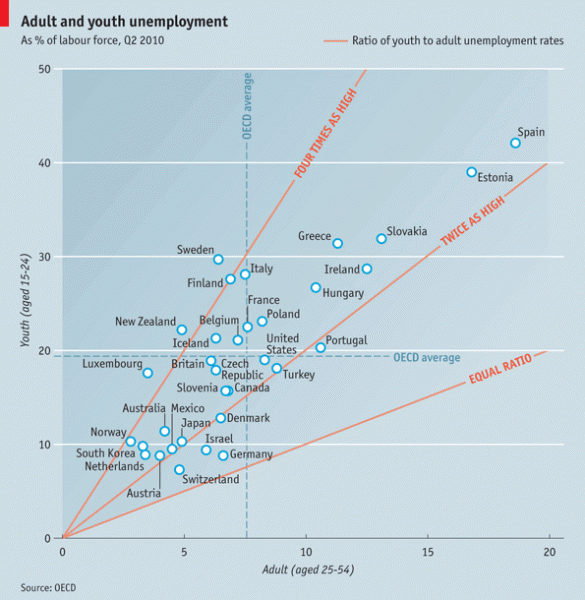
8. It's all Sue Bradford's fault. Roger Kerr picks up on this chart on the gap between youth and adult unemployment from The Economist that Eric Crampton blogged about last week. He says it's Sue Bradford's fault.
That is former Green MP Sue Bradford’s legacy to New Zealand. We are talking here about the most marginal low-skilled young people. Firms will pay young workers the minimum wage or higher wages if their productivity warrants it. Indeed they will be forced to do so because of competition for labour by other firms. But they won’t if young workers’ productivity doesn’t warrant it – they will make losses if they hire such workers.
Sue Bradford may have been well intentioned but it is outcomes that matter. This outcome is tragic. How does she sleep at night?
The government’s Welfare Working Group will have failed if it turns a blind eye to this appalling situation.
Economics blogs
9. Do lesbians get paid more than straight girls? Eric Crampton looks at the lesbian pay gap, and offers some thoughts on why this might be.
First, and most importantly, maternity risk. If an employer expects a lesbian employee to be less likely to take maternity leave, and if maternity leave imposes costs on an employer, then the employer will be more likely to hire and to promote the lesbian over the straight woman. What evidence do we have? Petit's field experiment showing that maternity risk is responsible for a fair bit of women's lower average salaries.
How could this be tested in the data presumably available in the original study? Test whether the wage gap between lesbian and straight women is larger for younger women than for post-menopausal women. That will confound with age cohort effects, but there may be a way around it: use state insurance mandates on assisted reproduction, or state policies with respect to same-sex adoption. If some states require that insurers cover fertility treatments as part of an employer's insurance package and others don't, or if some states make it easier for lesbians to adopt kids, then we'd expect the wage gap between lesbians and straights to be smallest in those states that make it easiest for lesbians to have kids.
Second, testosterone and negotiation strategies. Women, on average, are less aggressive in wage negotiations. If testosterone correlates with aggressiveness in salary negotiations, and some evidence suggests higher than average testosterone levels among lesbians as compared to heterosexual women (though that evidence is contested), then we've another candidate explanation.
I'd put money on the maternity risk variable. I'd only put money on the negotiations one at decent odds.
10. Funny video. Here's Billy T James trying to buy New Zealand back. Merry Christmas all.
We welcome your comments below. If you are not already registered, please register to comment
Remember we welcome robust, respectful and insightful debate. We don't welcome abusive or defamatory comments and will de-register those repeatedly making such comments. Our current comment policy is here.