

Here's my Top 10 links from around the Internet at 10 to 7 pm in association with NZ Mint.
I welcome your additions in the comments below or via email to bernard.hickey@interest.co.nz.
I'll pop the extras into the comment stream.
This Japan situation looks very serious. There was a hint of panic on global markets today. Haven't seen it like this since May last year during the Greek meltdown and in September 2008 when Lehman collapsed.

1. Japanese market panic - The Nikkei fell a shocking 16% this afternoon after initial signs of elevated radiation levels in Tokyo. Here's Bloomberg.
The Nikkei has now fallen 24% since February 21. That is a crash in anyone's language.
I wonder if it might be overdone though.
See below for a link to a detailed view of why the nuclear fallout fears might be over the top.
But the mere hint of higher radiation levels in Tokyo was enough to spook the market.
Remember though this a stock market that has crashed many times over the last 20 years. If you think New Zealanders don't trust their stock market, have a chat to the Japanese.
Their disillusion is 20 years old.
“The market’s chaos won’t calm down unless the BOJ will take more bold actions,” said Susumu Kato, chief economist for Japan at Credit Agricole CIB and CLSA in Tokyo. “A further plunge in stocks will pressure the BOJ into additional easing.”
While the central bank said after its policy meeting yesterday that the economy remained on course to emerge from its fourth-quarter slump, risks to consumer confidence intensified with the government’s failure to contain a crisis at a nuclear power plant. Prime Minister Naoto Kansaid in a televised address that the threat of further radiation leaks is rising.
2. More supply is coming - Bloomberg reports how US dairy farmers are cranking up output to take advantage of record prices, which is likely to push prices down in future. One for Fonterra farmers and their bankers to think about as they forecast the future.
These high prices may not last forever. Best to repay debt now while you can.
The milk rally that sent prices up 48 percent this year, more than any agricultural commodity, may be ending as farmers respond with record production and the costliest cheese in a quarter century curbs demand.
Output in the U.S., the world’s second-largest producer, may rise 1.7 percent to 196 billion pounds in 2011, enough to fill about 34,500 Olympic-sized pools, the Department of Agriculture estimates. Demand will weaken as restaurants cut promotions and grocers raise prices, said INTL FCStone Inc., a New York-based broker. Futures may drop 14 percent to $16.86 per 100 pounds by Dec. 31, a Bloomberg survey of 10 analysts showed.
Shawn Hackett, the president of Hackett Financial Advisers, who correctly projected in October that milk would surge, now says prices may fall as low as $15 amid higher output in Australia and New Zealand, the largest exporter.
Riots have erupted from Bahrain to Morocco, in part fueled by food costs the United Nations says reached a record last month. Protests already toppled leaders in Egypt and Tunisia. The projected drop in milk prices will do little to relieve the surge in food inflation that the World Bank says helped drive 44 million more people into extreme poverty since June.

3. Stagflation and a double dip - Nouriel Roubini writes here at Project Syndicate in a typically gloomy way about the Middle Eastern turmoil and how it increases the risk of stagflation and a double dip recession.
Just what we need. Talk about a buzz kill.
The transition from autocracy to democracy in the Middle East is likely to be bumpy and unstable, at best. In countries with pent-up demand for higher income and welfare, democratic fervor could lead to large budget deficits, excessive wage demands, and high inflation, ultimately resulting in severe economic crises.
So a bold new assistance program should be designed for the region, modeled on the Marshall Plan in Western Europe after WWII, or on the support offered to Eastern Europe after the collapse of the Berlin Wall. Financing should come from the International Monetary Fund, the World Bank, the European Bank for Reconstruction and Development, as well as from bilateral support provided by the US, the European Union, China, and the Gulf states. The goal should be to stabilize these countries’ economies as they undertake their delicate political transitions.
4. Don't panic, says an expert - MIT research scientist Josef Oehmen posted here at BusinessInsider a detailed piece explaining why the reactor at Fukushima won't melt down in a Chernobyl sort of way. It's well worth a read and it all seems plausible.
It's a welcome grain of salt to take with all the extreme headlines floating around at the moment.
I repeat, there was and will *not* be any significant release of radioactivity from the damaged Japanese reactors.
By "significant" I mean a level of radiation of more than what you would receive on - say - a long distance flight, or drinking a glass of beer that comes from certain areas with high levels of natural background radiation.
5. How radiation might spread - Dr Jeff Masters' Wunderblog (seriously) has a lot of detailed information and a handy chart on how radiation might spread.

6. Treasury bond yields slump - Bloomberg reports the US 10 year bond yield fell 15 basis points to 3.21%.
“The market is moving aggressively,” said Colin Embree, Singapore-based head of fixed-income trading and sales at Bank of Nova Scotia Asia Ltd., a unit of Canada’s third-largest lender.
“This isn’t a flight to quality. It’s a flight from disaster. The moves tend to be quite violent.”
7. Twice as expensive as Kobe? - Reuters reports Economists are revising up their loss forecasts for the Sendai earthquake and Tsunami to 3% of GDP, twice as much as the Kobe earthquake in 1995 cost and more than twice the relative cost of the Christchurch earthquake to the New Zealand economy. HT David via email.
It could lead to repatriation.
Who will buy all the bonds being sold by the US and European governments? Or the New Zealand government for that matter?
Moody's warned the crisis may bring forward the tipping point on foreign investor confidence on Japanese debt. Gee thanks.
The world's third-largest economy, already saddled with public debt double the size of its $5 trillion output, must rebuild its infrastructure -- from roads and rail to power and ports -- on a scale not seen since World War Two. Moody's Investors Service warned on Monday the huge financing needs Japan faces may erode investor confidence in the country's ability to repay its debts, forcing up borrowing costs.
"The earthquake may have shifted such a potential tipping point a bit forward, unless Japan's political parties are galvanized by the crisis to also address the country's long-term fiscal challenges," Moody's lead analyst Tom Byrne said in a statement.
Vanessa Rossi, senior research fellow at London-based think-tank Chatham House, estimates that 10 percent of Japan's capital stock was lost in the earthquake, which equates to around 20 percent of the country's GDP, or $1 trillion.
"The bigger cost is rebuilding of capital stock. This type of problem really causes damage to capital stock. There's enormous damage to infrastructure -- installations, power plants, housing, factories, ports, coastline," Rossi said.
"You couldn't possibly rebuild so extensively in the period of 1-2 years. I expect it would be 4-5 years of work."
She also said Japan's rich private sector was likely to supplement the debt-ridden government by selling its overseas assets and possibly using foreign exchange reserves, which could weigh on international markets.
8. Wikileaks vs Bank of America - A group of hackers allied to Wikileaks has just dumped a bunch of emails about Bank of America. This may be the bunch that Julian Assange suggested would bring down an American bank. Doesn't look like it at this stage, but interesting nontheless. Here's the NYTimes on it.
The leaked Bank of America emails indicate that Bank of America improperly foreclosed on several homes during the height of the financial crisis in 2008 that began one of the worst recessions since the great depression.
The report came from a former employee with Balboa Insurance — a risk management and insurance firm. The employee reportedly corresponded with Bank of America employees and was told to falsify loan numbers on documents to force Bank of America to foreclose on homeowners.
9. 'US$7.5 mln is still poor' - Bloomberg reports a survey of millionaires in America by Fidelity found that they didn't really feel rich until they had more than US$7.5 million.
Lucky for some...
“Wealth is relative, and to some extent the more you have the more you realize how much more you need,” said Sanjiv Mirchandani, president of National Financial, a subsidiary of Boston-based Fidelity, that provides clearing and custody services to broker-dealers, in an interview before the survey’s release today.
The more than 1,000 households surveyed had an average of $3.5 million in investable assets. About 42 percent said they don’t feel wealthy, saying they would need about $7.5 million to feel rich. The 58 percent of respondents who said they do feel wealthy were younger on average and have a greater number of remaining years in the workforce, said Mirchandani.
10. A video about Middle Class Whites (Blues)
55 Comments
FYI from Andrea Fox at Stuff on how America's Dairy Industry wants to block Fonterra's plan for share trading between farmers. Seriously.
Anyone who thinks New Zealand will get anything out of this Trans Pacific Partnership from America on the dairy issue is dreaming.
http://www.stuff.co.nz/business/farming/4768119/Fonterra-share-trading-…
The American dairy industry has challenged Fonterra's plans to introduce share trading among its farmers and create a listed fund on the stock exchange.
In a submission to the Government on potential law changes to allow the scheme, the United States Dairy Export Council said it was an effort to lock in Fonterra's monopolistic position and to use that monopoly power to capture "unfair shares of foreign dairy markets".
Screech being over there stirring things up has he? Given the JVs Fonterra has with USA companies including Dairy Farmers of America who they act as export agents for, this submission is nothing but filibuster and bollocks. It has the smell of bad country cheese about it.
TAF will give Fonterra shareholders a real choice. One which they don't have now which plays right in to the Corporate processors hands. That shareholders voted overwhelmingly in favour of this plan shows that they believe it is the right thing for them in giving them real options.
Open Country Cheese said' .... this has adversely affected competition, with new entrants struggling to procure reliable supplies of milk at economic prices." Er.... they have said in the past that all their factories are full, so they obviously don't have a problem getting supply.
As far as economic prices go, they should pay an honest price to their suppliers and if that means considerably less than Fonterra then so be it. I wasn't aware that Fonterra had to give consideration to all the corporate processors profitability when setting their milk price. Lets get real here Milk processors are by and large private companies. In the business world one does not and should not, subsidise their competition. If they can't stand the heat then get out of the kitchen.
http://www.stuff.co.nz/business/farming/4766506/Fonterras-share-trading…
The dairy industry is not an easy industry to be part of. Corporate processors are there at the mercy of their supplying farmers and IMO set themselves up with the intention of making big profits. What they didn't understand is that farmers can be fickle when dealing with corporates. With over 12,000 farmers there will always be farmers who choose not to be part of Fonterra. The question that really needs to be asked is are there too many corporates for the number of disenfranchised farmers? Most Fonterra farmers now, will be selling shares when they sell their farms. The majority of those who choose to cash in while they can will be doing so before TAF gets underway.
This isnt about the truth....its about money.....and some will sell their souls for a bit more...
regards
Daniel Gros from the European Policy Studies shop is usually good value on the Euro Sovereign debt shenanigans. Here he is at VoxEu
http://www.voxeu.org/index.php?q=node/6206
This weekend, EU leaders agreed to the outlines of a new mechanism to deal with Eurozone debt problems after the current mechanism expires in 2013. The mechanism is a continuation in the leaders’ preference for “tough talk and soft conditions”. This column argues that the package is merely the next step down the slippery slope of EU taxpayers sharing the burden with Greek taxpayers.
re # 4
if everything is under such control why is the Japanese govt calling the situation "grave" - it is rare for them to use such strong words
And why are radiation levels near the plant so high?
a thoughtful appraisal:
http://scienceblogs.com/casaubonsbook/2011/03/inconceivable_why_failure…
Good piece.......it costs to plan and have a backup so do neither, be positive nothing can go wrong attitude and poo poo anyone who suggests otherwise and so they gamble, and dodge and cover their asses just in case....it happens every day.........more than I want to me.
regards
http://www.telegraph.co.uk/finance/newsbysector/banksandfinance/8379302…
The total exposure of foreign banks to the struggling quartet of Greece, Ireland, Portugal and Spain tops $2.5 trillion (£1.6 trillion) once all forms or risk are included, according to the latest data from the Bank for International Settlements.
drjonathanwilson 23 hours ago Recommended by
75 people Ambrose
It is called Mutually Assured Economic Destruction - MAED- it was designed that way.
You can extend this web of bad debt based demolition charges around most of the global financial system.
Such a system is designed to prevent wars in the same way as nuclear weaponry was designed to prevent major wars through MAD.
MAED is meant to not only prevent major wars, but in the hands of its socialist designers, it is used as a method for wealth redistribution, centralization of global power leading to the extinguishing of national sovereignty and the death of individual liberty through tax serfdom and regulation (planning).
Unfortunately and ironically, unlike the success of nuclear deterrence to date, MAED is likely to usher in the horrors of a global financial meltdown due to trade imbalances and both chronic and creeping insolvency in large and small economies. MAED will thus be the harbinger of wars rather than the dove of peace.
Yet again socialism delivers the opposite of its intent. There is no road that leads to a redistributionist welfare utopia – but some people never give up trying at others expense.
The financial firewalls protecting British financial systems from MAED have been removed a long time ago and urgently need to be replaced
Mervyn King is probably the best placed person to begin the process of extracting Britain and British taxpayers from the worst effects of a future global MAED meltdown by bringing back firewalls between deposit, investment and insurance activities as a first step.
With regards to long term British solvency Mr. Cameron must do his part by occupying the crease and getting serious about deep cuts to the culture of entitlement and setting Britain once again on the road to personal responsibility and personal wealth creation.
Jonathan
thanks AJ- good to know someone is looking after the other planet.
But 'tis strange:
And oftentimes, to win us to our harm,
The instruments of darkness tell us truths,
Win us with honest trifles, to betray's
In deepest consequence.
Macbeth Act 1 scene 3
Now is the winter of our discount tent.
The Wilderness Shop
1988.
Interesting post AndrewJ....in a deja vu sense to repeated posts I made last year ..but in the sense that I believed prior to QE2 the U.S. was in the process of orchestrating a unilateral ground zero policy while China in particular were not playing ball......and so Democracy a la Capital has no problem with putting the fire under socialist intent provided the objective remains the constant.
The irony for me is that much of this world actually believes they live in a Democracy...eh maybe it's the word itself that needs clarification rather than the doctrine.
But Christov - it's not socialism, this is just a bunch of power-mongers wringing what they can out of the dishcloth.
Socialism was about spreading it around, wasn't it?
Et tu PDK...et tu
Brute (dies)
Then if Ceasar were slain for his ambition ....ambition should be made of sterner stuff.
from the States
2010 EXPORTS OF MAJOR DAIRY PRODUCTS NEAR ALL TIME HIGHS; MORE EXPECTED TO COME: (By J. Kaczor) One issue about future national dairy industry policy that seems to be nearing a consensus is the need for the U.S. to become a consistent supplier to international customers. The main reason given to support that position is that it would help to stabilize milk prices by avoiding sharp changes in increases or decreases in demand, which cause short term shortages or surpluses of milk and milk products. That seems to make sense, although arguments made to support an apparent foregone conclusion of stability and prosperity gloss over a number of inconvenient possibilities for milk producers who would be relied upon to be consistent suppliers of the raw product used to fill the anticipated consistent demand
a number of inconvenient possibilities for milk producers who would be relied upon to be consistent suppliers of the raw product used to fill the anticipated consistent demand
And therein lies the problem for the US industry.
Give them time and they may even ask to join that 'dreaded Fonterra Global Dairy Trade Auction!'
It might not be so bad for Fonterra shareholders if this happened, given Fonterra acts like export agent to Dairy Farmers of America and is involved in JVs there.
Mmm.....perhaps they should be careful what they wish for. ;-)
and Fonterra may yet themselves find the mouthfull more than they could chew...! .....where they are concerned a lesson in humility would not go amiss.
Reality of the dairy industry Christov - prices go up, prices come down (sometimes with a thump) regulations come and go, some are very good, some are well meant but badly put in to practice. Farmers have boom times and bust times - some have to walk off, some make money. Fonterra is a company many non shareholders would like to be part of. Fonterra is responsible for only around 3% of the worlds dairy production but punches well above it's weight as an exporter/export agent. The NZ media reports on it as though it is something much bigger on the world stage. It isn't the biggest player and never will be.
Because of it's success it is treated with near contempt by the majority of people outside of it. Love to dislike us - go ahead. We are used to knockers - tall poppy syndrome is alive and well in NZ when it comes to Fonterra.
Fonterra and its staff and shareholders will give more than $3million cash(still counting donations) to the Christchurch Earthquake appeal - name me any other company in NZ private or corporate that matches or beats that. On the radio today I heard the radio jock saying that Telecom will be giving $400,000 and he said 'this would have to be one of the biggest donations made by anyone'.
We are used to dodging the brickbats, we don't get/nor need bouquets.
So noted Cas O...and thank you for your thoughtful response......although there are many in the industry here in N.Z. who still clearly see Fonterra as an agressive monopolist hence the objections in regard to the current piece of legislation under review.
While I commend and appreciate thier charity in regard the ChCh situation....i was making no statement that reflected anything other than thier aggressive public demeanor and "cosy "liason with sucessive Govt's.
Free enterprise suggests the possibility of competition.......not a slogan I woud expect to chanted in Fonbterra boardrooms.
CO, can you help?
"given Fonterra acts like export agent to Dairy Farmers of America and is involved in JVs there."
I trying to find in Fonterra's accounts (any from 2002 to 2010) where the returns on these ventures show up, and especially from the relationship with DFA. Can you provide any light on the subject?
Thanks
Colin Riden.
Very little will be in the annual report. But the DFA agreement had external benefits to not only support the bottom line. It allowed for adequate management of global dairy trade rather than what happened in the past. Where the US effectively dumped its surplus at random times.
The annual reports are rubbish. The constantly are changing reporting lines, divisions and reporting seasons all to make real analysis difficult.
"The annual reports are rubbish. The constantly are changing reporting lines, divisions and reporting seasons all to make real analysis difficult."
I concur - and doubt it is accidental, but with effort it remains possible to made progress with analysis.
The numbers I accept at face value are the parent's (what the shareholders own) total assets and total liabilities. The group's considerable intangible assets don't show but still need to be taken into account. At which point Fonterra's accounts don't look pretty.
I was though hoping CO would volunteer information on an aspect of why the co-operative is purportedly so successful while their accounts look so bad.
I am not surprised by, but am still reflecting on, the implications of "adequate management of global dairy trade".
It is a real shame Fonterra is not subject to the same level of analysis as a listed company. I doubt many institutional investors would accept the low level of financial information given out.
Fonterra has systematically destroyed or attacked anyone who criticises performance. Where has Tony Baldwin, Alan Robb etc gone? And the P.R. machine totally manipulates the media. How many junkets are given to journos - trips to China, Chicago etc.. But you have to admire them, they are in control
I agree Fonterra's performance has been poor especially compared to Murray Goulburn or Nestle. Farmers need to realize that the share which they received are worth something and should be delivering real returns. The milk price and dividend have been especially poor. They have not delivered on the promises of Global Dairy Company.
Hi Colin
I'm on holiday at present until next month and so can't answer your question. Internet is also going to be only intermittent.
With Henry reported to be leaving at the end of his term and Andrew leaving, there could be some very interesting times ahead.
Thanks CO for the update.
My thoughts would be that Andrew is timing his exit better than Henry.
PM- urgent - bring all the Kiwis home and as many other’s from Japan as we can accommodate here in New Zealand. At least 5’000 should have knowledge/ skill to build and help Christchurch to make it the most wonderful “Garden City” in the world.
I'm still thinking if.........
...and yes Andrew very important - hmm!
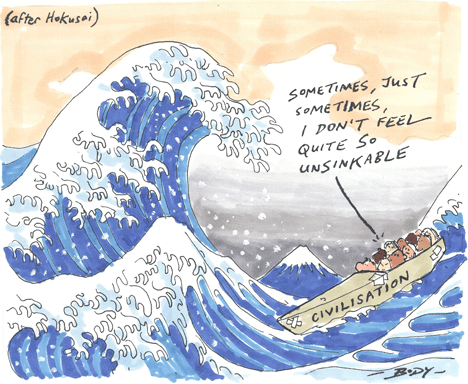
I'm generally a fan of the politically INcorrect but that "rising sun" cartoon seems a bit bad taste.
Sometimes , to make a point , humour hurts .......... But humour is more likely to get the message across , than any quantity of sermonising : Gummster's Theorem 101 .
yes - maybe correct - see yu in 27 days Gummster !
..while right now - China is preparing the evacuation of it’s people.
OK Walter : I look forward to that . ....... . As they say , " fine words butter no parsnips " ......... Every stream crossing or stone turned is linked with a mythical event ....... Good fats are found in fatty fish like salmon , sardines , mackerel , trout , and farmed oysters .
God Bless You , my friend !
We know about good fats in fish Rogie – but what the good farts in politics ? Please, list a few from "your political party", so we can vote for them, in stead of constantly rubbish the “goofies”.
" Party " is the problem . Our adverserial system does not produce optimal outcomes for the citizenry .
MMP is a crock . We need MPs who are directly responsible for an electorate . No free-loaders on a " list " .
Preferably voters would elect MP's who had worked outside of the public service , whether in business , agriculture , science , and non-profit organisations .
........ And failing that , get back to the sea-food diet , 'cos anything else will give you the shits .
Gummy.....actually you make no or limited sense on two levels,
If you want directly responsible actually MMP can be more so.....The green party exists because it is above that 5% threshold.....so to cease to exist they only have to drop from 9%? to 4.9% and they are gone in total.
ACT exists only because of Rodney Hide....and NZF cant get in, yet they have several % of the vote....those who voted for them either have more say than they should, or no say...For me that 5% should be dropped to about 1.25% or whatever % is enough to get a party one MP.......that 1.25% then gets some representation....so I think MMP needs twaeking, but I really think its better than FPP....
Consituant MPs, some are in marginal seats so have to listen to a wide range of consituants, secure MPs dont....
I'll take that as a compliment steven , most folk think that I make " no or limited sense " on all levels . Thanks , champ !
..... But I reckon you mist the thrust of my vision , no parties . Truely independent MPs , each representing an electorate , trotting off to Wellington to voice the opinions and wishes of their voters .
No Greens wagging the Labour or National dog . No NZ First holding up the country whilst they seek the baubles of office . ACT gone . NZ Maori gone ......... Loverly gubbily !
Ah now I think I would wholeheartedly agree if you dump parties, not because parties are bad but because the old ones are clearly bad...
Otherwise dumping MMP we do is end up with the big two swapping the main seats every few years...
Im not convinced though that MPs are that big a deal....they simply appear to support/help their real base....
regards
owwww......! bastaaaard
This is one black swan...hate to see it playing out.
Read through this http://www.businessinsider.com/japan-reactors-pose-no-risk-2011-3#ixzz1GdFwuV7s that someone posted and now wonder if this it is all a media beat up. I hope I have been had for the sake of lots of Japanese folk.
Germany's new boom: making money by making stuff
A recent American article described Germany as having a 'stakeholder Capitalist' economy... What's in a name?
Yes – and we dig, drill, import, consume and mortgage stuff with great support by policy makers and ministers like Brownlee, Joyce and Hide - a different economic culture.
Bahrain goes into a state of emergency...
http://www.stuff.co.nz/world/middle-east/4772316/Bahrain-declares-state…
So $2.50 a litre now looks quite probable.....maybe $3....if you can get petrol that is.
regards
Denninger has a good article on the Japanese meltdown and the Insurance costs
One must assume that the Japanese insurers are all insolvent. One must also assume that many global reinsurance outfits may be impacted. And since the BOJ's first act was to print, there is the possibility of a speculative attack by outside financial interests such as hedge funds aimed at either the equity markets or the bond market in Japan.
The BOJ has no good tool set for this circumstance. Printing is an attempt to offset deflationary and contractionary impacts in a ZIRP world. The BOJ of course has maintained ZIRP in an attempt to stop deflation (without success) for more than a decade now. But these sorts of disasters tend to be seriously-destabilizing events both in the short and long term.
In the short term they're likely to produce a serious contractionary force along with a collapse in government tax funding. The risk is that if you print into that, as the BOJ is doing, the possibility of a severe, sustained and successful speculative financial attack go up materially. This would then cross-link to the United States since Japan owns a huge passel of US Treasury bonds.
http://market-ticker.org/damn thingy on the pooter....where's Wally and his rubber thingy...damn it.
What's in your pooter Count....have we got a bug?
Rebuild your hard drive....just a minor job!
Nah..Wally.....its just the virtual is up to it's max so doing the three things at once is getting slow....time to retire this old girl and git me sumthin with a little more under the hood....
Christov - if you lift the needle gently, blow the fluff off, and lower it again, sometimes does the trick.
I got spare needles if you need.
Edison
No wonder your still collecting Gentle annie's PDK......they moved on to the STYLUS complete with magnetic curtains.
but they ruin the wax.
You're not using '78's are you?
futurist.
I see now PDK that you have a cylinder fixation........leading to a possible mantra ...that...
"it all comes out in the wash"
somehow relevant to events of late.
wax or no your needles are indeed sharp.
no - my approach is purely scientific.
When compact discs came out, I put one on the wind-up Victrola.
Unaccountably, the needle held the disc, while the turntable continued at 77 rpm.
I wrote to Victrola (and my Border Collie wrote to HMV) but alas, we still await replies.
I suspect that if I eliminate the braking effect, it may get up to speed and the problem will be solved.
ps - I'm working on a two-needle version and may invent stereo shortly.
stay tuned
will do..PDK.
Please would somebody rid us of this piece of shite.......
"Investors are being warned of a fresh round of "shocker" low-ball share offers from companies linked to trader Bernard Whimp." herald
We welcome your comments below. If you are not already registered, please register to comment
Remember we welcome robust, respectful and insightful debate. We don't welcome abusive or defamatory comments and will de-register those repeatedly making such comments. Our current comment policy is here.