
Here's my politico-economic blogroll for the week. Have a good weekend all.
From the right
1. Anger grows in Christchurch - Peter Creswell at Not PC demonstrates some of the anger brewing in Christchurch at the length of time it is taking to get anything done. We've had 10 building consents for new dwellings related to the September quake.
Government has appointed 20 people under Gerry Brownlee to fix things.
It took over a month to create this group and it doesn't even have a fixed CEO.
What power does the new Earthquake Recovery Authority have to deliver all this largesse, and make Christchurch’s post-earthquake recovery possible? Basically, they have all the powers the Earthquake Recovery Gauleiter has, with only a committee or two to limit them. As we have already seen, these include the power to
- demolish other people’s buildings; and
- requisition other people’s land; and
- ban people from their own property; while
- spending months deciding what people will be allowed to build where.
Basically, it’s an authority charged with “getting things done” that will continue doing everything in its power to make it impossible for entrepreneurs and property owners to get their own things done.
Want to rebuild your damaged commercial building? You’ll have to wait at least six months until council/government/the new authority decides what (if any) new building standards it needs to be built under.
Want to rebuild your damaged house? You’ll have to wait at least twelve months until council/government/the new authority decides what (if any) houses can be built or rebuilt on liquefied or unstable land.
Want to build new housing on the outskirts of town? You’ll have to persuade council/the new authority to relax their ring-fencing of the city, and wait at least eighteen months for the council’s damaged (and uninsured) services and infrastructure get to you.
Want to start building a new commercial heart to the city away from its now-devastated centre? You’ll first need to persuade the author’s of council’s “Strategic Plan” that there’s no way the city is ever going to “sustainably” (or affordably) the way the city is ever going to develop NOW, post-earthquake, the way they thought it would before the earthquakes struck.
2. The day NZ State Owned Enterprises were born - Homepaddock points out that on this day in 1987, the State Owned Enterprises Act 1986 came into existence. This from NZ Today in History:
The State-Owned Enterprises Act 1986 – the key provisions of which took effect on 1 April 1987 – heralded a major overhaul of New Zealand’s state sector. A number of government departments became commercially oriented organisations with an emphasis on efficiency and profitability.
The SOEs were a cornerstone of ‘Rogernomics’, the dramatic liberalisation of the New Zealand economy which followed the election of the David Lange-led Labour government in 1984. The name derived from Minister of Finance Roger Douglas, the main driving force behind the controversial initiatives.
For decades governments had used the state sector to minimise unemployment. But the new SOEs were to be run along private sector lines, which in many cases meant drastic cuts in staff numbers. These were painful times for many and things got worse following the October 1987 sharemarket crash. By that time Lange and Douglas were at odds over the pace of change in economic policy. Lange famously recommended ‘pausing for a cuppa’ while Douglas insisted that this was not the time to hesitate. Eventually Lange sacked Douglas and his key ally Richard Prebble. When caucus invited both men back into the fold, Lange responded by resigning in August 1989. A little over a year later Labour experienced its worst election result since 1931 as the National Party swept back to power.
3. Legalise dope and tax it to help pay for the quake - Lindsay Mitchell hints at the prospect of taxing illegal drugs (legalise them first though) as a good way to help pay for the Christchurch earthquake rebuild. She could write for The Economist.
It has been suggested that California legalise dope and tax it, to go some way towards fixing their financial woes. While NZ scratches around looking for ways to pay the Christchurch earthquake bill here's a company donating $5 from each sale. What does it produce? Cannabis look-alikes - or as they describe their products - "legal weed".
I wonder if the Mob or Black Power have made similar pledges?
Unfortunately I expect NZ will probably do the retrograde thing and close these legal businesses down rather than accept human nature for what it is and make some gain for the good. Similar products are already illegal in Germany and Australia apparently. Oh and look who is leading the charge.
From the Left
4. Invisible hand giving us the finger - No Right Turn looks at the spike in wholesale electricity prices last week that saw them jump 200 times normal levels, annoying a few SOE power companies, but bringing in a few million for another.
This sort of market manipulation is not new. In electricity crises in the 90's, generators were spilling water during a shortage to hike prices. And California's 2001 energy crisis was caused by corporations deliberately restricting supply, then further exploited by companies taking plants down for "maintenance" so as to profit from price spikes. In this case, we have a company exploiting a planned outage which removed the competition from the market - effectively abusing a (temporary) dominant market position.
And we'll all end up paying for this, through higher power prices in the future. As for the "invisible hand of the market", rather than leading people to a socially beneficial outcome through greed and selfishness, it instead seems to be giving us the fingers.

5. So why did they let South Canterbury Finance into the guarantee? Eddie at the Standard asks why, if John Key was being told constantly about bankruptcy concerns for SCF, why did the government keep renewing its guarantee Trust Deed? Cactus Kate has a go here as well.
The guarantee was originally announced by Helen Clark in an election speech after receiving a tip-off from Aussie PM Kevin Rudd they were about to announce one there. Clark said all financial institutions had to be included because there wasn't enough time to sort out terms and whatnot for entry criteria.
An argument against Eddies questions could be, if you're not going to guarantee the ones that are in danger of going bankrupt, then why have a guarantee at all?
There was no perfect way to handle the situation. Lax regulation and hand sitting by the government in the years before the finance company collapses could be largely to blame. Remember, did anyone ask questions why one of the biggest finance companies in the country was allowed to be audited by some unknown firm in Timaru around the corner from SCF's offices?
On November 19th 2008, Key and his ministers were sworn in. That very day, Treasury Head John Whitehead signed the deed admitting SCF into the retail deposit guarantee scheme “on behalf of the Minister of Finance” Bill English.
The deed was renewed on December 11th 2009, again signed by a senior Treasury official on behalf of English. It was updated on April 1st 2010, once more signed by the same senior Treaury official on behalf of English. And then amended on June 17th, again signed off by the senior Treaury official in English’s name.
The mere fact that there were so many reviews of the deed shows that Treasury knew things weren’t right. And Key’s acknowledgement that he and English were being repeatedly told “week after week” about SCF’s problems raises the question of why they kept on having their officials sign new deeds keeping SCF in the scheme.
Remember, the upshot of SCF being kept in the retail deposit scheme through all these reviews and updates was a bailout that put an average of $50,000 into the hands of the depositers, paid other debtors $300 million – all funded by us as taxpayers at a cost of $1.8 billion. We’re now lumbered as effective owners of a finance company that is only worth a fraction of what we paid because of the choices Key and English made.
The conclusion the Commission is clearly being encouraged to come to is that getting cheaper housing depends on us opening up the way to more urban sprawl, with the new outlying developments ‘served’ by motorways. The cabinet papers released by Rodney Hide last month spell out very clearly his analysis of housing unaffordability, so why go through the expensive farce of asking the Commission for advice?
I asked a panel of business people at SBN’s ‘Sustainability is Mainstream’ forum this week for their thoughts on improving productivity in the New Zealand economy. The responses included more investment and commitment to science, research and technology; staff engagement programmes that create a positive company culture where employees know they are valued and listened to; encouraging health and fitness through good nutrition and exercise, so people not only live better lives but also become more productive.
Pretty sensible ideas, already proven in practice by successful companies. No bogus research projects by a politically influenced commission required.
Economics blogs
7. Structural deficits are not cool man - Matt Nolan at TVHE (not the one giving us the finger) looks at the merits (and demerits) of cutting government spending. But he notes NZ needs to reduce its current account deficit.
The IMF reckons we have a structural current account deficit (it doesn't get fixed quickly by nice things like economic growth or high commodity prices) of about 5%.
It is true that when we have a cyclical downturn, cutting spending without a coordinated cut in interest rates from the central bank is likely to exacerbate the cycle.
And it is true we are in a cyclical downturn – output in the economy is below its potential level.
However, there are three factors that could well justify SOME cuts to government spending – as long as they don’t try to close the deficit immediately.
- The Reserve Bank still has the ability to respond by loosening monetary policy (although the effectiveness of cutting at current lows is a matter of debate),
- The cuts are focused on extremely low productivity elements of spending, as a result the contractionary impact will be smaller than in the case of indiscriminate cuts.
- Most importantly, the focus of the cuts are to remove the “structural” deficit.
The third point needs more explanation. Fundamentally, the “potential size” of the New Zealand economy is now believed to be smaller than it previously was. As a result, in order to have government taking up the same share (a share that is determined by the tax take, which is hopefully set according to the share society desires) the level of government spending does need to be lower – or else we run a structural deficit.
Structural deficits are not cool, it implies that the government won’t balance the books over the economic cycle and will cause unnecessary disruption to economic activity when it does try to – and as a result, it is often seen as a good idea to minimise them.
8. Market mover. This is great. David Farrar at Kiwiblog wrote an April Fools joke on Judith Tizard returning to Parliament this morning (that's not what's great). Eric Crampton has the reaction on iPredict after the post. there might be a few peeved off traders.
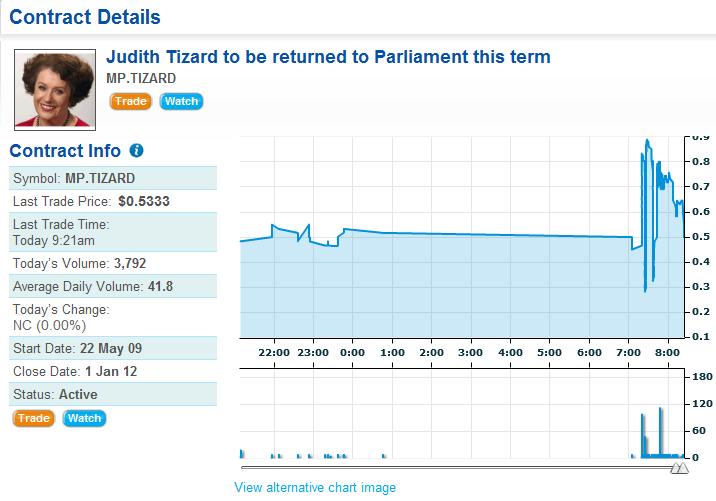
I love the volatility in the Tizard contract. The price ran from 0.50 to 0.82, back down to 0.30, up again to just shy of 0.90, down to 0.32, up to 0.80, then simmered down again to 0.50.
Kudos to Farrar.
9. How can raising your price be anti-competitive? Anti Dismal questions the state of economic journalism in New Zealand after suggestions it is anti-competitive to raise milk prices.
I mean it does on the face of it seem a very strange claim. The normal anti-competitive pricing activities would be things like predatory pricing or the closely related limit pricing, but both of these involving lowering your price in such a way as to either force competitors out of the market or prevent them from entering.
But raising your price is the opposite of this, it would seem to involve giving an incentive for firms to enter the market or if already in the market expand supply, thereby increasing competitive pressures.
So have none of the economic journalists out there asked themselves, Can raising your price really be anti-competitive? Have any journalists thought of going to the Commerce Commission and asking them to explain the logic behind this claim?
10. Funny video. Here's some funy clips for your weekend viewing pleasure.
12 Comments
#1 is on the money.
Of course bureaucrats, politicians and military-men know how to build a city better than entrepreneurs and private enterprise.
Oh and you don't need to keep property and business owners onside either, they'll just do as told.
And to win an election in seven months time, all you need to do is do nothing, say the job's too big, stall and claim your doing your best even if that is doing nothing.
There is limited political risk doing nothing as this election is won in Auckland, it will never be won in Christchurch. The economic damage is already done...the rest of the country may have empathy however you they can't appreciate what you are living through and well their life goes on....relatively uneffected...
PM and broadcasting minister J. Coleman time to delete violent programs on national channels and care about the wellbeing of the nation.
There are increasing problems on many NZfronts and worldwide. Effects can lead to frustration and worse. Without the wider NZpublic participating or at least listening dealing with such problems, unrest among people in the streets are the consequences.
People, who have access to the media, especially TV should use that advantage, pushing for more political, economic, social transparency. The media must become the mediator between the public and our authority. We do need urgently open and detailed debates including people concerned or involved about an issue and experts and politicians. This should/ can take entire evenings and not just programs like close up/ Campbell life etc. lasting 20 minutes.
#1. In "The Shock Doctrine", Naomi Klein wrote about how a super committee in New Orleans used Katrina to gut process and enrich their pockets. In one fell swoop, low income neighbourhoods were eliminated and public schools sold off to become charter institutions.
#3. Legalising Dope is not the answer, but de-criminalizing dope is; or would that affect the business model for our new private prison system?
#5. The dogs used in conducting this sniff test have all died. Nice tidbit.
Judith Tizard will decide this weekend , whether to take up her entitlement to re-enter parliament ....
. . Lest we forget , this is what MMP is based upon , not " picking winners " ........ But swallowing the " dead-rats " that your own party list leaves you with .........
......... And speaking of swallowing , with Derryn Hughes departure , Judith Tizard will add the " balls " to Labour's up-coming election campaign which young Hughes apparently lacked .
Bernard you stirrer, what a thing to read on a Sunday morn...save the economy by cutting the value of the Kiwi$...and I thought you understood...we shall have to start all over with your lessons Bernard....
Of course you could save all that by giving Bolly a call...and he would quickly put you right...any lift from such an action would short lived..a suger high..followed by....you guessed it.
Every time you fill the tank Bernard....that's when you should grasp the thread of knowledge..when that cost goes up, so too will all prices throughout the economy, some instantly and other slowly but they will all go up...which leads to less spent, less govt revenue...
To think the exporters who will collect more NZdollars, will splurge and employ..is just wishful humbug.
It is a stable Kiwi$ v the trading partners which should be the goal.
Hello Wolly : So Bernard has joined the worldwide circus of " devalue our currency against all the others " ......... And what will stop that from leading to rampaging inflation , and a host of unforeseen consequences within the economy .....
.... Back here in NZ , and the Gummster is amazed that the Tazzies humming with prosperity compared to us .......... And all they got to offer the world is piles of woodchip and some dairy products ........... ummmmmm , same as NZ , truth-be-told !
Competitive devaluation is the problem Wolly...if everyone else devalues then we wont have a stable kiwi it will appreciate....so when some say NZ should devalue if its to keep pace with others that actually achieves a stable kiwi$.
Pretty clearly the US and the EU are going to try and get inflation later on.....if they can avoid deflation in the next few years (which I think they cant myself) in order to destroy the dbt burden and to compensate for lack of growth.....Yes, tank filling...the biggest problem with that is I dont think they will take into consideration the impact on their economies from the change in the price oil oil and chnage in price from its scarcity a double hit....the result will be a crazy zig zag in and out of recession but with a downward trend....at some point even I think a decent % of countires will start to actually default as thier Govns build up crushing debt trying to stimulate the impossible....
I wish I could see a way out of it that our Pollies will take, but I cant and they wont.....having to admit to the public they are failures will unleash great anger IMHO....but there is no one else to vote for.
regards
Also I see the possibility of greater in-equality if we dont de-value, or accept we cant fight inflation to the death and the inequality is bad enough as it is...
My big concern is the job losses that result if we do not (de-value) but everyone else does and our exporters can no longer compete with the competition....This would have 2 bad effects, 1) Less income of foreign $s (which also effects our balance of payments) and if exporters cant make ends meet more un-employment as they let staff go.
So yeah sure inflation is bad but if my choice today is spend $50 filing my tank and $75 filling my tank in say 3 years time, or $60 a tank in three years time but no job so I cant fill it at all, I know what my choice is going to be.
So those who keep jobs with low inflation and high un-employment do well...if however you lose your job you are stuffed....and that isnt good for NZ in terms of benefits costs and increases in tax to cover it and those ppl have little to spend, which causes a contraction....
I think my biggest disappointment is this is really complex and all I see are ppl with small slivers of the big picture jumping to conclusions / actions that are actually potentially way bad overall.......I think its dangerous to focus in just one ascpet without worrying/considering allt he others....
regards
Happy days are here again ...it's a jobless, growthless, American "recovery" destined to end in you guessed it...Quantitative Easing version THREE...let's all sing along now..."happy days are here again the Fed is busy printing again....dee dum da da dee dum".....yep Dumb is the word...!
http://www.marketoracle.co.uk/Article27327.html
Anyone for some debt?.....come on now...grab it while you can...don't be shy....the more you owe the richer you will be...
The high Kiwi Dollar is a misnomer - dairy farmers don't need a lower NZD, and neither do even sheep, beef & wool...certainly exporters into Australia don't need a lower dollar...but the biggest one of all is Kiwi consumers, they ceratainly don't need a lower dollar
The one thing we're guaranteed into 2012 is INFLATION, the hope is that ours will be a whole lot less than some countries who's savers are going to either get wiped out or considerable damaged. I for one value savers
#6. The productivity commission was an agreement with Act after the last election -
"The National-Act Confidence and Supply Agreement includes a commitment to explore the concept of a New Zealand Productivity Commission associated with the Productivity Commission in Australia."
Common knowledge, so why are the Greens bleating about it now? The issue should be why it took 3 years to organise.
The cabinet papers released by Rodney Hide last month spell out very clearly his analysis of housing unaffordability. Can anyone forward this to the commission as it already includes most of the information they will be searching for. Are there bonuses for completing their report in one month instead of twelve?
We welcome your comments below. If you are not already registered, please register to comment
Remember we welcome robust, respectful and insightful debate. We don't welcome abusive or defamatory comments and will de-register those repeatedly making such comments. Our current comment policy is here.