

Here's my Top 10 links from around the Internet at 10am in association with NZ Mint.
I'll pop the extras into the comment stream. See all previous Top 10s here.
I welcome your additions in the comments below or via email to bernard.hickey@interest.co.nz.
I will not welcome any mention of this wedding thing in Britain. Interest.co.nz is officially a wedding-free zone this week.

1. The problem with Saudi Arabia - One of the reasons I'm firmly in the peak oil camp is I just don't believe the Saudi Arabian's oft-repeated claim they can increase production to match growing demand with growing supply.
Stuart Staniford at Early Warning picks up on four signs that Saudi Arabia is having real problems making up for the 1 million barrels lost in Libya.
I for one reckon we'll be looking at US$300/bbl oil some time in the next five years.
I'm getting used to being a cyclist.
HT Powerdownkiwi and a bunch of others on yesterday's Debt thread.
All of this evidence points in the direction of Saudi Arabia being unable to raise production much if at all in the near term. Given a global economic recovery, rapidly growing demand in China and other developing nations, and little hope of a quick resolution in Libya, that raises the odds of a major oil shock a lot.
Some of us have been warning for several years that as soon as the global economy recovered sufficiently, there would be another oil shock. I started wondering as long ago as December of last year, whether 2011 could be the year?
Even the head of the Internationa Energy Agency reckons the age of cheap energy is over.

2. Not very elastic - As an economics student I loved learning all about elasticity and how reactive demand or supply was to price. This piece from Early Warning about the IMF's latest forecasts for the elasticity of oil demand when prices increase is a great read. I need to get out more...
The conclusion is that GDP growth requires oil production growth or inflation. Guess what we've got now?
I've tended to be an inelasticity hawk, but these numbers are really eye-popping. -0.007 for emerging market oil price inelasticity! That implies a 10% increase in oil prices produces a negligible 0.07% decrease in consumption.
That's the short term number, but even the 20 year horizon is only -0.035. Meanwhile, short term global income elasticity is 2/3. So that 4% economic growth requires 2 1/3% annual increases in oil production to keep prices stable.

3. The Americans are worried - This video is one of many doing the rounds in the viral landscape in America, which shows how concerned Americans are about their growing debt.
4. Perigo vs(?) Don Brash - Here's Lindsay Perigo on Stratos (via Youtube) interviewing Don Brash. The interview starts around the 4 minute 30 second mark.
Brash points out John Key has wasted two crises -- the Global Financial Crisis and the Christchurch earthquake.
He attacks subsidised doctors visits for everyone.
Brash talks about the new party he is thinking of setting up around the 19 minute mark.
5. Canadian house prices to fall 90% - Here's Max Keiser and Nicole Foss talking about the Canadian housing market.
Foss sees an eventual 90% slump in prices. An entertaining watch.
6. Here's more from Foss in which she predicts deflation:
7. The bitter truth about Sugar - This is a bit off the beaten track, but it's a fascinating watch on how increasing use of fructose in America's food supply is poisoning the population.
It's long but worth the watch.
America is eating and spending and borrowing and fighting itself to death.
And the irony is the big agricultural companies that produce all the high fructose corn syryp killing Americans are subsidised by the US government...
8. Oh boy. It's started - The Telegraph in Australia reports property prices in Sydney's Eastern suburbs fell 15% in the last nine months. HT Hugh.
SYDNEY'S great property divide is being turned on its head, with the wealthy Eastern Suburbs suffering a shock 15 per cent slump in property prices, while values in the city's west continue to soar.
Property monitors and analysts are stunned by the sharp reversal in fortunes in traditional real estate hot spots, claiming the nine-month plunge has wiped billions from the collective wealth of the city's richest homeowners. And it could be just the start.
Property analyst Jason Anderson, of MacroPlan Australia, believes the Eastern Suburbs could face a further 5 per cent decline in values in the next quarter alone if sentiment failed to turn around and first-home buyers continue to sit on the sidelines.
Such an additional fall would take the market correction to beyond 20 per cent from the inflated peaks reached last year, erasing the majority of gains the Eastern Suburbs recorded in the mini property boom post the Global Financial Crisis.

9. So much useless stuff - The WSJ reports Americans now spend US$1.2 trillion a month on stuff they don't need, or 11.2% of total consumer spending, up from 5.4% in 1954. Is this the problem?
How much junk do we buy?
The sheer volume of non-essential spending offers fodder for various conclusions. For one, it could be seen as evidence of the triumph of modern capitalism in raising living standards. We enjoy so much leisure and consume so much extra stuff that even a deep depression wouldn’t – in aggregate — cut into the basics.
Alternately, it could be read as a sign that U.S. economic growth relies too heavily on stimulating demand for stuff people don’t really need, to the detriment of public goods such as health and education. By that logic, a consumption tax—like the value-added taxes common throughout Europe—could go a long way toward restoring balance.

10. Totally Jon Stewart video on this Donald Trump for President madness.
107 Comments
@#1
Having just returned from the insanity that is America I looked very critically in the latest “Oil Shock”. I called around to a few oil storage facilities around the US and I got the same answer time and time again “Were Full”. By my calculation the US now has over 300+ days of oil stored around the US right now. So there isn’t a supply problem from any source right now. So the issue has to be one of speculators driving the price up on derivatives trading and rolling over their contracts. Even if you were to take physical delivery there is no place to put it unless you want to pay to store it on a tanker parked in a slip.
Thanks for that Troy. It really is quite amazing that in the midst of one of most rabid money printing orgies of all time some of these so-called esteemed commentators (includes our own RBNZ governor) come out with this crap that surging commodity prices are solely due to supply-demand dynamics.
As my grandmother told me on many occasions…
”Banks will always side with the government, can goods last longer, and In ‘interesting times’ cooler heads prevail”
Troy...the SPR has about 30~40 days....
300 days is a very high amount, ..it means that provate companies hold 10 times the SPR....so if thats the case whenever the US taps its SPR to ease things the ratio should make that effect very small....maybe even negligable.....and of course you rang every holder of oil and tyhey told you so....
Sorry but without some evidence that just strikes me as farcical.
regards
Your calculation is based on what?
URLs?
I thought its more like 90 days?...
oh but I think NZ has barely 30days....so OK the US is still functional 90 days from THE event...NZ by that stage has collapsed....no fuel to collect or transport food...
regards
Nah...I went old skoll...i made actual phone calls. I had unlimited long distance minutes so I took advantage of it. :)
Troy - I think there are a couple of things going on, including a newly-opened pipeline with no downstream infrastructure, but that's from memory, been too busy and it's not really my interest.
America is the biggest consumer, but not the playmaker at this point. #2 might be the key.
http://www.indexmundi.com/energy.aspx
The green bars give you an idea.
http://www.businessweek.com/news/2010-12-01/u-s-oil-terminal-storage-ca…
385.6 (2010) divided by 18.81 gives us 20.4 days.
then there's the strategic reserves, not sure whether they're inc or ex the 385:
http://www.fossil.energy.gov/programs/reserves/
if that 727 million is 'ex', then 38.6 days on top of 20.4 = 59 days best stretch.
I'd be interested to know how you got 300?
powerdownkiwi: Interestingly, when you click on the link for each country name, while oil consumption is falling for most Western countries in the past 2 years, China increased oil consumption by 3%+ in '08 and by 6%+ in '09. That's a key part of the engine driving 'scarcity' pricing for oil, IMHO.
There are currently derivatives contracts representing over 1.6 BILLION barrels of oil sans deliver on the market right now. 70% of those contracts are held by speculation entities betting on “what if-what is”. They don’t actually need the oil. There isn’t enough storage capacity in the US to store that much oil if everyone took physical deliver tomorrow so these guys are simply rolling over their contracts hoping the conflict in Libya continues and the price goes up. Now for the math, at current consumption of 18Mbd those contracts represent 80+ days of paper storage rolling over quarterly. That is just paper. The US also produces 9-10 Million of oil a day…and gets another 5 million from NAFTA partners. The US only imports 3Mbd from questionable sources (insert dodgy country here) . The strategic Oil reserves are 780 million plus another 380 million in commercial storage, all of which are full. So at the end of the day there is a full year under direct storage. Oh and the kicker there is another 225 days’ worth under contract for actual delivery. If Saudi Arabia stopped shipping tomorrow and you add it all up and you get a full year of oil right now plus another full year under various paper contracts.
I can find,
Strategic reserves, of which 1.4 billion is government-controlled.".....so we get to possibly 2 to 6 months....note though other data suggests different data....thats interesting given westerners taste for not stocking up...ie just in time inventory....
Futures and under contract to deliver are not posession of actual oil.....its an iou that might or might not have a backing....
The US produces about 8.4mbpd I can find, but some data says 6.1....uses about 21mbpd but some data says 24....so the difference is what gets sucked out of reserves if nothing can be imported....still cant see past 6months.....not 11 months.
Even then of course NZ's barely 30 days is bloody awful.
regards
Troy - by your figures, oil in hand is 780 million plus 380 million equals 1160 million.
Divide that by 18 million (per day) and it's 64.4 days in storage.
you stated "By my calculation the US now has over 300+ days of oil stored around the US right now".
I got to 59 days up-thread. Paper storage I've tried, but it just clogs the tank.....
:)
I can see that math isn’t everyone strong suit here. I blame myself I must not have made myself clear. You guys are failing to take into account that the US is an oil producing nation and does not import 100% of its oil. So I’ll make this very clear there is over 1.1Bbl stored in the US right now with another 1.6 billion under contract. North America as a whole produces 15Mbd of its own so the US only really needs to import 3Mbd from other sources (i.e. SA, VZ, LB, etc)
1160/3 = 386 days
If you want to exclude NAFTA you’re looking at 120 days. Not exactly a panic situation.
Troy, did you know that there is legislation that prevents speculators to out number end users of any commodity ?... Well the funny thing is that Goldman Sachs was granted doing so, some laws do not apply to GS.... Only in America.
Pricing can also be driven by futures. So though oil storage facilities may be full today, the one year or two year outlook may be less rosy. At some point, that oil will be purchased at that (expected) price.
Troy commodities are a sponge for inflation of dollar debasement so derivatives will keep rolling higher. I would not call it speculation... It is a hedge against the FED's policy..
Michael,
Agreed the FED’s export of inflation is a part of it. But it doesn’t explain all of it. The major explanation is that derivatives markets are buy and selling contracts to each other. So instead of a straight up bet on “what if” scenarios they are now betting on “what if-what if’s”. I think people seem to underestimate, to their detriment, what influence the derivatives market can have on the spot price. It’s 2008 all over again!
There is no doubt about that 2008 all over again.
Short Oil stocks since oil will be coming down after July....
we have 2008 again, I remember that at the top of the mkts the FED gave another round of punch by removing interest rates. i wonder if this time- when they reach the top- they will increase the OCR. And remove the punch bowl.
Troy
You are right and you are wrong, Cushing currently is quite full but the problem is that its not full of WTI or its like. West Texas Intermediate is rapidly becoming a mythical benchmark and therefore inaccurate.
A lot has been written recently about the inflows into Cushing of the Bakken Shale oil and Canadian Crude unfortunately the refinery infrastructure around Cushing can't handle the current mix, this is evindenced by:
1. That refineries that can handle heavy/sour crude are running flat out (unusual this time of year) wheras the others are running below average
2. There is a growing disconnect between US Gas/Petrol Price and WTI, which is more than a high crack spread, but is because US refineries are having to 'buy in' higher priced higher quality crude
The US not only consumes a lot of oil but exports a huge amount of refined product and there was talk of reversing one of the Cushing/Gulf pipelines so they can export crude they can't process, but this is not likely to happen (and I think I remember reading somewhere that the pipeline co owns refineries, so they are doing well out of the situation)
Crude oil is not a homogenous compound
Neven
Ok but how does that invalidate my initial argument that the US is awash in crude right now and the current price level has nothing to do with supply and demand?
Also,
I’m not sure when this happened, but when did this perception that the US is a 100% oil importer happen? Did I miss something?
Because it is 'awash' in crude it cannot immediately use, so yes, supply/demand is contibuting to the high price (not just speculation), its just demand for light sweet crude, I'd suggest you look beyond this just being 'oil' at one price.
The US is not a 100% importer (as it is the 4th largest producer in the world) but as oil is fungible I'm not sure what your point is
Neven
FYI Chile's peso is up near three year highs.
Last time this happened Chilean authorities intervened to push it lower.
What's our Reserve Bank up to?
http://www.bloomberg.com/news/2011-04-26/chilean-peso-reaches-strongest…
The peso advanced 1.1 percent, the biggest gain among 25 emerging-market currencies tracked by Bloomberg, to 462.67 per U.S. dollar, the highest level since April 2008.
The peso reached 465.75 on Jan. 3, prompting the central bank to announce a $12 billion dollar-buying plan to slow its gains.
Right Bernard but the funny thing is that as they intervene they are also rising the OCR to counter the efects of imported inflation so in the end it is back to square one, remind you that it is high season for agro exports in Chile and a stronger US$ is fine for producers. The central bank is buying at a rate of 50 M $ a day unil 12 B $ are gone... What I do not know is if they are intervening because they are looking forward to a higher dollar in the near term. In case they had not intervened the $ would be app 5% cheper right now. If the US hikes rates soon the Chilean central banker will be genius, if not....
The last time the Peso went up it got to 417 so there is still room to rise.
Andrew Gawith from Infometrics and economist Susan Guthrie have written an interesting piece for NZHerald on how Working for Families has acted as a subsidy and reinforcement for companies to pay low wages.
They point out it also lifts youth unemployment.
http://www.nzherald.co.nz/business/news/article.cfm?c_id=3&objectid=107…
While WfF has definitely alleviated financial stress among low-income families, like most subsidies it has distorted market signals. Low-paid jobs are a traditional route for younger workers to get more experience. However, under WfF, low-paid jobs are more likely to be accepted by older workers with dependents: their living costs are higher and not normally covered by a low wage, but unlike younger workers their take-home pay (thanks to WfF) can far exceed what the employer pays.
The result is that relatively inexperienced youth get locked out of the labour market, contributing to the high rate of youth unemployment.
Experienced workers are employed in jobs that do not use their full potential (detracting from productivity growth). Furthermore, these workers are employed at artificially low wages thanks to WfF, to the detriment of those they are competing with (workers without dependents).
Rather than chasing the dream of matching Australian incomes, let's first make sure workers with families can live with dignity from the wages their employers pay them instead of having to rely on selective income subsidies from the Government.
That may involve giving workers more bargaining power to negotiate an increase in their share of national income.
That would be a step towards narrowing the distribution of income and wealth in New Zealand which has broadened over the past three decades and may be cramping our ability to grow.
The disparity in income is obvious the guy who used to run the NZPO with 60-70,000staff was paid about $80,000 per year and a trades man at the NZPO about $40,000...The CEO of Telecom with about 8-10,000 staff is paid 1 Million + stock options and fees and anything else not nailed down; the lines man $50,000 so no brainer really, but this last sentence is well...lol
Quote:That would be a step towards narrowing the distribution of income and wealth in New Zealand which has broadened over the past three decades and may be cramping our ability to grow.
How are you going to beat this reality? http://www.gmo.com/websitecontent/JGLetterALL_1Q11.pdf in the idea of growth? in the idea of growth?
Perhaps one of those bank economists could enlighten us all? lol
Bernard,
It would be interesting to know to what extent WfF has contributed to the increase in house prices in the past decade.While "cheap money" contributed to the increase I think that WfF has distorted the income of many people to allow people to bid higher prices for houses and if WfF was removed many people would have problems servicing the mortage that they have taken on. I think the attempt to catch Aussie wages (and no doubt prices) is both flawed and dangerious - better to focus on NZers creating our own lifestyle rather than seeking to emulate the Aussie or Amercian lifestyle which we see on TV. Aussie may have a generious sprinkling of natural resources but how long will they last and just as importantly can they feed themselves.
I think NZ should seek to find it's own direction and destiny not seek to emultate that of our closest neighbour. Perhaps it shows how insecure we are as a country.
#5. Nicole Foss, wow. And next..... Ken Rings predictions on house prices.
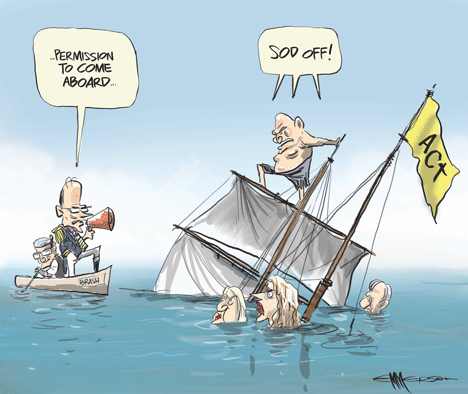
Love the cartoon....Rodney should be throwing whatever comes to hand and Brash left port in a dinghy....how apt.
My favourite Beijing economist and expert China Watcher Michael Pettis says America should give up the US dollar and says it an interesting way at FT.com
http://www.ft.com/cms/s/0/365e772e-6605-11e0-9d40-00144feab49a.html#axz…
If the dollar’s status is to decline in the future, it will require that Washington itself take the lead in forcing the world gradually to disengage.
Ironically, this is exactly what Washington should be doing. Conspiracy theory notwithstanding, claims that the reserve status of the dollar unfairly benefits the US are no longer true. On the contrary, it has become a burden, both for America and the world.
This cost comes as a choice between rising unemployment and rising debt. The mechanism is fairly straightforward. Countries that seek to supercharge domestic growth by acquiring a larger share of global demand can do so by gaming the global system and actively stockpiling foreign currency, mainly in the form of, but not limited to, central bank reserves.
In practice, dollar liquidity, limited Washington intervention, and the size and flexibility of US financial markets ensure that countries such as China stockpile dollars.
This importing of US demand by other countries forces the US economy to respond in one of two ways. Either American unemployment must rise as demand is diverted abroad, or Americans must counteract the employment impact by increasing domestic consumption or investment.
But what about the benefits to the US of reserve currency status? Analysts argue that the predominance of the dollar gives the US two: reduced cost of imports and lower government borrowing costs. Both arguments are flawed. Americans over-consume, and don’t need lower consumption costs, especially at the expense of employment.
The large imbalances that this system has permitted now destabilise the world. If forced to give up the dollar, the world might reduce global trade somewhat, and it would probably spell the end of the Asian growth model. But it would also lower long-term costs for the US, and reduce dangerous global imbalances.
The US should therefore take the lead in shifting to multi-currency reserves, in which the dollar is simply first among equals.
Oh and China has tightened again, Bloomberg reports. And it's using loan to value ratios...
http://www.bloomberg.com/news/2011-04-25/china-said-to-raise-capital-ad…
China’s banking regulator set capital targets for the nation’s five biggest lenders above the minimum 11.5 percent ratio amid concern that credit risks may rise, three people with knowledge of the matter said.
The regulator also set differentiated targets last month including loan-to-deposit ratios for the five banks, which include China Construction Bank Corp. (939), Bank of China Ltd. (3988) and Bank of Communications Co., following discussions with the lenders, the people said. The watchdog plans to amend those requirements every year, they said.
The central bank has raised benchmark rates four times since October and lifted the reserve ratio requirement for the biggest banks to 20.5 percent to curtail credit growth and inflation. Still, consumer prices rose 5.4 percent in March, the fastest pace since July 2008, and lenders increased new loans last month by a third more than the amount offered a year ago.
I enjoyed this link that powerdown or stephen posted yesterday, spent the night thinking.
http://greatchange.org/ov-simmons,club_of_rome_revisted.html
Nice link. Will put that aside for a weekend read. Sad to think Mr Simmons http://en.wikipedia.org/wiki/Matthew_Simmons is no longer with us.
cheers
Bernard
I always chuckle when someone claims that there is such a financial unicorn as “sustainable growth”. Besides what is wrong with just sustaining? Why do we always need to grow? I know a few successful small businesses that have weathered several finical storms by refusing to grow. Growth isn’t necessarily the wises finical strategy.
Sustainable growth quick que in the clowns on unicycles eh? Or perhaps the unicorns ride unicycles?
Its called a oxymoronic statement, but be careful dont inform the general public they may wise up!
Good point, I'll file this nugget under "T" for “Secret”. Nobody will look there.
Good luck, Kate and Wills!
sssssssssssssh ! ........ I mentioned the Royal Wedding in England , and all hell broke loose ....... Gareth threatened me with fire ....... Or meebee I misunderstood , and he was inviting me to his BBQ ?
Does GV wish NZ Inc to become a republic?
Yes he does.
but we are missing out on discussing the economic impact of the wedding...
George Freidman at Stratfor reckons the Middle East is more volatile than people think. HT Jason via email.
What is actually going on is that the United States is urging the Iraqi government to change its mind on U.S. withdrawal, and it would like Iraq to change its mind right now in order to influence some of the events taking place in the Persian Gulf. The Shiite uprising in Bahrain and the Saudi intervention, along with events in Yemen, have created an extremely unstable situation in the region, and the United States is afraid that completing the withdrawal would increase the instability.
Read more: Iraq, Iran and the Next Move | STRATFOR
http://www.telegraph.co.uk/finance/economics/gilts/8474725/Hole-in-Gree…
jonlivesey
What we are seeing here is not so much contagion as a kind of spiral taking hold. As the sovereign debt of places like Greece deteriorate, and it becomes clear that "austerity" is increasing the Greek deficit, not cutting it, the holdings of sovereign debt, and thus the balance sheets, of European Banks will continue to deteriorate. And how do Banks improve their balance sheets? That's right, they sell debt to raise cash. So more sales of debt lead to lower prices and higher yields, which leads to yet more balance sheet deterioration. It's too early to say if this spiral will lead to a collapse, but this isn't some hypothetical problem. This is what happened to the Banking System back in the thirties.
A Canadian guy owns a beachfront , near to me . He's a real estate agent from Vancouver . ............. Gummy couldn't resist , and gently asked about the high cost of houses there ........... He seemed non-plussed by the question , " over-valued ? "
Bernard - thanks for 1 and 2.
I didn't do your elasticity thing - I came at it from the physics, working backwards. I think of it as 'efficiencies', hence the pen-name. The big questions are how much can be efficientised, and what impact that has.
The Saudi question is all about Ghawar. 5 mbpd, 50 years old, peaked in 1980/81.
It's being water-cut (I've no problem with that - it's being well managed) but the problem with water-cuts is that they deplete fairly quickly.
http://www.theoildrum.com/node/5432
There is some concern/comment that in the past Saudi over-produced fields in order to get peak oilflows up for short periods of time as the swing producer....in doing so they believe they have probably reduced the total they will extract....However what's interesting is the recent Libya thing and now Saudi has said its "cut back"....just wondering if they tried to open the valves and got huge water cuts and hey presto did some notable damage....and found themselves with less.....so here we are at $123 and looking upwards....and Saudi cant do a damn thing.....they have ak'd in the past that $80 to $100 is about the sane/fare limit....so they must know they are dealing with a new recession.....if tyey cant get the price down....either taht or they are getting a stockpile of $s now as they see it coming anyway....who knows but I cant see it ending well.
regards
ESSENTIAL reading - Jeremy Grantham's latest missive to his investors. If you dont know who Grantham is there is a link below the PDF
http://www.gmo.com/websitecontent/JGLetterALL_1Q11.pdf
http://en.wikipedia.org/wiki/Jeremy_Grantham
If you only read one thing the whole week I suggest you make it that piece.
snap......
" The fact is that no compound growth is sustainable"
Stunning, Andyh - simply stunning.
Where's Hugh? PB? GBH?
It's the all of it, in a coherent nutshell. Bernard should put it up, a part a day. And ask our polies some hard questions. At least, if they deny all such knowledge, we can have some fun ridiculing them, now and in the history books.
Wotcha problem ? ........... The Gummster is sitting on a pile of copper , in a lake of oil , and with a beach of gold ...... I'm set for the future .
...... And lest you forget , human progress is not lineal ...... technology pushes us into ever greater effiencies , and into entirely new realms of products and services ........
Compounding is so great , so bloody amazing ..... Go GDP , go you good thing ...... and for once , nary a mention from Gummy of the Royal Wedding in England .
........ Gareth will be pleased with me .
Hey Gummy, watch out for piles from that copper you're sitting on...
According to Bloomberg TV , " copper is the new gold " ........... So what the heck was the old gold ? ...
..... Alotta talk about the takeover of Equinox by Barrick of Canada ..
.......also China is exhorting its businessmen to buy up assets worldwide , rather than prop up US Treasuries .......... I have copper / gold / oil / mangos ....... c'mon guys , pay me eye-ball-bleeding amounts of renimbis for it ........
It's a very good piece. Will lead tomorrow's Top 10 with it.
cheers for the links people
Bernard
I met Dich Smith back in '81. I was helping David Lewis get his 2nd (3rd, if you count Icebird) Antarctic expedition together, did a bit of the rigging. Dick Smith came along as a late sponsor, as I recall. (if you google images : dick smith explorer, theres a couple of old pix).
Interesting dude.
Your mantra is flawed on two fronts Hugh.
You are alive now, and may even be tomorrow. Want to bet that you will be forever, on that basis? There's a word for that.
Stupid.
You don't need to leave it to 'experts' either. Just thinking clearly does it. You should have the time - extolling Brash surely doesn't take much.
Oh, and Julian Simon had a wee problem with physics. Here's Heinberg:
How can resources be infinite on a small planet such as ours? Easy, said Simon. Just as there are infinitely many points on a one-inch line segment, so too there are infinitely many lines of division separating copper from non-copper, or oil from non-oil, or coal from non-coal in the Earth. Therefore, we cannot reliably quantify how much copper, oil, coal, or neodymium or gold there really is in the world. If we can’t measure how much we have of these materials, that means the amounts are not finite—thus they are infinite.[1] It’s a logical fallacy so blindingly obvious that you’d think not a single vaguely intelligent reader would have let him get away with it. Clearly, an infinite number of dividing lines between copper and non-copper is not the same as an infinite quantity of copper. While a few critics pointed this out (notably Herman Daly), Simon’s book was widely praised nevertheless.[2] Why? Because Simon was saying something that many people wanted to believe. Again - stupid.Ive recently re-read Malthus triggered by "so many" ppl thinking he was vile and awful......Ive come away with the same conclusion I had in the past, he's merely warning, saying this is or will be a problem. These attacks seem to be repeated when anyone says hold on we are over-reproducing and cant feed these ppl...."oh no they have a right to have as many kids as they want" "we dont want another china here"....its really simple....if we dont curb Nature will...
Tis simple in the so called green revolution all we have done is change one form of energy, oil and gas into fertilizer to make another form of energy we can consume, food and its in-efficient.
The ultimate logic is we are on a finite planet, even if it was all made out of oil, we'd use its all up one day....the only Q is when.
vatican, bet they dont grow much food in there....so their real foot print is far, far larger.
Housing issue....the above makes your issues moot.....
regards
That is always the Q - when. Nobody can claim to really have an answer of the future to such an extent.
I wonder if Grantham to some degree has the guilts, in part that the industry he represents has squandered wealth on a massive scale.
Robby - with respect, I think you're wrong on 3 counts.
1. No 'wealth' was squandered. All 'wealth' must be underwritten by something real, otherwise it's just a chimera. Bollard once spoke of "the dollars lost stretching to the sun, and half-way back". Well, they would perhaps have, had they existed. They did not, the whole thing was leverage on inflated values of already-existing things (shares, property). They were only real dollars in wishful minds.
2. I could forgive the economists nearly all the 'replacements will be found at a certain price' mantra, but never for energy. Nothiong happens without it. Nothing. Given that they're 100% wrong in that regard, you wanna bet - and I use the word with care - that they're right about exponential growth based on perpetual replacement-finding of everything else, from a finite planet? I wouldn't go there - note that ALL of Nationals proposals for 'wealth' involve one-off resource extraction.
3. You want to say that exponential growth - of anything - is do-able within a finite sphere of operations? See you in Court! I might not win over the Hugh types, but the evidence is irrefutable in logic terms.
So you can count on growth stopping at some point, on energy being required to do work, and wealth beind directly linked to the two. At that point - which I got to in 1975, aged 20 - you start looking at energy supply as the key - when it peaks, there went 'growth' (barring efficiencies) and there peaked the underwriting of wealth (there went the supply of 'stuff', in other words.
$4 trillion in overbuilt housing called to disagree with you.
Steven, you say "if we dont curb Nature will". Yes, and so? Why not let Nature do its thing? Or are you saying you know better and would rather play God?
If we dont do something about the birth rate we will eat out the food and destroy its eco-system....at which point the most common meat available will be human, odes that sound great to you? ignore history at your peril.
....its really simple, we need to have a max of 2 children....ie replacements, nothing more.
regards
So what do you suggest to achieve this? Would you outlaw singledom and force people to "couple up" and to produce exactly the required amount of children, no more, no less?! Maybe also make sterility & homosexuality illegal and ban girls/women from dying before they have met their quota? While you're at it you might want to consider dictating the exact age at which women should have those 2 children to ensure a precise population replacement (clearly, you need to take life expectancy into account and adapt to each country).
By the way, replacement rate is not 2 but 2.1 children per woman. I can feel trouble when you tell 1 in 10 couples they must have 3 children and the other 9 they must have 2.
So all things considered, I'd rather live in this world than in your ideal world...
Ive been listening to him via youtube for a while......I think he's one switched on chap....
http://www.youtube.com/watch?v=MThMfTNxaB8
I think this is one of the few ppl you ignore at your financial peril.....
regards
Hmm, interesting. I shall have to spend a while reading through it but I took exception to this bit:
"There is little productive new land to bring on and, as people get richer, they eat more
grain-intensive meat."
Sorry, he should get out of the city more. There is a vast amount of under-utilised land out there. The more productive parts are just so very productive they make it uneconomic to farm the rest.
Drive inland from the sea on the East Coast of the USA and there are hundreds of miles of deciduous woodland. Deciduous woodland means good soil. Its not dead flat so it is cheaper to grow stuff further inland.
He is of course quite right about compound growth being unstainable but what seems to happen is that population growth stops as poverty declines.
The cure for high prices is high prices - it makes it economic to develop unused resources and encourages better use of existing ones.
OOPS. I forgot to mention Ukraine, the bread basket of Europe before Stalin. Deep black soil, lots of underused resource there.
and a wheat harvest that collapsed this year.....no water...AGW...etc
regards
Agriculture always goes in cycles steven. Harvests collapse, harvests have bumper crops, harvests collapse. Time in between varies. Go back through history and you will find famines - AGW caused them hundreds of years ago too did it?
Ignorance in bliss on your part eh...try looking at the statistics, we are breaking records for the frequency of hot spots but also cold ones, AGW isnt about warming its about the accelerated change in the climate and the extrems it causes.....witness the number of out of bound weather events in the last 18months.
regards
Not ignorance Steven. I make my living working with nature - taking note of her cycles. Occassionally she throws us something out of left field, just to stop us getting too cocky. The snow in Southland last year - do you consider that to be part of AGW? If so, what do you put the snow there on Christmas day 50years ago down to - AGW? I have over 70years of a farmer's diaries to refer to and in that 70 years there are examples of extremes of weather - cold and hot. Hence I am less likely to be suckered in by those who are set to gain financially from promoting AGW.
Climate change is with us - as it has been down through the millenia. AGW is simply something dreamed up by those with vested interests.
You have diaries that are one location and not multiple locations over far bigger time periods oh spare me.
Yes it is ignorance....the inability to even bother to consider that there are others with a higher intelligence, specialist knowledge and ability and have spent decades studying this stuff and giving honest data and opinions....but oh no its not happening they just want my money. So if you are ill you go see the doctor? you know the specialist?....or maybe you go down the pub and chat to the barman....buy a beer off him and get his opinion? Both cost, which do you trust? obviously in your case the barman.
......Russia has a heat wave thats a 1 in 1000 if not 2000 years event....Australia 6 years+ of un-preciednted drought followed by 7 years rain all in a few days....and there are lots more examples or extreme, hot, cold, dry and wet events. The reak kicker though is an independant source, statisically the insurance industry is now talking of 1 in 100 year events happening as 1 in 50s, possibly 1 in 20s....so your insurance goes up or even maybe you will find you cant get any in a few years as they decline to insure you. What pray would that do to the value of your home and ability to get a mortgage if that happens? simple a huge collapse in value....
regards
Even the UN has stopped calling it Global Warming steven, and calls it climate change. The climate changes and always has - even you refer to a 1 in 1000year event - so it has happened before.
The key to your argument steven is one little word 'opinion'. giving honest data and opinions.
It's a bit like medicine - I am a follower of homeopathy but also use conventional medicine when the need dictates it. So I listen to what the experts opinions are and make my own mind up on what is relevant to me and what isn't. Practice and theory and the difference between the two, steven.
As a farmer if certain weather patterns start to emerge then you change your system to cope the best you can - we don't go round like henny penny saying the sky is falling. Time you got used to changing weather patterns steven, and adapt to it rather than thinking man will win out over nature.
By the way I suppose you also are one of those believers that the Christchurch earthquake was a result of AGW.
Casual Observer - from where I sit, you seem to conveniently make you mind up in you own favour.
Like that nonsense about 1200 cows worth of geese.
:)
:-) You gotta chuckle over 1200 cows worth of geese pdk.
We all make up our mind in our own favour - me, you and steven. Diversity of opinion is what makes it such an interesting world.
CO - but there's only one truth, usually.
And if you have the high ground in matters of truth, you don't need spin.
:)
CO - "AGW is simply something dreamed up by those with vested interests".
There we differ. Who, pray tell, has the most to win or lose in this arena?
I'm always sceptical when those who might have to pay something, put up scientific appraisals like 'fart tax'. That's about the disingenuous level of your geese comment.
AGW is indeed a problem, and is demonstrably happening. This is a process with capacitances, though - think of it a stream of water let loose uphill. If it doesn't appear when you expect at the bottom, it's probably filling a pool somewhere. One has to identify/verify the pool, not to use the non-appearance-yet of the water to 'prove' that it won't arrive.
I sailed back across the Pacific last year, measuring 1 - 1.5 deg higher water temp than expected. We discussed the cyclone implications - and we were on the money.
When you are the biggest biomass on the planet, and have the tech power we have, you hold the future of all planetary species in your hand. The only mature societal approach in that situation, is the precautionary one. Otherwise, the law of averages will get you - as in Russian roulette.
Now the ETS is a different thing. That's a doomed attempt by a system based on exponential growth, to continue itself. You can do anything (even burying CO2 a thimble at a time, 1000 ft down) is you have enough energy. There is not enough left to do the job, and even as they try, BAU will become increasingly compromised. A permanent cry of 'we can't afford it'.
T'would be ironical if it were not such a tragic indictment.
Are you sure Al Gore wasn't a paid promoter for the nuclear industry?
Personally, I don't trust US politicians and I don't like nuclear.
Roger - I don't think it matters.
There's only one source - long term sustainable source - of energy, that's the sun.
Wind and hydro are only secondary solar.
And all tramsmission involves losses.
So it's not rocket science - the best target is solar energy, captured onsite.
And it has to be a mature/available tech before the current energy source declines.
RW - doubling-time is the wee problem.
How many you think? One?, Two?
Nineteen doublings takes 1 to 1,048,576. Call it a mill.
Nineteen doublings.
How much land you reckon?
There's been a lot of thought appled to the possibility that our cranial wiring is linear, that we haven't had to deal with exponentiality.
Yet.
By "land" he means the whole thing...primary limitation of that is lack of water...we can drain the underground water and stop rivers getting to the seas by just using the land we have....so its likely more land cultivated wont go much further....also there is the thing known as the eco-system....natural land susteins the eco-system, farm land damages it......
"Population growth drops as poverty declines" this is nonsense on the scale needed, ie to get to that level is generations and a huge uptake in energy from that of near poverty....you need to look at at all of the curve and the implications not just the top....
Money is a proxy for energy......if it takes you 1 unit of energy to extract one unit of energy it doesnt matter if that unit cost $1 or $1000 you wont do it as there is no net benefit...but its worse, in order to have the complex and specialised society we have we need 10 : 1 not 1 : 1...
regards
Thanks for the great link.
Clever guy but where's his crediblity when he says this? - -
The Position of the U.S….The U.S. is, of course, very well-positioned to deal with the constraints. First, it starts rich, both in wealth and income per capita...
I ask you this - If the US "has to" print money to pay their public servants are they really wealthy? In a fools world, yes. In the real world, no!
Also, the oil price just hit a new low. Yes, a new low in terms of ounces of silver. Gold and silver is the only real money. Paper money can be created on a whim. Gold and silver can't. Oil is cheap and may get cheaper if you hold real money.
Don't believe oil is cheap? - check this Schiff classic:
http://www.europac.net/media/video_blog
ps here's a good story from a few years back about donal trump's actual worth
dude's a magician
RE: #7 Good video.
The tips at 1:09 are excellent. Also, at 1:11 I would also point out building muscle allows you to eat more because your metabolism increases big time. The more muscle you have, the more you can eat. And he's totally right that trying to burn calories via exercise is a joke. 60 minutes brisk walking burns around two hundred or about one latte.
A bit over a year ago I read and watched as much about food and nutrition as I could (from university lectures to blogs) and one book I really enjoyed was The End of Overeating: Taking Control of the Insatiable American Appetite by David Kessler.
http://www.amazon.com/End-Overeating-Insatiable-American-Appetite/dp/16…
Here is a little excerpt:
"For thousands of years human body weight stayed remarkably stable.
Throughout adulthood we basically consumed no more than the
food we needed to burn.... In 1960, when weight was still relatively
stable in America, women ages twenty to twenty-nine averaged
about 128 pounds; by 2000, the average weight of women in that age
group had reached 157.
A similar trend was apparent in the forty-to-forty-nine-year-old
group, where the average weight had jumped from 142 pounds in
1960 to 169 in 2000.
Also striking was the evidence that we were entering our adult
years at a significantly higher weight, reflecting the gains that had
taken place during childhood and adolescence. And from age
twenty to age forty, many of us kept gaining. Rather than a few
pounds, the average adult man was gaining more than a dozen
pounds in those years.
...While on average everyone was
getting heavier, the heaviest people in the population were gaining
disproportionately more weight than others. The spread between
those at the upper end of the weight curve and those at the lower
end was widening. Weight gain was primarily about overweight
people becoming more overweight.
What had happened in such a short time to add so many mil-
lions of pounds to so many millions of people? Many years of
research led me to an unexpected answer. "
One of my favourite parts of the book is from food manufacturer insiders describing how they layer salt, sugar and fat plus use the texture of food to make it (paraphrased) slide into you easier and cause you to eat more of it.
My main advice if you want to get healthy would be do some reading, watch some documentaries and get a really good overview of the issues then make some changes, starting with cut out processed foods, sugars and added fats. Plus try to get some exercise.
It makes me so sad to see kids walking around with large coke bottles and a cellophane wrapped chocolate chip cookie for breakfast. Then not atypically fish and chips for lunch.
A study I read about on (it may have been Stuff?) said there was a correlation between lack of carbohydrates in the mother's diet and an actual genetic change causing obesity in their children. Carbohydrates need to make up the bulk of your diet. Generally recommended ratios are Protein: 15%, Fat up to 30%, Carbs 55% plus of course there are recommended levels of vitamins, minerals and fibre. But obviously carbs are not all created equal and yes, a calorie is NOT a calorie but it helps to keep an eye on the total.
My advice is cook your own food as much as possible....know the ingredients....sure it takes a bit of time but you can cut out so much fat, chemicals and crap that way...as someone said a traditional recipe had 4 ingredients, how come the shop one has 11?
What I have noticed in manufactures becoming inventive and masking what they are putting in, for instance Olivite used to be 22% olive oil, the highest, now when they say "oils" its not all good olive oil anymore its a mix of say olive oil 18% and not specified could be palm, bad stuff....or whatever is the cheapest this week they dont actually say what the non-olive oil is could even be peanut and kill someone.......Result I wont buy it. Now its got to the stage that no manufacturer highlights they have "improved" the recipe, short for 50% lless good stuff bulked with corn syrup...or they just say "herbs" or "flavour"..... now its quietly change it and dont say....
regards
I agree with you on cooking your own food (and growing it too while you're at it). It might sound surprising but takeaways & fast foods are only typical of Anglo-American culture (that includes UK, US, NZ, Australia). In many other countries it is not at all something people rely on or use. In fact, I first discovered the notion of take-away when we moved to the UK (I was 23).
The first time I brought a cake at work in the UK my colleagues were astonished I had actually made it, and then even more astonished I had made it from scratch with some real eggs. I was puzzled and wondered what the fuss was all about... In NZ, there seem to be a sausage sizzle every couple of weeks at school and more often than not, kids seem to be given lollies during the day when they do well. I swap them for "book vouchers" at home but really, what kind of habits is this giving the kids? (And then people wonder why there obesity is such an issue here). Maybe some countries should take a closer look at European countries/mediteranean diet. [end of rant]
Olivite, is that an olive oil? Just checked the label on mine (Lupi) and it's 100% olive oil, as you might expect for a bottle of extra-virgin olive oil :)
My daughter had a similar reaction to yours in the UK Elley when her then partner (now husband) started taking in home baking to work. It was one of the highlights of the week for the staff, waiting to see what treat they were getting that week. It stopped once the children came along. :-)
Sausage sizzles are an easy way for schools/groups to fundraise. It doesn't take a lot of manpower or other resources. Our kids saw them as a treat.
I'm curious, what do/did schools/groups do in France to fundraise or are they fully funded, Elley.
No fundraising at all, all fully funded. One thing I found strange too was to receive an "invoice" for school "donation" last year when our oldest started school. I don't mind at all but school is supposed to be free for all so it seemed a bit strange to get an invoice for a donation (and might put pressure on less well-off families)! Re-meals, in France, every school has a canteen serving hot, healthy, balanced lunches every day.
Cook your own food , steven ? ........ I am amazed at you , and appalled ! ....
.... Don'tcha know that cooking creates a carbon-footprint , and that cooking destroys essential vitamins ........ You oughta be eating your rutabegas and tofu raw ........
.. Tch tch ...... And you think that you know someone ; shame upon you !
GBH...we know well......excuse me the damn fillet steak delivery mechanism is still running around....now where is that chainsaw....i'll chop its legs off....that'll slow it down...way easier to eat then.
regards
Oh what bliss that would be Elley. Fully funded schools! :-)
'Free' education in NZ is a concept rather than a reality in NZ Elley. The higher the decile rating of your school, the more fundraising it is likely to do.
Yep, and when I say school it doesn't stop at high school. Tertiary education is almost free too. Eg, it takes 5 years to get an engineering degree in France and I paid $500/yr. My husband who wasn't from a well-off family paid a symbolic $5/yr. Uni fees are around that or less.
That said, the system is extremely competitive - a lot of it works by a type of "exam" where the number of spaces available is limited and related to the market demand. ie, you may do very well at the exam but with 100 spaces and 2000 candidates, you may still fail. In other words, slackers needn't bother. It probably limits the number of students "subsidised" by the govt and also ensures those who are end up with not only a degree, but a job. That's the idea anyway, but the pressure (on students) can be quite intense...
Olivite is a olive oil based spread....I also use that, olive oil, peanut and rice oils for cooking....we have to be vegan ie egg and dairy-free house.....I swapped to olivite (22%) because it was cheaper than olivani (21%) and used to have more olive oil, Im now swapping back as they have dropped to 18% from 22% and 4% isnt stated...I dont want palm oil.....
I dont like sausage sizzles the sausages are pure crap IMHO....but I love a good sausage and typically pay $18~24 a kilo for good ones....
Our schools dont give out lollies, I suggest you complain.....our kids would spend on sweets if they could but do what we do is allow them a bit extra for a small toy or get them to save and earn via chores and buy the occasional family sweet packet to share as a family (dvd time), rarely coke....its milk or soda water.....if its flaovured we have shotts which are 55% fruit...
We get invoices for a voluntary donation and one to cover expenses like materials, I (have to) ignore the voluntary one.....in the UK my parents had to pay for materials so its long established....
Obesity....we have a high pacific island content which seems to regard being uh "large" as OK and being the lower-socio group of course live in kfc etc.....not sure how much that taints our figures...
Diet, there are two interesting youtube clips on food, the future of food and the one above....both were eye openers...or maybe WIDE openers...we already avoided GE, palm and corn syrup anyway (as much as we can) but these really drove it home....but they are hard to avoid totally....looks like Johnson's baby shampoo for instance has it....cant find anything yet as an alternative....and other manufacturers sneak stuff in....which p*sses me off no end I almost have to check every week now that the staples we buy have not been doctored....
One we are watching with "horror" is palm kernels, somehow the loobu right wing brifgade in the FU dont seem to get it....but we buy organic milk anyway...
regards
That is my experience in the UK. I used to make and take my lunch to work each day, eat wholegrain foods, fruits, nuts. I'd take a little pack of walnuts, dates, brazil nuts, cacao beans, apricots as a morning tea snack. The amount of people who came and asked me what 'those things were' or just thought I was weird was amazing. Especially so for the cacao beans.
We cook all our food, organic, whole grains and check labels constantly. One thing I have to say about the UK is that labels are clearer in the most than in NZ.
The Future of Food video is a true eye opener.
$80 ooo ooo ooo us each month...."please MR Hu...can you lend us some more"...that's Barry O getting his Mandarin just right...don't forget to kowtow Barry....
US house prices are still falling. The de-leveraging can't even start really until asset values stop falling. HT Hugh via email
http://www.bloomberg.com/news/2011-04-26/home-prices-in-20-u-s-cities-f…
Residential real-estate prices dropped in the 12 months to February by the most in more than a year, putting the market on the verge of eclipsing the nadir reached during the U.S. recession.
The S&P/Case-Shiller index of property values in 20 cities fell 3.3 percent from February 2010, the biggest year-over-year decline since November 2009, the group said today in New York. At 139.27, the gauge was just shy of the six-year low of 139.26 in April 2009, two months before the economic slump ended.
and much is accounted for on the bank books I wonder....bet not a lot.
regards
BTW -
I’m not sure when this happened, but when did this perception that the US is a 100% oil importer happen? Did I miss something?
Who said that?
Latest figures I can see say 6mbpd+
regards
Greg Gent is not seeking re-election this year on the Fonterra Board. Being in the industry for 18years so he's given it a good innings. Pity is, he is one of the more intelligent thinkers.
Ferrier, Gent and in two years Henry, going, is going to leave quite a hole in Fonterra Governance experience. Could be some interesting times ahead.
Gent was quality - shame He did not get the inside running for Chair.
Going to be a massive power vacuum now in Fonterra.
Wonder how Chris Liddell will find the joys of cooperate governance?
India bank termites eat cash. Just as well we don't have termites in banks here - or do we ;-)
Fabulous rort that CO...Termites my arse....bankers fingers me thinks...
We wake tomorrow to the day of the BS...yes it's Ben's day...when he gets to tell the world what a wizz he is with his mouse..QE or not QE, that is the question.
Count how many times helicopter Ben uses the word "recovery". That's the canary in the coal mine. Propaganda on steroids eh Wolly.
"The SPR holds 727 million barrels of crude oil, about 40 days of US consumption and 70 days of oil imports. In addition, the US has about 1.1 billion barrels of commercial crude oil inventories. All in all, the US has sufficient domestic crude oil stocks to cover about six months of imports. But it is one thing to hold such reserves, another to deploy them."
"when crude oil consumption has exceeded 4% of GDP, the US has typically fallen into recession - in some cases in as little as 30 days, and generally not more than six months. Crude consumption as of April 22 stood at 6% of GDP, well in excess of the historical threshold."
They are not the only one to comment on 6% of GDP.....
http://www.energybulletin.net/stories/2011-04-25/pick-one-spr-or-recess…
Perigo vs Brash?
"vs" More like he was offering to kneel and uh....hmmm lets not go there.....funny that Brash considers himself centre-right....that he isnt....it will be very interesting to see if Brash does his own thing.....7% of the vote? really doesnt look like it unless a decent % jump from National.....but then ACT did get a decent % early on.....6.1%? so now some suggest they will get > 7%? seems a big ask, crazy thing is such a vote "success" would, can only suck away National's voters....which means huge ammo for Goff, no way would I trust National to stay where it is ie the centre ground......
regards
Matt Ridley, in "The Rational Optimist", says stressing about earth's resources being "finite", is like setting out for a sail from the coast of Ireland and stressing about running into Newfoundland, because the Atlantic Ocean is "finite".
Ridley's book should be compulsory in all secondary schools. There is a major loss of reason abroad in society, and Malthusian, Ehrlichian nonsense is the worst feature of it.
Again and again in the history of humanity, the brute ignorant majority follows the rabble rousers and refuses to listen to wisdom. Communism, Naziism; Environmentalism has the potential to be even more catastrophic for humanity. There is no guarantee that wisdom and truth will ALWAYS be around afterwards to write the history. What did Winston Churchill say about humanity descending into a dark abyss lit only by the dim light of perverted science?
We welcome your comments below. If you are not already registered, please register to comment
Remember we welcome robust, respectful and insightful debate. We don't welcome abusive or defamatory comments and will de-register those repeatedly making such comments. Our current comment policy is here.