

Here's my Top 10 links from around the Internet at 10 past 2 pm in association with NZ Mint.
I'll pop the extras into the comment stream. See all previous Top 10s here.
I welcome your additions in the comments below or via email to bernard.hickey@interest.co.nz.
The WSJ report on growing civil unrest in China is today's must read.

1. 'Euro headed for breakup' - Nouriel Roubini writes here at Economonitor that the Euro zone is headed for breakup.
His analysis is brutal and inexorable.
This is one of the reasons why I'm a perma-bear.
We face a potential European debt meltdown, a US fiscal crisis and doubts about China's growth model.
Either one of them could shut down markets for months on end and slam the global economic and trading systems.
Remember that New Zealand has to roll over bank debt worth 50% of GDP on these markets every 90 days...
Still.
Nothing has been fixed.
Nothing.
All that has happened is that private debt has been shuffled onto public balance sheets and various debts have been extended while governments and banks pretend that growth will make them go away.
Meanwhile, central banks have cut interest rates to virtually nothing in an exercise in financial repression designed to punish savers and inflate away the problem.
All this has done is inflate commodity prices, trigger the North African spring and put emerging economies such as India and China into an inflationary spiral.
Where will it end. I can't imagine this will end with a soft landing and the onwards march of growth forever.
The muddle-through approach to the eurozone crisis has failed to resolve the fundamental problems of economic and competitiveness divergence within the union. If this continues the euro will move towards disorderly debt workouts, and eventually a break-up of the monetary union itself, as some of the weaker members crash out.
The Economic and Monetary Union never fully satisfied the conditions for an optimal currency area. Instead its leaders hoped that their lack of monetary, fiscal and exchange rate policies would in turn see an acceleration of structural reforms. These, it was hoped, would see productivity and growth rates converge.
The reality turned out to be different. Paradoxically the halo effect of early interest rate convergence allowed a greater divergence in fiscal policies. A reckless lack of discipline in countries such as Greece and Portugal was matched only by the build-up of asset bubbles in others like Spain and Ireland. Structural reforms were delayed, while wage growth relative to productivity growth diverged. The result was a loss of competitiveness on the periphery.
2. Welcome to the 2% economy - Time's Rana Foroohar details 5 myths about the US economy to explain it just can't get going again.
There may be $2 trillion sitting on the balance sheets of American corporations globally, but firms show no signs of wanting to spend it in order to hire workers at home, however much Washington might hope they will. Meanwhile, the average American is feeling poorer by the week.
"If one looks at unemployment and housing, it's clear that for all practical purposes, we have yet to fully get out of recession," says Harvard economist Ken Rogoff, summing up what everyone who doesn't live inside the Beltway Bubble is thinking. While the White House's official 2011 growth estimate, locked in before Japan and the oil shock, is still 3.1%, most economic seers are betting on 2.6%.
That's not nearly enough to propel us out of an unemployment crisis that threatens to create a lost generation of workers who can't find good jobs and may never find them. Welcome to the 2% economy.

3. One to watch - The Australian reports Australia's mortgage delinquency rates are rising as the squeeze goes on across the Tasman. This is one to watch. As soon as the Australians and their banks get stressed that will bounce back across the Tasman to us.
A report from credit rating agency Fitch finds that Queensland is the worst-performing state for arrears, with mortgages under pressure from rising interest rates before the floods and cyclones struck in January.
It is estimated that 1.23 per cent of borrowers nationally have missed at least one repayment, and arrears rose in all states.
However, 2 per cent of Queensland mortgages have been in arrears in the six months until the end of March, up sharply from 1.54 per cent previously. The Logan area of southern Brisbane is the worst-performing region nationally for loans in trouble.
4. QBE's profit downgrade - This came through from SMH.com late last night from QBE, which suggests the earthquakes and floods are hitting insurance profits very hard.
The line about reinsurance below was particularly noteworthy.
QBE's bad news came hours after rival ins urer IAG told investors in an investor day update that while it was standing firm on its profit insurance margin forecasts, it had not yet had time to assess the impact or potential costs of the latest earthquake tremors in Christchurch.
Given IAG's track record of profit downgrades - seven in three years and one profit upgrade - the market intepreted this as a possible softening up of investors ahead of possible disappointments in the full-year result.
The gloom followed revelations last month from Suncorp that the two earthquakes in New Zealand had cost it a combined $2.1 billion in gross claims, which is far worse than expected and will cost reinsurers $2 billion and Suncorp a net $NZ120 million.
It doesn't bode well for negotiations with reinsurers over reinsurance renewals in terms of the price, with premiums in some areas such as catastrophe reinsurance expected to jump by up to 50 per cent, which will be passed on to Australians in higher premiums.
In New Zealand, some brokers are talking about a 500 per cent rise in premiums on the earthquake portion of catastrophe cover. An unintended consequence of these sorts of increases is that people will only build and insure in certain areas.
5. Worse than the Depression - CNBC reports US house prices are now down 33% from the peak.
Prices have fallen some 33 percent since the market began its collapse, greater than the 31 percent fall that began in the late 1920s and culminated in the early 1930s, according to Case-Shiller data. The news comes as the Federal Reserve considers whether the economy has regained enough strength to stand on its own and as unemployment remains at a still-elevated 9.1 percent, throwing into question whether the recovery is real.
"The sharp fall in house prices in the first quarter provided further confirmation that this housing crash has been larger and faster than the one during the Great Depression," Paul Dales, senior economist at Capital Economics in Toronto, wrote in research for clients.

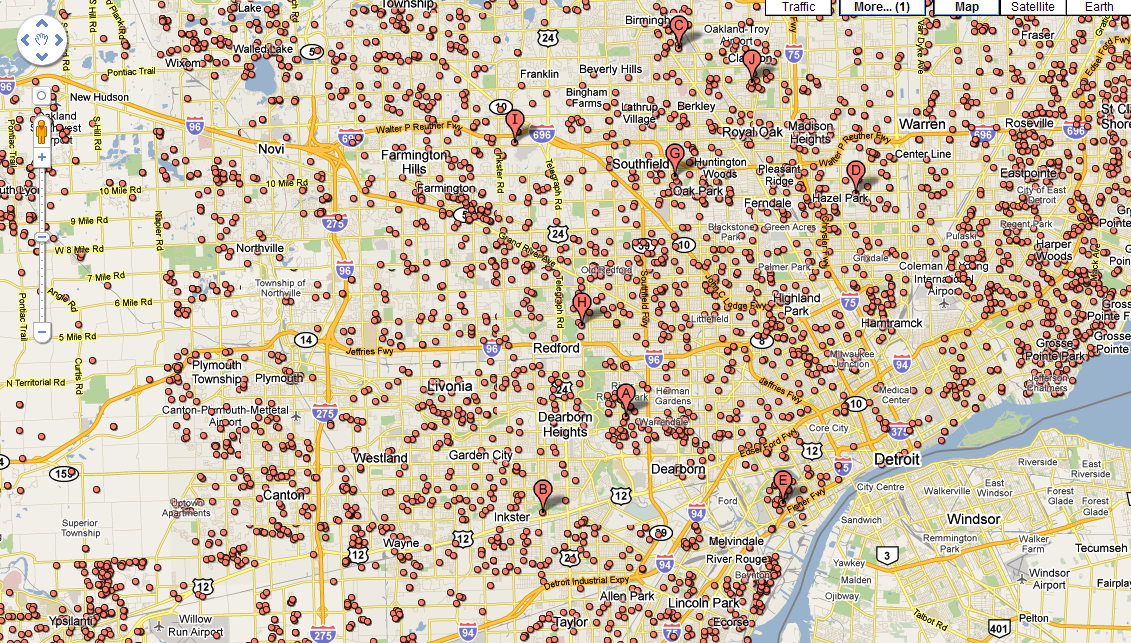
6. Detroit foreclosure map - Ritholz reports the red dots on this Google Map of Detroit are of houses in foreclosure... HT Brian via email.
7. Wave of unrest spreads through China - The WSJ reports a wave of violent unrest has spread across China in the last three weeks.
Remember yesterday's article on the price of pork up 43.5% in the last year?
The North African spring was triggered by the jump in food prices that followed the Fed's QE II. No wonder the Chinese are so keen to slam on the brakes.

A wave of violent unrest in urban areas of China over the past three weeks is testing the Communist Party's efforts to maintain control over an increasingly complex and fractious society, forcing it to repeatedly deploy its massive security forces to contain public anger over economic and political grievances.
The simultaneous challenge to social order in several cities from the industrial north to the export-oriented south represents a new threat for China's leaders in the politically sensitive run-up to a once-a-decade leadership change next year, even though for now the violence doesn't appear to be coordinated.
In the latest disturbance, armed police were struggling to restore order in a manufacturing town in southern China Monday after deploying tear gas and armored vehicles against hundreds of migrant workers who overturned police cars, smashed windows and torched government buildings there the night before.

8. Saudi oil reserves depleted - Reuters reports Goldman Sachs saying Saudi Arabia has little ability in the long term to ramp up oil production.
Saudi Arabia's cushion of spare oil capacity would shrink to almost nothing if the kingdom quickly ramps up to 10 million barrels per day (bpd), Goldman Sachs' global head of commodities research said on Monday.
Last week the kingdom said it would unilaterally produce as much oil as the market needed after the Organization of the Petroleum Exporting Countries failed to reach agreement as a whole on output policy.
9. On review - Zerohedge points out Moody's has put French banks Credit Agricole, BNP and SocGen on review for downgrade because of the Greek debt crisis.
The primary focus of all three reviews will be the banks' credit exposures to Greek government debt and the Greek private sector and the potential for inconsistency between the impact of a possible Greek default or restructuring and current rating levels. The review of SocGen will also assess the likelihood of future government support since our systemic support assumption is currently higher than the average for the French banking system.
Moody's also noted that exposures to Greece are to be included within the ongoing review for possible downgrade of Dexia Group's core operating banks.
10. Totally happy story about a Korean street merchant doing a Susan Boyle on Korea's got talent. This is today's feel good story.
We welcome your comments below. If you are not already registered, please register to comment
Remember we welcome robust, respectful and insightful debate. We don't welcome abusive or defamatory comments and will de-register those repeatedly making such comments. Our current comment policy is here.