

Here's my Top 10 links from around the Internet at 12 midday in association with NZ Mint.
I'll pop the extras into the comment stream. See all previous Top 10s here.
I welcome your additions in the comments below or via email to bernard.hickey@interest.co.nz.
When are we all going to stop extending and pretending?

1. Extending and pretending - USA Today reports the US government is expected to announce two new ways for the unemployed to keep their homes and not make interest payments.
When is all this extending and pretending going to end?
It's just shifting liabilities forward into the never never.
I'm beginning to wonder if it might be better to let the US default and then deal with the consequences.
At some stage there has to be a day of reckoning.
The Federal Housing Administration began offering four months of mortgage relief to unemployed homeowners nearly a decade ago. Banks and mortgage brokers participating in the program must comply with the new standard. The Home Affordable Modification Program has been offering three months of relief to the unemployed since last year. Those who service mortgages under the program are expected to follow its voluntary guidelines.

2. Tougher line - Ruralnews reports ANZ's rural bankers (which includes the old National Bank operations) are getting tougher on rural lending, including changing to valuations on earnings rather than land value.
Fascinating in the light of the capital gains tax and land tax debate.
ANZ Bank, which holds 40% of rural loans, is no longer lending money to farmers on asset valuation but on earning capacity. Some farmers are interpreting its review as shutting the door on the farming sector but the ANZ Group's chief risk officer Richard Wilks says it's open for "the right kind of business".
Loans for dairy conversions have been cut back and all loans are signed off by two bank officials. Speaking at the SIDE 2011 conference at Lincoln last week, Wilks said too many conversion loans "were done on the back of cigarette packets; there were too many cost overruns."
Concerns about ballooning rural debt prompted the bank to review its dairy loan book in 2009. It found 1100 farmers carrying $6 billion debt. The concern was about 100 farmers in "dire circumstances" struggling to service interest bills of 8% at a milk payout of $5.40/kgMS. Another 370 farmers were found in the "high risk category".
Wilks says based on ANZ's market share, its figures translate into 250 farmers in dire situations throughout the industry. Another 1000 are high risk.
"The farmers in trouble made excessive use of leverage and over-reliance on capital gains."
Ruralnews also includes some interesting comments from Bill English to a conference last week.
In his address to SIDE delegates, English expressed worry at the level of farm debt. The extra investment in farming was not producing proportionate output.
"The farming sector is over-capitalised and over-indebted," he told delegates. "The world will not lend us money to grow our debt 4-5 times faster than our economy."

3. 'It's going to take a while' - US Treasury Secretary Tim Geithner explains in this video below that the US recovery is going to take a while...
Some (Zerohedge) have interpreted his comments as admitting Keynesianism has failed.
Visit msnbc.com for breaking news, world news, and news about the economy
4. Italian nerves - Bloomberg reports Italy's market regulator is looking at banning naked short selling of stocks after heavy selling of bank stocks last week.
This is what Australia had to do in the depths of the Lehman crisis. Things are getting mighty nervy in Europe.
5. God help us all - Bloomberg reports Porsche is increasing its production of its Cayenne barges on strong Chinese demand.
Any growth is being funneled to the richest.
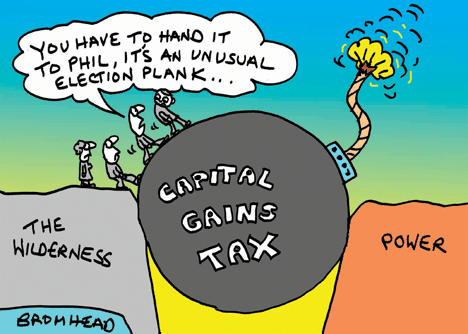
6. Chinese growth slowing - John Key is remarkably confident about unending growth in China keeping our commodity prices up for a decade or two. HT Chris
Yet China's growth is slowing quite quickly, Bloomberg points out.
China’s slowdown was underscored by the weakest import gain since 2009 in June, limiting the chance for the U.S. and Europe to export their way out of their own domestic challenges. A 58 percent jump in bank credit in 2009-2010 and concern that local governments may default on loans leaves Wen with less room to unleash the scale of stimulus that aided the world in 2008.
China’s economy probably grew the least in almost two years last quarter, contributing to a global weakening that Premier Wen Jiabao confronts with more limited scope for policy response than during the 2008 world recession.
“Any significant policy loosening or introduction of another big stimulus right now would run the risk of plunging the Chinese economy into a real hard landing, with inflation running out of control and government debt and bad loans piling up,” said Lu Zhengwei, Shanghai-based chief economist at Industrial Bank Co., who was rated China’s best analyst in 2010 by China Business News newspaper. “Softer growth is more sustainable” and will help contain inflation, he also said.

7. Why do we trust multi-nationals when they do stuff like this? - Bloomberg reports Caterpillar used tax havens in Bermuda and Switzerland to avoid US$2 billion in taxes and then demoted an executive who argued internally that these structures breached US tax law. HT Troy via email.
Peoria-based Caterpillar, which reported year over year earnings growth exceeding 250 percent in each of the last two quarters, is among several U.S. multinationals asking Congress to end U.S. corporate income taxes on profits earned abroad. The company had $3.7 billion of pretax income last year on $42.6 billion in revenue, 68 percent of which came from offshore.
“What we are asking for is a level playing field when we compete with foreign competitors,” said Edward Rapp, the company’s chief financial officer, in testimony to a congressional committee May 12. The company’s shares fell as much as 3.4 percent in New York Stock Exchange trading today.
Caterpillar’s Swiss strategy, as described in depositions and exhibits attached to Schlicksup’s lawsuit, reflects one way U.S. corporations reduce their actual tax rates. Aided by lower taxes overseas, the company had an overall effective tax rate of about 26 percent on about $27 billion of pretax income from 2000 through 2009, based on data compiled by Bloomberg from the company’s disclosures. The top federal corporate income tax rate in the U.S. is 35 percent.

8. 'Doomed without reform' - James K Galbraith writes at Credit Writedowns that the European project is doomed unless it fixes its structural problems.
Well worth a read.
This noble project was built on an end-of-history economics, on frozen-in-time free-market notions and on dogmatic monetarism linked to arbitrary criteria for deficits and public debt.
In the wake of a global financial meltdown, these no longer serve. Unless they are abandoned soon, they will doom Europe as surely as communism doomed the empire of the East.
Europe's structure is also suspended between two stable formations: the federated nation state and the international alliance. This in-between structure is called a confederacy, and it is something that was tried and which failed in North America on two occasions, most recently in 1865.
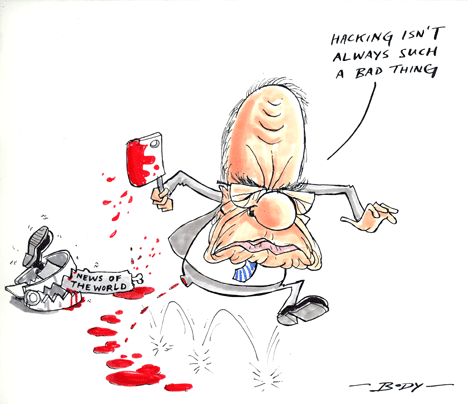
9. Spanish mortgage revolt - AP reports via HuffPo that Spanish mortgage defaulters are being evicted, sparking angry protests from hordes of supporters every time.
Defaulters are a small minority in Spain – nearly 98 percent of mortgage holders are up to date on payments. But their plight is generating a wave of solidarity as unemployment soars to record highs: When an eviction appears imminent, demonstrators often gather by the hundreds outside the property to try to block it.
In the rallies, protesters form a human cushion and physically prevent court clerks and bank officials with a locksmith in tow from ejecting residents. The association behind the demonstrations has succeeded about 50 times since 2009, although ultimately it just delays the inevitable.
Last week, the government passed a decree that seeks to address the plight of evicted debtors. It protects more of their wages from being claimed by banks, and changes the way such people's post-foreclosure debt is calculated, to try to trim it.

10. Totally 'the rent is too damn high party' - Climb aboard the Jimmy McMillan express.
This is a trailer for a movie based on the campaign of the 'The Rent is too damn high' guy. He ran for governor of New York.
57 Comments
Obama wants debt deal within 10 days - http://www.bloomberg.com/news/2011-07-10/obama-says-debt-accord-needed-…
Italy is going septic and it seems some banks are beginning to finally accept that Greece will have to default in some form. Hold on tight.
Here's the Torygraph
Top European Union officials will meet in Brussels on Monday morning to discuss the growing eurozone debt crisis amid fears that Italy could be the next country to be affected. The meeting comes as the Financial Times reported that leaders are prepared to accept that Athens should default on some of its bonds. The newspaper said the move would be part of a new bail-out plan for Greece that would put the country’s overall debt levels on a sustainable footing.Hold on tight. But what exactly does that mean?
I find so many commentators talk about the impending shock/collapse - and that capital markets could freeze up again - but this time worse than the Lehman's crisis... so what does the average household do to prepare?
For example, we're heading overseas for a month shortly - is there the chance that credit card use will be curtailed/disrupted if there is a credit crisis? Will access to funds in banks be frozen as well? Should we carry more cash than planned? Should we stock up on tin cans before we leave in case the shelves are empty on our return? Might we get marooned over there, i.e. will planes stop flying? etc. etc.
It's the practical outcomes of a sudden shock that is missing from all the "hold on tight" commentary. I get the feeling, no one is prepared to stick their neck out on such predictions.
I agree. Most of these types of articles make these statements.
Maybe the writers just don't know what will happen or what the average person should be doing.
I think that all these comments do is create uncertainty and fear in the readers.
Hey Kate
Agree.. Im bored with the constant its all headed for a sticky end.. With the smarts from people here surely we can provide some clever solutions..
Personally Im planting fruit trees and vege gardens and have some chickens.. this is usefull and healthy no matter what happens...
Debt paydown is smart but also counter intuitive to helping the enconomy.. so I dont know about this one..
Who knows on the other hand im not sure if we are just talking ourselves into doom.. America is in a real bad way.. really really bad.. but americans are smart and will not roll over...
Jomosapian you are doing some good things & looking at it all the rightway. I would be cautious about assuming America will bounce back , it is now a Long way from certain. Have a look & read of these guys to understand what is really happening in the states , if you are not already doing so
Bob Chapman www.theinternationalforecaster.com
Max Keiser - economist
MaxKeiser.com
Gerald Celente - trends research
www.trendsresearch.com
Nomi Prinds
www.nomiprinds.com
In the meantime keep an open mind , pragmatic approach , as these skills are always helpfully.
All the best
I don't know about debt paydown - as it seems to have gone largely under the radar - but the US looks to be getting big into debt forgiveness. See;
and
http://www.zerohedge.com/article/banks-commence-wholesale-unsolicited-mortgage-forgiveness
I know it's not conventional thinking but what other way out is there for the world aside from sovereign debt forgiveness - and following on from that bailing out the bubble homeowners?
And as for gold - well, the question is... in a cash/credit strapped world, how do you turn it into something you can buy bread with?
If people cannot get hold of cash or if cash eventually becomes worthless, people will have to barter with each other for food and services.
Gold used to be used as a means of exchange so I suppose in the event of a total breakdown it could be used again.
I have read blogs where people say you couldn't buy bread or something else small with a sovereign but why not? If things come to that I suppose you would get some silver and extra goods as change or even go into credit with the baker.
Nobody discussing how we can avoid a return to batering before we are faced with the possibility of it. How about using our sovereign currency & reserve bank to build factories for core requirements or ensure that in a global collapse we have a country continuity plan. Countries who produce most of their core needs such as south africa will be best placed.
It was reported a week or two ago that new bank notes were planned.
Now once you are tooled up to print, no problem at all to print a little more......might not be much of an adjustment to make a complete new currency.
But otherwise you have to be kidding about being prepared right? Who the hell would do something like that?
Quite, because as usual we are busy discussing the side shows of CGT etc which of course we are getting tax raises on various sorts regardless.
Listening to people discuss trivial topics is frustrating.
Good questions Kate. For what it's worth, I always try to think in terms of what would happen to a person or business if they were in as much debt as the USA and the world in general.
If a person or business doesn't declare bankruptcy when they should and they keep refinancing or 'stealing/counterfeiting' money what happens to them? They run for public office right?
Jokes aside, I think the big "ahh that's what we were all so worried about" moment will be a painful rise in interest rates to levels that will freak us all out and make us think "how did that happen", "we didn't see that coming"...but of course, we should have seen it coming and we all can but don't want to admit it.
Fair enough.
I would not make any major financial committments in the next three to four weeks until the European debt crisis has settled and America has lifted its debt ceiling.
By committments I mean large loans or investment decisions.
Traveling would be fine I'm sure. I'm sure credit cards will keep working.
If there is a crisis you'd expect the NZ to fall.
cheers
Bernard
Hi Kate
I've pondered that question myself. You really need an answer somewhere between "stockpile food and ammo" and "it's all contained". Here's what I'm doing, and you are free to think I'm a tinfoil hatter if you like:
1. Mostly nothing more than all NZers should do in case of an earthquake. A banking crisis could shut down payment systems and the government might have to nationalise them in a hurry. So I think it's a good idea to have some emergency supplies, and maybe enough cash for a week or two. This is stuff you should have anyway, for earthquakes, rather than financial crises, so should be easy.
2. I generally travel with more than one credit card from separate banks, and travellers cheques as a further backup. I think it's at least possible that some credit cards/bank cards might not be accepted, having more than one option reduces your risk considerably. If you are a very casual traveller, and don't always have a return or onward ticket, then you might want to make sure you do have one this time.
3. If possible get out of debt, especially floating rate debt. There is a risk that there will be a significant rise in interest rates if markets turn rational at some point, and start to price in the amount of debt out there, and the risk.
4. It's a good idea to have enough savings to tide you over for a few months. If a severe recession looks imminent, some employers may ditch staff quickly. If you have a safety cushion it'll help. Most of my savings are in Kiwibonds, which are government guaranteed (the banks aren't, and I don't want to rely on a government bailout).
From what I can see no credit or eftpos....no banking system at all.....and with just in time and no eftpos how do you eat?
Civil dis-order?
rioting?
fun eh?
Not sure NZ will be as bad as many places....I dont think we have had the pressure cooker effect for the last three years that some places have had.....like 30% youth unemployment.....prospects? zero....
This has been "foretold" for 2 years or more, are you really going to be that unlucky that it happens when you are away for a month?
regards
"put the country's overall debt levels on a sustainable footing". Sounds all fluffy & almost like a good thing right.
Buckle up it's accelerating fast now. Watch the war machine crank up further as the nations fall. Oh what a world !
It's time Caterpillar were making tracks
Gees PDK its only Monday.
Looking forward to seeing you let loose on Friday. I tried a ban the Bernard vote this past Friday, but it went over everybodies heads.
Aim lower - you're more likely to hit something.
Important.
#3
Can't be bothered watching boring old Timmy but two things I am reasonably sure of:
1. No part of US fiscal policy since 2000 has conformed with Keynesian prescriptions so I guess you would have to say that Keynsianism can't have failed if it hasn't been tried;
2. You can guarantee that 99.99% of those who rail against Keynes have never read Keynes' actual words.
Correct, Paul Krugman has said for 3 years that the "stimulus" such as it was was half the size it needed to be and even the amount they did use was neutered in things that had fractional multipliers....so it was setup to fail....and Timmy d*ckbrain is responsible, why the hell doesnt he have a noose around his neck?
regards
http://www.rawstory.com/rs/2011/07/10/new-imf-chief-lagarde-issues-dire…
New IMF chief Christine Lagarde warned on Sunday that a US debt default would jeopardize global economic stability and urged warring American politicians to forge a compromise budget deal.
A default "would certainly jeopardize the stability, but not just the stability of the US economy, it would jeopardize the stability at large," the first woman to head the International Monetary Fund told ABC News.
"And that's clearly against the purpose and the mission of the International Monetary Fund. So we are -- we are concerned."
Without an agreement, she said she could see "interest hikes, stock markets taking a huge hit and real nasty consequences, not just for the United States, but for the entire global economy, because the US is such a big player and matters so much for other countries."
What a joke , do people see through the charade yet. Always the same line , keep adding more debt or the world will blow up. All the while giving handouts to banks via the crooked Central Banks &IMF. It's going to blow up eventually & the more debt in the system the worse it gets no. Unless the real elite know something the rest of us plebs don't, because it's making no sense from any logical angle.
Crooked Central banks and IMF? no I dont agree, crooked pollies, yes.
Blow up, yes.....and its looking close.
There are no real elite in terms of organisation etc....its just ppl acting greedily not caring what they damage as its not their "concern". I recall a french bimbo had the same attitude until a sharp blade seperated her at the neck.
regards
#2 my farming friends have been told to keep away from the O/D limit, or they get to learn that O/D doesn't stand for overdraft but 'On demand' They are all very focused on keeping down costs and our rural town knows all about it.
Yes, I'm guessing that one of the first things that will happen in the event of another Lehman-like crisis - is that O/D limits will be lowered/withdrawn. This happened to alot of homeonwers in the US who were using preapproved O/Ds (I think they call them "options" or some other such name) secured on the value of their houses - which were suddenly closed/pulled when the RE crash happened.
One of the first things will be the banking system will freeze up....no inter-bank transfers.....also credit cards....sudden demands for repayments...? I assume they can and even foreclose on you for a few $K....it will be about recovery of capital....fast.
regards
FYI from Obama. He needs a debt deal within the next 10 days. I'd be wary about making a major committment before this is all sorted.
thanks for the tip BH - I won't propose to her just yet.
PDK, I think Bernard is just advising you to check her assets, twice for good luck.
Asset-grabbing might get you into trouble, Aj.
It's all this PC nonsense.....
"a major committment before this is all sorted."
Gees Bernard....you are getting so excited you spelt comittment wrong.
You should be more specific.
Maybe it would be better to tell people not to take on any debt until this is out of they way.
or to draw some cash out of the bank, fill the car, hall cupboards and pantry, pay all the short term accounts etc...
Or wait till I list some sovereigns on Trademe and tell everyone to buy gold.
This is a circus ,my guess is if they don't reach consensus of some sort, Barry will use his power to bypass congress , just like he did to declare war, woops i mean peace in Libya , and sort the issue unilaterally. Perhaps he may use reconstruction clauses in the constitution to bypass congress. Regardless the USA do not owe 14tn , they have hundreds of trillion of fraudulent derivatives liability they are being frigged over with, but let's focus on more sideshows.
"Hold on tight. But what exactly does that mean?"
Im with Kate on this this ! What should we be doing???
Split your savings betwen 3 banks, diversify, buy some Gold, buy hard assests?
Pay down debt?
Pureant - his posts are long by current attention-span standards, but might give you some ideas:
Hold on tight to what Bernard?
What about some nice land- I here thats in short supply in Auckland.
We are such a regulated society, Pureant, that if Bernard or anyone here, most probably, were to answer that then they'd probably earn themselves a sinister call from the FMA.
Fair point tribeless.
But here's what I'm doing personally. This is financial advice to myself if you like.
I've been trying wherever I can to repay debt. I've invested in this business directly and indirectly.
I have avoided unnecessary spending wherever I can. We haven't replaced our car for a decade.
Any foreign spending we do we try to pay for with foreign income. So far successfully.
cheers
Bernard
BH- I know what you mean - income's foreign to me too
Thanks Tribeless BH PDK et al for candid reply. So I think the bottom line is a steady hand on the helm, reef the sails keep an eye on the weather forecast. I,m always looking for a cosy nook to anchor in when I sail, specially if the weather looks dodgy.
All good common sense stuff really, no way of avoiding the weather!
Pureant -
http://www.poetryfoundation.org/poem/176150 You're actually safer with a bit of offing :)What are the solutions to this problem?
Kiwi software skills 'shallow'
http://www.stuff.co.nz/the-press/business/5264129/Kiwi-software-skills-shallow
"The raw talent is here. New Zealand produces software engineering graduates in numbers that are probably adequate to get started. They are just working on the wrong stuff or, even worse, leaving New Zealand."
Flying in more "experts" or establishing beachheads overseas was not the answer, he said. "Visits from US venture capitalists and angels are helpful in gaining perspective, but don't put action at the root of the problem."
They also tended to blow a lot of smoke, he said. "US investors will always say they see potential. They never say your idea is stupid or your team is weak. I suspect Kiwi entrepreneurs are naive in interpreting what they hear."
Dr McKendry advocated establishing New Zealand as a "virtual suburb" of Silicon Valley.
He said an entity should be set up to provide locally-based engineers to US startups, but it was possible there was no opportunity and New Zealand was in a "declining spiral that cannot be broken".
Price of gold has gone down so far today.
No one else is holding on tight.
You know I bet those americans have finally figured out how to spin gold from straw (or some other element) and are going to drip feed it onto the market to solve their debt problems. Scientists are smashing atoms and building cells from scratch so what happens when they figure out how to make a gold atom?
Hmmmm seems the paucity of solid what to do when the the **it hits, advice is an oxymoron.
If the FMA & the likes were to give good timely advice, then that would destablise the banking system, which would then become bad advice. So the best we can expect are vague allusions
to an implending problem, and hope we "get it", and take ...um ...well some sort of action.
The debt ceiling is a self imposed, arbitrary limit, and there is a school of thought that Obama doesn't even need Congressional approval to go over it....
http://www.slate.com/id/2298671/
In any case, US debt is still in high demand, with 10 year Govt bonds yielding < 3% as of right now.
Brad deLong thinks it's a liquidity trap...
Jellyfish shut down nuclear power plants;
http://www.stuff.co.nz/world/5268508/Climate-change-blamed-for-jellyfish-explosion
Oh the irony!
Where does the money come from to pay ?
Today - unusual downpours with flooding in Switzerland my birth- country, worldwide natural disasters – China, Peru, USA, Australia, Japan, etc. Severe damage on infrastructures, businesses. Costs in the trillions for the clean up.
It was predicted
http://jrscience.wcp.muohio.edu/fieldcourses08/PapersMarineEcologyArtic…
No shell, no calcium carbonate needed - they've got it all over shellfish in an acidic ocean...
Philosophers should govern the world not politicians or worse money and greed.
As I wrote many times, authorities, economists aren’t aware or/ and underestimate the massive challenge and costs the consequences of climate change is causing for societies. In correlation to currently financial, economic, political and environmental problems a new, almost insoluble event for civilisation.
Only revolutionary solutions based on ethic and sustainable principles can succeed and improve the situation. Philosophers should govern the world not politicians or worse money and greed. I doubt – it is ever happening. I think we ran out of time.
People of Aotearoa don't talk about our politicians - time to sack them.
"China numbers , if true, indicate a sold and robust economy with debt/gdp ratio at 50% and a demographic to die for. This country is going to take over the world in the next 10 years"
http://www.marketoracle.co.uk/Article29172.html
"if true"...harrrrrrrrrrhahahahahaaaa....I can picture those two old farts laughing their heads off in the Muppets on that statement.
The piigs are falling apart...... http://www.telegraph.co.uk/finance/financialcrisis/8629228/Italy-debt-contagion-fears-hit-markets-as-top-EU-officials-meet.html
and the usa is waking up to being beyond salvation.
Meanwhile across the ditch...Jewleeya is a gonna!
" insurers had made it clear there was no future for old buildings."
The next full moon is on or near the 15th...Friday !!
The filth that needs to be removed from NZ.
"Police said the men were all Maori and aged in their late teens or early 20s."
http://www.nzherald.co.nz/nz/news/article.cfm?c_id=1&objectid=10737895
Well would you believe that...Gummy Bears are coated with Beeswax to make they shine...I wonder if Gummy Bear Hero gets a beeswax once a week!
We welcome your comments below. If you are not already registered, please register to comment
Remember we welcome robust, respectful and insightful debate. We don't welcome abusive or defamatory comments and will de-register those repeatedly making such comments. Our current comment policy is here.