
By Alex Tarrant
Here's my blogroll for the week.
Have a good weekend everyone, and go the ABs etc, etc.
1. What power would the government have over the partially privatised energy companies if it wished to make changes like asset swaps? Not as much, one would imagine, as it would also have to act in the interests of its other shareholders. Eddie at The Standard picks up on Labour's David Parker asking this to Acting Energy Minister Hekia Parata in Parliament on Tuesday.
Hon David Parker: Could steps like the requirement to sell those assets from Meridian Energy to Genesis Energy have been taken if Meridian Energy and Genesis Energy had been in partial private ownership; if so, how would the Government have achieved that?
Hon HEKIA PARATA: That is not the situation we have, and speculating on what might happen under what is proposed does not seem to me to be a reasonable question.
Hon David Parker: Is the Minister then now giving notice to anyone considering buying shares in these companies if they are sold that National might, for market reasons, intervene, with repercussions on the value of shares?
Hon HEKIA PARATA: No.
Hon David Parker: Is the Minister then now admitting that following the privatisation of shares in Meridian Energy and Genesis Energy, the Government’s ability to intervene in the market in order to get better prices is to be constrained?
Hon HEKIA PARATA: No. [Laughter]
National can’t have it both ways. Either potential investors in electricity companies have to know that purchasing shares in these companies comes with the risk that the government will, as it frequently does, use its legislative ability to drastically reform the industry and stuff their share price; or future governments wouldn’t be able to intervene, as National has, in the interests of the public because they would have to consider the rights of private investors and we really will not own our future.
A friend of Lambcut's was in the National Bank branch that is nearest the Parliament end of Lambton Quay, today.
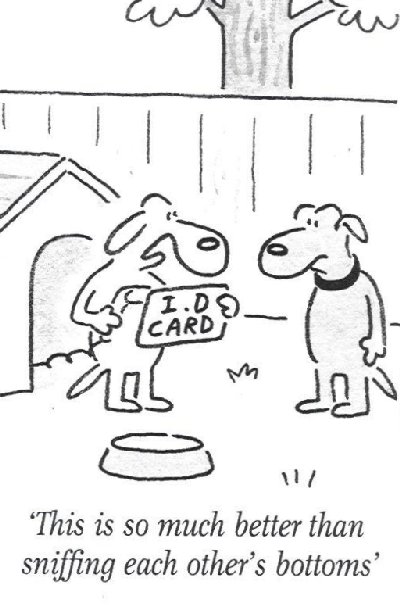
Bill English happened to be there too. Apparently, our Deputy Prime Minister fronted up to the teller, as one does, regarding whatever transaction he had in mind. The teller asked him for ID.
I love New Zealand.
A CCT seems likely to have some quite insidious properties. The proposal calls for the CCT to be applied to all non-financial assets including the family home. They don’t specify in the article how the capital value of the asset is to be determined. Is it the purchase price or the current market value? If it is the purchase price, then the tax would create the same sort of distortion as a capital gains tax applying only to realised gains—an incentive to hold on to appreciated assets in order to avoid the tax rather than choosing a portfolio because of their underlying value.
If it is on the market value, then homeowners would be subject to large fluctuations in their tax liabilities from year to year independent of their income streams, at the whim of property valuers. This, of course, is already an issue with local-body rates, but the amount levied in rates each year is trivial compared to a 30% tax on 6% of the valuation of a house.

4. Here's what I would do. Economist Matt Nolan blogs on what his election policies would be if he were to contest the general election. Go for it buddy. Here's his tax and Reserve Bank policies.
Tax policy
Complete removal of current tax system – except externality taxes
A flat rate of GST, with the rate determined by an independent body subject to the constraint that “the books must be balanced over a 10 year period”.
Direct transfers to help compensate losers from the change in the tax system (GST will transfer from current savers to borrowers – a one off tax on the debt stock which is then given to savers will help compensate for this)
A land tax, set at a rate that will provide for essential infrastructure that is made by government on public good grounds (or a similar argument).
Public research into the appropriate level of externality taxes, so they can be set at their “right” level.
Reserve Bank Act
Change the target of “1-3% over the medium term” to “2% over the medium term”.
Define medium term as 5 years – have the Bank openly state why they have deviated from target when they have (will always be due to a price level shift, which they need to look through – think the open discussion of it would help transparency and communication with the public)
Look into operational separation between monetary policy and financial stability goals of bank – along with a separate contract for any specifed financial stability aim.
Increase co-ordination in forecasting and openess regarding policy debate in private: Treasury, independent tax body, and the RBNZ (in both its financial stability and monetary policy roles).

5. Why the mixed ownership model doesn't work - government stake will still politicise the firm. Economist Paul Walker at Anti Dismal has a go at David Farrar's Herald on-line column which defends National's asset sales policy. Paul concludes that if the government really wants to improve the performance of these companies, then full privatisation is the way to go. This week's must read.
As to the point that buyers of assets in the past have been foreign, this is not an argument against asset sales, xenophobia is not any kind of economic argument at all, for anything. Also having foreign bidders just means that the price the government gets for its assets is higher than it otherwise would be. A higher price is also paid for a controlling share in a firm, selling a partial share in a firm will lower the price paid. 51% is worth a lot more than 49%!
Also having "Mum and Dad" investors - and a New Zealand investor bias - is not necessarily a good thing, this will also lower the price received, as will use of a stock market float. All the evidence on privatisations via a float on the share market shows a large amount of under pricing. Also these studies show that "Mums and Dads" sell out to other larger buyers very quickly. Having "Mum and Dad" investors could also affect the efficiency gains that having private owners can bring about. A single large, albeit partial, owner is more likely to be able to force efficiently enhancing changes on the firm.
In more general terms we already have insight on how partial private ownership is likely to turn out; not well. The SOE Act states that SOEs, basically, have to be run like normal non-government owned firms. In effect this requirement is the same as you could get if private owners have a stake in a firm. The private owners would, we assume, wish to maximise profits, but the government may not. And you see this with SOEs. The government often wishes to intervene in the running of SOEs to get them to carry out not profit maximising activities, just as it would if it had a partial stake in a mixed ownership firm.
This problem of having SOEs (or mixed ownership firms) trying to serve two masters was noted more than 10 years ago by Spicer, Emanuel and Powell in their book "Transforming Government Enterprises: Managing Radical Organisational Change in Deregulated Environments" (The Centre for Independent Studies, 1996). They warned that there are two pressures on SOE's: the first being towards privatisation since the productivity and efficiency gains achieved by SOE are in danger of being eroded over time. Privatisation is a way of both cementing in the commercial orientation of enterprises and wringing out further gains resulting from the high powered incentive and control mechanisms which can be bought to bear in privately owned and publicly traded companies.
The second pressure on SOEs is towards being pulled back into the public sector where social and political objectives can be more readily be meet. What we saw under the Clark government was the second of these pressures being very strong. But not for socially useful reasons. Most interventions seem to be more politically motivated.
These pressures would also be there for a mixed ownership firms and help explain why they don't do as well as fully privately owned firms. For example, Aidan Vinning and Anthony Boardman in "Ownership and Performance in Competitive Environments: A Comparison of the Performance of Private, Mixed, and State-Owned Enterprises", Journal of Law and Economics vol. XXXII (April 1989) conclude 'The results provide evidence that after controlling for a wide variety of factors, large industrial MEs [mixed enterprises] and SOEs perform substantially worse than similar PCs [private corporations].' The basic problem is that full or partial government ownership politicises the firm.
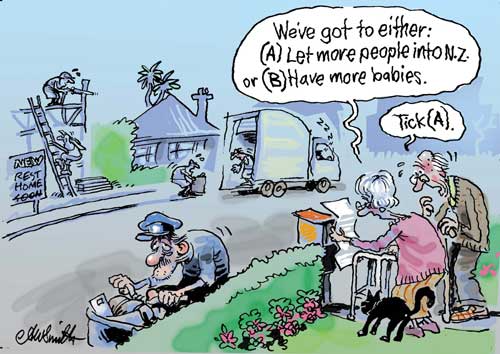
6. Our demographic problems aren't future ones - they're here now. NZIER economist Bill Kaye-Blake blogs on the NZ Association of Economists blog that the future is already here, but no one is pushing the panic button. He first points to research done by US blogger Brad DeLong.
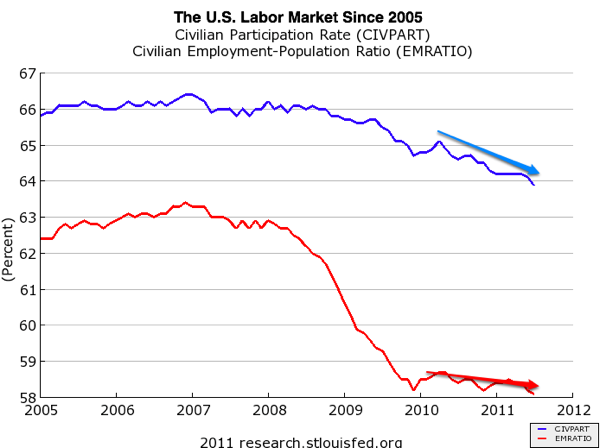
The employment-to-population ratio has fallen in the US. Therefore, the number of people being supported by each employed person has increased. While this is not an increase in the dependency ratio (which is defined by age cohorts), it has the same effect: fewer workers supporting more people. And yet, I’m not hearing the same urgency, the same concern to move heaven and earth to solve the actually existing problem.
Then he did the same for New Zealand.
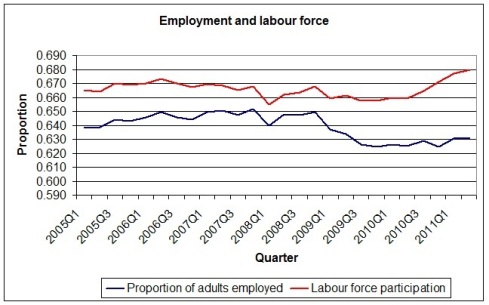
I calculated the proportion of adults employed as (all employed, seasonally adjusted) divided by (people aged 15+), and labour force participation as (all employed + registered job seekers) divided by (people aged 15+). The proportion of adults employed has, indeed fallen by 2 percentage points since 2008. Meanwhile, labour force participation has actually increased. That is, we have people ready and willing to go to work, but we aren’t using them.
Having fewer people employed to support our population is a concern for the future. However, it is also a problem now.
7. Why the government is merging departments. Roger Kerr picks up on a chart from Treasury Deputy CEO Andrew Kibblewhite, which shows (in Kibblewhite's words) "just how comprehensively our small country has divvied up our state sector into a clutter of agencies".
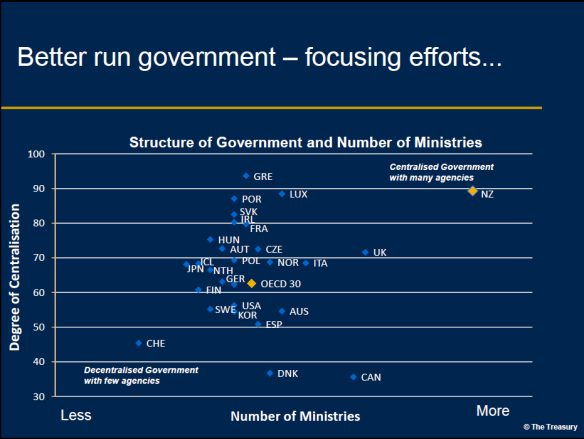
Two things in my view are much more important than rearranging the bureaucratic furniture.
The first question that should be asked is whether we need parts of the furniture at all. On coming to office John Key as minister of tourism abolished the Ministry of Tourism. Has anybody noticed or cared?
Second, instead of focusing on restructuring the bureaucracy (often by establishing advisory groups of bureaucrats), the government would do better to focus on leadership by top quality CEOs. Numerous appointments in recent years have been unimpressive, and there has been little sign of the State Services Commission moving poor performers on. The government would find that top CEOs would solve many of the problems of bureaucratic sprawl and inflated headcounts by themselves.
8. Bored for the next six weeks. I think DimPost sums it up quite nicely. (....but go the ABs)
We’ve all had the experience of being trapped with a bore – sitting next to one on a plane, or at a wedding or in their taxi, or wherever. And they browbeat you about some subject they’re obsessed with but you have no interest in. Cars. Conspiracy theories. Apple products. The politics at their office. And you just want to read your book, or go to sleep or talk to someone else – but they won’t shut up! You can’t get away from it!
That’s what the Rugby World Cup is like for those of us who don’t care about rugby. For the next six weeks. Spare some sympathy for us.
9. Labour coup during the World Cup. Homepaddock picks up on a Trans-Tasman comment that says one cannot rule out a "sudden, panicky, caucus mudslide which sweeps Goff aside before the election campaign starts properly". This could come around the time of a quarter or semi-final, where not many people would notice, it says in TT. There are a few young gun labour caucus members on the list for whom it's looking touch and go for the election (See more from John Armstrong here).
Homepaddock opines:
Panic isn’t one of the better reasons for a leadership change.
But if the polls continue what appears to be an inexorable slide towards a worse result than 2008, panic could combine with self-interest and prompt at least one of the four would-be leaders to chance their hand.
The danger is that if one gives it a go at least one of the others will want to be in contention too. Instead of a quick, clean coup they’ll get a prolonged and messy contest which will provide yet another reason to panic.
10. Get away with it? Of course I will, have you ever seen an Australian newspaper? Clarke and Dawe on rumours Shane Warne proposed to Liz Hurley. I don't think they're fans of tabloid reporting.
We welcome your comments below. If you are not already registered, please register to comment
Remember we welcome robust, respectful and insightful debate. We don't welcome abusive or defamatory comments and will de-register those repeatedly making such comments. Our current comment policy is here.