

Here's my Top 10 links from around the Internet at 10.30 am in association with NZ Mint.
I welcome your additions in the comments below or via email to bernard.hickey@interest.co.nz.
I'll pop the extras into the comment stream.See all previous Top 10s here.
I'm loving the poster of Animal from the Muppets at number 8 and the Niall Ferguson video at Number 10.

1. Way too innovative - William Mace at Stuff reports on how KPMG's Strategic Financial Solutions group designed the 'Optional Convertible Notes' that it called 'Hybrid Into New Zealand' (HINZ) and that are now subject of IRD allegations of tax avoidance in a High Court case.
It seems its benefit was based on the tax deductions on interest-free loans from New Zealand companies...
Sigh...
What is it with financial innovations that reduce tax bills?
Why can't our innovators actually design new products and services that create value for customers and shareholders and the greater human race rather than just shuffle money from one group (often the rest of society) to a smaller group (in this case foreign shareholders)?
Here's what the court heard and it's not pretty:
The IRD argued there was no economic cost to the New Zealand subsidiary in making the loan to its Australian parent, and the claim should be seen as tax avoidance.
Dr Moorad Choudhry, head of business treasury at Royal Bank of Scotland's global banking and markets division and IRD's first expert witness, told the court the "option" part of the note was valueless.
Choudhry said that several types of OCN were common on world financial markets, but likened Alesco's particular brand of OCN to the instruments that caused sub-prime mortgage defaults in the United States because they had no market.

2. 'Don't hold your breath' - The BBC reports even the World Bank's President Robert Zoellick is reluctant to bet on the Chinese rescuing everyone with a 'bag of gold'
In an interview with the BBC, Mr Zoellick said the idea anyone will come along with a "bag of gold" is fanciful.
"I have been cautioning people not to look for the panacea," he said. "A co-operative international response to Europe's crisis is useful and it helps that the International Monetary Fund and World Bank can draw on capital from cash-rich countries.
"But the idea that you are going to have the Chinese come with a bag of gold and bail everybody out of this problem, I wouldn't hold my breath," Mr Zoellick said.

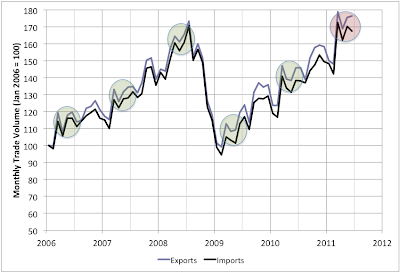
3. Is Global Trade about to fall? - This chart courtesy of Early Warning certainly suggests it is
4. Brace, brace, brace - Bloomberg reports Germany is bracing for a bunch of bad bank bailouts if the Greek, Italian and Portugese situations go nuclear, or at least feral.
Germany’s bad banks, backed by the state to prevent the collapse of Hypo Real Estate Holding AG and WestLB AG during the credit crisis, would be the hardest hit in the event of a Greek default, leaving taxpayers to shoulder the bill a second time.
Hypo’s FMS Wertmanagement, with 8.76 billion euros ($12 billion) in Greek sovereign investments and loans, and WestLB’s Erste Abwicklungsanstalt, with 1.21 billion euros, bear more than half of German banks’ Greek debt, according to data compiled from company reports and statements.

5. Kick Greece out to avoid Depression - Dr Doom Nouriel Roubini reckons in this Reuters Op-Ed that Greece needs to leave the euro and adopt the Drachma as part of a broad collection of interventions to save the world from another Great Depression.
He's not kidding. His piece is a nice (if discomforting even for me) summary:
The risks ahead are not just of a mild double-dip recession, but of a severe contraction that could turn into Great Depression II, especially if the eurozone crisis becomes disorderly and leads to a global financial meltdown. Wrong-headed policies during the first Great Depression led to trade and currency wars, disorderly debt defaults, deflation, rising income and wealth inequality, poverty, desperation, and social and political instability that eventually led to the rise of authoritarian regimes and World War II.
The best way to avoid the risk of repeating such a sequence is bold and aggressive global policy action now.

6. What is wrong with the world? - A former hedge fund manager and professional footballer in New York has opened a Doggie Day Spa called Spot to cater to the doggie lifestyles of the rich and famous (and time poor).
It costs US$600 a month to have your dog there...
This is trickle down economics at work.
The details are here courtesy of BusinessInsider:
Already the place is attracting celebrities: Spot has catered to the pooches of Mariah Carey, Glenn Close, James Gandolfini, Gerard Butler, Will Arnett and Amy Poehler, Kristin Chenoweth, Donna Karan, Howard Stern and Beth Ostrosky, Kelly Ripa and Mark Consuelos, Bernadette Peters, Lorne Michaels, and former New York Giants players Jim Finn and Todd Pollack.
There's a pool and an outdoor dog park with special turf that is good for the dogs' joints, and an antibacterial mesh lining to prevent diseases from spreading.
If your schedule doesn't permit dropping your dog off at Spot, don't worry: a van will pick and drop off your pooch. Grooming services are also available.

7. Why won't the Americans riot - I've often wondered this. The BBC looks at the prospects after New York Mayor Michael Bloomberg warned of such riots if jobs couldn't be found for America's young.
Here's the BBC with a useful backgrounder:
In interviews with the BBC, analysts, writers and historians feared the US was ripe for some sort of social upheaval, but said a lack of social organisation and a sense of despair had prevented social movements from coalescing.
Peter Dreier, professor of politics and director of the urban and environmental policy programme at Occidental College in Los Angeles, said Americans do not have the "psychology of rioting", and said Americans who bear the brunt of the economic downturn are "demoralised" and discouraged from taking collective action.
"People are angry, and right now they're taking their anger out on themselves - the quiet riots of suicide and depression," he said.
"It took about three years into the Depression before people overcame this sense of blaming themselves about their plight, before they got angry at the banks and the business community and local mayors, before they externalised their anger and made it a political issue rather than a personal one."

9. Why is Italy such a problem - Ed Harrison at Credit Writedowns points out that Italy owes German banks 116 billion euros...
Handelsblatt figures show that there are only four countries where German banks have greater commitments:France (€145.6 billion), Spain (125.2 billion), Luxembourg (120.9 billion), and the Netherlands (117.7 billion). By comparison, German banks only have loans and credit of about €17 billion to Greece.
Die Welt, another German newspaper, reported yesterday that Italy has become the main concern for the euro zone as its debt sells off. Contagion has clearly reached the core. The ECB suggests doubling the EFSF and IMF facilities to deal with this. However, I should add that Felix Zulauf warned in May in Handelsblatt that he had turned bearish and expected Italy to be the next crisis country in euro land. He also mentioned a slow motion run on Italian bank deposits as a worrying sign. Ed Hugh also wrote a good piece on Italy’s problems last week.
10. Totally a Niall Ferguson TEDtalk about the 6 killer apps of prosperity. It's brilliant because it has a chart going back to 1500. He sees a redivergence where the east and south catch up with the west.
Over the past few centuries, Western cultures have been very good at creating general prosperity for themselves. Historian Niall Ferguson asks: Why the West, and less so the rest? He suggests half a dozen big ideas from Western culture — call them the 6 killer apps — that promote wealth, stability and innovation. And in this new century, he says, these apps are all shareable.
(Updated with correct day of the week .... HT Chris_J)
We welcome your comments below. If you are not already registered, please register to comment
Remember we welcome robust, respectful and insightful debate. We don't welcome abusive or defamatory comments and will de-register those repeatedly making such comments. Our current comment policy is here.