

Here's my Top 10 links from around the Internet at 1 pm in association with NZ Mint.
I welcome your additions in the comments below or via email to bernard.hickey@interest.co.nz.
I'll pop the extras into the comment stream.See all previous Top 10s here.
There is absolutely no mention of Dan Carter's groin in the links below.

1. Buckle up - Britain's Sunday Times reports Belgium is on the brink of nationalising its largest bank Dexia, which has assets worth 180% of Belgium's entire GDP, Zerohedge points out.
How does that work?
How can a bank possibly have almost twice as many assets than the GDP of its country?
It turned out to be pretty easy in a single currency zone with obscene levels of leverage.
No wonder the Europeans want to impose a Tobin Tax to chase them all away.
I'm sympathetic. What good do these highly leveraged investment banking, wholesale trading banks actually do?

2. Global credit crunch imminent - The Telegraph's banking correspondent Harry Wilson reports the global financial system is on the edge of a new credit crunch as the cost of insuring the bonds of banks across the world hits new highs. He mentions Australia.
The final quote is a tad concerning.
Credit default swaps on lenders as far afield as China and Australia, countries that until recently seemed immune to the chaos, have doubled in the last two months to levels not seen since the financial crisis.
In Europe, French and Belgian government officials are due to meet on Monday to discuss the crisis enveloping Dexia as speculation mounts about a possible break-up of the Franco-Belgian lender.
"The money ran out in June and what you are seeing now is the beginning of a new credit crunch, except this time it will be truly global, not Western," said one senior London-based credit analyst.

3. 'We won, you lost, and it's not fair' - Warren Buffett's idea of taxing the rich more has set off a real debate in America.
Here's his latest comment, which makes some excellent points about 'class warfare' and how the rich won the war. The tone of the questions in the video below is interesting to show how the debate has formed. HT Greg Sargent at WaPo.
QUESTIONER: Are you happy seeing your suggestion, this new Buffett Rule, becoming more of a basis of a political battle that really has turned into class warfare?
BUFFETT: Actually, there’s been class warfare going on for the last 20 years, and my class has won. We’re the ones that have gotten our tax rates reduced dramatically. If you look at the 400 highest taxpayers in the United States in 1992, the first year for figures, they averaged about $40 million of [income] per person. In the most recent year, they were $227 million per person — five for one. During that period, their taxes went down from 29 percent to 21 percent of income. So, if there’s class warfare, the rich class has won.
4. Why #occupywallst is getting a run on - The local media have finally woken up to the #OccupyWallSt sit down protests in New York that seem to be spreading.
Here's Epicurean Dealmaker, an investment banking blogger with his cultured take on it, and a picture below from a protester answering the question: So what do you want then?
As long as we can believe that we have a chance, too—that luck has a chance to find us and reward our own faith and effort—Americans will pull contentedly at the grindstone while simultaneously ooh-ing and ah-ing over the social and financial success of our betters. But central to this implicit social contract is the idea of fairness: that the deck is not stacked against the little guy, and that he or she has just as much chance of becoming the next Warren Buffett, or Lloyd Blankfein, or Barack Obama as the next guy. It is not a belief in fairness of outcome, but rather one of fairness of opportunity. There is nothing that raises the cultural hackles of most Americans more than learning that the game is rigged, and that the guys at the top are gaming the system in their own favor.
Now, cynics (and Europeans) might laugh at such naïvete. Of course, they say, the game is rigged; of course the guys at the top skim more than their share of the cream and leave the dregs for the hoi polloi. What's new about that? But Americans understand that too, at least instinctually. That's why we have such a long history of suspicion and hostility against Big Business, and Big Government, and Big Anything. That's why, among other things, the Tea Party movement has gained such broad-based traction in this country: it is the natural outpouring of frustration and suspicion grounded in the most basic American myths and beliefs about ourselves. We may acknowledge that is the way the human cookie crumbles in any society with unequal distribution of wealth and privilege, but we do not accept it, at a very fundamental level, as the way things should be.That is one big reason why the ongoing scandals rocking the financial sector are creating such outrage and upset among the American polity. Citizens are discovering that a very large percentage of people whom they used to admire and envy for mouth-watering financial success earned a large portion of that success by cheating, by gaming the system, and by rigging the rules in their favor. What seems to outrage many Americans even more is that these very financiers do not seem to recognize that they have violated the implicit social norms almost everybody else seems to accept. They hide behind a defense of arrogance, superciliousness, and moral obliviousness which makes most Americans' teeth grind in frustration.
This is a dangerous situation for the plutocracy. For, when you get right down to it, most Americans are not really interested in supporting a system that is designed to preserve the wealth and privileges of those who have already made it to the top. Instead, they want one that will give as many people as possible a reasonably fair shot at reaching the top themselves. That is a distinction which seems to elude many of the wealthy and powerful. They misperceive the struggle as one of capitalism versus socialism, when what it really is is a struggle for the heart and soul of capitalism in this country. On one side is a new aristocracy of money, entrenched interests, and cronyism, and on the other is an ethos of equal opportunity for all.

5. Targeting the Fed - Washington's Blog points out the protesters in New York and Boston are also targeting the US Federal Reserve as well. You can tell they're really grumpy Americans because they have superimposed Bernanke's head with Bin Laden. Photoshop can be a dangerous thing in the wrong hands.

6. 'There may only be painful ways out of the crisis' - Zerohedge points to a Boston Consulting Group paper on the latest crisis that has some uncomfortable conclusions.
That institutions as conservative and mainstream as this (BCG) are saying this is a worry. It even talks about some sort of biblical style debt jubilee.
We believe that some politicians and central banks - in spite of protestations to the contrary - have been trying to solve the crisis by creating sizable inflation, largely because the alternatives are either not attractive or not feasible:
- Austerity - essentially saving and paying back - is probably a recipe for a long, deep recession and social unrest
- Higher growth is unachievable because of unfavorable demographic change and an inherent lack of competitiveness in some countries
- Debt restructuring is out of reach because the banking sectors are not strong enough to absorb losses
- Financial repression (holding interest rates below nominal GDP growth for many years) would be difficult to implement in a low-growth and low-inflation environment
Inflation will be the preferred option - in spite of the potential for social unrest and the difficult consequences for middle-class savers should it really take hold. However, boosting inflation has not worked so far because of the pressure to deleverage and because of the low demand for new credit. Moreover the inflation "solution" while becoming more tempting, may come to be seen as having economic and social implications that are too unpalatable. So what might the politicians and central banks do?
It is likely that wiping out the debt overhang will be at the heart of any solution. Such a course of action would not be new. In ancient Mesopotamia, debt was commonplace; individual debts were recorded on clay tablets. Periodically, upon the ascendancy of a new monarch, debts would be forgiven: in other news, the slate would be wiped clean. The challenge facing today's politicians is how clean to wipe the slates. In considering some of the potential measures likely to be required, the reader may be struck by the essential problem facing politicians: there may be only painful ways out of the crisis.

7. 'It's time to think the unthinkable' - Esteemed and closely watched commentator Martin Wolf writes in the FT.com (gated) that it's now time to fire up the printing presses.
It is the policy that dare not speak its name: the printing press. The time has come to employ this nuclear option on a grand scale. The alternative is likely to be a lost decade.
The waste is more than unnecessary; it is cruel. Sadists seem to revel in that cruelty. Sane people should reject it. It is wrong, intellectually and morally.

8. More debt to solve a debt problem - Satyajit Das writes at FT.com that the latest European plan being considered to solve its Sovereign Debt problem is actually a vehicle that looks a lot like the toxic bonds that blew up in America in 2008...
The EFSF must borrow money from the markets, relying on its own CDO-like structure, backed by a cash first loss cushion and guarantees from eurozone countries. In fact, some investors actually value and analyse EFSF bonds as a type of highly rated CDO security known as a super senior tranche. This means that the arrangement outlined above would have features of a CDO of a CDO (CDO²), a highly leveraged security which proved toxic in 2007-08.
The ECB, the provider of protected debt, has capital of about €5bn, supporting about €140bn in bonds issued by beleaguered eurozone nations, purchased as part of market operations to reduce their borrowing costs. The ECB has also lent substantial sums (market estimates suggest more than €400bn) to European banks without access to money markets at acceptable cost, secured over similar bonds. While the eurozone central banking system has capital of about €80bn that could be available to support the ECB’s operations, this adds to the incremental leverage under such a plan.
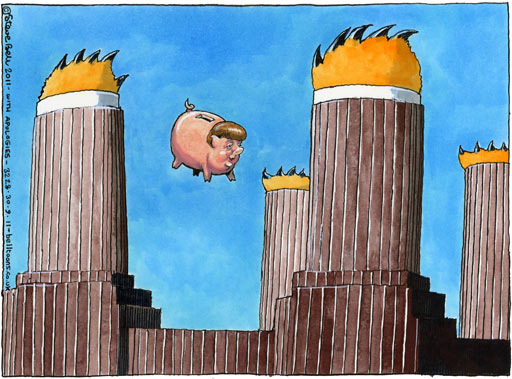
9. The problems in Wenzhou - The New York Times has written a detailed piece here on the problems many Chinese businesses are now finding getting credit after the central government crackdown on easy money. Initially they went to loan sharks, but now the money is running out.
More than two-dozen small, private businesses in the eastern city known for its entrepreneurial success have gone belly up in recent days because they couldn't repay maturing bank loans, according to state media reports. Wenzhou officials on Thursday urged banks to limit lending rates and make more funds available to small businesses amid worries about a credit crunch.
The reports have added to downward pressure in China's stock and currency markets because Wenzhou was one of the first places to boom when China began to embrace private enterprise three decades ago and is considered the cradle of private-business ownership.
"Numerous reports of debt distress in Wenzhou have contributed to the latest iteration of China hard-landing anxiety," said Tim Condon, Singapore-based chief Asia economist with ING Groep NV. "The fear is that Wenzhou is the tip of an iceberg."
10. Totally a slient movie version of Star Wars.
We welcome your comments below. If you are not already registered, please register to comment
Remember we welcome robust, respectful and insightful debate. We don't welcome abusive or defamatory comments and will de-register those repeatedly making such comments. Our current comment policy is here.