

Here's my Top 10 links from around the Internet at 9.30 am in association with NZ Mint.
I welcome your additions in the comments below or via email to bernard.hickey@interest.co.nz.
I'll pop the extras into the comment stream.See all previous Top 10s here.
I see the French and Germans agreed over the weekend to bail out their banks, but won't give the details til early November. Hmmm.

1, He actually said this - IMF Advisor Robert Shapiro warned in a BBC interview on October 5 of a worldwide banking meltdown within "perhaps 2-3 weeks" unless the Europeans can get their act together pronto.
The G20 meeting in early November is shaping up as crucial.
Unless the Europeans have a 'bazooka' bond buying fund, bank recapitalisations and more ECB money printing all hell could break loose.
We've had US Treasury Secretary Tim Geithner warn of this.
Now the IMF is saying the same thing.
These are not nutters buying baked beans and shotgun shells.
They actually run the show or at least know what's happening in the bowels of the system. They are that worried.
Here's the quote and the video below:
"If they can not address [the financial crisis] in a credible way I believe within perhaps 2 to 3 weeks we will have a meltdown in sovereign debt which will produce a meltdown across the European banking system. We are not just talking about a relatively small Belgian bank, we are talking about the largest banks in the world, the largest banks in Germany, the largest banks in France, that will spread to the United Kingdom, it will spread everywhere because the global financial system is so interconnected. All those banks are counterparties to every significant bank in the United States, and in Britain, and in Japan, and around the world. This would be a crisis that would be in my view more serious than the crisis in 2008.... What we don't know the state of credit default swaps held by banks against sovereign debt and against European banks, nor do we know the state of CDS held by British banks, nor are we certain of how certain the exposure of British banks is to the Ireland sovereign debt problems."
2. Worrying correlations - Here's some sobering charts via Zerohedge of the comparisons between various Japanese and American indicators at similar points at their recessions.
This first one compares the stock markets.

The second one compares money supply contractions.

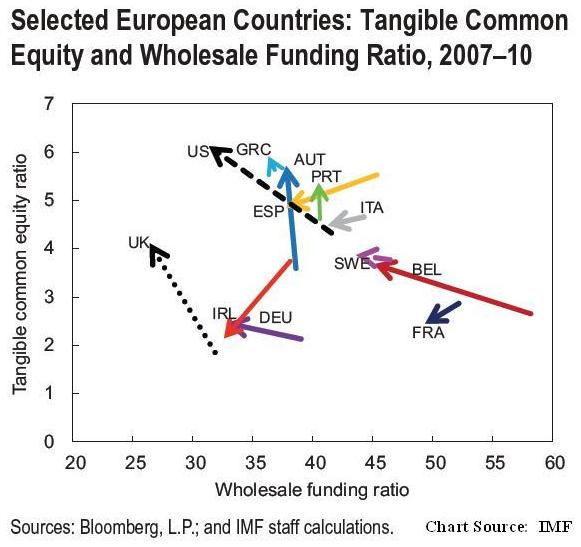
3. Europe's Banking problem - Its banks don't have enough capital and are too reliant on wholesale funding markets. That's the conclusion of this IMF study. HT Ed Harrison at Credit Writedowns
This chart shows the French, Belgians and Italians are still very dependent on 'hot' money that has a tendency to freeze. They have improved their banks much less than the Americans and Brits over the last three years.
4. Depression or not? - Reuters looks at the return of the D word to the economic debate.
But now "depression" is very much back in the mainstream lexicon as the small economic bounce from the deep global recession of 2008/09 fades rapidly after little more than two years and Europe's bank and sovereign debt crisis intensifies.
Economist and doomsayer Nouriel Roubini now says there's a "huge" risk of 1930s-style depression and, on the other side of the political spectrum to Ferguson, advocates further government spending to offset it.
HSBC chief economist Stephen King, who wrote earlier this year of a "new economic permafrost", warned last week that the systemic financial threat of a euro zone collapse and breakup risked another "Great Depression".
5. 'All bankers are capitalists in the good times but socialists in the bad times' - Here's a cracking interview Satyajit Das, author of Extreme Money, gave recently to Max Keiser. Ignore the first 14 minutes of the video. The interview starts at 14 mins 20 seconds. HT Neco in Friday's 90 at 9.
Barack Obama slept through his securities law class at Harvard. That’s the only explanation I can offer for his answer to Jake Tapper’s question at a press conference Thursday. Tapper asked him about the failure of his administration to prosecute a single Wall Street executive. From the transcript.
"Well, first on the issue of prosecutions on Wall Street, one of the biggest problems about the collapse of Lehmans and the subsequent financial crisis and the whole subprime lending fiasco is that a lot of that stuff wasn’t necessarily illegal, it was just immoral or inappropriate or reckless…."
By “a lot of stuff”, the President means everything that happened, from fraudulent sales of real estate mortgage-backed securities, to Repo 105, to filing false affidavits in foreclosure proceedings. He knows this even though there have been no criminal investigations, no FBI inquiries, no Grand Jury subpoenas, and apparently no review of independent investigations. For him, this isn’t about law. He just knows that the immoral and inappropriate and reckless behavior that caused the Great Crash and the Lesser Depression wasn’t a crime.

7. And here's why Obama's wrong - Karl Denninger does the work for Obama compiling what the banks did. This is the reason why there are growing numbers of people protesting in America. The 1% got away with it.
Here's Denninger:
- Laundering drug money. Wachovia admitted to doing it in court. They got a "deferred prosecution agreement" and not only did nobody go to jail nobody other than a few bloggers like myself raised hell about it until days before that agreement expired. Then, magically, it got news coverage. This is a clear black-letter felony; where are the handcuffs?
- The former chief risk officer for Citifinancial testified under oath before the FCIC that the company knowingly sold loans on to investors that did not meet their quality guidelines and published claims. In fact, he testified that by 2007 80 percent of those loans were defective. This is functionally identical to selling you a car and rolling back the odometer, peddling tainted medicine or selling melamine-laced baby formula. There is nothing complicated about this and there is under-oath testimony establishing that it was not an accident or an "error in judgment" as it continued for more than a year after it became known and was the subject of internal memos to corporate officers. This is not my conjecture or analysis, it is factual sworn testimony before a government body. Where are the damned handcuffs?
- Perjury is a felony in most circumstances. Banksters admitted to more than 100,000 instances of it by withdrawing perjured ("robosigned") affidavits. Just as with the testimony under oath in the case of Citifinancial, just as in the Wachovia admission of drug money laundering, in this case the violation of the law is clear. Perjury can only be cured at "no penalty" up until it is clear that the defective statement or filing will be discovered; once you're "caught" you cannot avoid liability by withdrawing the filing. Whether someone was paying their mortgage or not is immaterial as to whether filing a false affidavit is a criminal matter -- it is. Again, where are the damned handcuffs?

8. Too much money in the (political) system - Laurence Lessig writes at Huffington Post that the corporate money now embedded in America's political system is one of the major problems behind the economic mess.
Lessig said the ultimate example of Congress's warped priorities is the extraordinary amount of energy members devoted this spring, in the midst of an economic crisis, to the issue of bank swipe fees -- as chronicled by HufPost's Ryan Grim and Zach Carter. "The number one issue they focused on is bank swipe fees," Lessig said.
"That's only because bank swipe fees was the issue that dumped the most money into campaigns."
9. The power to tax - Simon Johnson and James Kwak, the authors of 13 Bankers, write in Vanity Fair that America's revolutionaries actually realised they needed to tax the population to deal with national emergencies, contrary to what the Tea Party thinks.
It's a great history lesson.
As a young artillery captain in the Revolutionary War, Alexander Hamilton learned a crucial lesson: Good credit, based on the power to tax, is essential to a nation’s security. As the first U.S. Treasury secretary, he built America’s fiscal policy on that principle. Will the Tea Party destroy his legacy?
And here's Simon Johnson being interviewed by Andrew Patterson on Radio Live's Sunday Business.
10. Totally Jon Stewart on OccupyWallStreet
We welcome your comments below. If you are not already registered, please register to comment
Remember we welcome robust, respectful and insightful debate. We don't welcome abusive or defamatory comments and will de-register those repeatedly making such comments. Our current comment policy is here.