

Here's my Top 10 links from around the Internet at 12.30 pm in association with NZ Mint.
I welcome your additions in the comments below or via email to bernard.hickey@interest.co.nz.
I'll pop the extras into the comment stream.See all previous Top 10s here.
I'm back today after a couple of days leave. It's amazing how much work you can get done around the house when you don't have to work.

1. China's Shadow banking system - FTAlphaville points out Societe General thinks China's shadow banking system needs a bailout.
It's a useful piece with lots of detail on this sector, which is being watched increasingly closely by those worried that China's slowdown may turn into a hard landing.
When the state banks turned off the taps earlier this year to slow down the economy and cool inflationary pressures, many small businesses and property developers went to loan sharks charging 20% plus.
Now those loans are coming due and the debt is crushing the life out of many of these small businesses.
There's been a lot of attention given to the suicide and 'running away' of some of these business owners, particularly in the bellwether city of Wenzhou, which has a history of being the the most 'out there' with private business and property development.
Here's Societe Generale with the detail:
According to the PBoC’s Wenzhou branch office, the size of the underground banking in the city is estimated to have reached CNY 110bn, equivalent to 18% of Wenzhou’s CNY 602bn formal bank loans. The central bank also estimates that close to 90% of households and 60% of local enterprises are participating in this credit boom.
Troubled enterprises are usually heavily involved in underground banking, which is basically direct and informal lending and borrowing between family members, friends, and people from the same community or locality. These unnerving stories always begin with PBoC’s lending curbs on formal banks, followed by surging underground banking, and then at some point – there is always such a point – inevitable and abrupt breaks in liquidity chains, and ending finally with run-away business owners or their suicide.

2. BMW town's pyramid fraud - The Telegraph reports on some extraordinary goings-on in the small eastern Chinese crab fishing village of Shiji.
What happened in Shiji is a fraud that plays out every day in some corner of China's murky economy, as local Communist Party officials and greedy entrepreneurs collude in vast pyramid schemes.
"It all began when a man named Shi Guobao returned to Shiji after working in Beijing," said Zhu Yi, the head official in the village.
"He became a property developer, but he wanted to make a bigger fortune so he decided to also become a loan shark." Together with 17 of his friends, Shi began tapping the villagers for their savings, promising to pay them 10 per cent interest each month.
The gang quickly raised 350million yuan, (£35.5million) which they then lent out at rates of 30 per cent or more each month to borrowers including local property developers. Shi became known as "King Claw", the man at the head of the pyramid. For a while, the scheme worked well. Other property developers borrowed from Shi in order to begin construction and the local government, which earned income from every acre sold to the developers, also prospered.
You can guess what happened next. Click through for the gory financial details.

3. 'CERA mandated overcharging' - Christchurch IT business owner Ben Kepes writes on his blog about how demolition costs have blown out 400% and how CERA seems reluctant to do much about it.
Here's a taste of a blog that needs wider distribution.
After February 22nd, Civil Defence decided that our building was a signifciant risk (a fact that could readily be disputed) and ordered an emergency demolition. Once the emergency demolition had happened we understood that there was the possibility that we may be charged for this work. And we even expected that, given the changing situation, the price might rise a little. What we were wholly unprepared for was receiving the invoic.
Yes, we were being charged 400% more than the price quoted by the original demolition company. 400%! Highway robbery anyone?
We’re lucky that we had taken a subsequent insurance policy out, only a week before the February event, to cover the costs of demolition should there be another event. While it looks like our particular costs will be covered, that is entirely not the point. There is a moral obligation to try and get to the bottom of this situation as many other people don’t have the luxury of insurance and are being bled dry by CERA-mandated over-charging with seemingly no right of appeal.
4. 'A crisis of bigness' - Paul Kingsnorth writes at The Guardian about Leopold Kohr's views from 50 years ago that large companies and countries are inherently unstable.
The crisis currently playing out on the world stage is a crisis of growth. Not, as we are regularly told, a crisis caused by too little growth, but by too much of it. Banks grew so big that their collapse would have brought down the entire global economy. To prevent this, they were bailed out with huge tranches of public money, which in turn is precipitating social crises on the streets of western nations. The European Union has grown so big, and so unaccountable, that it threatens to collapse in on itself. Corporations have grown so big that they are overwhelming democracies and building a global plutocracy to serve their own interests. The human economy as a whole has grown so big that it has been able to change the atmospheric composition of the planet and precipitate a mass extinction event.
One man who would not have been surprised by this crisis of bigness, had he lived to see it, was Leopold Kohr. Kohr has a good claim to be the most important political thinker that you have never heard of. Unlike Marx, he did not found a global movement or inspire revolutions. Unlike Hayek, he did not rewrite the economic rules of the modern world. Kohr was a modest, self-deprecating man, but this was not the reason his ideas have been ignored by movers and shakers in the half century since they were produced. They have been ignored because they do not flatter the egos of the power-hungry, be they revolutionaries or plutocrats. In fact, Kohr's message is a direct challenge to them. "Wherever something is wrong," he insisted, "something is too big."

5. A painfully expensive circular logic - Peter Whoriskey writes at Washington Post that the practice of peer benchmarking by renumeration committees on the boards of big companies has created an upward spiral in excecutive pay.
It turns out many boards believe their special executives should be paid at the upper end of what their peers are paid because they're so good.
Guess what? When everyone pays at the upper end, the benchmark moves inexorably higher...
At Amgen and at the vast majority of large U.S. companies, boards aim to pay their executives at levels equal to or above the median for executives at similar companies.
The idea behind setting executive pay this way, known as “peer benchmarking,” is to keep talented bosses from leaving.
But the practice has long been controversial because, as critics have pointed out, if every company tries to keep up with or exceed the median pay for executives, executive compensation will spiral upward, regardless of performance. Few if any corporate boards consider their executive teams to be below average, so the result has become known as the “Lake Wobegon” effect.

6. The problem with High Frequency trading - Theoretical physicist Mark Buchanan writes at Bloomberg about how the astonishing growth of high frequency trading, where trades are executed automatically in the blink of an eye by programme trading algorithims, is making the stock market more liquid, but also more unstable.
High-frequency trading now accounts for almost 75 percent of all buying and selling of U.S. equities, and a race to trade even faster is under way. The technology to trade thousands of times per second has existed for several years, and it won’t be long before that rate is pushed to a million. The fastest exchanges are now executed in about 10 microseconds -- the time it takes a jetliner flying at full speed to travel one 10th of an inch.
An informal study by the New York Times, reported a few weeks ago, found that single-day share-price changes as large as 3 percent to 4 percent are now more likely than at any other time in recent stock-market history. Academic studies show much the same thing: In the past six years, large and volatile movements in stock prices over periods of 15 minutes or so have become much more common.
This isn’t surprising. It just means that markets now behave the same way over short periods (minutes) as they have done over hours and days -- with a marked tendency toward sudden movements. It’s when you consider the consequences of this increasing volatility that Haldane’s analysis becomes most interesting: He argues that the precarious position in which some high-frequency traders find themselves, especially during stormy periods in the markets, may cause their actions to exacerbate the trouble.

7. Here's what's really wrong with America - This long, detailed piece from Jane Mayer at The New Yorker explains everything that is wrong with America's electoral system and its excuse for democracy.
It tells the tale of how a very rich businessman spent quite small amounts of money to tip the balance in North Carolina so he could then gerry mander electoral boundaries for the national Congress.
This is one of the reasons why there is such division in Congress now and a lack of an ability to see the other point of view. Congressional electoral boundaries have been so finely drawn that candidates rarely have to convince someone 'not like them' to vote for them.
It means hardliners from both sides get in and then fail dismally to compromise once in power. Hence the budget deadlock earlier this year.
Politicians of both sides know that money is required to convince the voters and will do a lot to get that money from various backers.
Here's Mayer. It's long, but it explains so much about American politics.
In the spring of 2010, the conservative political strategist Ed Gillespie flew from Washington, D.C., to Raleigh, North Carolina, to spend a day laying the groundwork for REDMAP, a new project aimed at engineering a Republican takeover of state legislatures. Gillespie hoped to help his party get control of statehouses where congressional redistricting was pending, thereby leveraging victories in cheap local races into a means of shifting the balance of power in Washington.

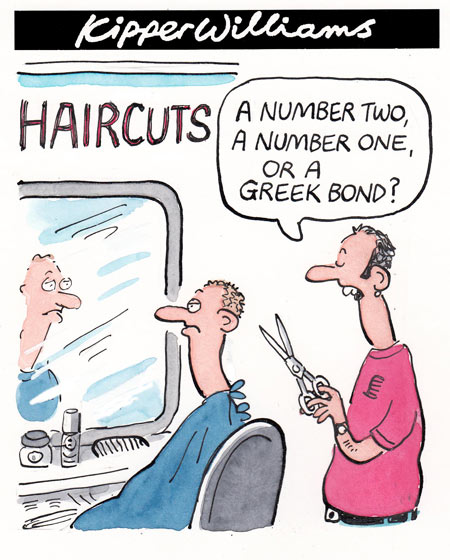
8. A really big haircut required - Reuters reports some people in America are beginning to talk about a giant haircut for those crushed under debts they will never repay.
A debt jubilee.
Here's Jennifer Ablan and Matthew Goldstein at Reuters:
More than three years after the financial crisis struck, the economy remains stuck in a consumer debt trap. It's a situation that could take years to correct itself. That's why some economists are calling for a radical step: massive debt relief.
Federal policy makers, they suggest, should broker what amounts to an out-of-court settlement between institutional bond investors, banks and consumer advocates - essentially, a "great haircut" to jumpstart the economy.
What some are envisioning is a negotiated process in which cash-strapped homeowners get real mortgage relief, even if it means forcing banks to incur severe write-downs and bond investors to absorb haircuts, or losses, in some of the securities sold by those institutions.

9. So many delays - Tamlyn Stewart reports at Stuff on problems one Christchurch builder, Daryl Hewitt, is having getting work started in rebuilding.
Daryl Hewitt, owner of homebuilder DJ Hewitt, says he has had projects ready to start for the past four months but that delays in insurance payments mean the work is still on hold.
"I have clients just waiting and wanting me to do work for them and we can't do anything," Hewitt said. "Some insurance companies are more proactive than others but we're really struggling to move forward at the moment."
Hewitt said there was repair work and new building work that could not be done until insurance payments started coming through. "It's just red tape, so much red tape and no relief."
His company has about 20 employees – carpenters, project managers, office staff and apprentices. Nine have left since the February quake, moving overseas or signing up with project management companies.

10. Jon Stewart talking about Sarah Palin's decision not to run for President. But she keeps a bunch of money raised from her supporters...
This goes nicely with number 7.
We welcome your comments below. If you are not already registered, please register to comment
Remember we welcome robust, respectful and insightful debate. We don't welcome abusive or defamatory comments and will de-register those repeatedly making such comments. Our current comment policy is here.