
By Bernard Hickey
The noise around the global economic downturn, ruinously high debt and rising inquality is deafening.
We hear every night of riots, bailout packages, bank rescues, protests, strikes and stock market slumps, but what's really going on in this 'new normal' for the global economic and political system?
It's all about who gets stuck with the bill at the end of the party.
The developed world finished a near two decade long spending spree funded with debt in 2008. The core problem was that output per person in the developed world (US, Europe, Australia, NZ) slowed its growth through the 1990s and 2000s. A lack of investment in infrastructure, a lack of progress in finding job-creating new technology, ageing populations and a shift in manufacturing to Asia saw growth in real income per worker in the developed world flatten out.
At the same time the liberalisation of financial systems in Europe and the United States allowed consumers and governments to borrow to keep growing their incomes and growing consumption, often of products made in China and Germany with money borrowed from China and Germany, or with money created by central banks.
Now the chickens are comimg home to roost. Rising debt is only sustainable when real incomes are growing faster than debt, but that hasn't been happening for at least a decade.
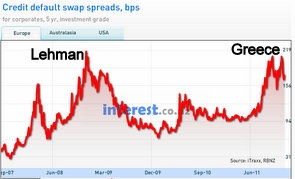
The Lehman Brothers crisis of September 2008 was the first chicken to land. Since then the debt problem has shuffled from bank balance sheets to taxpayer balance sheets as banks, central banks and governments have kicked the can down the road, hoping they can restart growth and fix the problem with rising growth or at least through rising inflation.
The second chicken is the sovereign debt crisis on the fringes of the Euro zone that is rapidly spreading to the core. This weekend's latest crisis summit is the latest attempt to find another way to kick the can down the road and hope to restart growth before the chickens die and start rotting.
Banks are the canaries in this chicken mine. They feel the stress first and that's what is happening in Europe as those lending to banks are getting nervous about whether all the government bonds they hold are actually worth what they are valued at on their books.
The moments of truth in this process are when banks are forced to revalue their assets. This process is often called 'getting a haircut'. That's when the banks agree with the borrower how much to write down the value of the debt. This comes after they realise the debt can never be repaid and the interest costs have spiralled out of control.
Europe is now at that point.
The question then is: who will take the losses when the haircuts are agreed? Is it the bank shareholders and bond holders? Or can the debt be shuffled onto someone else to eventually pay the price?
The latest deal in Europe was designed to reassure private holders of European government bonds that they would not be forced to take a 'haircut' again after the shock they got when Greece restructured its debts.
There are two ways to make debt go away. It can be restructured, or the debt can be inflated away in real terms by inflating prices and incomes. When it is restructured bank shareholders and bond holders take the pain. When it is either inflated away or shifted to government balance sheets then taxpayers and term depositers take the pain.
Essentially this is all a battle between the owners of banks and the public at large.
So far bank shareholders and bondholders are winning. In America they successfully arranged bailouts by the US Federal Reserve and a shift in the most toxic debt to the government and the central bank. In addition to the debt shuffle to the public, the bankers, the central bankers and politicians want to make the debt go away by increasing inflation above the level of interest rates, which are being suppressed at both ends by the US Federal Reserve in a process called 'The Great Repression.'
Now the same process is being played out in Europe. Bank bond holders and shareholders want taxpayers to guarantee their bonds will never lose money and are baying for the European Central Bank to use the same tactic as the US Federal Reserve and Bank of England of printing money to buy government bonds off the banks.
German taxpayers are revolting at the plan, as are many unemployed youth in Europe and United States. Politicians and central bankers want to avoid a collapse so are giving in to the calls for government bailouts and money printing.
We'll see whether taxpayers ultimately accept the bill that the owners of banks and their bond holders don't want to pay.
It is a battle between the 1%, who own the bank bonds and bonds, and the 99%, who are taxpayers and term depositers.
So far the 1% are winning, but the 99% are fighting back through the ballot box and on the street.
That's what all the deafening noise is about.
We welcome your comments below. If you are not already registered, please register to comment
Remember we welcome robust, respectful and insightful debate. We don't welcome abusive or defamatory comments and will de-register those repeatedly making such comments. Our current comment policy is here.