

Here's my Top 10 links from around the Internet at 1.30 pm in association with NZ Mint.
I welcome your additions in the comments below or via email tobernard.hickey@interest.co.nz.
I'll pop the extras into the comment stream. See all previous Top 10s here.
#7 is today's must read from Joseph Stiglitz.

1. London's bankers just like 1970s unionists - Renowned British economic blogger Greg Pytel ("Financial Crisis? It's a pyramid stupid) writes that David Cameron's decision to pull Britain out of the new EU treaty proposed by France and Germany may prove the death knell for the City of London financial centre in the same way that the onset of globalisation killed off Britain's manufacturing base in the 1970s.
He makes some excellent points about the direct and implied subsidies now given to the bankers in London.
He says Germany and France will now try to lock London out of Europe's financial markets, which is a big deal given London is Europe's main financial centre.
Frankfurt is champing at the bit to take that spot.
And the French will egg them on.
This could all backfire horribly for the British.
But Pytel wonders if the loss of the City is ultimately such a bad thing.
In the 1970's the British heavy industries refused to adopt to a changing world: first signs of globalisation. They put a pressure on the British government to subsidise them with taxpayers money and keep them going. As a result within a couple of decades the industry that had led the world into the 20th century was confined into history. The very same process is happening now. The City financiers demand state subsidies (i.e. bailout, quantitive easing, tax exemptions, etc) and want to carry on as before. They disregard the fact that the world is changing.
They look after their short term interest and it looks like that the financial industry that led the world to the 21st century will be history in the UK not before long. It is the same approach as militant trade unionists of the 1970's although they most likely were acting unwittingly and were not wise enough to understand that. However considering the current degenerated and pathological state of the financial industry in the UK, which appears to be beyond help, finishing it off, unlike the collapse of the manufacturing, may actually be the best option for the British future. Countries can be successful without overblown financial services: Sweden, Denmark, the Netherlands or Germany.
Now it is clear they cannot be successful without healthy manufacturing.
2. Lowering top tax rates enriches the rich and doesn't increase economic growth - That's the conclusion in this piece at VoxEu from Economists Thomas Piketty , Emmanuel Saez and Stefanie Stantcheva
There are two cracking charts with this, including data from New Zealand.
Figure 1 shows that there is indeed a strong correlation between the reductions in top tax rates and the increases in top 1% pre-tax income shares from 1975–79 to 2004–08 across 18 OECD countries for which top income share information is available. For example, the United States experienced a 35 percentage point reduction in its top income tax rate and a very large ten percentage point increase in its top 1% pre-tax income share. By contrast, France or Germany saw very little change in their top tax rates and their top 1% income shares during the same period. Hence, the evolution of top tax rates is a good predictor of changes in pre-tax income concentration.
.gif)
Figure 2 shows that there is no correlation between cuts in top tax rates and average annual real GDP-per-capita growth since the 1970s. For example, countries that made large cuts in top tax rates such as the United Kingdom or the United States have not grown significantly faster than countries that did not, such as Germany or Denmark. Hence, a substantial fraction of the response of pre-tax top incomes to top tax rates documented in Figure 1 may be due to increased rent-seeking at the top rather than increased productive effort.
.gif)
3. Yes it's another Downfall spoof - This one is on Hitler finding out about the the Standard and Poor's mass downgrade last week. Some funny moments.
4. Harikiri British style - Hugo Dixon writes at Reuters' Breaking Views about Britain's monumental mistake in opting out of the European grand plan.
None of this was remotely necessary. The euro zone countries weren’t trying to impose fiscal discipline on Britain, only on themselves. In fact they weren’t trying to impose anything on the UK. True, France has often seemed like it wanted to undermine the City of London’s position as a financial center. But until now, it has had zero success because the UK has always managed to assemble enough allies to support its position. In future, though, that can no longer be guaranteed.
France’s President Nicolas Sarkozy may find he has allies if he wants to push through regulations that disadvantage what he calls his “British friends”. The risk of an inner club acting as a caucus and imposing its wishes on the UK has increased significantly.
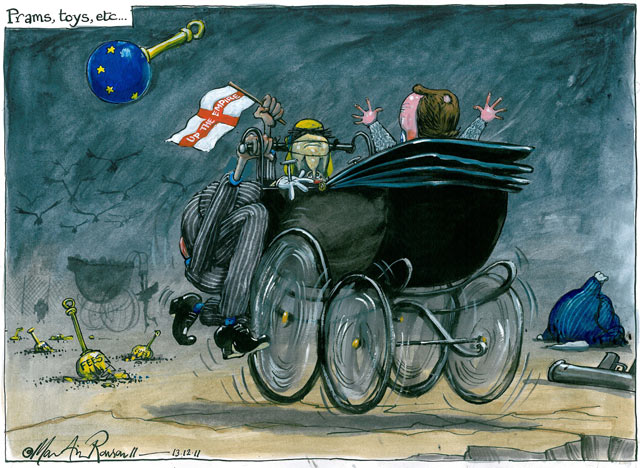
When the dust settles, Friday 9 December may be seen as a watershed, the beginning of the end for Britain in Europe. But more than that – the emergence for the first time of a cold new Europe in which Germany is the undisputed, pre-eminent power imposing a decade of austerity on the eurozone as the price for its propping up the currency.
The prospect is of a joyless union of penalties, punishments, disciplines and seething resentments, with the centrist elites who run the EU increasingly under siege from anti-EU populists on the right and left everywhere in Europe.
"For the first time in the history of the EU, the Germans are now in charge. But they are also more isolated than before," said Charles Grant, director of the Centre for European Reform thinktank. "The British are certainly more marginal than before. Their influence has never been lower in my lifetime."

6. Decline of an empire - Renowned China watcher Andy Xie takes aim at America in this Caixin comment piece via MarketWatch. He hits the mark. HT Donald.
A rising empire rewards people who contribute to its growth and invest in its future. The empire’s decline begins when certain members of society are over-rewarded by means of privileges, and the empire’s money is wasted on outdated endeavors.
Today, America rewards the wrong people and spends disproportionately on projects of the past. Symptoms of the flawed incentive system in the U.S. economy include a massive fiscal budget deficit, high unemployment rate, crumbling infrastructure and a failing basic education system. International competition isn’t threatening the United States, but internal problems are. And unless the United States tackles its wrong-way incentive system and spending spree soon, its gradual decline will continue until it eventually joins the likes of Latin America.
Most of America’s well-to-do are corporate executives, doctors, lawyers, bankers and the like. Their rewards are tied to positions, not performance. Corporate managers are paid a lot more than average employees, even if they’re not worth it.
For example, one report said salaries for big U.S. company CEOs have jumped to 343 times the average pay for their own employees, up from 42 times in 1980. Of course, a CEO whose work generates a lot of value deserves a decent slice. But look at the stock market: Common shareholders have done terribly over the past decade. How can CEOs justify millions in take-home while shareholders — their bosses in theory — do so poorly. I’m sure the compensation consultants can come up with good excuses. But this has been going on for years.

7. Why saving the US economy will never fix the US economy - Nobel prize winning economy Joseph Stiglitz writes via VanityFair that the Depression of te 1930s was caused by an increase in productivity on farms. He sees something similar happening now with job losses in the shift from manufacturing to services.
He says monetary policy has failed and now governments must invest massively in new technology to create a new era of prosperity, as they did by accident during World War II.
This is today's must read. HT Troy via email.
The inability of the monetary expansion to counteract this current recession should forever lay to rest the idea that monetary policy was the prime culprit in the 1930s. The problem today, as it was then, is something else. The problem today is the so-called real economy. It’s a problem rooted in the kinds of jobs we have, the kind we need, and the kind we’re losing, and rooted as well in the kind of workers we want and the kind we don’t know what to do with. The real economy has been in a state of wrenching transition for decades, and its dislocations have never been squarely faced. A crisis of the real economy lies behind the Long Slump, just as it lay behind the Great Depression.
The parallels between the story of the origin of the Great Depression and that of our Long Slump are strong. Back then we were moving from agriculture to manufacturing. Today we are moving from manufacturing to a service economy. The decline in manufacturing jobs has been dramatic—from about a third of the workforce 60 years ago to less than a tenth of it today. The pace has quickened markedly during the past decade. There are two reasons for the decline.
One is greater productivity—the same dynamic that revolutionized agriculture and forced a majority of American farmers to look for work elsewhere. The other is globalization, which has sent millions of jobs overseas, to low-wage countries or those that have been investing more in infrastructure or technology. (As Greenwald has pointed out, most of the job loss in the 1990s was related to productivity increases, not to globalization.) Whatever the specific cause, the inevitable result is precisely the same as it was 80 years ago: a decline in income and jobs. The millions of jobless former factory workers once employed in cities such as Youngstown and Birmingham and Gary and Detroit are the modern-day equivalent of the Depression’s doomed farmers.
8. Value destruction - The Mirror reports on a New Economics Foundation study finding that British bankers cost the public 8.4 pounds for every pound they create. HT Troy via email.
A study by think-tank the New Economics Foundation found the average banker destroys £42million a year in value while creating just £5million.
Meanwhile hospital cleaners on £6.26 an hour are worth £10 for every £1 they cost because they prevent superbugs, saving the economy a fortune.
9. Wanna buy a government bond? - The OECD has forecast OECD governments will need to borrow US$10.5 trillion in 2012, having raised a similar amount in 2011.
The fourth OECD Sovereign Borrowing Outlook provides estimates for 2011 and projections for 2012. Higher than anticipated gross borrowing needs of OECD governments are expected to reach USD 10.4 trillion in 2011 and USD 10.5 trillion in 2012, including a strong increase in longer-term redemptions in 2012. Against this backdrop government debt ratios are expected to remain at high levels. Raising large volumes of funds at lowest cost, with acceptable roll-over risk, remains therefore a great challenge for a wide range of governments, with most OECD debt managers continuing to rebalance the profile of debt portfolios by issuing more long-term instruments and moderating bill issuance.
Additional challenges for government (and corporate) issuers are the complications generated by the pressures of a rapid increase in sovereign risk, whereby “the market” suddenly perceives the debt of some sovereigns as “risky”, as well as euro area-induced contagion effects. Growing concerns among investors have resulted in the offloading of significant holdings of European debt.
10. Totally Jon Stewart on how America gave Iran a drone for Christmas... I love the pictures of the Hillman Hunters driving in the streets of Iran.
We welcome your comments below. If you are not already registered, please register to comment
Remember we welcome robust, respectful and insightful debate. We don't welcome abusive or defamatory comments and will de-register those repeatedly making such comments. Our current comment policy is here.