

Here's my Top 10 links from around the Internet at 2 pm today in association with NZ Mint.
We welcome your additions in the comments below or via email tobernard.hickey@interest.co.nz.
See all previous Top 10s here.
My must listen today is #1. Most people don't realise that America's banking system was shut down in the middle of the depression.

1. FDR's Bank Holiday speech - This video below includes US President Franklin Delano Roosevelt's fireside chat from March 12, 1933 explaining his 'bank holiday' of early March after a nationwide-run on banks.
An interesting history lesson on the closure of an entire banking system while it restructured by the government in the middle of a depression.
I wonder how long before some European leader has to do the same.
It may not be long in Greece.
If things keep going the way they are in Spain and Italy then a bank holiday can't be ruled out there either.
Here's FDR.
The failure of many banks, runs on banks, and a general climate of financial panic played an important role in the Great Depression. After taking office in early March 1933, President Franklin D. Roosevelt made a radio address (a "Fireside Chat") outlining federal strategy to reopen the banking system.
The system had been closed as part of a "bank holiday" declared by president to halt panics and runs. Although many other aspects of New Deal policy often receive more attention, backing up the banking system at least prevented the Depression from worsening. Prevention of financial panics remains an important economic policy in the contemporary world.
2. Now German bond yields are rising too - The FT points to growing disqueit this week about a rise in German and French bond yields at the same time as Spanish and Italian bond yields are rising.
Previously, German and French yields were falling as investors shifted money from Southern Europe to 'core' Europe in case there was a euro-zone breakup.
Now, the FT says, investors are also pricing in the other side of the bell curve of risk, being a full euro zone guarantee, which would mean German and French taxpayers start guaranteeing Spanish and Italian bonds.
Madre de Dios.
Germany, the UK and France’s 10-year bond yields have risen 25 basis points, 16bp and 47bp to 1.42 per cent, 1.69 per cent and 2.73 per cent respectively since the start of the month.
Analysts said this was a worrying development, which indicated investors could be starting to prepare for two “tail-risks” – a break-up of the common currency bloc or moves towards fiscal union.
“If we see a trend of periphery bonds, Bunds and the euro start to sell off simultaneously we’d move from concern to alarm,” said David Lloyd, head of institutional portfolio management at M&G Investments.
3. Britain's leaders are 'dead scared' - The Daily Telegraph's Deputy Editor Benedict Brogan has written a frightening editorial pointing out the risks for Britain. It's a stunning read from a Tory supporting paper. It's obviously written with inside knowledge.
The prospect of an economic cataclysm terrifies the upper reaches of the Government. In public it is all confident smiles, but in private they are dead scared. Politically, meanwhile, every assumption has been ground to ashes. Instead of recovery leading to re-election, all they can see ahead is stagnation and uncertainty. Is there anything they can do?
There are plenty on the Conservative side who are beginning to think that whatever the dangers, a sudden, cathartic moment which saw Greece or others ejected from the eurozone, or even a disorderly break-up of the single currency, would be better than the long-term damage done by years of stagnation. Better a short, sharp disaster now, than one that goes on and on. Mr Osborne understands too well the appeal of such a logic. “A total meltdown is a very risky thing to wish for,” one ally says. “Once you start to look at the implications, it’s quite terrifying.”
Among Conservatives, however, there is a growing number who say he can do even more. They want Mr Osborne to be more daring, and are growing increasingly vocal and public in their criticism. If things get worse – certainly if the euro breaks up – then all bets are off and Mr Osborne will be freed of the constraints of the Coalition. He will have permission to do things that he does not currently contemplate, including unfunded tax cuts and a radical paring-down of employment regulations. Privately, he recognises this may become necessary. Tory MPs speak of an emergency Budget acting as a defibrillator on a moribund economy, with tax cuts and a programme to pump credit straight to businesses, possibly through the state-owned RBS.
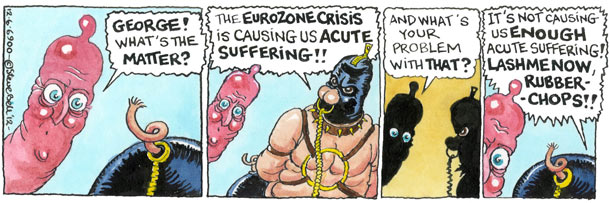
4. Here's the problem - Ekathamerini reports that a cup of coffee costs more in Athens than in Berlin. By the way, €4.7 equals NZ$5.90 about NZ$7.55. That's expensive alright.
Economic theory says Greek prices need to fall in euro terms, or the Euro falls.
Or the price of a coffee in New Zealand is too cheap...and that can't be true or right.
A telling example of prices in Athens is that of served coffee, which in Athens averages out at €4.70, while in Berlin it costs €4.18. This has been affected by the increase in the value-added tax rate in Greece.

5. Trade war alert # 452 - Reuters reports China is threatening to impound European passenger jets if Europe pushes ahead with its carbon levy for people flying to and from Europe.
Chinese airlines, which have been told by Beijing not to comply with the European Union's Emissions Trading Scheme, refused to meet a March 31 deadline for submitting carbon emissions data.
A new stand-off looms after EU Climate Commissioner Connie Hedegaard said the carriers would have until the end of this week to submit their data or face enforcement action. The head of the United Nations agency responsible for seeking a global solution to the row expressed concerns over the dangers of tit-for-tat retaliation between Europe and China.
"We are very concerned about what is happening with Europeans and China - retaliatory measures. We are very concerned about that, because we want air transport to continue growing," the International Civil Aviation Organization's (ICAO) president, Roberto Kobeh Gonzalez, told Reuters.
China, which according to Airbus and other sources in the aerospace industry is delaying plane orders worth up to $14 billion from European planemaker Airbus over the row, has asked the EU to push the scheme back by a year.
6. Why Spailout failed - Mohamed el Irian from Pimco, the world's biggest bond fund, explains here at CNBC why the Spanish bailout over the weekend failed so spectacularly to win back the confidence of bond investors.
The package did not rupture the increasingly problematic link between weak Spanish banks and deteriorating sovereign creditworthiness. Too many operational details remain unclear; others raised questions about the seniority of existing investors. And the unconfirmed reaction of Spanish banks, which reportedly sold some of their government bond holdings, added to the uncertainties.
These are all legitimate but they do not explain the extent of the selloff in key financial assets. Indeed, the price action suggests that markets overall are losing confidence in the policy response function, and doing so in an accelerated fashion.
As such, rather than encourage the private sector to co-invest along the public sector, the provision of official financing is seen as facilitating its disengagement. In turn, this serves to aggravate the economic implosion and mounting joblessness; it also makes bank bailouts even harder to defend, politically and otherwise.
The vicious cycle is familiar to those who lived through the debt crises of emerging economies in the 1980s, 1990s and early 2000s. The more the private sector losses confidence in the policy response, the harder it is for these responses to stabilize the situation let alone get ahead of it. As private sector de-leveraging accelerates, the already-serious policy challenges become all the more daunting.

7. The link between obesity rates and rising inequality - Lane Kenworthy blogs here about the research showing that rising income and wealth inequality seems closely correlated with rising obesity rates in developed countries.
This seems counterintuitive in a way. Surely more poverty means less food to eat.
Maybe not. There are 46 million Americans on food stamps and the cheapest forms of food now are high calorie options from fast food outlets, which are still growing like topsy in developed countries, particularly English-speaking countries.
According to this research, New Zealand is second behind America for both increased obesity and rising divergence between the richest and poorest, often described as the Gini rate.

In the past several years some researchers have advanced an alternative hypothesis that blames rising income inequality and/or economic insecurity (see here, here, here, here). These are said to increase stress, which in turn prompts overeating.

If the English-speaking countries do in fact stand apart in their obesity rates or trends, there is an alternative hypothesis that ought to be considered. Rather than being driven by income inequality or economic insecurity, it might owe to these countries’ weak regulation of food and restaurants and to their lack of a well-entrenched healthy eating culture. Large-portion restaurants, particularly fast-food ones, may have proliferated more rapidly in the English-speaking nations. Junk food may have become available in grocery and convenience stores sooner and in larger quantities. And the shift away from home cooking and limited snacking may have occurred more quickly and decisively. This strikes me as more plausible than the suggestion that Americans and their counterparts in other English-speaking nations suddenly began eating more due to heightened stress. It’s also consistent with my own anecdotal impressions, though I haven’t seen any hard data.
8. Why aren't companies and wealthy individuals investing in growing companies and employing more people? - This seems the central question of the moment. Corporate balance sheets and chock full of cash and wealthy individuals have never been wealthier.
Yet they are hoarding their cash in government bonds and bank accounts.
This chart courtesy of Brad de Long shows US private domestic investment lagging heavily.
9. The problem in China - Here's Bloomberg Businessweek with a great chart showing the slowdown in the economy there.
And this time around China can't and won't be repeating its 2 trillion yuan stimulus (mad building spree) of late 2008 and early 2009.

The Chinese seem aware that the last spending spree resulted in overbuilding. “The efforts for stabilizing growth will not repeat the old ways of three years ago,” Xinhua reported on May 29.
Some economists are skeptical. “There is already massive overcapacity. But they are saying everything is going to be fine,” says Patrick Chovanec, a business professor at Tsinghua University. “That’s because the government is going to spend lots of money. Think of the moral hazard there.”
10. Totally Jon Stewart and his mates explaining Trickle down economics. "It's rich nutrients are spread around."
We welcome your comments below. If you are not already registered, please register to comment
Remember we welcome robust, respectful and insightful debate. We don't welcome abusive or defamatory comments and will de-register those repeatedly making such comments. Our current comment policy is here.