

Here's my Top 10 links from around the Internet at 9.30 am today in association with NZ Mint.
As always, we welcome your additions in the comments below or via email to bernard.hickey@interest.co.nz.
See all previous Top 10s here.
My must read story is #7 on the debate over fiscal multipliers, which is crucial in the great debate between the Austerians (or should that be Austrians) and the Keynesians.

1. The changing face of the IMF - Bloomberg's leader writers have a nice summary of how the IMF has changed its thinking from hardline economic orthodoxy to something more pragmatic.
New Zealand's economic policy making elite are still stuck in the old IMF mode of always targeting smaller government, lower taxes, less regulated markets and free capital flows.
The new IMF is much more nuanced and sensible.
It says free movements of capital can be dangerous and counter productive for small open economies (ie New Zealand).
It also says austerity doesn't always work.
When is Treasury and the Reserve Bank (not to mention the cabinet) going to catch up with the change in the debate overseas?
Here's how the IMF has changed:
The IMF used to demand a severely conservative orthodoxy in fiscal and financial affairs. Its officials never saw a budget deficit that wasn’t too big or a financial restriction that wasn’t choking growth. As a dispenser of aid to governments under financial duress, the IMF could insist on its way or else, and rarely flinched from doing so.
In the past few years, through public statements and its many publications, the IMF has moved a great distance.
On fiscal affairs, its watchword is no longer “austerity now” but cautious pragmatism. It used to be more fiscally conservative than the average government. For the moment, it’s arguably less so, often emphasizing the dangers of too much fiscal tightening too soon.
On international capital flows, where it once deplored any and all restrictions, it’s coming around to judicious use of controls under certain circumstances.
Inflation was previously the spawn of the devil; the new view says it’s bad, but there can be worse things. When demand is deficient and fiscal restraint unavoidable, says the IMF’s new World Economic Outlook, adequate and possibly unorthodox “monetary accommodation” (which it might once have called gambling with inflation) is vital.
Even the editors of Bloomberg (which caters to bankers and fund managers) agrees:
The recession has thrown doubt on a lot of supposed certainties -- or should have. With interest rates pinned at zero, fiscal policy must shoulder a bigger role in countries where public debt isn’t so high as to rule out stimulus. In today’s accelerated financial markets, cross-border capital flows can be so disruptive (especially in developing or undiversified economies) that mild controls, intelligently applied, might sometimes be better for growth and stability than laissez faire.
2. Spreading to the core - Bloomberg reports on how mortgagee sales in Spain are spreading to the wealthier home owners.
It turns out the parents who guaranteed their kids to give them a lift up into a bubbly housing market are now being caught. Sound familiar? How many wealthier New Zealand families are doing the same for their kids here, particularly in Auckland?
Spanish business people, upper middle class families and their loan guarantors, typically parents of first-time buyers, now account for 60 percent of foreclosures in Madrid, according to AFES, an association that advises homeowners facing repossession. Three years ago, 80 percent of foreclosures were on the homes of immigrants, usually the first to lose jobs and fall behind on loan payments in a souring economy. They now comprise 40 percent of the total, according to AFES.
“Repossessions are encroaching further into the city centers, like an overflowing river,” said Emilio Miravet, head of real estate finance at the Spanish property unit of advisory and investment firm Catella AB. “At the beginning of the crisis, it was homes in the periphery areas belonging to the less affluent that were being foreclosed upon.”
Loan guarantors, often parents who used their houses as collateral to help their children become homeowners when real estate was booming, now represent a fifth of foreclosures, AFES data show.
3. Now it's close - Reuters reports Barack Obama and Mitt Romney are now even at 45% each in the latest opinion poll.
Romney and Ryan are austerians. If they get in, be ready for a U.S. slump.

4. A very short honeymoon - Wolf Richter writes at Naked Capitalism about the political situation in Spain. Remember, it's politics rather than economics that will drive the ultimate results in Europe and America.
The public are becoming disillusioned with politicians in general. Spain was a dictatorship until 1979.
Disillusioned and disappointed, they have taken to the streets with near daily waves of protests, demonstrations, and occasional street battles. Ignore them, Rajoy told a business audience in New York, and instead count on the “silent majority.” Turns out, that silent majority must be rather smallish as 77% of the people support the protesters.
5. The logic of pauperisation - Companies in Europe are starting to readjust their marketing strategies to deal with the poverty sweeping the continent.
They're looking at using the strategies they use in places like India, selling single sachets and the like.
“Poverty is returning to Europe,” said Jan Zijderveld, head of Unilever’s European operations, in an interview. The British–Dutch consumer products company, third largest in the world, was adjusting its commercial strategy to this new reality, he said, by redeploying to Europe what worked in poor countries of the developing world. Now the stars of the industry are affirming it. “The logic of pauperization,” L’Oréal CEO Jean-Paul Agon called it on Wednesday.
“If Spaniards are down to spending on average €17 per shopping trip, I can’t sell him detergent for half of his budget,” Zijderveld explained. “In Indonesia we sell individual packages of shampoo for 2 to 3 cents and still earn a fair amount.”

6. A curious type of inflation - A Columbia University paper on China's amazingly lucrative art market gives a fantastic insight into how China's officials are bribed.
It's called 'elegant bribery'.
We explore the impact of corruption on the Chinese art auction market. More specifically, the Chinese have coined the term “elegant bribery” to describe bribery cases that involve cultural objects. The most common scenario of such transactions is as follows: The briber first presents a forged artwork as a gift to the official being bribed, which does not violate the Chinese anti-corruption laws since such artworks have very low monetary value. Then, the official auctions the painting via an auction house.
Finally, the briber attends the auction and purchases the artwork back for a very high price, as if he mistook the work for an original. Since bribery, rather than investment or personal appreciation, is the purpose of such purchases, “elegant bribery” is a significant source of inelastic demand for works of art in the Chinese auction market, driving prices beyond what can be explained by observable characteristics.
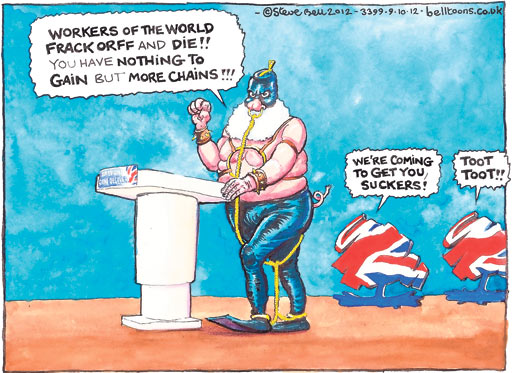
7. Fiscal multipliers - INSEAD Economics Professors Antonio Fatas and Ilian Mihov point in their blog to an interesting discussion in the latest IMF forecasts about fiscal multipliers.
The austerians have, it turns out, been underestimating the multiplier effects of government spending, which means the austerity programmes they are demanding are contracting economies more than expected...
The worrying thing is the actual academic research shows multipliers of over 1, while the Austerians have just assumed it's much less than 1 or even zero. The Austerians assume the private sector will always pick up the slack, but that's not happening as household sectors deleverage and the income share shifts to the upper end of the spectrum.
Here's Fatas and Mihov:
These new (and old) academic results have simply be displaced by the ideological debate that followed the fiscal policy stimulus of the 2008-2009 period, which somehow led to the conclusion that those policies did not work and that what we now needed was more austerity. And when over the last two years we forecasted GDP growth rates in the face of coordinated austerity by many governments we somehow forgot to consider that multipliers can be large.
This is what the IMF suggests now in their analysis, which, by the way, is also self critical. They look at their recent forecasts for global growth and they suggest that their model was implicitly using fiscal policy multipliers around 0.5 when measuring the impact of fiscal consolidation. Given that their GDP growth forecast has been overestimating growth, the IMF now wonders whether multipliers are higher than 0.5. The analysis in the current World Economic Outlook suggests that multipliers might be within the range 0.9 to 1.7.

8. Ultimately debt forgiveness is the only solution - As the screws tighten in Europe, it's clear the only sustainable way to restart these indebted economies is to forgive or destroy debt. The other solution is to inflate away the debt, but let's not talk about that too much...
Here's CNBC looking at Ireland's proposed new laws to encourage debt forgiveness:
Most countries that have suffered housing busts, including the United States, have made limited use of so-called mortgage write-downs, the process of forgiving a portion of the principal on the loan. The worry has been that some borrowers who can afford their mortgages will stop making payments to take advantage of a bailout. Banks have also been reluctant since they could face unexpected losses.
Ireland is different from the United States and most countries. During the financial crisis, Ireland bailed out the banks, and the government still has large ownership stakes in some of the biggest mortgage lenders. So taxpayers are already responsible for mortgage losses. In other countries, the burden of principal forgiveness would largely fall on privately owned banks.
But the debate is the same: whether to push lenders to take losses now, in hopes that things will get better faster, or wait for the housing market to heal on its own, which could cloud the economy for years to come.
Countries suffering from a housing hangover will most likely be watching Ireland closely to see how the law works. Spain, swamped with mortgage defaults, introduced a measure in March that allows for debt forgiveness, though under strict conditions.

9. Spain's growing black hole - Bloomberg reports on the growing black hole that is Spain's budget. It highlights the fundamental problem in Europe. Further to the fiscal multipliers discussion at #7, the austerity contracts the economy, which makes the budget deficit worse, which triggers more austerity, which contracts the economy...
You get the picture.
Rinse and repeat.
The fiscal and political consequences of demanding austerity in a shrinking economy highlight the dilemma facing Rajoy. To trigger a European financial lifeline, he may have to impose yet more cuts, repeating the pattern seen in Greece, Portugal and Ireland.
Spain’s economy probably contracted for a fifth quarter between July and September, according to the central bank. Output won’t return to the 2008 level until at least 2017, the International Monetary Fund forecasts. As a result, the program of budget consolidation the EU first set out for Spain in 2009 is going backward.
“Even as you cut, the gap between spending and revenue collection keeps getting larger,” said Jonathan Tepper, a partner at research firm Variant Perception in London.

We welcome your comments below. If you are not already registered, please register to comment
Remember we welcome robust, respectful and insightful debate. We don't welcome abusive or defamatory comments and will de-register those repeatedly making such comments. Our current comment policy is here.