
By Bernard Hickey
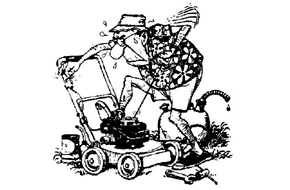
I have a reasonably cheap and modern four stroke lawnmower that I bought new five years ago from one of those big box hardware stores before the Global Financial Crisis when the New Zealand dollar was strong. It cost less than NZ$300 and didn't have all the bells and whistles.
This gorgeous spring weather around at the moment means I'm using it a lot.
It doesn't have an electric starter so I have to start it myself and have learnt over the years how to get it started with the least possible amount of pulling on the cord. It has a rubbery squeezy ball thing between the fuel tank and the engine that I have to push three times exactly to squirt petrol into the chambers. Too many squirts and the engine floods with petrol. I then have to wait for the petrol to drain out and try again. Too few squirts and I find myself pulling endlessly on the cord waiting for the engine to fire.
After 5 years of squirting, pulling and mowing I've worked out 2 and a half squirts is just right, rather than the 3 squirts recommended in the manual.
I dread the first mow of the spring because my carefully remembered number of squirts doesn't work. The engine is out of practice after months of not being used and no doubt some residual dust and corrosion change the delicate balance of chemistry and mechanics required for ignition. Every Spring it takes me as much as half an hour of squirting, pulling, waiting, adjusting and pulling again until it fires up in a cloud of blue smoke.
This is where the global economy is at right now.
Central banks have flooded the 'engines' with fuel, hoping to fire up economic growth and start cutting unemployment.
Firstly, they cut interest rates to zero or nearly zero and that didn't work.
In a sign of their increasing desperation to get the engine started, they started printing money to buy government bonds, effectively squirting money into the banking system to encourage lending.
But still the engine hasn't fired up.
Some believe the engine has had so much petrol pumped into the banking system that it is flooded and can't fire up. Economists describe it as the 'zero bound problem' where the closer interest rates get to zero the less risk banks and borrowers want to take on. Money tends to get hoarded in central bank deposits or in government bonds, failing to be pushed out into the real economy to build new factories, start new businesses and employ people.
Some are worried there's so much petrol squirted into and over and around the engine that when the engine does fire up the global economy will burst into flames in a surge of inflation or hyperinflation that could prove very damaging.
Certainly much of the petrol of printed money has spilled out of the printing economies such as America, Japan, Britain, China and Europe is surging into smaller economies like New Zealand and Australia who have open borders for investment flows and free floating exchange rates. This is pushing up their exchange rates and creating asset bubbles in these smaller open economies. It's a bit like squirting petrol onto your lawnmower and then over the fence into the neighbour's barbecue while he's cooking.
The question every policymaker in the world is asking right now is: why won't the engines fire up?
It's been almost six years now and economic growth is barely 1-2% in the developed economies, much less than the 3-4% seen during normal recoveries.
Many economists are now wondering if there's some structural problems in the engines that might need to be fixed.
Firstly, ageing populations in the developed world, and increasingly in China, is slowing growth down. As workforces get older, households start saving more for their retirements and taking less risk with their investments. This means there's less appetite to invest in new products or markets or infrastructure that might generate volatile returns.
No one nearing retirement wants to find out just before they need to draw down their retirement savings that their investment has slumped. Older savers opt for government bonds and guaranteed bank deposits. That pushes down investment returns, and, ironically, means those saving households have less money to spend.
Secondly, there's been a structural shift in income and wealth over the last 20 years from the middle and lower income groups to the higher income groups.
Those with higher incomes tend to spend proportionately less of their incomes, thus reducing demand for goods and services that generate economic growth. Those on middle to lower incomes topped up their spending power over the last two decades with debt, but now they have maxed out their credit lines and are repaying debt. That means they are spending less, which in turns creates a negative feedback loop of less investment, less employment, less spending and less investment.
Thirdly, a deregulation of the global financial system over the last 20 years has heightened financial market volatility, created 'Too Big To Fail' banks and shifted a chunk of profit share and income to a sector that has destroyed value rather than created it. This too has lowered the economic speed limit and helped stop the engine from firing.
It's clear now the engine needs rebuilding, rather than being flooded with more petrol.
That means a redistribution of income and wealth back to those who consume most of their income, a restructuring of debts that cannot be repaid with current growth rates, and a re-regulation of a financial sector that leveraged up the developed world and created dangerously large institutions with the capacity to blow up financial markets again.
The mower needs a new engine, not just more squirting and pulling.
------------------------------------------------------------------
This article first appeared in the Herald on Sunday. It is used here with permission.
We welcome your comments below. If you are not already registered, please register to comment
Remember we welcome robust, respectful and insightful debate. We don't welcome abusive or defamatory comments and will de-register those repeatedly making such comments. Our current comment policy is here.