

Here's my Top 10 links from around the Internet at 10:00 am today in association with NZ Mint.
Bernard is on his summer break and will be back in late January 2013, probably from Wellington.
As always, we welcome your additions in the comments below or via email to david.chaston@interest.co.nz.
See all previous Top 10s here.

1. Matching workers with jobs
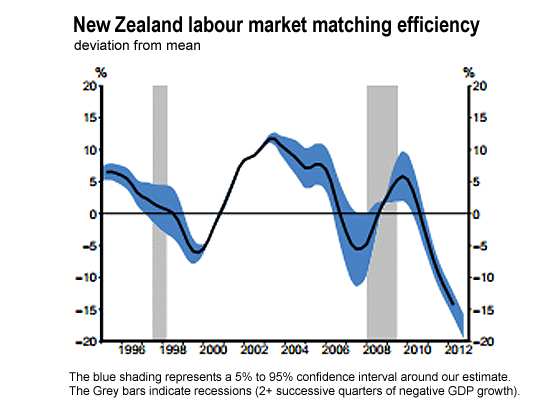
Since the trough of the 2008/09 recession, the NZ unemployment rate has remained high. However, some other indicators suggest that there might be less downward pressure on wage and price inflation than the unemployment rate alone implies.
Three RBNZ analysts explore this apparent discrepancy by looking at the relationship between vacancies and the number of people unemployed and by estimating a measure of the effectiveness of the labour market at matching unemployed workers with vacancies.
They suggest that both the Canterbury earthquakes and international migration flows are probably contributing to a decline in the matching efficiency in our labour markets.
In this paper, we use some analytical techniques to try to shed some light on what has been going on in the New Zealand labour market over the past few years. The unemployment rate suggests a lot of excess capacity in the labour market (and there are certainly a lot of people unemployed, looking for work), but some other indicators suggest that the labour market is tighter, and less disinflationary than the unemployment rate alone might suggest. We report estimates of a modeling exercise suggesting that the labour market has become less efficient in matching the skills required by employers and those of job seekers.
The Canterbury earthquakes, and the big structural changes in the patterns of economic activity in Christchurch, appear to have caused a significant regional decline in matching efficiency. The net outflow from New Zealand of prime age workers over the past couple of years, even as demand for skilled labour has been increasing, may also have contributed to the apparent decline in matching efficiency across the entire country.
Around the world, educational achievement is rising. But a disturbing trend is accelerating - in the arms race between 'rich' and 'poor', high-end education is streaking ahead, extending the "achievement gap". And in high-productivity economies, ones where job growth is low, it is no longer a benefit to have rising educational achievement. You apparently need to be in the in the top quartile. A new inequality is growing.
2. Your resolution?
3. "Effective and efficient"
Yesterday we got a media release from the Auditor General. Apparently their work now includes asking the public service how well they are doing, and publishing those stories. "We have not audited the organisations' initiatives to check the facts, although each organisation has confirmed that their story is fairly represented," they say.
In an environment of fiscal constraint, New Zealand's public sector is looking for more effective and efficient ways to deliver public services. So how are they coping? The Office of the Auditor-General was interested in finding out, and has today published Effective and efficient: Stories from the public sector, which shares the ideas and experiences of 48 public sector agencies - from their own perspectives. Contributions come from city, district and regional councils, public service departments, and Crown entities of all sizes and locations. You can read them here: http://www.oag.govt.nz/2012/efficiency-stories Most of the stories have common elements: collaboration and sharing services, capable and engaged staff, and fostering an organisational focus on effectiveness and efficiency. There are also stories about improving corporate or back-office functions, and directly improving services. All highlight the common aim of delivering better services to the public.
We would be interested in feedback on any of these stories.
4. Today's raw market data ...
A quick holiday update:
| as at 11:10am |
Today 9:00 am |
Yesterday |
Four weeks ago |
One year ago |
| NZ$1 = US$ | 0.8339 | 0.8414 | 0.8066 | 0.7559 |
| NZ$1 = AU$ | 0.7959 | 0.7991 | 0.7740 | 0.7633 |
| TWI | 74.38 | 74.96 | 72.85 | 67.99 |
| Gold, US$/oz | 1,665 | 1,694 | 1,615 | 1,613 |
| Dow | 13,220 | 13,318 | 12,836 | 12,169 |
| Copper, US$/tonne | 7,946 | 8,005 | 7,433 | 7,275 |
| Volatility Index | 15.57 | 16.34 | 13.45 | 24.29 |
5. A toe in the water?
The RBNZ sold a net $NZ64 million on NZ dollars in November, the largest amount since 2008. In a First Impressions note Westpac said the central bank is acting on its mandate to manage its currency reserves by selling while the dollar is high, buying when it is low and making a return in the long run. They say although the amount was not large the fact that the sell-off occurred is meaningful.
Senior economist Michael Gordon says the last time the Reserve Bank undertook this sort of currency trading was in 2007 and 2008, when it made hundreds of millions of dollars of [unrealised?] profits.
6. About as corrupt as America in 1928
The WSJ reports on a new study showing corruption in China is around the level it was in America in 1928 and there's a life cycle in corruption as richer consumers and voters demand less corruption.
When both countries were at a $2,800 per-capita income level - 1996 in China, early 1870s in the US - newspaper-reported corruption was 7 to 9 times worse in the US. By the time, the two countries reached US$7,500 per-capita income – 2009 in China; 1928 in the US - the reported corruption was roughly similar in both countries. The significance, Mr. Ramirez, concludes, is that “while corruption in China is an issue that merits attention, it is not at alarmingly high levels, compared to the US historical experience.”
7. Smart money bets
We all know that Ben Bernanke said before the US presidential election that we did not wish to be re-appointed. So when he goes at the end of his term (January 31, 2014), who will replace him? Some people think it could well be Timothy Geithner. (I had thought that Geithner once worked for Goldman Sachs, but apparently that isn't true. Geithner has never worked on Wall Street.)
8. The meaning of marketing
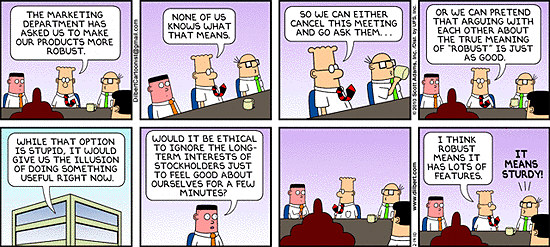
As usual, Dilbert nails it.
9. We're not the only ones
Reuters reports even China looks like it will have a pensions shortfall by 2050, citing a new book, with one of the snappiest titles seen for some time ;).
China is likely to accumulate a massive funding shortfall in its urban pension system by 2050 unless it raises its retirement ages and taps more state assets, according to a book published this month that takes an in-depth look at China's finances.
The book titled "Research into China's state balance sheet" is co-authored by Deutsche Bank chief China economist Ma Jun and Xiao Mingzhi, a researcher at Accenture, one of the world's leading management consulting, technology and outsourcing companies.
10. Today's quote
A successful man is one who makes more money than his wife can spend. A successful woman is one who can find such a man. Lana Turner
No chart with that title exists.

We welcome your comments below. If you are not already registered, please register to comment
Remember we welcome robust, respectful and insightful debate. We don't welcome abusive or defamatory comments and will de-register those repeatedly making such comments. Our current comment policy is here.