

Here's my Top 10 links from around the Internet at 10:00 am today in association with NZ Mint.
Bernard is on his summer break and will be back in late January 2013, from Wellington.
As always, we welcome your additions in the comments below or via email to david.chaston@interest.co.nz.
See all previous Top 10s here.

1. UBS's lies - Felix Salmon at Reuters reports on what the FSA found
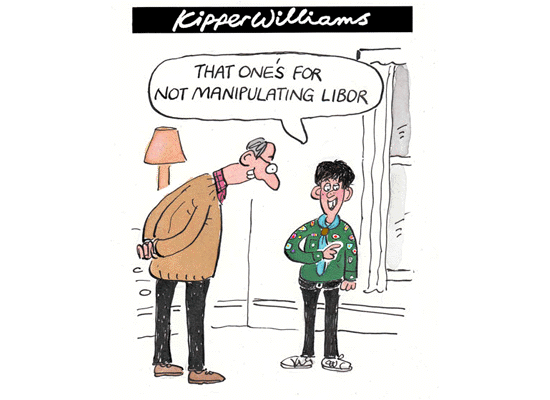
Call me naive, but after the Barclays revelations, I actually thought that I couldn’t be shocked about the extent of Libor manipulation. Boy, was I wrong. I could quote all 40 pages of the FSA notice fining UBS for Libor fraud: this is far, far worse than simply understating UBS’s borrowing costs so as to make investors think the bank was healthy. In fact, a lot of the fraud was designed to move Libor up rather than down: whatever the traders could make the most money manipulating.The FSA concludes, quite explicitly:
UBS’s misconduct is, although similar in nature, considerably more serious than Barclays’ because it was more widespread within the firm, being exacerbated by the control failings, in particular the inherent conflict of interest in its submission function. More individuals, including Managers and Senior Managers, participated in or knew about the manipulation and there were more instances of individual manipulation, across more currencies. Furthermore, the extent to which UBS colluded with others was significantly greater and involved financial rewards being paid to Broker Firms.
The latter point is key: UBS didn’t just manipulate its own submissions, but actively attempted to manipulate other firms’ submissions as well. And at points the bribery was so explicit as to beggar belief that anybody would ever communicate such things on the record:
If you keep 6s [i.e. the six month JPY LIBOR rate] unchanged today … I will fucking do one humongous deal with you … Like a 50,000 buck deal, whatever … I need you to keep it as low as possible … if you do that …. I’ll pay you, you know, 50,000 dollars, 100,000 dollars… whatever you want.
A “50,000 buck deal” here does not mean a $50,000 deal: it means a $50 billion deal. If the broker on such a deal siphons off a fee of 0.0001%, that’s $50,000 right there.
2. Without magic, Santa would need 12 million employees
Someone figured out that there are 760 million children that need a Christmas present. Then an enterprising journalist at NPR asked around about how big the Santa Inc. logistics operation actually is.
Here are just a few of the positions Santa would need to fill to pull off Christmas. (Note: For the complete list, see the graphic at this link.)
* 46 international distribution centers, to allow Santa to reload as he crosses the globe. That means 400,000 workers for loading presents onto Santa's sleigh.
* 60,000 workers to develop optimized flight plans and communicate with the FAA, secure flyover rights, etc.
* 7,000 people monitoring demand and tweaking his route in real time.
* 100 meteorologists to make sure Santa doesn't fly into a blizzard.
* 40,000 people to help Santa clear customs.
3. Peak farmland?
If you're looking for a dash of optimism about the future - and who isn't, these days? - you can find it in a rosy new prediction about the planet's ability to produce food for the next half-century. It comes from a trio of researchers at Rockefeller University.
Their bottom line: We have more than enough land to grow all the food that the world's increasing population will desire. In fact, farmers' ability to grow more food on less land will even outrun demand for that food, and farmers will abandon land once used to grow crops.
The Rockefeller group, for instance, says that demand for meat, and in particular, beef, is not increasing as quickly as some have predicted. Chinese are eating more meat as they get richer, but they are not duplicating the meat-heavy diets of many other countries.
The single most important assumption, however, concerns farmers' ability to increase the amount of food they can grow from each acre of land.
The Rockefeller University group assumes that farmers will continue to increase their crop yields at roughly the same pace as they have since 1961 — some 1.7 percent per year. Others, like the FAO and the International Food Policy Research Institute, don't believe that's likely. Yield increases have been much lower — about 1.2 percent per year — over the past 20 years. And that's before one even considers the impact of the climate change, which could be devastating for some regions. Jesse Ausubel, who led the Rockefeller group, says that it's "arrogant" and "peculiar" to assume that the world's farmers cannot increase their productivity rapidly, if needed. Large gains in crop yields haven't been needed over the past two decades, he says, because food has been relatively abundant.

4. Today's raw market data ...
A quick holiday update:
|
Today 9:00 am |
Yesterday 11:10am |
Four weeks ago |
One year ago |
|
| NZ$1 = US$ | 0.8336 | 0.8339 | 0.8098 | 0.7677 |
| NZ$1 = AU$ | 0.7955 | 0.7959 | 0.7747 | 0.7619 |
| TWI | 74.35 | 74.38 | 73.04 | 68.62 |
| as at eob New York/London | ||||
| Gold, US$/oz | 1,650 | 1,665 | 1,615 | 1,614 |
| Dow | 13,278 | 13,251 | 12,788 | 12,104 |
| Copper, US$/tonne | 7,825 | 7,946 | 7,433 | 7,275 |
| Volatility Index | 17.74 | 17.36 | 15.02 | 23.22 |
5. Getting things sorted
Reuters reports a bunch of Chinese banks have grouped together to create a rainy day fund in case they get into trouble. They're putting up 10% and borrowing the rest ...
A group of small- and medium-sized Chinese banks including China Minsheng Banking Corp has started a 3 billion yuan ($480.3 million) rescue fund to guard against financial risks as the country frees its interest rate market and as its economy slows.
The group of 22 banks and one insurance firm have banded together to start the fund with 10 percent cash upfront, said Shi Jie, an assistant to the chairman of Minsheng Bank.
The remaining 90 percent of the fund is backed by guarantees from members to provide financing when needed, he told a news conference. Members pay at least 10 million yuan to join the fund and get up to 500 million yuan of financing when in need.

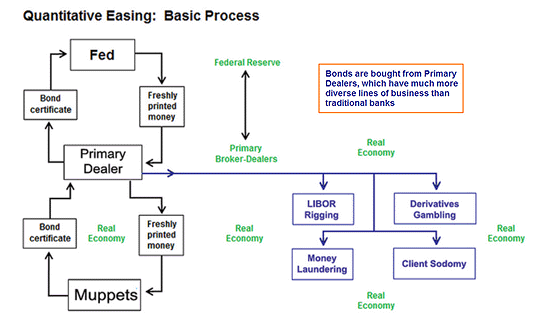
6. Here's a quite technical explanation of Quantitative Easing
from someone who may not be a fan. HT Ritholz.
7. New Record
Another record milk production month in October. The nation's dairy farmers produced 242,746 tonnes of milksolids from 2,994,000 tonnes of milk, higher by 3.6% than the previous record in October 2011. October is the 'money month' when the maximum milk flush occurs. Prices are holding in the latest globaldairytrade auctions.
8. Bonus Dilbert

9. 'A beautiful deleveraging'
Renowned hedge fund manager Ray Dalio talks a lot in this Dealbook conference video about how deleveraging is working in financial markets and global economies. HT Macrobusiness.
QE is losing its efficacy.
Rate turn probably finally coming late in 2013.
The world is still in deleveraging. Effects of QE diminishing as we do more rounds..
We’re facing austerity. And growth is flagging. This is an unprecedented risk the economy is facing. A slowdown with very little room to maneuver.
10. Today's quote
"Money is like a sixth sense - and you can't make use of the other five without it." - W. Somerset Maugham
Economic growth
Select chart tabs
11. oh, and one more thing
In case you overlooked it, today is the end of the world ...
So here is a convenient live blog of the event - you wouldn't want to miss it. And of course R.E.M. knew it was coming ... Everyone is making jokes about it like there is no tomorrow.
We welcome your comments below. If you are not already registered, please register to comment
Remember we welcome robust, respectful and insightful debate. We don't welcome abusive or defamatory comments and will de-register those repeatedly making such comments. Our current comment policy is here.