

Here's my Top 10 links from around the Internet at 10:00 am today in association with NZ Mint.
Bernard is on his summer break and will be back in late January 2013, from Wellington.
As always, we welcome your additions in the comments below or via email to david.chaston@interest.co.nz.
See all previous Top 10s here.
Merry Christmas. We return Thursday.
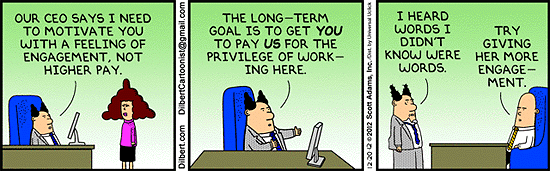
1. Hedge funds run rings around EU officials, make huge profits
EU public policy officials play an inept game against professional hedge fund managers.
They blinked first in a standard commercial game of 'chicken', one they were warned about beforehand.
But not to worry, the deal was done, and it's only euro-taxpayers money. Easy come, easy go. Brussels bureaucrats have no skin in the game, they feel no pain.
“I just don’t understand why they did this,” said Mitu Gulati, a sovereign debt specialist at Duke University School of Law, who argues that Europe could have saved up to two billion euros. “This would have been an easy transaction to do, and still the hedge funds would have come out with a hefty profit.”
Indeed, opportunistic hedge funds have profited handsomely from the euro zone crisis, be it by speculating in Greek bonds or by buying up the senior debt of failed Spanish banks. They have successfully bet that Europe, ever fearful of Greek-style contagion, will prefer taxpayer-financed bailouts to forcing concessions from the private sector. The latest outcome follows a series of victories, in and out of the courtroom, by holdout debt investors against countries like Argentina and Ireland seeking to restructure their debt.

2. 'Studying economics turns you into a liar'
This from Jordan Weissmann at The Atlantic: "Ever hear the joke about the lying economist? No? Well, neither have I. But we might need to come up with one. Such is the takeaway from a working paper released in January, which I stumbled on while browsing Professor Andres Marroquin's top papers of 2012. Written by a pair of researchers from universities in Montreal and Madrid, it examined whether the study of economics made students more apt to lie for financial gain. The answer: a resounding yes."
You can click through to the actual paper for the research itself. It is from a university in Madrid, but the paper is in English.
Abstract: Recent experimental evidence suggests that some people dislike telling lies, and tell the truth even at a cost. We use experiments as well to study the socio-demographic covariates of such lie aversion, and find gender and religiosity to be without predictive value. However, subjects’ major is predictive: Business and Economics (B&E) subjects lie significantly more frequently than other majors. This is true even after controlling for subjects’ beliefs about the overall rate of deception, which predict behavior very well: Although B&E subjects expect most others to lie in our decision problem, the effect of major remains. An instrumental variables analysis suggests that the effect is not simply one of selection: It seems that studying B&E has a causal impact on behavior.
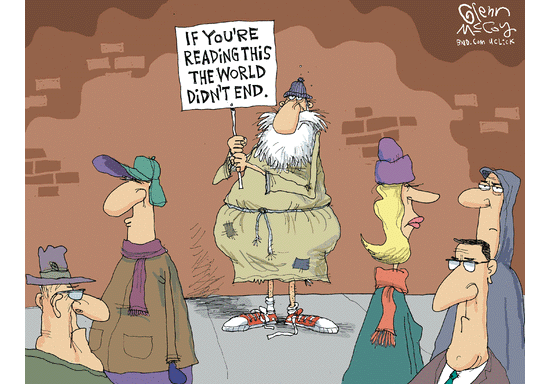
3. The economics of gift giving
Behavioral economists study human errors. People don’t always make the best choices for themselves, so there’s good reason to doubt whether they will always make the best choices for others. If you’ve ever received a useless gadget, a horrendous tie or some kind of bowl, you’ll know that when people buy Christmas presents, they can blunder badly. Cass Sunstein has some advice:
Chances are pretty good that whatever you end up getting people this year, and however hard you try, some of your friends and family members aren’t going to think that the gift is worth what you paid for it.
Here are some tips for gift-givers, building on six behavioral findings that bear directly on holiday-season mis-giving. They might help you get through December a little better.
4. Today's raw market data ...
A quick holiday update:
|
Today 9:00 am |
Friday 11:10am |
Four weeks ago |
One year ago |
|
| NZ$1 = US$ | 0.8221 | 0.8346 | 0.8238 | 0.7739 |
| NZ$1 = AU$ | 0.7922 | 0.7959 | 0.7879 | 0.7634 |
| TWI | 73.62 | 74.38 | 73.69 | 69.18 |
| as at eob New York/London | ||||
| Gold, US$/oz | 1,652 | 1,665 | 1,751 | 1,608 |
| Dow | 13,191 | 13,135 | 12,788 | 12,104 |
| Copper, US$/tonne | 7,769 | 7,946 | 7,771 | 7,590 |
| Volatility Index | 17.84 | 17.67 | 15.50 | 21.43 |
5. Wild over-capacity
Caterpillar, Komatsu and other construction-equipment makers have built enough capacity in China to satisfy global demand twice over while sales in the country are falling, according to a research company. New Zealand buyers should be able to get equipment at knock-down prices.
Manufacturing capacity in China is almost 600,000 excavators a year while the worldwide market is about 300,000, according to London-based Off-Highway Research. Inventories of crawler excavators in China are about 100,000, almost equal to projected 2012 domestic sales, the research firm’s Managing Director David C.A. Phillips said.
The supply glut is a blow to Caterpillar and its competitors who built factories and bought local companies to grab a share of the biggest construction equipment market. Now, with government property controls slowing construction, those companies are cutting output and trying to export unsold equipment.
“It’s all very scary,” Phillips, who visited China in November, said in an Dec. 12 interview.
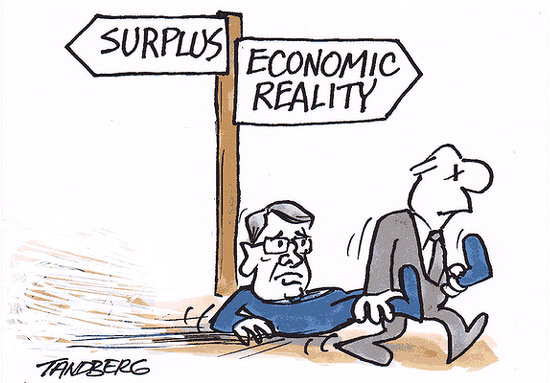
6. Worries over the high gold price start to bubble up
Many wealthy investors have been attracted to commodities, and gold in particular, but with the future of the global economy uncertain, these holdings may not turn out to be the safe havens they were hoping for. Yuri Bender surveys the scenarios:
“[Gold] has no intrinsic merit other than being a store of value.”
The gold story is over-sold, believes Mr Rajan. Although it makes sense for pessimistic investors, who subscribe to the ‘muddle through’ or deflationary scenario to allocate as much as 10 per cent of their portfolio to gold as a capital hedge, it can be a risky investment.
The metal, says Mr Rajan, may be caught in another bubble resembling that enveloping certain, over-bought fixed income categories. “Like other asset classes, gold will eventually lose its glitter,” he says. “If the US avoids a fiscal cliff, and the peripheral nations in Europe continue to record improvement in their economies the gold price will go into reverse, until the next crisis rears its ugly head.”
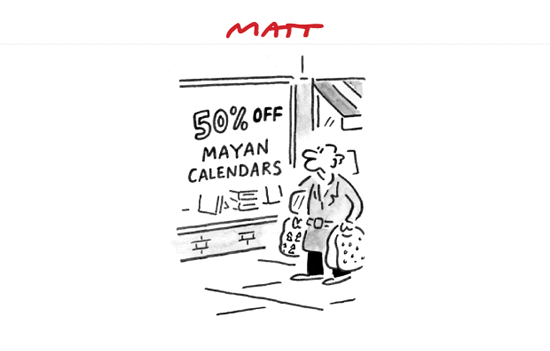
7. Did the bankers really screw up?
Chicago professor Raghuram Rajan thinks we may be blaming the wrong folks for the subprime failures - he suspects a well-meaning law, the Community Reinvestment Act, designed to get more low-income people into home ownership may have been the catalyst.
Few areas of economic activity in the United States are more politicized than housing finance. Yet the intellectual left has gone to great lengths to absolve regulators, government lending mandates, and agencies like Fannie Mae and Freddie Mac of any responsibility for the housing boom and the subsequent bust.
But bankers’ political tin ear in the aftermath of the crisis – first taking public bailouts and then paying themselves huge bonuses as if nothing had changed – ensured that they got the lion’s share of the blame, with everyone else willing to pose as their unwitting victims. As a result, the public-policy response has been dominated by “the bankers did it” narrative. The risk is that this approach is incomplete – and thus unlikely to be effective the study suggests that we should move beyond blaming the bankers.
We must recognize that in the desire to broaden home ownership, essential checks and balances broke down. Households, politicians, and regulators were also complicit. As we go about the process of reform, we should bear in mind that the only thing worse than fighting the last war is fighting the wrong last war.
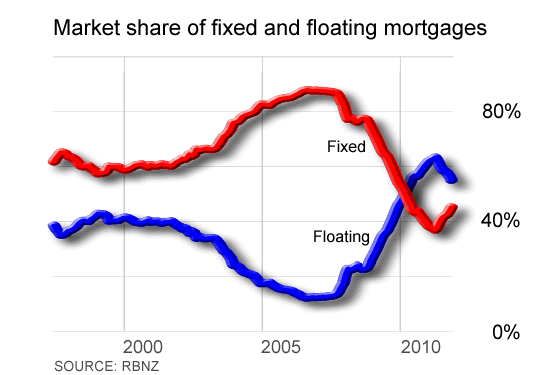
8. Moving back to fixed
We are shifting away from floating rate mortgages more to the lower fixed rate offers. In November, housing credit rose a net $934 million, the most it has risen in one month since April 2008.
9. Checking out your adviser
GMI (Gareth Morgan Investments) have put together a short checklist of things to consider before you give your money to someone else to invest. As they say, if you can’t be bothered investigating whether the manager of your money is worthy of your trust, then you run the risk of losing the lot. We have the bullet points below, but the whole two pager is worth reading.
Common sense reminders
- Don’t tell me, show me.
- If it sounds too good to be true, it probably is.
- Don’t rely on the regulator to protect your savings for you.Key point #1
Make sure no one can do a runner with your money
- Separate and reputable custodian for client assets
- Independent and reputable auditor for client assets
- More than a one-man band and clear separation of duties/tasks within the firm
- Existence of broader governance structuresKey point #2
Now you know they can’t nick it, make sure they can’t blow it all up with excessive market risk
- Transparency around the assets held and how returns are generated
- Diversified or concentrated portfolio
- Investment philosophy and processes
- Liquidity of underlying investments
10. Cost and value
"Money often costs too much." - Ralph Waldo Emerson
Overseas debt
Select chart tabs
Merry Christmas everyone. We will be back on Thursday.

We welcome your comments below. If you are not already registered, please register to comment
Remember we welcome robust, respectful and insightful debate. We don't welcome abusive or defamatory comments and will de-register those repeatedly making such comments. Our current comment policy is here.