

Here's my Top 10 links from around the Internet at 2 pm in association with NZ Mint.
As always, we welcome your additions in the comments below or via email to bernard.hickey@interest.co.nz.
See all previous Top 10s here.
My must read today is #2 from Paul Krugman on the hot money blues. I don't have a solution, but we're seeing plenty of hot money flooding into New Zealand property and stock markets at the moment...and we remain mystified by the 15% overvaluation of the New Zealand dollar and the surge in Auckland property prices...By the way I went to an auction in Wellington today where a Chinese speaking couple bid against another Chinese landlord to push the price of a Berhampore do-up property with an RV of NZ$475,000 all the way to NZ$580,000. It's spreading from Auckland.

1. How to get around capital controls - Most of the developed world having had to think about this for a long time.
Remember when New Zealanders had to apply to the Reserve Bank to obtain the foreign currency to buy a Morris Minor?
I can't, but I'm regularly told those older and wiser than me that this happened and it was a very, very bad thing that we don't want to go back to.
In Cyprus, the government and the people are having to think very hard about these things.
They are worried about everyone trying to withdraw all their money from the rubble of Cyprus' banks the moment they reopen. That's a fair fear after the shenanigans of the last couple of weeks.
Here's Cardiff Garcia quoting John Dizard at FTAlphaville looking at the various ways and means of circumventing the controls when they're imposed tonight.
Capital controls turn into trade controls, as the locals attempt to find ways to turn hard assets or non-banking services into foreign exchange. At some price, for example, you can buy a boat in Cyprus with post-haircut, capital-controlled local deposits, sail it to Lebanon, and then sell it for real, usable money. The same with antiques, jewellery, or anything else you can think of.
Even capital goods such as fork lifts can be motored off in the middle of the night. Of course the authorities anticipate some of these problems, but there are always new ones. Particularly after the initial shock of control imposition wears off, the population turns from productive effort to finding ways to game the system. Some cultures are more resistant than others to this change in character, but in all cases social cohesion and respect for law are eroded over time.
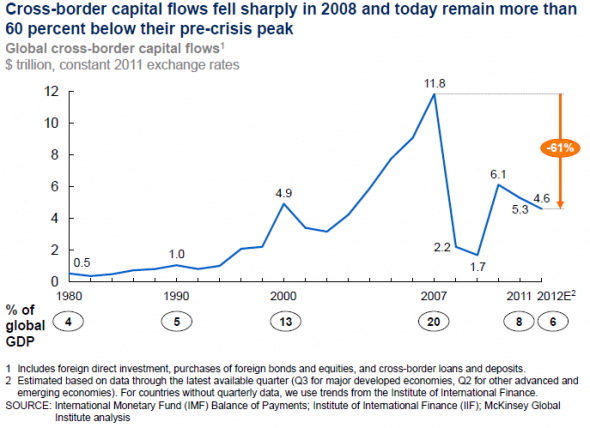
2. The end of the free movement of capital? - Here's Paul Krugman wondering if the Cypriot capital controls are the beginning of a trend of a clampdown on the amazingly free movement of capital around the globe, which seems to have coincided with the boom and bust of the last decade.
He says capital controls used to be the done thing. We tend to forget that.
It will mark the end of an era for Cyprus, which has in effect spent the past decade advertising itself as a place where wealthy individuals who want to avoid taxes and scrutiny can safely park their money, no questions asked. But it may also mark at least the beginning of the end for something much bigger: the era when unrestricted movement of capital was taken as a desirable norm around the world.
It wasn’t always thus. In the first couple of decades after World War II, limits on cross-border money flows were widely considered good policy; they were more or less universal in poorer nations, and present in a majority of richer countries too. Britain, for example, limited overseas investments by its residents until 1979; other advanced countries maintained restrictions into the 1980s. Even the United States briefly limited capital outflows during the 1960s.
That's not the sort of thing you'll hear from the Reserve Bank and Treasury here, who remain locked on the neo-liberal targets.
As a result, countries that did step in to limit capital flows — like Malaysia, which imposed what amounted to a curfew on capital flight in 1998 — were treated almost as pariahs. Surely they would be punished for defying the gods of the market!
But the truth, hard as it may be for ideologues to accept, is that unrestricted movement of capital is looking more and more like a failed experiment.
It’s hard to imagine now, but for more than three decades after World War II financial crises of the kind we’ve lately become so familiar with hardly ever happened. Since 1980, however, the roster has been impressive: Mexico, Brazil, Argentina and Chile in 1982. Sweden and Finland in 1991. Mexico again in 1995. Thailand, Malaysia, Indonesia and Korea in 1998. Argentina again in 2002. And, of course, the more recent run of disasters: Iceland, Ireland, Greece, Portugal, Spain, Italy, Cyprus.
4. Plenty of control - Ryan Avent from the Economist points out that some of the most successful (and biggest) economies have capital controls.
The world's second largest economy maintains very tight controls over capital flows. The third largest economy is actively engaged in managing its currency. The sixth-largest economy has used capital controls to limit appreciation of its currency. Many of the world's other large economies are part of a monetary union actively experimenting with a handful of financial-repression mechanisms. The International Monetary Fund has taken the official position that the use of capital controls may be warranted as a financial stability tool. And so on. I would say that the era of free capital mobility is definitely on life-support.
Now, many of these policies may be designed to be temporary. And China looks interested in gradual liberalisation of its capital controls. But there are two reasons to think that the trend will continue toward less rather than more mobility. One is that a half-open world is probably not a stable equilibrium.
5. 'The Eurozone will now slip into a Depression' - So says Matthew Lynn at MarketWatch.com.
The Cyprus debacle will deepen the depression now starting to grip the European economy. This is no longer a financial crisis — it is an economic crisis. And the collapse of Cyprus will make that a whole lot worse.
The so-called rescue will push one more country into a catastrophic recession. It will provoke an outflow of global funds from the euro-zone. And it will encourage small businesses and depositors to hoard cash. A modern economy can’t function without a healthy banking system. And after Cyprus, no bank in the euro zone can be regarded as safe anymore.
6. Another business model - This is a fun story about the dress designer Vera Wang charging US$500 for women in Shanghai to try on her wedding gowns. It was designed to discourage counterfeiters. She's just dropped the charge.
The copiers aren't deterred. Remember, this is a society built on a lack of respect for the rule of law and on institutionalised dishonesty.
Li, one seller of "Vera Wang style" dresses on Taobao Marketplace, China's largest e-commerce site, says he can achieve up to 90 percent similarity to the namesake garments without even seeing the originals. A Vera Wang original can range anywhere from $2,000 to over $10,000, but on Taobao some imitations go for as little as $100.
"For the experts you don't need to try on the dress to figure out how to copy it, you just need to see it or feel it at the shop," said Li, who declined to give his full name. Li's factory, based in Suzhou, a city near Shanghai, makes Vera Wang knockoffs from photos of her creations, then sells them online for between 600 yuan ($97) to 1,700 yuan ($270).
7. Only 25 billion pounds short - That's the amount of capital that British banks need to bring their balance sheets up to scratch...
Here's the Guardian reporting on the Bank of England's estimate of the capital shortfall. Read the article to get the tone. The politicians don't want to stump up the money or force the banks to deleverage to improve their capital ratios. This is why I wouldn't have any of my money anywhere near a British bank.
Bank of England policymakers have warned that UK banks have a capital shortfall of £25bn, after ordering them to make a more "honest" assessment of hidden losses on their balance sheets – sparking an immediate row with the business secretary over the capital hike.
The banks, and some building societies, with shortfalls were not identified but have until the end of the year to plug the gap by winding down businesses or retaining more profits. The taxpayer will be able to avoid pumping in more cash on top of the £65bn already ploughed into Royal Bank of Scotland and Lloyds Banking Group, although the focus will turn to the two bailed out banks.
8. Watch out for Cypriot credit cards - I'm halfway serious about this. The capital controls due to go on in Cyprus this weekend also look at the use of Cypriot credit cards. Here's the Reuters report.
Cyprus is set to restrict the flow of cash from the island and may curb the use of Cypriot credit cards abroad as it tries to avert a run on itsbanks after agreeing a tough rescue package with international lenders.
A Greek newspaper published details of what officials told Reuters was as yet only a draft government decree to restrict outward payments to documented imports and limit how much people could take abroad in banknotes or spend on credit cards.
9. End the petrol subsidies - That's the view of the IMF, as reported by the Washington Post. I hadn't thought of this as a solution to global warming, but it's not a bad idea.
Governments around the world subsidize gasoline, electricity and other major forms of energy to the tune of $1.9 trillion a year according to a new International Monetary Fund study that calls for that amount to be offset through carbon taxes or other means to battle climate change and other social problems.
For the United States, that would require a $1.40 levy per gallon of gas and other fees totaling about $1,170 per person to offset the full cost of fossil fuel use, including “externalities” such as pollution and steps to mitigate the effects of global warming.
Not recognizing those costs, the fund argues, has had profound consequences for energy markets and the world economy: encouraging overconsumption; leaving some nations short of funds to address health, education and other needs; and distorting investment decisions.
10. Totally Jon Stewart talking to Michael Moss about 'Salt Sugar Fat'
We welcome your comments below. If you are not already registered, please register to comment
Remember we welcome robust, respectful and insightful debate. We don't welcome abusive or defamatory comments and will de-register those repeatedly making such comments. Our current comment policy is here.