
By David Chaston
I am a regular bus user. (Jafa alert: This article is about Auckland.)
One day recently my local bus carried a house ad that said the average fare they collected is $2.10 per ride and the average subsidy Auckland Transport pays is $1.43 per ride. That makes the total actual price $3.53 per ride.
Given what I recall of subsidy levels in other cities I have lived in, that actually seems pretty reasonable. Providing bus transport is a losing proposition so non-riders (ratepayers) need to subsidise riders to the tune of about 40% of the full cost of a ride.
I like buses; they go where I need to go. Even if my needs change, I am confident they will go there as well. They provide more than 50 million trips per year in Auckland.
But I am a real sceptic of rail. I have been for a long time because of a number of reasons, including cultural cringe ("I loved the London underground, we should have that here"), twisted public policy ("lets regulate housing so that we can justify rail"), colonial attitudes ("they do it in Britain"), and cost (measured in billions and it never goes lower).
Rail is a 19th century, highly addictive drug.
There are benefits - it takes workers in routine 9-5 jobs who work in the city centre off the roads, making road travel easier for the rest of us.
But as any Auckland road user knows, these aren't the people causing traffic flows to clog our streets, it's school kids! (or more precisely, parents who insist on taking their children to school in the family car). Without exception, when there are school holidays in Auckland, traffic flows are a pleasure to be in.
So I emailed Auckland Transport to get the equivalent subsidy data for Auckland trains.
After a few email sidesteps, they coughed up the data:
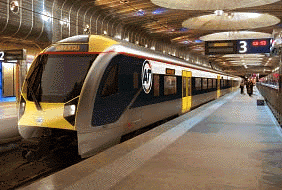
The annual operating cost of running the Auckland train system is $85.54 million, the annual fares collected are $25.86 million, and they handled 10.026 million passenger trips for this money.
So I can report non-riders are paying 70% of the cost of a train ride, while riders are paying on average $2.60 per trip.
But it is actually [much] worse than this. The bus comparison includes the capital cost of buying the buses, plus a return for the bus operators - a real cost of capital - but the train numbers include none of that.
(We should also remember that subsidised public transport is regularly - although infrequently - held hostage by unions and politicians. When we are hooked into them, the more frequent the hostage-taking. Sydney and Melbourne are the local poster-examples.)
We are spending truck-loads of public money on the Auckland train system. As far as I can see, it is at least $670 million not including Len Brown's wish for the Britomart-to-Kingsland tunnel loop which is thought to add another $2.4 billion. So, all up it is a train system that would have $3 billion plus spent on it - creating a system that struggles to get 30% of its operating cost at the farebox.
This is the capital that has been spent so far:
| NZ$ millions | |
| Cost of electrifying the Auckland rail network | 80.0 |
| Cost of the new trains from CAF | 400.0 |
| Cost of the Wiri main depot | 40.0 |
| Cost of 31 level crossing upgrades (E) | 60.0 |
| Cost of new signalling system | 90.0 |
| ====== | |
| Total direct cost of just these 5 components | $670.0 |
(These costs don't count the $200+ million Britomart train station.)
Assuming this system has a practical life of 50 years, and a realistic cost of capital of 7.5% (although it probably should be twice that level if these projects were in the real world and not being foisted on powerless ratepayers), then the current annual operating costs need to have $15 million of depreciation and $50 million of 'cost of capital' added to them.
When you do that, we find non-riders are paying a whopping $15.05 per ride of the total $17.65 ride cost.
Just limiting yourself to Auckland's transport problems, you have to ask whether spending $670 million, and thereafter losing/subsiding the system at the rate of almost $125 million per year is a good public policy choice. Talk about bequeathing a debt burden to future generations!
Many other things could be done, starting with turning away from the obsession with trying to get commuters on to Queen Street.
Perhaps ridership will rise after the new investment makes this 19th century travel option come on stream fully. But you just know the only certainty will be the call for more 'investment' in the system with all eyes turning to the $2.4 billion, 5km rail loop. Rail enthusiasts won't give up until they have their version of 'little England' implanted here.
But they will point out that we are spending too much on our roading projects, and there are a number of these. Here is a list of the big ones over the past ten or so years:
| NZ$ millions | |
| SH16 Causeway upgrade | 100.0 |
| SH20 Waterview connection | 1,400.0 |
| SH1 Newmarket Viaduct replacement | 150.0 |
| Northern Busway | 300.0 |
| SH1 Victoria Park Tunnel | 340.0 |
| SH18/SH16 deviation and extension | 220.0 |
| SH20 Manukau harbour crossing | 230.0 |
| ====== | |
| Total direct cost of just these 7 components | $2,740.0 |
| The system is maintained by the Auckland Motorway Alliance, cost over 10 years | 100.0 |
There are 1.4 million vehicles in Auckland and they make 900,000 trips per day just on the motorways! Even if they only make an average of one journey per day off the motorway system, that is a total system that provides 450 million journeys per year. (Unfortunately too many of them are for taking school-age kids to and from school.)
Aucklanders pay about $1.56 billion per year in petrol excise taxes and road user charges (RUCs), plus another $230 million in GST when they buy fuel. That's a way better contribution rate than either buses or trains. I am sure many of them want less people on the roads when they use them, and getting 'others' to take buses and trains seems like something worth paying for.
But do we realise how much we pay as a non-rider?
Travel 100 km, and it will cost a driver about $77 (if you accept that the IRD reimbursement rates cover all costs). It will cost a bus rider $42 plus the ratepayer another $29, for a similar total of $71.
But the 100 km numbers for train travellers are quite different: the rider pays $52 while the non-riding ratepayer is paying $248 for a total of about $300, or more than four times the costs of driving or taking the bus.
Trains add cost, and it seems highly doubtful expanding the 'investment' in fixed rail infrastructure will add any productivity improvement to the Auckland economy.
| Costs to ride 100 km | Car | Bus | Train |
| $ | $ | $ | |
| Paid by rider | 77.00 | 42.00 | 52.00 |
| Subsidised by taxpayer | - | 28.60 | 119.00 |
| - plus depreciation and cost of capital | incl. | incl. | 130.00 |
| -------- | -------- | -------- | |
| Cost of 100 km trip | 77.00 | 70.60 | 301.00 |
| of which ... | |||
| Excise/RUC/ETS paid by user | 8.96 | 8.24 | ? |
| GST paid by user | 10.04 | 5.48 | 6.78 |
| -------- | -------- | -------- | |
| Direct taxes collected by Government | 19.00 | 13.72 | 6.78 |
Auckland Transport annual reports have details of what ratepayers spend on road, bus and rail operations, plus what is being spent on capital works. Central government funding flows though Auckland Transport for many projects, in addition to direct New Zealand Transport Agency (NZTA) funded projects. It is a very big system.
In 2012, Auckland Transport had gross operating income to run the system of $755 million, of which ratepayers contributed $323 million, central government contributed $261 million, and "public transport income" of just $46 million (Note 4). Things like parking fees made up the difference.
In 2012, Auckland Transport spent $592 million in capital projects, $397 million on roads, and $166 million on "public transport". This was funded by by Auckland Council to the tune of $481 million, and $76 million by central government.
81 Comments
David
I see the only reason you love buses is that you use them but they suffer from the same delusion, They are marketed as a green solution but are actually a eighteenth century social service. Why should they be subsidised? because they are cost effective transport..clearly not..because they are energy efficient..no, they are simply a stopgap which extends BAU for a little longer, whilst auckland has a density less than LA they will never be effective and in a modern city there would be better solutions.
Its nice to see someone call trains for what they are though a 17th century invention embedded in the psyche of many a boy
Neven
"Why should they be subsidised?" Well many older and poorer cant afford or have a car, so yes as a social need.
For peak rush hour transport ie when full I think the numbers will show they are greener than individual cars, the problem is I see them running around empty in the afternoon picking up the very occasional OAP who with a gold card get it for free. this clearly is not green or cost effective. They should really switch to a shuttle sized "bus" and even then......I suspect a 1600~2000cc hyundi diesel car would be big enough.....ie only one or two on it.
Trains, yes in NZ they make no sense and light rail at $4500 a metre doesnt either....trolley buses however, yes, anything that provides a transport service without the use of diesel / petrol is good news IMHO.
regards
Steven
It would be cheaper to hand out Taxi chits to the poor and disenfranchised than justify a whole infrastructure based on this. Bear in mind road damage is the fourth order of axel weight so even the rush hour aguement is dodgy. My preference is for smaller compact communities where travel is not a basic requirement as it is now in auckland
taxi chits, sort of, the answer is then of course the demand for any free product is infinite....hence there has to be a cost.
I doubt the rush hour axle wear is a worry, buses are significantly lighter than what the road is designed for, but interesting point, I recall no comment on a raod wear allowance. Take a full bus of 50 ppl v 50cars though? interesting one to find an answer on.
Your preference is what I think we'll see in the future, really its back to villages and twons and cities as hubs it was like that because of energy. However there needs to be a huge mindset change and no one right now want to change, or even know/accept they have to.
regards
Ironically, "car dependent" and "walkable" urban form are two points on the same scale - which is "dispersed" urban form.
Trying to concentrate population on rail corridors and centralise their destinations, causes such distortions to property markets that people are "priced out" and end up travelling further and further. Who can walk to an Auckland job if the only house they can afford is in Thames?
Think of the USA's highly dispersed cities with very low land costs, and next to no commuter rail corridors, as potentially thousands of walkable villages side by side. If you get a CBD job, CBD apartments are one fifth the cost of Dorkland's. "Inner" suburbs are one third or one quarter the cost of Dorkland's. A house handily located to a suburban node of services, is one third or one quarter the cost of Dorkland's. If you want efficiency, you don't have to be a yuppie to pay for it.
"Smart growth" with inflated land costs (as a consequence of growth containment) only ever creates de facto gated communities for the very wealthy where all the best locations are, by pricing the hoi-polloi out.
I agree on new trains, i simply cant see them adding up....and as for light rail at $4500 a metre installed, uh no....madness, not when we can do trolley buses for a fraction of the cost.
Though bare in mind the scenario I often quote, fossil fuel price and even scarcity...I honestly think we'll see rationing....
regards
Problem with rail is that if you are living away from the nearest station you still have to get there by bus, drive, walk.. For Auckland rail loop in particular, it would be better to limit the traffic flows into the CBD and then run bus (or trams) shuttle system, like many Europeans city and Melbourne.
Also, hardly any rail systems that make a good profit! most are relying on govt subsidies.
Are there many roads that make a good profit?
Car drivers do not get 70% plus of their total costs - car, petrol, insurance, repairs and maintenance - subsidised. Why should rail riders be subsidised by more than about the 5% subsidy that "free" roads represent to car drivers?
How many of the taxpayers who pay for roads, are not car drivers; versus how many of the taxpayers who pay for the commuter rail subsidies, who are not rail riders?
That is an understatement, mate. Possibly only Tokyo and Hong Kong have commuter rail systems that cover their costs in fare revenue. Even the famous European ones, and NYC's one, are about 50% subsidised.
We have to ask David the question:
There has been a lot of discussion, here, for a long time, about energy-availabiity, and the impact which depletion would have on (a) finance, (b) doing stuff like travel (c) infrastructure-material availability (d) future work habits.
None of which were mentioned, apart from a glancing "assuming this system has a practical life of 50 years"
Yet "productivity improvement to the Auckland economy" is the presumed - and ultimately impossible - goal.
Actually, the bitumen-replacement question raises it's ugly head in a 50-year scenario, as does the fuel used, as does the carbon-sequestration of concrete. Steel-on-steel will always be the most efficient land transport, diesel-electric ditto, but even it needs ballast, sleepers, track, culverts, tunnels and bridges. What it 'costs' will get lost in the coming melee - it's what you have, whether you can run/maintain it, and if it's still going to be relevant, are the questions.
David Chaston
I got 5 questions for you
When was the last time you took the following commute trips exitting the city at 5:00 pm
- - Train travel City to Ranui
- - Train travel City to Pukekohe
- - Road trip via Southern Motorway
- - Road trip via North Western Motorway
- - Road trip via Harbour Bridge to Devonport
Be honest now
What percentage of total travel is done on the congested central parts of the network anyway?
You might be surprised how low it is. The majority of travel, to and from dispersed destinations, is an unnoticed success story, because it is so successful.
The least congested cities in the world are the lower density ones with low land costs and high level of dispersion of employment.
Increase the dispersion. Trying to decrease it specially to create a radial rail system that will still only be used for a minority of total travel, is backward and irrational. The funds should go to dispersion based on roads.
The nail just got hammered!...the real question David could have asked..."why are we still insisting on bringing all the little peasants together to indoctrinate with the lastest mush...why in the 21st century, are they not learning from home?"
That would take how many heaps off the Auckland roads..and free up how much land currently built over with 19th century skool piles...freed up for housing and parkland...
Thems what fails to get passed the 'can you read this?' stage, would be dragged off to high rise skools.
If you treat buses like you do trains, buses can become a solution almost as good as trains. If Auckland Transport made the following changes to the major bus routes (there are probably say 20 of them) then I think they would at least postpone the requirement for the city loop:
1) Have proper dedicated bus lanes operating a minimum of 6AM to 8PM 7 days
2) Use bendy buses which can carry almost twice as many people per bus
3) Remove 2/3 of bus stops - trains don't have stops every few metres which is why they get from A-B so much quicker
4) Get rid of cash fares, you must either use a HOP card or pre purchase a cash fare at a machine at bus stop or at the local dairy
5) Use an honesty system (with regular inspections) so you don't need to have everyone queue up to tag on beside the driver. Big double doors open up on side of bus so many people can get in or out at once,
6) Change the routes to make them more direct
7) Change the payment system so the bus users get the same subsidy as train users, making buses much cheaper than trains
8) Look at over passes or under passes at very busy intersections
9) Look at electrifying the main bus routes - either through overhead wires or at least hybrid buses
Changes 1-7 really shouldn't cost much at all. Change 1 is the main change; it hasn't been done because business owners have complained about the car parks in front of their shops being changed into bus lanes (even though the council has offered to replace them with parks in side streets). Spending billions of dollars on trains just to keep a handful of car parks seems absurd.
In terms of the business case for rail, think of it this way - how many cities that have good rail would give it up for a few billion dollars? Not many I would think!!
Curitiba's bus-based system was once the envy of anti-car activists all over the world. Somewhere along the line, the memo went out from the Komintern that buses use roads and represent too much freedom.
Buses and trains are so out of date...the in way is the electric powered sidewalk...just step on and enjoy the breeze.
Careful, DC, you're talking sense. Folks will Take Notice.
The issue with rail is also very basic (despite the esteemed PDK's notes re steel on steel efficiency from an energy POV).
It is simply that it cannot deviate from the tracks. (Unless it has a wish to feature on 'NZ's Worst Drivers')
Whereas busses, cars, tradesperson's vehicles etc frequently need to go where the Tracks are Not. Or so I'm reliably informed.
Rail started out from the plateways laid between e.g. quarries and canals - a production point or a factory point, and transport. They are still stuck in that mode.
The purest current example of that in NZ is the long haul from West Coast mines above Westport, all the way to Lyttelton for export of coking coal for steelmaking.
Do railways work for a multi-villaged city, with a casualised/part-time workforce, with Saturday sport for kids, surfing at beaches (where there is a noticeable absence of railways), etc etc? Not well, except as part of park-and-ride or hub-and-spoke. But that implies a degree of joined-up thinking that tends to elude the Transport elite.
A good article....
Where you fail of course is not going very, very basic, you assume oil. So yes sure it cant deviate from the tracks, hence everything else has to work around it, or not work. Cars if you understand doubling time, and you seem to, have maybe 15 years for most ppl.
regards
"......So yes sure it cant deviate from the tracks, hence everything else has to work around it, or not work....."
Important point. So you'd nationalise the land around the rail routes so the owners of the property don't "gouge"?
Why do you think the situation ever existed, that the land owning class reaped most of the gains in incomes, via "rent"?
Perhaps the land owning class quite likes urban planning that restores this condition?
Include nationalisation of their land in your scheme to "save the planet" and you might be showing a bit more understanding of how economies work.
But in any case, what jobs would people be catching trains to, in an economy without energy? Wouldn't most people need to be in survival mode on lifestlye blocks, like PDK?
Heres a simple analogy from a fairy tale
"The Emperor's ministers(read councillors) cannot see the clothing themselves, but pretend that they can for fear of appearing unfit for their positions and the Emperor (read : Len Brown) does the same."
A child then says " the Emperor has no clothes "
Thats an extract from a synopsis of the 1837 fairytale by Hans Christian Anderson the EMPERORS NEW CLOTHES
Its analogous that David Chaston has just pointed to out the Auckland Council and Len Brown that the " The Emperor has no clothes "
Its time to move on from this nonsense about a rail loop , and sort out Aucklands road chaos before it starts to negatively affect our economy and productivity
Its time to recognise that trains are archaic monsters , neither efficient , nor at todays cost structures , viable.
And Len Brown must go!
I've said it before and I'll say it again. In my travels around the world there were two kinds of large city: those that had proper rail and those that didn't. We had another term for it: cities without good rail 'sucked' and those that had it didn't.
David's missing one big cost - that of peoples' time. In a city with good rail, there is no faster way to get around. You CAN'T sort out roads - they will never be good enough - just ask anyone in L.A.
As the city grows, something must be done. It's expensive, but unless some new technology turns up it's the best option there is. Perhaps people should have a good think about why rail is so expensive and innovate to reduce the cost.
The population of LA is 12 million. The population of the Auckland Region is 1.4 million.
Comparing Auckland to LA is absurd. Auckland is not a 'large city' and thus rail is not going to be cost effective.
Yes but Auckland's trains are going to cost about $3billion - I would imagine to put enough trains in LA would be more like $100billion.
I doubt you could spend $3billion on Auckland roads and make as big an impact on average travel times as you could by doing the rail loop.
The cost of $3 billion is deferred expenditure - it's a one-off - it should have been done years ago - and needs to be offset against the costs to productivity of the work-force sitting in commuter traffic
Excuse me, it is investment in ROADS that is more like "one off". Commuter rail requires operating subsidies from there on to eternity, that are so expensive people might as well be using cars. Better to invest the money in road lane miles, and dispersed urban form.
I am opposed to massive highways radiating out from CBD's, by the way. I say get the regional network right and replicate the highly successful cities in the USA where they are like a whole lot of small, well-functioning cities next to each other. Akl already has reasonably dispersed employment and this should be "run with" by the planners, not resisted just to create rail corridors. This is "tail wags dog" physical determinism. How do you know you even have an economy that suits this form? Most cities don't.
It is almost like saying water is more expensive to provide than buying coke from the supermarket so we should all drink and shower in coke.
Andrew S you are so right
Another selective one-dimensional Chaston proposition that ignores one vital aspect - the future
Here you go
Melbourne has excellent roading infrastructure
Melbourne Rail - 222 passenger trips per year
http://en.wikipedia.org/wiki/Railways_in_Melbourne
The metropolitan roading transport system is on its knees
If the rail system was closed tomorrow and 222 million passengers trips were tipped out onto the roads and buses the city would become a zombie city. It is totally reliant on it rail system.
Auckland Rail - 57 million passenger trips per year
http://en.wikipedia.org/wiki/Public_transport_in_Auckland
Read the blurb. Auckland rail has only two rail corridors yet carries 57 million passenger trips a year, more than Chastons 52 million bus-passenger trips per year. If the Auckland rail system was closed tomorrow and all the passengers were tipped out on to buses - what would happen? - would Auckland cope? It's not coping now.
Aucklands road networks are at absolute capacity now
Aucklands population is growing
The road system can't even cope now
How will it cope with future growth?
There you go Mr Chaston
What about tomorrow, and next week, and next year, and 10 years down the track?
Where are you going to put them?
Melbourne is a good example of a big city rail system. Auckland is not a big city.
Rail along high density corridors makes sense, putting rail everywhere does not make sense.
Its the same with bus routes and timetables, running half empty buses does not make sense but since you have the driver for the whole day anyway...the buses run empty.
Do that with rails and trains and it gets very expensive fast.
The best thing to do is remove the subsidy, then we'll see where the need actually is. Pay the poor directly with a tax credit instead of subsidizing every ticket sold. I don't need my bus ticket subsidized but my neighbor might.
Where do all the cities in the USA that are one half to one third Dorkland's density, and have next to no commuter rail system, put all these car drivers?
Indianapolis is about Dorkland's population, is one third the density, and has well under half the traffic congestion delay. Its house prices are also one third Dorkland's, for bigger and better homes.
It is just absurd to be wasting so much money on commuter rail systems that are an ongoing cost, when road lane miles could be built and would be there forever at very little ongoing cost. This is why the US's low density cities are actually among the world's most economically productive for "average" cities. London, Hong Kong etc are unique outliers - density most of the time correlates to reduced productivity, housing affordability problems, social immobility, traffic congestion and local pollution.
"Dorkland' ?. And you strive to be taken seriously. Wanker.
I live in Tititrangi and the buses here are a real problem for the following reasons:
1) If you want to get to the CBD you have to catch a bus to New Lynn first, then stand around waiting for another bus or train.
2) I have never seen any more than 2 people on any one of these buses, they are normally empty. They are painted all green and contain text stating what a green option they are. Well they're not very bloody green if they are chugging around the hills here with virtually no one using them.
3) The roads around here just can't accommodate them. They can't get around the corners without taking up both lanes, forcing cars to the side of the road! If buses must be used in this area, they need to be half the size. In fact given no one uses them, a 4 door car would do.
4) They are easily the noisiest thing in this area. They start at around 6am and you can hear them straining up the hills, engine and full revs.
5) They put out heaps of diesel fumes. This is again because of the hills and again is not at all green. Makes it really unpleasant if you are walking or riding in the area.
I live in Mt Roskill and the buses are all standing room only and there is a bus every 5 mins in rush hour - imagine putting all of those people into cars!
They should get rid of the seldom used bus routes and make the ones that do get used much better.
David I am not sure if rail is economic or not but your article doesn't tell us. You are just comparing average costs of buses versus trains and that doesn't give the complete picture.
Roads are public goods in the economic sense (look it up). More than one user can use it at time. The more users you have the easier it is to repay the initial investment of building the road. The problem is that if demand grows too much then you reach a congestion point where each additional user lowers the value to all other users by causing delays etc. At this point you need to invest in a bigger road, or vehicles that carry more passengers i.e. buses or an alternative system like railways.
Obviously you will choose the most cost effective transport system first and as that reaches capacity then the next and so on. So comparing the average costs of the first generation public investment, -roads for private car transport with 2nd and 3rd generation investments in buses and train is not really valid.
What you need to look at is what is the next transport system we should add to our transport system now that we have reached capacity with our existing system.
Thank you, Brendon! Perfectly explained.
So David, the BIG question is ... what next (given the already over-capacity road network)?
It should be your follow up article.
Give him a thumbs-up, Kate. It was an excellent comment. Brendon has nailed it.
There are grossly distorted comparisons being used to compare the costs of roads versus public transport. "Initial versus ongoing" is one such absurd comparison.
Chaston is right - commuter rail is like the "Concorde Project". It costs a packet to build, and it costs a packet to run, and it never pays back a cent, and cannot possibly capture positive externalities sufficient to justify the cost.
The other absurd comparison is "roads are subsidised, therefore public transport should be too".
We are talking about two systems here. Both have "rolling stock", running costs, depreciation, insurance, repairs and maintenance. Car drivers pay for everything except some alleged fraction of the cost of the roads they drive on - which is less than 5% of the costs of the system that they DO cover. And those paying the "subsidy" are largely drivers themselves anyway. There is no such "fit" between the payers of rail subsidies, and the direct beneficiaries.
Commuter rail riders, however, get subsidies of well over 70% of the cost of the entire system - the rolling stock, the running costs, everything. The only reason it might cost $3.50 to ride a train from A to B versus $12.00 to run your own car (total) is that ratepayers and taxpayers are paying most of the cost for you. The $ cost is actually very close, ALL UP, for running an average car with only one person on board, and the rider-km cost of commuter rail.
There is also a social justice issue in that rail riders generally are above-average-income CBD workers. And the subsidy of their transport costs capitalises into higher property values for CBD property owners.
It is one of the biggest hidden rorts in the entire socio-economic system.
I can think of a bigger rort - urban sprawl being subsidised by rate payers and taxpayers while intensification is restricted by absurd density limits and height to boundary limits.
Please add the huge costs of the free Park & Ride facilites at multiple stations to the costs of the train and buses plus the very expensive busways.
Motor vehicles win every time !
Not every time - you can't tell me London or New York would be better off without the Underground or Subway?
There comes a time when the current roads are full and there is no more room to add new roads. This is when rail starts to make sense. Auckland it pretty much at this point now, and definitely will be in ten or so years time.
Jimbo, no city in the world has "become like London or New York". You need London or New York's other reasons for existence, and evolution to what they are over centuries; and you can't plan this.
No city in the world is going to become denser and denser and denser, piling people on people on people on its existing footprint. London and New York are both nowhere near as dense now as they were a century ago. You have to have had the density in the pre-modern era, and then have retained it due to the nature of your urban economy.
If you haven't got Wall St, forget about being NYC. London has even more "global finance" than NYC has, as well as having been the capital of the nation that once had the world's biggest empire, for centuries.
The third world's cities will NOT predominantly become replicas of London and NYC. They will either stay slum-ridden hell-holes, or they will latch on to dispersion at lower density. The "first world's" cities, NZ's included, will not become replicas of London or NYC either. If you enact policies like the UK has, to constrain urban growth, your cities might become like the UK's cities OUTSIDE of London. Good luck to the residents of the grossly overpriced grimy row-houses in another few decades. NZ, the way you want it for your descendants?
Ok, would Melbourne be a better place without the trams? Was Vancouver before the sky train? Was Auckland a better place when the trains stopped a 6pm (about 10 years ago). Is there a single city that has good train links that would be a better place without them? Let me guess Houston doesn't have trains and it is the best city in the world, right?
Houston does have some trains ; )
http://www.youtube.com/watch?v=OwcYcedLxZc
http://www.khou.com/video/featured-videos/Dash-cam-captures--203116621.html
Jimbo asks: would Melbourne be a better place without the trams?
I reckon Trams in Melbourne are the biggest menace to traffic going around .. unbelievable bottle-neck to traffic .. tram-stops every 200 metres .. cars can't undertake at tram-stops .. a wonderful incentive to drive cars off the road and encourage drivers onto trains
News alert: Sydney has today announced they have let a multi-billion contract to Leightons to build the new north-west rail corridor. Makes you wonder who is right doesn't it?
Trains ! Dont forget the new trains drama in Wgtn - costing an absolute fortune,when they arrived, the geniuses that puchased them didnt allow for the fact that they used heaps more voltage then old ones so a whole lot of extra power substations had to be built.The Johnsonville tracks are so steep and tight curved that the new trains emit a horrible wail from their wheels which has got the local residents so uptight they have regular Train Meetings to plead with the experts for a decent nights sleep.
And no one has ever complaind about a new motorway being built?
I seem to recall that the Easter Islanders cut down their trees faster, to move more statues, to appease their gods, who would presumably help them get round the problem of not having enough canoes or firewood.
Probably lost on you, gonzo - but some of us ask with what repetition and severity that kind of event will reocurr, given that the line has been just fine there for how long? And we note the cause won't have been the renewable-energy-using portion of our transport system.
Good luck with that.
The regional council assures ppl that the squealing has been fixed....
;]
BTW, "heaps more voltage" no, I believe it was the braking re-generation feedng power back in as the main issue?
Looking at the timetable the trains start at 6.04am and finish at 1130pm...
regards
The level of subsidy in Wellington is similar to what Chaston calculates for Dorkland. Except on the J'Ville line, it is several times as high again.
I don't know why you and PDK bother to defend rail based commuter transport. It isn't even more energy efficient than currently-common small cars, per rider km.
"Steel on steel" is more efficient? Hulls on water are even more so. Bring back canals....!
Problem: the energy efficiency of a full vehicle in motion does not determine the efficiency of the entire system. Rails superseded canals and waterways as a transport mode. Rubber tyres on roads superseded rails. The Kondratieff Cycle for rails peaked in about 1950. There are sound economic reasons for this evolution, seemingly in the direction of inefficiency if your viewpoint is limited to "bogie level".
Waymad has a valid point - rail was point-to-point. But what, say, Sydney has, is a central-hub spider-web, and can't be described as point-to-point. It works, and works well.
It is a mistake - or is a purposeful fudge with an ulterior motive? - to confuse economics and economic 'cycles', with physical efficiencies. The 'sound economic reason' was nothing more than the temporary availability of Fossil Fuels. Steel-on-steel will always beat deforming-once-a-rev rubber, the loss is - as usual - in the form of heat. The source of said heat, was the fuel in the tank.
Shipping (ocean) is more efficient, and I champion same. Canals require embedded energy in the build, and the dispacement-vs-time issue is a pertinent factor; the water ahead of the craft has to end up behind, an energy-sapping condition that open-water craft don't face.
Using cost benefit analysis to determine what services should exist within a city can be very limiting.
Imagine if cost benefit analysis was done before installing water and sewer systems in a city - they would probably find it cheaper to drink bottled water and user port-a-loo's.
Society would not exist as it does today if everything was costed and user pays. Luckily the generations before us had more sense!
The simple fact is that when a million more people move to Auckland and there is no other option but to use the already at capacity roads, it just isn't going to work, and no amount of cost benefit analysis will change that.
". . . the Earthship is the epitome of sustainable design and construction.
No part of sustainable living has been ignored in this ingenious building."
So maybe try alterntaive thinking. These catch their own water and treat their own sewerage so that is 2 pipes saved....many also collect/make thier own power.
The 2~3 generations before us had cheap energy to waste, the 2 or 3 after us (and even us soon) will not.
regards
Jimbo, it is not necessary for all new residents as a city grows, to use the same roads.
Why do you think a city like Houston has 5 times Dorkland's population, is one third the density, and average commute to work times are 28 minutes?
I bet Dorkland's are longer. Dorkland's congestion delay per 1 hour of driving is higher than Houston's - in fact it is higher than LA, which is the USA's worst. LA has 12 times the population, and is the same density as Dorkland; which is the highest density in the USA. Higher density correlates with Carmaggedon, not low density a la most US cities.
Think of a free-market city as a collection of many small, well-functioning cities adjacent to each other. Most people in such cities never go anywhere near the centre or the other side of the metropolis.
Easy to have a job out of the city when all the jobs involve working on an oil drill...
You forgot to require the capital cost for the land needed for cars (roads plus parking). Cars must use around 90% of the roads. The capital cost of this must be at least $10bn a year.
Lets face it , we would sooner give up Rugby , than our cars . We are never going to get everyone in Auckland into trains and busses , and the Unitary Plan fails to recognise these hard realities
Simply , the whole of Len Browns Unitary plan is a joke . Its got more holes than a kitchen sieve .
I have read the Unitary plan document cursorly , its Glossy , its vague , full of flowery language, has plenty of nice pictures of families on the beach and farmers on quad bikes , and sprinkled with nice- to have stuff , but most importantly thin on hard details
The rail loop is for a tiny % of the city's residents , leaving out massive areas such as the North Shore and the outer West. Its not economically viable and wont pay for itself .... ever.
No cognisance is taken of the fact that most Kiwi's( me included ) are in favour of more busses ,thats because we want fewer cars on the road. I wont use the bus however , I want everyone else to use the busses so there is less congestion .
The Unitary Plan is all for densification, doubling the population in some suburbs , but makes no mention of the need to enlarge the existing schools .
It also makes no mention of the fact that the drainagle and sewer systems in the older suburbs wont cope and will need to be re-built .
And the roads in those suburbs to be densified already cannot cope
Well bye bye rugby then, then cars.
Right now I know ppl spending $100~$150 a week in petrol to commute, at $2, how will they cope at $3? or $4? or what happens when we see rationing? simple really...
regards
car-less days again, mucho car-pooling
Which potentially takes 75% of the cars off the road...whats not to like, not much of a rush hour...
regards
The reason there, Steven, will be the urban planning racket that forces people into long commutes. They will be paying more for their housing, too.
Cities where the housing is one third the cost AND people can afford something closer to work, will be functioning quite productively decades after NZ has inflicted an economic Darwin award on itself.
Check out:
http://www.tomtom.com/en_gb/congestionindex/
http://www.realtor.com/realestateandhomes-search/Indianapolis_IN
http://www.realtor.com/realestateandhomes-search/Salt-Lake-City_UT
http://www.trulia.com/PA/Philadelphia/
Jeepers Boatman what are you grizzling about - you've done alright
Last really big infrastructure was the Auckland Harbour Bridge, then later they removed the tolls for you, then you got the Greenhithe Bridge doubled up right outside your front gate (do not forget that) then you got the upper harbour crossing right past your front door, and then last but not least they spent $500 million on your own personal tunnel under victoria park to get you home faster
Quite right!
And dont forget those double decker buses that have just been bought for that selfish lot over the shore!
Rugby nerds are too simple to be allowed to drive.
The rugby nerds who wear rugby jerseys when they have no intention of playing rugby, should only be allowed to do this in their own homes or at those 'sports' bars.
Certainly no rugby nerd jerseys on public transport.
Agreed. The population is not dense enough for rail to work. Buses are a good option as designated bus lanes can be built around congestion points and the buses can, of course, go on normal roads around the residential areas to ensure the service is easily accessible for all. People won't use a service if it's not cheaper and easier than driving. Even if you put rail in place, people will have to drive or bus to get to the stations.
Lets not forget ferries, there are a few great ferry services already in place in Auckland and there's no congestion in the gulf.
It is certainly dense enough, and the population is getting denser every single day from what I observe
I'm going to guess that the subsidy figures given to DC for Rail included amortization costs based on revaluations of land and tracking that has been in place and paid for, for over 100 years. And I'll guess further, the Bus costs do not include any share of the roading costs the buses use and run on.
Buses pay Road User Charges.
Road congestion pricing should be the next incremental investment.
Until we are using the existing infrastructure at near capacity there is no need for massive investment in rail of a highy debatable value.
Incremental bus services with their point to point operations and flexible routing should be next. We have a long way to go in exploiting incremental capacity in busses long before new train investment is undertaken.
Why are McDonalds playgrounds free? Why are McDonalds toys for kids free? Why do they provide clean bathrooms? Because they give things away and provide free services in order to ultimately do well financially. And they do, do well financially
The roads and bridges in Auckland (and NZ) already exist. They are crowded because people are misusing their cars. (Cars should be used for trips to out of the way places or for picking up or delivering goods or for travel at odd times of the day or night, for going on holidays or adventures). Cars should not be used for commuting. It is wrong thinking..
Building more rail lines, roads and bridges- or bulldozing housing/bush/farmland to build rail-lines, roads and bridges, JUST because we are misusing our wonderful cars (for a purpose that they are hopeless at, commuting), is compounding an error
so
(1) Buy/build thousands of modern buses. The seating must be as comfortable as the front seat of a modern car. We could look at hybrid buses for the inner city (diesel electric). The bus ride is now as comfortable as a car ride.
(2) Make all fares a gold coin donation, (we are a South Pacific culture) thrown into a funnel. No mucking around with tickets. No one is excluded. Taking the bus suddenly becomes way cheaper for everybody than driving. (It is much cheaper for me to drive my car that to take the buses in Dunedin)
(3) Have fast, free wi-fi on every bus. Taking the bus is now relaxing and entertaining
(4) Have bus company vendors get on and off of buses with coffees, sandwiches, pastry, sushi, cold drinks etc. There could be depots along the main bus routes so the vendor could get on the bus, ride for so many stops, get off at another depot, replenish supplies and catch another bus back to the original depot. The bus company could make the majority of its income from selling food and drink and bits and pieces. The bus is now a place to have breakfast or lunch or even dinner or late night food.
(5)People still have to walk to the bus and from the bus to their destination- so the use of buses becomes a key in the battle against obesity, diabetes and heart disease (metabolic syndrome)- ALL of which respond positively and quickly to regular physical exercise. Design exercise into our daily lives- do not make it extraneous! The savings in health care costs will be billions of dollars. Also, there is a correlation between exercise and increased productivity (It helps the NZ curse of brain fade).
(6)Our present digital culture is increasingly isolating people. Watch the hundreds of thousands of people sitting alone in their cars, listening to the radios, getting frustrated and wound up in traffic, as they commute to work/activities. Increased use of buses will decrease isolation and stress. We are social animals.
(7) We will use our fuel stocks more efficiently, our balance of payments will improve, CO2 emmisions will decrease (delaying the Appocolypes) helping us meet any climate change promises we have made, air quality in cities will improve, (decreasing lung disease)
(8) It is scalable. Start with the busiest, easiest routes and expand as the bugs are ironed out. (9) It is low tech. The plan could be implemented tomorrow. All of the technology is reliable, inexpensive and proven. Almost all of the infrastructure all ready exists. (10) View the proposal the same way one would view a gym membership- It doesn't really cost you money, you are saving money in health costs, increased life expectancy, quality of life, hot water and transport (if you start walking/cycling everywhere). The nub (as in all things) is how you do the accounting!! (11) Use some of the billions of dollars saved to build dedicated bike paths and lanes in our less crowded roads
I read that Government were projecting spending something like $60,000,000,000 for Auckland's transport needs. Why not spend $1,000,000,000 (two thousand $500,000 buses (very nice buses!) and we could use some of the saved $59,000,000,000 to do other things- like build apartments?
This is my proposal. If you have anything to add or any questions, please pipe up!!! Everyone can still have their cars for tasks that a car is good for (holidays- adventures- pick up delivery). When we do use our cars, it will be more enjoyable- because the roads will be un-crowded (except for the beginning and end of big holidays)
The key is too make the bus trip as comfortable as a car, AND more relaxing, experientially richer and much much cheaper than driving. Who wouldn't want to get driven to work as they drink coffee, munch on a pastry and watch youtube on their tablet? What a life! And it costs bugger all.
(We should also remember that subsidised public transport is regularly - although infrequently - held hostage by unions and politicians. When we are hooked into them, the more frequent the hostage-taking. Sydney and Melbourne are the local poster-examples.)
Who captured Richard Branson's Virgin Rail? - was it not him capturing the taxpayers?
Read these three Guardian articles in succession - a great effort by the jounalist.
The First - I once called Richard Branson a carpetbagger. A new report reveals that I was correct to say he built his business empire with millions from the taxpayers – only it's worse than I thought
The Second - Chakrabortty claims "the only way Branson and the vast majority of train barons make their profits is through handouts from the taxpayer". This misrepresents why subsidies were paid in the early years of the west coast franchise, when it was heavily loss-making and costing the taxpayer a fortune. The subsidies were calculated by government to cover losses in those early years and ensure a regular service could be maintained while the track was repaired and before we could start turning around the franchise.
The Third - Richard Branson didn't like my column about his rail company – but he can't deny that taxpayers are piling up debts to subsidise his profits - The rich are different from you and me: they hire PR advisers. As night follows day, any criticism of Richard Branson will be met with a fierce counterblast from his troops.
David,
Very good article, thanks,
Have personally liked the idea of a good train system in Auckland, primarily on the basis that the status quo transport system is often clogged, and the thought of adding a million people to it is not a nice thought, without something relatively radical in transport arrangements. And then we are all informed to some extent by our experiences in other cities, a number of the more successful of which do have train systems. Is this cultural cringe, or just looking for a solution; it doesn't really matter, but I don't think its cringe. Separately I don't think Southern Motorway snarl ups are all school children transport.
Neverthelss the operating costs you've uncovered are considerably higher than I would have thought- I always imagined rail as a high capital cost, low operating cost model. And while I doubt you are advocating getting rid of the rail we do have, any significant new developments would really need to show how they could be run with significantly lower operating costs, or we will need to manage with buses and cars.
There are so many errors and misunderstandings in this article it isn't funny. I won't address all of them but here are some.
1. There are a number of different bus companies in Auckland and the routes that they each run have different financial results. Some routes are actually profitable while others aren't so the mix of these that each company has will determine how much subsidy they need. Overall farebox recovery (the amount collected from passengers vs the amount it costs to run the system) for buses is around the 50% mark.
2. Yes rail farebox recovery is currently very low at around 27% however there are a couple of things that are important to understand. Rail trips are on average something like three times longer than bus trips so the subsidy per passenger kilometre is actually not that different from buses. Our current trains are clapped out pieces of crap that cost a huge amount of money to run. This is one of the key reasons for electrification. Among other benefits, electric trains are considerably cheaper to run (both in service and with maintenance), so much that with the same amount of funding we will be able to run a lot more services and with more capacity. Along with other benefits like improved reliability it will drive a lot of patronage growth which will bring up the farebox recovery to around bus levels.
It’s worth noting that forecasts on the impact of rail projects has tended to underestimate what actually happens, in some cases dramatically. As an example, when the business case for Britomart was done in 2001 they estimated that by 2011 there would be 18,000 people a day using the station and that by 2021 there would be almost 22,000 per day using it. In 2011 the actual number was over 25,000
3. Rail may be a 19th century but so are cars. The first steam train was made in 1811 while the first car was considered to have been built in 1886. Not that it really means anything anyway. Modern trains, cars and buses are nothing like even what existed a century or more ago and many are high tech pieces of kit.
4. Your capital costs for the rail network incorrect by quite a wide margin (lower than what they actually are). Electrification which includes the signalling, level crossing upgrades and a heap of other things is costing about $500m while new trains and the wiri depot are costing roughly another $600m but importantly the cost of these are included in the operational costs (like what happens with buses)
5. Your costs for the roading network are vastly wrong and you have cherry picked just a couple of major ones (and missed out a couple e.g. the CMJ upgrades).Further the NZTA only pay in full for state highway projects, for local roads at least half of the funding is also from ratepayers. Figures I have from the NZTA show that over the last decade, $6.9 billion has been spent on building and maintaining roads in Auckland which is made up of $4.5b on new/upgraded roads and $2.4b on maintenance, operations and renewals.
6. Your figures for how much Aucklanders pay in road taxes is wrong. Road taxes including petrol, RUC and registrations go in to the National Land Transport Fund (NLTF). Annual NLTF revenues are around $3b and Auckland contributes ~1/3rd of that so about $1b.
7. While rail is expensive, the projects that are happening are working to make it more efficient and therefore cost less in the long run (which is why it ended up cheaper to electrify than buy new diesel trains). At the same time the improvements will drive more patronage and so farebox recovery will be being improved from both angles. We also have a bus system that in many ways competes with the rail network by unnecessarily duplicating it resulting in an inefficient use of resources. This is currently in the process of being address as Auckland Transport have recently launched a plan to overall the bus network across the entire region.
Lastly it is worth considering the impact rail currently (and in future) makes on the regions transport system. At the height of the morning peak, around 4000 people arrive at Britomart (and more at other stations). That is the equivalent of around 80 buses. That number is only expected to increase and those extra buses on the road would cause even more congestion. It is also more people than enter the CBD from the motorways at Nelson St.
Matt,
Pretty good answers to my note a couple of minutes earlier, and at least start to make a counter argument to David's. You sound like you are from the Council, or consulting to it, which is fine. I would say that the Council could, it seems to me, be a lot more proactive and transparent than they appear to be. I trust David enough to get that he has made enquiries of the Council, and they have, it sounds like, been somewhat evasive. They could for example respond with what the future operatings costs will be after electrification, and how exactly that will be achieved.
The numbers absolutely matter. If they are there for all to see; and in a way that plausibly explains how they won't in reality end up being double the plans in terms of costs, then all good. (and I retract any implied criticism in my comment above). There is an impression that either the planning isn't all that good, or that something is being hidden.
No I don't work for the council or consult to it but I do run http://transportblog.co.nz so have a pretty good understanding of the information.
Yes I agree that Auckland Transport and the council can be cagey with information at times. Often it depends on who you talk to as some are better than others. As a whole the organisations have a lot of improvement to do.
The info I have is scattered all around the place so I'm not going to go and get links to it all but there is a quite a bit of info on what is happening to change the PT system in the recently approved Regional Public Transport Plan. Doesn't have future operating costs though.
It does however list the targets for the future farebox recovery (which are based of what they expect to happen) as:
Current (2012)
Bus: 47.7%
Rail: 26.3%
Ferry: 78.4%
Overall: 44.3%
2012-2014
Bus: 47-50%
Rail: 28-33%
Ferry: 75-80%
Overall: 45-48%
2015-2018
Bus: 49-52%
Rail: 40-45%
Ferry: 75-80%
Overall: 49-52%
StephenL - to get what Matt put up there, you'd have to ask the right questions. I used to snipe at my local Council, then decided I'd better put my money where my mouth was and stood. You soon realise that a lot of what you slanged-off about, was something there was no choice about doing (statutory) or that the alternatives were actually either unworkable, impracticable, or no the best option.
Too often, those whose agenda is less curtailment of their particular greed, rail at these legal bodies, often we just have to who stands to profit, and remember that we are the Council and we are Central Govt. If they profit, we profit. The only folk unhappy with that, are those who want to be better off than other Kiwis, and we can discount them.
That said, Matt omits the most powerful reason for rail.
Can anyone actually come up with anything that can transport an extra million aucklanders other than rail? Can we realistically put an extra million people on the roads? Where are these new roads going to go? Underground? How many more lanes can we add to the motorway? Can we put a million more people in buses? Where will cars go when the roads are full of buses?
JJones - wrong question, I respectfully suggest. A lot of the green camp ask the same kind of stuff. The real question is: What will still be being done in a CBD, given fossil fuel constraints and given where communication is going? If you can 3d/hologram committee skype, why not live and work somewhere else? The only historical reason was proximity for paper-sending and verbal interfacing - both reasons are history.
That leaves a few cafes, a brothel or two and a sticky-uppy thing making holes in the sky.
We are at 'Peak Infrastructure' now, and the older stuff is falling apart:
http://www.npr.org/2012/08/31/160391678/time-to-overhaul-americas-aging-bridges
Good luck with that extra 'million' - just remember that it's number-crunchers projecting from their reariview mirrors. My guess is that by 2030, a lot will be being re-absorbed in agriculture. They just won't be there.
I think everyone can agree that busy trains, buses and cars all work and are efficient. If the crowding is enough, even trains are cost-effective.
Since we can't control the costs of rail, the thing to control is density. That can be done with carrot or stick.
Right now the current NZ model is stick, with local councils making new construction expensive, driving up the price of real estate to about 3 times the price of the US for inferior housing stock. Its a travesty.
If we use a carrot instead, we could lower the price of housing *and* add those neat-o trains we love so much. If the council invests say 300 million in building a row of 30 story luxury apartment buildings, and offers a %50 subsidy on their price, they will get filled overnight. Then build a rail network connecting the buiildings to the CBD.
Presto, instant density and instantly profitable rail network. It would also greatly improve the city with high density services and cosmopolitan living, instead of the car culture big box wasteland that most of Auckland is becoming.
"A U-turn? No, it's a loop";
http://www.stuff.co.nz/national/politics/8843727/Govt-Auckland-rail-loop-u-turn
Very cute.
Here is a success story - The Britomart Transport Centre
http://en.wikipedia.org/wiki/Britomart_Transport_Centre
By spending $440 million on the existing rail system and bringing the rail terminus into the CBD from its previous location three kms away, the metro rail system realised the real potential of the rail network
An important consideration for expenditure on transport infrastructure is to enable commuters to exit the city easily.
The planned city tunnel-loop-extension at a cost of $2 billion will achieve two things. It is an increment to the existing system, and more importantly it will complete the project and allow it to realise its full potential to move people in and around and out of the city quickly.
By way of comparison, the Waterview Tunnel project, a "road of national significance" with a projected cost of $2 billion will not deliver any benefits to the city. The bottlenecks at the city boundary will remain
In re-opening the Onehunga Line, the next project should be to extend the line out to Mangere Airport. Why stop at Onehunga? It's just a stones throw to the Airport. Auckland has a predisposition to plan for yesterday. The Waterview Tunnel project is designed to speed up CBD-Airport commute times via the western link.
Govt confirms plan to back Auckland's city rail link - have fun paying that off for the next decade
realities beat ideologies every time, gonzo. How did you like the Obama speech?
Been an interesting day.
We welcome your comments below. If you are not already registered, please register to comment
Remember we welcome robust, respectful and insightful debate. We don't welcome abusive or defamatory comments and will de-register those repeatedly making such comments. Our current comment policy is here.