

Here's my Top 10 links from around the Internet at 10.30 am today.
As always, we welcome your additions in the comments below or via email to bernard.hickey@interest.co.nz.
See all previous Top 10s here.
My must read today is #9 on the problem with American wages and jobs, and why it matters for the world's biggest consumer economy.

1. Crisis? - What crisis?
There's plenty in Fonterra's actions and inactions over the last year to criticise, starting with the dirty pipe, the length of time it took to confirm the botulism risk and the inconsistent warnings and information once the results were known.
There's also plenty for Fonterra and New Zealand to learn around the way food safety issues are notified and communicated.
As mentioned below, New Zealand's dairy industry does have to work harder to protect the 100% Pure image. And certainly Fonterra Chairman John Wilson needs to be much, much more visible in New Zealand, given CEO Theo Speirings is rightly in China.
But for all that, we have to put what has happened into a broader context and drop the panicked 'crisis' tone from the coverage.
The whey and base infant formula powder exports that are currently suspended in China are worth NZ$125 million a year. That's worth less than 0.3% of New Zealand's total exports.
The smart money has already decided this is not an economic crisis or a crisis for New Zealand's brand. The currency is now a full cent above where it was before the announcement by Fonterra it had found the strains of bacteria that might cause botulism. Fonterra's unit's are now down just 2.4% from their Friday levels. This morning's auction of milk powder saw prices fall just 2.4% when some had expected a fall of up to 10%.
Keep chomping on that chill pill people.
Bizarrely, as of 10 am today, I have yet to see Wilson quoted or cited in the media. I'm sure there's a good reason...
Here's Scatchard:
John Wilson is looking like a fair weather chairman. He's not prepared to front a bad news story. Where is he? He's letting us down. There's a cultural arrogance at top management and at board level.
Glib assurances that the problems are "details" or that they are a sign that New Zealand is a "victim of its own success" in trade just don't cut it. The glibness is stalking other aspects of New Zealand's foreign trade, with the country's "100 Percent Pure" tourism campaign becoming a festering sore as experts claim that the country might not in fact be "100 percent pure."
John Key, who also serves as tourism minister, defended the campaign in April: "It's like saying 'McDonald's, I'm loving it' - I'm not sure every moment that someone's eating McDonald's they're loving it ... it's the same thing with 100 Percent Pure. It's got to be taken with a bit of a pinch of salt." No, Mr Key, it needs to be fixed before your trading partners just stop "loving it."
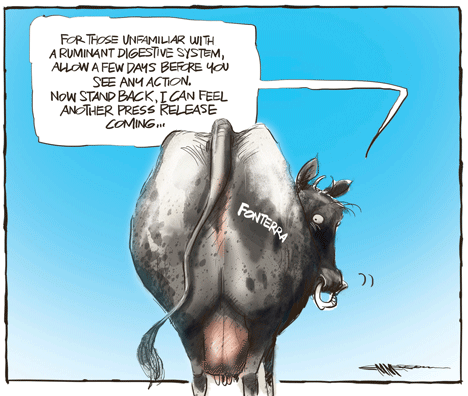
4. Digestive tracts - Here's an excellent cartoon from Rod Emmerson in the NZ Herald. I spent much of my youth working on dairy farms looking up from this perspective.
5. Politics and interest rates - Kate McKenzie at FTAlphaville has a nice discussion here about the influence of Australia's Official Cash Rate on politics there. It's all very topical now Kevin Rudd has set the date (September 7) for the Australian election and the Reserve Bank of Australia yesterday cut the official rate there by 25 basis points to a record low 2.5% (now the same as in New Zealand).
It seems John Howard once said interest rates were always higher under Labor governments. Maybe not....
Foreign financial types visiting Australia are sometimes amused at the obsession with bank mortgage rate spreads over benchmark rates, and how iron ore prices are a subject of dinner party conversation in some parts.
We’re cool with that; both are important topics for members of the highly leveraged, China-exposed Australian economy. The bigger question is whether the analysis, and the accepted wisdom, on either subject is anywhere near correct.

6. Sea floor robots in the Cook Islands - Rupert Neate writes in the Guardian about The Cook Islands' plan to transform itself by sending robots to the sea floor to collect precious minerals...
A new geological survey by Imperial College marine geochemist David Cronan estimates that the Cook Islands' 2 million square kilometre exclusive economic zone contains 10bn tonnes of manganese nodules.The nodules, which vary from the size of a potato to that of a dining table, contain manganese, nickel, copper, cobalt and rare earth minerals used in electronics. The minerals will be mined using robots first developed for underwater warfare and espionage. The technology has already been adapted for underwater oil and gas projects, but has yet to be used for large deep-sea mining projects.
Brown said it would be about five years before mining starts. He said he is in talks with some of the world's biggest mining companies and other nations about licensing deals. "We are here to meet the new players," Brown said at the world's first deep-sea mining conference in London last week. "We have had a lot interest from some companies and countries, [but] we certainly won't be jumping into bed with the first person to come along."
7. A nation of hamburger flippers - Economonitor's Dan Alpert talks here about the problem in America where much of the jobs growth is in low wage, part time service industries.
We have become a nation of hamburger flippers, of Walmart sale associates, of barmaids, of check-out people and all those those other people who are working at a very very low wages. And this is a situation that is eventually going to percolate into labor costs throughout all sectors. The bottom line is, you have a lot of people coming off unemployment you have for many many months.
Those people were earning if you actually calculate it across the board, you’re talking about people who basically being paid the equivalent of 11.50$ an hour on unemployment. Throw in some food stamps, maybe you’re talking about 12 bucks. A $15 dollar wage to work versus $12 that you were getting – it’s no impact on the economy, the consumption is ruffly the same. That’s why GDP numbers and retail sales are so lackluster.
8. Is China about to relax its One Child policy? - Kate McKenzie at FTAlphaville looks at growing speculation in China that officials are about to relax the One Child policy at least partly responsible for China's stagnant working age population.
Kate quotes Nomura's Zhiwie Zhang here:
We believe the chances of changing the one-child policy are rising. The size of the working age population dropped in 2012, and the ratio of the male to female population stands at 1.18, a highly imbalanced level, due to the one-child policy. The new government may gradually relax the one-child restriction in the next several years to smooth out the effect of this reform on demographics and the economy. If implemented, this reform would be positive for China in the very long term as it helps to promote sustainable growth.
The implications for the next 16 years may be mixed. The effect on the average growth rate may be slightly negative, because the saving rate will likely drop which affects investment growth adversely, and the size of the labor force remains unaffected in this period. It would also lead to a faster decline in the current account surplus as the saving rate declines, reinforcing our view that China may experience a current account deficit as early as 2015. On the positive side it helps to rebalance the economy toward a more consumption driven model, hence it may reduce the volatility of growth.

9. 'The pay is too damn low' - James Suroweicki writes in The New Yorker about the growing protests by fast food workers about their low pay. See more below from The Daily Show.
A few weeks ago, Washington, D.C., passed a living-wage bill designed to make Walmart pay its workers a minimum of $12.50 an hour. Then President Obama called on Congress to raise the federal minimum wage (which is currently $7.25 an hour). McDonald’s was widely derided for releasing a budget to help its employees plan financially, since that only underscored how brutally hard it is to live on a McDonald’s wage. And last week fast-food workers across the country staged walkouts, calling for an increase in their pay to fifteen dollars an hour.
Low-wage earners have long been the hardest workers to organize and the easiest to ignore. Now they’re front-page news.
10. Totally John Oliver with more on the fast food wage increase campaign...and the reaction
And some more here...made me LOL


We welcome your comments below. If you are not already registered, please register to comment
Remember we welcome robust, respectful and insightful debate. We don't welcome abusive or defamatory comments and will de-register those repeatedly making such comments. Our current comment policy is here.