
By Bernard Hickey
New Zealand's previous economic recoveries and housing booms used to be spread fairly evenly.
They were often led by Auckland, but the provinces eventually caught up and the 'goodness' of rising house prices would infuse through the department stores, builders yards and hardware stores to create jobs, wages and yet more house price inflation.
But not this time around.
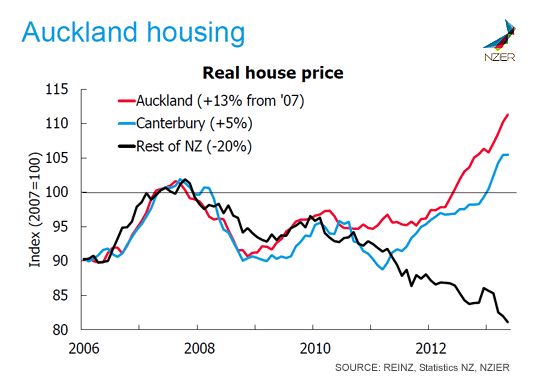
While real house prices in Auckland rose 13% from their 2007 peaks and Christchurch prices rose 5%, real house prices in the rest of New Zealand fell 20% and are still falling.
"People tell me prices never fall. Go and have a look at the prices in the provinces," NZIER economist Shamubeel Eaqub said this week in his quarterly predictions briefing.
Take out a few of the warmer spots such as Queenstown and central Wellington and the price falls are much heavier in real terms in cities and areas such as Palmerston North, Wanganui, Gisborne, Whangarei, Rotorua, Northland, the Coromandel and the West Coast of the Southland.
The reasons for this disconnection aren't obvious.
Many of these provincial areas are nestled in amongst the farming and tourism generating areas that have picked up over the last couple of years.
Most are not as directly exposed to the slowdown in the rest of the world as, for example, Auckland. But scratch a little deeper and there are some heavy weights dragging down on provincial New Zealand.
Firstly, the ageing of the population and the continual exodus of young New Zealanders on their often permanent OEs are hitting smaller towns and cities hardest.
Their populations have been hollowed out, leaving many residents in or near retirement.
They are less likely to be splashing out on new houses and all the household-formation spending sprees that drive a normal economy.
Secondly, a lot of the manufacturing and light industrial job losses seen over the last five years have hit areas outside of Auckland and Christchurch hardest.
The likes of Porirua, Lower Hutt, Dunedin and Oamaru have been slammed time and again by plant closures.
The jobs lost are often the 'best quality' jobs with higher wages that support entire families.
The almost visceral reaction by Dunedin's civic leaders of the government's latest plan to close the Invermay AgResearch station was a sign many smaller cities have come to the end of their tether.
Thirdly, a lot of the extra dairy, meat and logging income that has surged into New Zealand over the last two years is not circulating in the regions from which it was harvested.
Farmers are loathe to reinvest or spend their windfalls, choosing instead to either repay debt or store up the savings ahead of the next downturn, particularly in sheep and beef sectors.
Finally, the combination of the job losses, the internal and international migrations and the resulting house price falls are creating a type of self-fulling feedback loop.
Once the momentum is built up, the economic decline becomes a vortex from which many of these small cities and towns are struggling to pull out of.
Young families leave in anticipation of job losses and the slow drip, drip of house price falls is corrosive. Why buy or build a house when its price keeps falling?
That's why the very strong house price growth in Auckland and Christchurch and the massive public infrastructure investments now adding to that activity are so tough to take in the provinces.
They can feel the growth happening at the other end of the state highway and can see their young being pulled into the centrifuges of Auckland and Christchurch, but can do little to stop it.
The final straw would be a nationwide interest rate hike next year to reduce the dangers to the overall economy from a housing boom in Auckland.
Solutions are hard to find and few are suggesting that Auckland and Christchurch should be starved of the infrastructure investment needed to cope with their population growth and earthquake rebuild respectively.
But the pressure will build for more government thinking on regional development and migration policy.
Too much money, too many families and too many communities are embedded in these provincial areas to just let vortex of decline accelerate.
-------------------------------------------------------------------------------------
This piece was first published in the Herald on Sunday. It is used here with permission.
We welcome your comments below. If you are not already registered, please register to comment
Remember we welcome robust, respectful and insightful debate. We don't welcome abusive or defamatory comments and will de-register those repeatedly making such comments. Our current comment policy is here.