

Here's my holiday edition of Top 10 links from around the Internet at 10:00 am today. We now have a Monday-Wednesday-Friday schedule for Top 10.
Bernard will be back with his version this Wednesday. We will have a guest posting on Friday.
As always, we welcome your additions in the comments below or via email to david.chaston@interest.co.nz.
See all previous Top 10s here.

1. 'To secure stability, treat finance and fast food alike'
Justin Fox is the executive editor at the Harvard Business Review and he makes the case that the 'success' in avoiding a complete financial meltdown in 2008 has come at the cost of inadequate root-and-branch reform.
In the early 1930s, policy errors by governments and central banks turned a financial crisis into a global economic disaster. In 2008 the financial shock was at least as big, but the reaction was smarter and the economic fallout less severe. We actually had learned something in the intervening three-quarters of a century about how the economy and the financial system fit together.
But we hadn’t learned everything - and we still haven’t. In fact, macroeconomists and finance scholars clearly forgot some important lessons along the way. And the seeming success (compared with the 1930s, at least) of the 2008 bailouts and subsequent government and central bank actions may actually dilute the lessons of the recent crisis. In the 1930s and 1940s, the financial system was essentially built anew, with tight regulation and drastically changed attitudes about risk and responsibility.
That approach surely had its costs, but it ushered in a financial-crisis-free era in the United States and Europe that lasted for decades. This time around, the system has survived more or less intact. That seems like a good thing, on balance; but it may also mean we’ll be having more learning experiences soon.
John Kay says the purpose of financial regulation shouldn't be to prevent the failure of private financial institutions, but to prevent the failure of public financial systems. Let banks go bust, even the big ones (especially the big ones) he says. But we should regulate the system to ensure that even if a big one does go down, it is just like a 'normal' failure of any other large company.
Kay points out that the desire by regulators to avoid the failure of 'systemically important institutions' is a failure of the concept of regulation itself.
Financial stability is best promoted by designing a system that is robust and resilient in the face of failure, which is why effective and implementable mechanisms of resolution are the key to meaningful financial reform. Some progress has been made, but overall very little; living wills too complex to implement at all, far less within hours, are no solution to the problem of too complex to fail.
Now we have an equally dotty, and essentially similar, proposal to fund the bailout of failed derivatives exchanges using customers’ collateral. The explicit rationale is that it is more important to keep the institution intact than to protect the interests of its customers. But the reverse is the case. The services may go on (or not: the commonest reason commercial organisations fail is that people do not want their product). But the failed organisation that provided such services need, and should, not.
This applies to fast-food outlets and supermarkets and car plants – and also to utilities such as electricity, water, and the payment system. Financial services differ only because the lobbying power of incumbent companies is so great.

2. Fed aims for more inflation
People of a certain age (me, for example) lived through a pernicious era of embedded high inflation. It was accompanied by low growth. We called it 'stagflation'. Home loans were over 20%. It just killed the saving ethic. It transformed my generation, converting us from from long-term savers to short-term spenders and borrowers. We are the ones who think of home ownership as an 'investment'. Inflation distorted us, turning our notions of good behaviour on their head.
But as we gained 'power', it became normal. Then the GFC came along and exposed such attitudes as hollow.
But now, some central banks want to re-encourage inflation. The debate will be generational - between those who 'remember' its effects, and those for whom it is academic history. More from the NY Times:
The Fed, in a break from its historic focus on suppressing inflation, has tried since the financial crisis to keep prices rising about 2 percent a year. Some Fed officials cite the slower pace of inflation as a reason, alongside reducing unemployment, to continue the central bank’s stimulus campaign.
Critics, including Professor Rogoff, say the Fed is being much too meek. He says that inflation should be pushed as high as 6 percent a year for a few years, a rate not seen since the early 1980s. And he compared the Fed’s caution to not swinging hard enough at a golf ball in a sand trap. “You need to hit it more firmly to get it up onto the grass,” he said. “As long as you’re in the sand trap, tapping it around is not enough.”
All this talk has prompted dismay among economists who see little benefit in inflation, and who warn that the Fed could lose control of prices as the economy recovers. As inflation accelerates, economists agree that any benefits can be quickly outstripped by the disruptive consequences of people rushing to spend money as soon as possible. Rising inflation also punishes people living on fixed incomes, and it discourages lending and long-term investments, imposing an enduring restraint on economic growth even if the inflation subsides.
3. Payback time
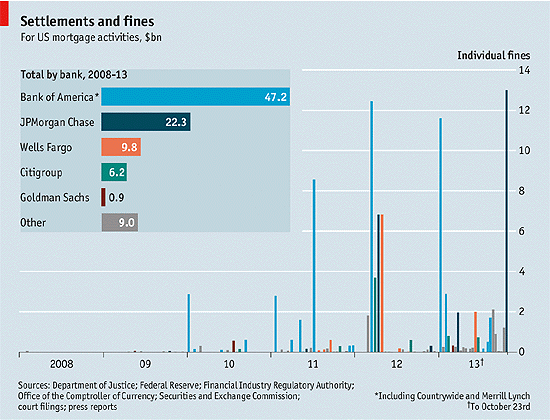
I thought the eye-popping JPMorgan US$13 bln settlement made them the bank who has paid the biggest penalty for the subprime disaster. But I was wrong on two fronts. Firstly, BofA is way ahead in the penalty stakes. And, these things aren't 'fines' as such; they are substantially orders to force these banks to pay back those they took advantage of. Just like in NZ the regulators may have been slow out of the blocks, but they are getting a roll on now. The Economist has a set of charts and this one is helpful:
JPMorgan Chase, America’s largest bank, has provisionally agreed to pay $13 billion to regulators to resolve investigations into its mortgage activities. It is the latest in a string of hefty settlements.Since 2008 financial firms have agreed to over $95 billion in mortgage-related penalties. But things could get worse. Bank of America may soon reach a $6 billion settlement with housing regulators. And JPMorgan’s announcement may not stop ongoing criminal probes into its mortgage activities.
4. German house prices
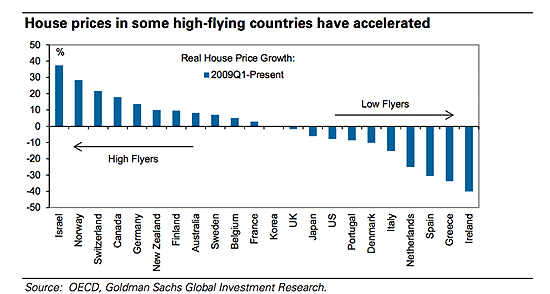
There's been a bit of talk recently about using Germany's approach to the housing affordability problem. Here's a graphical update, and more from The Atlantic/Quartz:
Nearly half of all Germans rent, which makes the nation a somewhat odd candidate for a housing bubble. But there are signs that officials are concerned about puckish surges in housing prices. In its October monthly bulletin the Bundesbank warned that prices of apartments in cities such as Berlin, Hamburg and Munich were as much as 20 percent higher than economic fundamentals could justify. An analyst who spoke to the Wall Street Journal said apartment prices in Berlin are up some 80 percent between 2009 and 2012.
Observers blame an inflow of international capital for the price jumps. Investors have used low interest rates to invest in homes in Germany, a bastion of economic stability within the eurozone. Goldman Sachs analysts point out, however, that overall "given that house prices are just coming off a low base, national house prices are unlikely to be significantly overvalued at this point."

5. KiwiSaver fees
It was very disappointing to see the release by the FMA on Thursday headlined by them "KiwiSaver assets jump 30 percent to top $16.5b". Most non-expert readers would have concluded that KiwiSaver returns were 30%. The press release doesn't say that of course, but headlines like the FMAs are the type of spruiking the FMA was set up to control.
If the returns aren't 30%, then what are they? The FMA report doesn't say. In fact, it deals with the 'year to March 31, 2013' which makes it kind of out-of-date as far as returns are concerned.
But it does have some useful statistics. For example, it shows that the funds management industry took $178 million out to run these schemes for the year, a 1.4% expense ratio. Here is an extract we modified from the FMA Report:

6. What we have put into KiwiSaver
Before we get to the actual returns, let look at what now makes up these KiwiSaver funds. The IRD has more up-to-date data than released by the FMA; the IRD data is up to June 30. That shows employees, employers and the Government have contributed $15.030 billion, funds paid over to the scheme providers by the IRD.
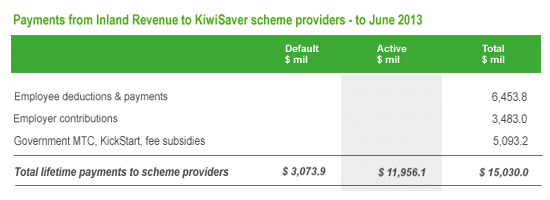
If we update the FMA valuation data at March 31 with the RBNZ valuation data at June 30, that lifetime contribution of $15 billion is now worth $17.203 billion. That is, fund managers have grown the value of the contributions over the six year the scheme has been in operation by $2.17 billion. Now we are back to the initial question: what sort of return is that? It certainly wasn't "30%" in the year to March, as some people may have assumed after reading the FMA headline.
7. Taxing KiwiSaver
There are two things to keep in mind about taxes on KiwiSaver. Firstly, there is a complicated split on how earnings are taxed. Some taxes are paid by the funds themselves, but under the PIR regime most are not assessed in the fund but are paid by you in your KiwiSaver account at your PIR rate. In the end, that is good for you, but it makes talking about after-tax fund returns fearsomely complicated.
Assuming you are on a 17.5% PIR (which applies for people earning between $48,000 and $70,000), in 2013 about 8.8% tax will be paid by the funds, and the balance to your PIR rate, or a bit under 10% will be paid by you in your account. Look at your account transactions and you will see these tax liabilities deducted from your fund balances.
The other thing is that while you and your fund are paying tax, the government is collecting it. In 2013 they will get back from KiwiSavers something like $200 million. Our calculations show that since KiwiSaver was introduced, the government of the day has gotten back less than $400 million in tax payments. The government also needs to have fund managers do a lot better because that will increase their tax revenues.

8. What we are getting out of KiwiSaver
Of course, the answer of what 'returns' are being earned will very much depend on what Fund you are in. We have comprehensive data in our KiwiSaver resources on this website. There are some great ones delivering outstanding returns, some that generate volatile returns over time, some that give slow and steady returns, and even some that are dogs losing money for their 'investors'.
But we can calculate the averages, and they are not very impressive. Half the 2.1 million members will be getting these unimpressive returns or worse. Frankly, its not very satisfactory and very disappointing. As an industry, fund managers have a huge opportunity to make a much better contribution. Most have failed to add significant value, although 2013 was the first time we saw any noticeable improvement.
However, there is something important you should realise when anyone talks about 'returns' - as a member you (and your employer) are making monthly contributions to your fund. It is typical for scheme managers to talk about the type of returns their funds earn on a stable capital sum. Even the new MBIE guidelines make fund managers calculate returns for a "$10,000" fund. But that is not how your situation works - you are most likely in a 'regular savings' pattern. Returns on your relatively low balances early on will be much less important to the returns on your current balances because those latest balances will be much larger.
We can, however, look at the overall KiwiSaver industry on a 'regular savings' basis and calculate returns. That shows:
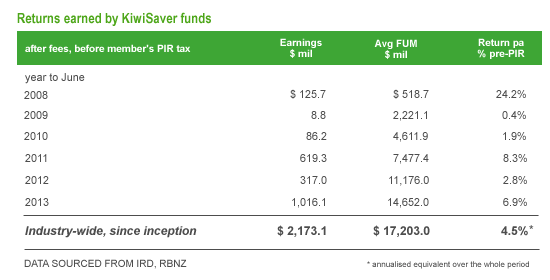
4.5% before tax ? !! We compared these returns with average one year bank TDs and they returned 4.4% before tax over the same period. To be fair, you can't walk into a bank with $17 billion and expect to get the carded rate - you will be offered much lower if you had much more than $4 million. But still, it's hardly a ringing endorsement for the funds management industry. 6.9% is better in 2013, but still nothing like what the Super Fund achieved ( an exceptional 25.8% return in the year to June 30, 2013 and over the whole period 13.9%).
The results at the NZ Super Fund set a benchmark. Fund managers may not like it, but it is one here to stay; it is an unavoidable benchmark for managers. It is strategically important for the country that this industry does better. Failure to do so will undermine public and public policy confidence in their capability.
The establishment phase is over. Members must demand better returns. Some managers are delivering. Members need to get active and shift funds away from under-performers. The key is long-term results but don't let the industry use that as an excuse for current poor performance. They must do better, starting yesterday.
9. Measuring a key asset
I read the other day that "The overall NZ rainfall is the same as the whole of Australia and is 2.5 times that of the whole of the UK." Actually it is an interesting comparison, but it's not - nowhere close - even in a dry period in Australia. More like, NZ can be compared to WA.
Both the ABS and StatsNZ publish national and regional Water Accounts so you can check claims like this.
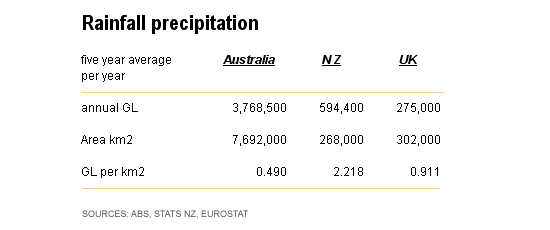
NZ's rainfall is a key and unique national asset. Letting too much of it run out to sea and get contaminated with salt is pure waste.
10. Today's quote
"There is a very easy way to return from a casino with a small fortune: go there with a large one." - Jack Yelton

We welcome your comments below. If you are not already registered, please register to comment
Remember we welcome robust, respectful and insightful debate. We don't welcome abusive or defamatory comments and will de-register those repeatedly making such comments. Our current comment policy is here.