

Here's my edition of Top 10 links from around the Internet at 10:00 am today. We now have a Monday-Wednesday-Friday schedule for Top 10.
Bernard will be back with his version this Wednesday. We will have another guest posting on Friday.
As always, we welcome your additions in the comments below or via email to david.chaston@interest.co.nz.
See all previous Top 10s here.
1. From anonymity to scourge of Wall Street
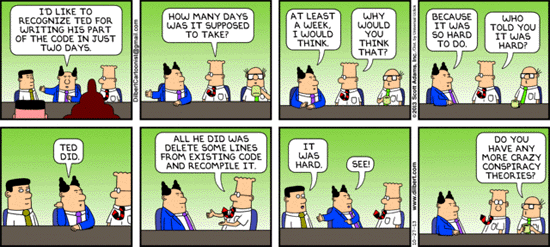
The architect of a recent legal crackdown on Wall Street’s dubious mortgage practices was not the attorney general, a United States attorney or a rising star in the Justice Department.
Instead, it was Leon Weidman, an unassuming 69-year-old career prosecutor, toiling away in anonymity 5,000 kms from New York. Peter Lattman and Ben Protess at Dealbook have uncovered a fascinating story.
Weidman is using an obscure law that almost everyone overlooked - although it does raise the question about how anyone is supposed to know every clause in every law. I'm cheering for him in this case, but slightly uncomfortable that there may be a technical law or regulation out there just waiting for some smart-arse lawyer to take me on. You don't know what you don't know. Lawyers and judges love the 'ignorance is no excuse' line just because it puts them front-centre-and-hands-in-your-pocket in any dispute - and they back each other up. The legal profession seems like a collusive monopoly to me.
(But really; I love and deeply appreciate them. I really do, Judge.)
In this case, it is reassuring to know that there is at least some law that can hold these TBIF institutions to account, even if it is arcane, obscure, and made for another purpose. It's ok to use it against 'them' - just don't use it against me.
That case [against S&P] hinged on Firrea (the Financial Institutions Reform, Recovery, and Enforcement Act of 1989). Enacted in the late 1980s after risky lending practices imperiled the savings and loan industry, the law created a powerful tool to punish fraud committed by banks and their executives.
Firrea is unusually crafted, as it requires a criminal violation like wire fraud or mail fraud to set off the law’s penalties. But because it is a civil statute, it requires a lower burden of proof than criminal charges - finding guilt by a preponderance of the evidence versus beyond a reasonable doubt.
That broad authority has alarmed some defense lawyers, who have argued that the Justice Department has stretched the application of Firrea far beyond its original intent.
The wave of cases has ignited a legal controversy, raising the question of whether federal prosecutors, in dusting off an old statute, are misapplying the law. So far, judges have blessed the government’s tactics.
2. Bubbles in the broth
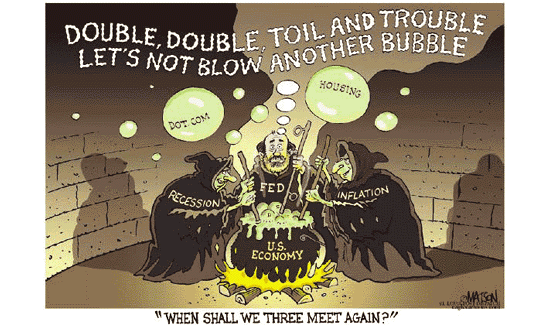
We just had an RBNZ OCR review. And we are about to have (November 13) a Financial Stability review. The official interest rate is used to control inflation, while the FSR macro-prudential tools are used to keep our financial system stable. Most central banks are now doing both duties and using tools like the LVR speed limits more aggressively these days.
But some people are still not convinced the split will work. Here's Nouriel Roubini, who is one of the sceptics:
Some policymakers – like Janet Yellen, who is likely to be confirmed as the next Chair of the US Federal Reserve – argue that we should not worry too much. Central banks, they argue, now have two goals: restoring robust growth and low unemployment with low inflation, and maintaining financial stability without bubbles. Moreover, they have two instruments to achieve these goals: the policy interest rate, which will be kept low for long and raised only gradually to boost growth; and macro-prudential regulation and supervision of the financial system (macro-pru for short), which will be used to control credit and prevent bubbles.
But some critics, like Fed Governor Jeremy Stein, argue that macro-pru policies to control credit and leverage – such as limits on loan-to-value ratios for mortgages, bigger capital buffers for banks that extend risky loans, and tighter underwriting standards – may not work. Not only are they untested, but restricting leverage in some parts of the banking system would merely cause the liquidity from zero rates to flow to other parts of it, while trying to restrict leverage entirely would simply drive the liquidity into the less-regulated shadow banking system. According to Stein, only monetary policy (higher policy interest rates) “gets in all of the cracks” of the financial system and prevents asset bubbles.
The trouble is that if macro-pru does not work, the interest rate would have to serve two opposing goals: economic recovery and financial stability. If policymakers go slow on raising rates to encourage faster economic recovery, they risk causing the mother of all asset bubbles, eventually leading to a bust, another massive financial crisis, and a rapid slide into recession. But if they try to prick bubbles early on with higher interest rates, they will crash bond markets and kill the recovery, causing much economic and financial damage. So, unless macro-pru works as planned, policymakers are damned if they do and damned if they don’t.
For now, policymakers in countries with frothy credit, equity, and housing markets have avoided raising policy rates, given slow economic growth. But it is still too early to tell whether the macro-pru policies on which they are relying will ensure financial stability. If not, policymakers will eventually face an ugly tradeoff: kill the recovery to avoid risky bubbles, or go for growth at the risk of fueling the next financial crisis. For now, with asset prices continuing to rise, many economies may have had as much soup as they can stand.
3. 'We need to get men back in the workforce'
We get our unemployment stats this week, and closely watched will be the Participation Rate. In New Zealand it is about 74% for men (which has declined from about 90% in the 1950s), and about 63% for women (which has risen from under 30% in the 1950s).
American labour force participation rates are significantly higher there - by about 10% - but that is not stopping them worrying about the fall-off. More from William Galston in the WSJ:
What we do know is that the start of the third millennium marked the end of a long cycle in the U.S. employment market. In the early 1960s, labor-force participation among men ages 25 to 64 began a slow steady decline from 95% to about 84% today, a trend masked by the surge of women into the labor force. But women's participation in the labor force peaked in 2000 and has since declined by two percentage points. Unless men re-enter the job market, prospects for the resumption of vigorous growth in the U.S. labor force are dim.
Some analytical modesty is in order. Men have been withdrawing from the workforce for five decades—in good times and bad, in tight and slack labor markets, in periods of Keynesian stimulus and green-eyeshade austerity. No one is sure why.
Neither do we know whether a 73% participation rate represents a permanent ceiling for women, or just the most they feel able to do in the face of social policies that do little to counteract the tension between family responsibilities and work outside the home.
But we do know that prospects for robust growth and shared prosperity are dim unless we can devise more effective labor-market policies. It is hard to see how that can happen as long as our political system remains obsessed with issues that matter far less.
4. Foreign capital 'key to agriculture'
One of the most senior figures in the Australian Labor Party has come out in favour of more foreign investment in Aussie agriculture.
Senator Penny Wong has conditions, of course, but she is backing more investment from offshore. Policies like this line up curiously different in Australia; the 'left'/Labor is for FDI, whereas the 'right'/Coalition is instinctively anti - especially when it comes to agriculture. Here, the 'anti-foreigner' attitudes tend to come from the 'redneck left'. More from The Australian:
Senator Wong said foreign investment had helped accelerate Australia's growth and development, citing the rapid development of the resources industry.
She said foreign investment would also be a key to the expansion of agricultural sector.
"If we are serious about becoming the food bowl of Asia, we have to front up to the reality and necessity of foreign investment in our agricultural sector.
"As a nation that exports two-thirds of its total food production, it is inconceivable that we will be able to develop and scale-up production to enable us to fully tap into the growing consumer markets of Asia without foreign investment."
5. Ignoring history
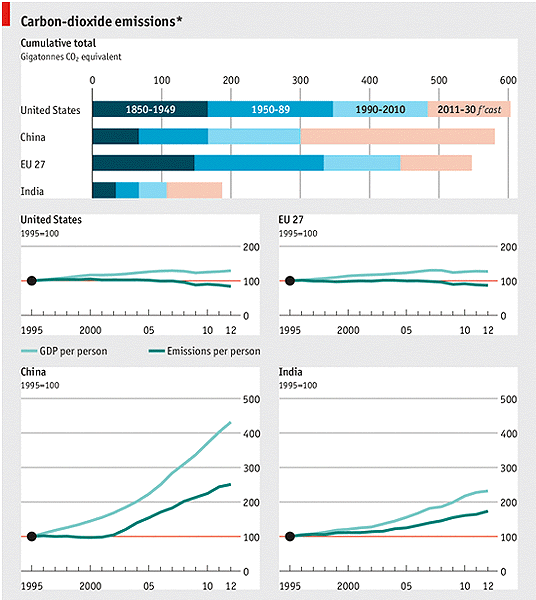
Here's a bad idea - aggressively expand collateralising core assets, effectively getting a chain of manufactured 'assets' out of one base asset. Done that; failed spectacularly. But blind to history, the Chinese are about to embark down that road. This will not end well, methinks. More from Reuters:
Chinese regulators have expanded a pilot plan allowing banks to package loans into tradable securities to include foreign banks, sources said.
Chinese policymakers see securitization as a tool to shift risk away from the banking system to reduce the chances of a financial crisis as economic growth slows and bad loans rise.
Securitization would also help satisfy voracious investor demand for alternatives to the chronically weak stock market and frothy property sector.
Chinese Premier Li Keqiang told a cabinet meeting in late August that China would aggressively expand the securitization of credit assets.
6. What we are building
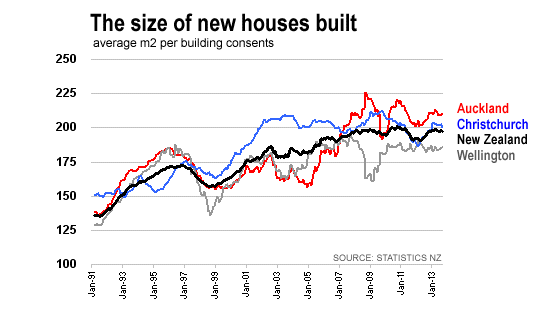
It will probably come as no surprise to learn that the houses we are building are getting bigger. The building consent data shows that 2013 houses are on average 196 sq m; that's 44% larger than 1990 dwellings which averaged only 136 sq m.
2010 was 'peak house' in New Zealand, when the average was 200 sq m. Since then, they have been getting smaller.
The size of house we are building changes in spurts. Back in the 1970's we were building houses of only 110 sq m average. But this grew to 125 sq m and settled thereabouts till 1990. Then there was the McMansion spurt seeing them grow to 175 sq m and by 2010 reaching 200 sq m five years later.
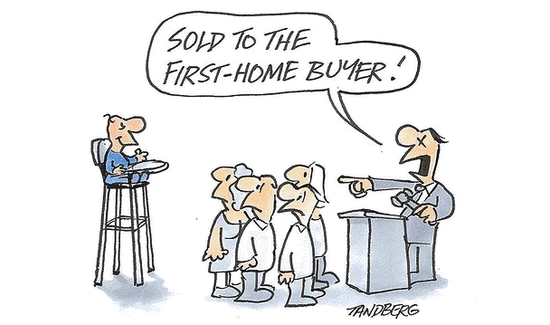
Part of the reason for rising house sizes is 'affordability'. As low interest rates and abundant credit pushed prices for pre-built houses higher, and councils added their various restrictions, only the well-off tended to be able to afford a new build and they built the size they wanted. The averages rose because the first-home buyer started to get squeezed out.
Perhaps the peak was achieved in 2010 because after that we started seeing more 'apartments' being built, and increasing numbers of these are for the fast-rising retirement home chains. This influence may grow as the boomer generation's needs push them into this smaller type of accommodation.
We can put this into an international perspective using the data in #9 below:
| sq m average | |||||||
| UK | Ireland | Spain | France | Denmark | N Z | Aust | USA |
| 76 | 88 | 97 | 113 | 137 | 196 | 206 | 214 |
This data is from a BBC story (we've added the NZ data), and believe it or not "the average new British house is roughly half of the size of a new house built in the 1930s, before planning laws were brought in."
7. What its costing us
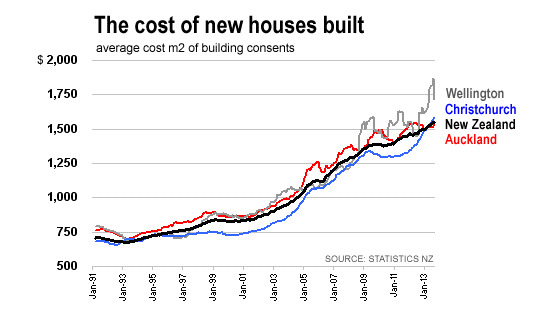
Back in the 1970s regional variation in new build costs were low, and average house building costs were $120 sq m. Today there seems to be a 15% difference between Auckland and Wellington, with the capital being more expensive (and building the smallest dwellings in the main centres).
And it now costs almost $1,600/m2 to build.
That means, for a 196 m2 house, the raw build cost is now $307,400. Of course, that doesn't include the fitout, the landscaping, or the land itself. Today, your average new house doesn't come cheap, which may be why there is competition for existing, already built houses.
Interestingly, in Auckland, the 2013 average is $305,100, in Wellington its $351,800 (not a typo), and in Christchurch its now $312,300. Who would have thought Auckland would have come at the bottom of this 3-city list?
Who is building and what they are building will have an impact here; my suspicion is that the relatively well-off are increasingly featuring in the new-build stats over time, and that is pushing this data up.
The Productivity Commission has looked into these costs and made recommendations (see Section 10). Readers can infer their own conclusions from the chart below as to the timing and availability of cheap credit on these costs.
8. Celebrating a success
In the past ten years, there have been nine months where road deaths were less than 20 per month. However four of those months have occurred in 2013.
A combination of better driving, much better road engineering, lower alcohol consumption, better enforcement policies, and better weather conditions have all resulted in 14% fewer deaths than last year, and 38% fewer than 5 years ago. Over ten years, that is 960 people alive today that wouldn't have been without this progress.
Road deaths
Select chart tabs
9. 'The insanity of the UK's housing market'
Daniel Knowles has 15 reasons "why you will never be able to buy a house" in Britain. I have lived in Australia, the US, the UK and New Zealand each for many years (UK the shortest) and I can certainly sympathise with British frustrations. But it is the worst, so I expect that is understandable. Their problem is that they don't seem to have the will to do anything practical to fix their issues; they seem to have the DNA to fight over everything so progress is glacial in this area. We don't know how lucky we are, despite our issues.
For the first time pretty much in recorded history, home ownership is falling. The private rented sector meanwhile - yeah, that’s just getting bigger and bigger.
Margaret Thatcher’s government stopped councils from building new houses themselves and she made it easier for people to get mortgages. But she didn’t make it much easier for private developers to build new houses on green fields. So all of the new borrowed money just pushed prices up and up.
The same planning laws which stop us from building new houses on fields also stop us building taller buildings in central London. It is illegal to build anything that blocks the views of St Paul’s cathedral from several key points - one is a hole in a hedge 10 miles away in Richmond Park. That view is apparently more important than people having somewhere of an OK size to live at a reasonable price.
So what’s the solution? Well, we can change the law.
According to the London School of Economics, if we let London expand by one mile into the scrubby green belt within the M25, we could add 1m new homes. Doubling the density of some of zone 2’s neighbourhoods by making it easier to build upwards could have a similar effect. Both would upset people who already own homes nearby - but it would make London’s housing cheaper and more spacious for everyone else.
10. Today's quote
"If all the economists were laid end to end, they’d never reach a conclusion." - George Bernard Shaw
42 Comments
#9. UK housing is indeed nuts. What used to be a minimal quality terrace house housing one low income family is often now divided into three flats. Just awful. And housing high income people - who have trouble affording even that.
But the answer is not to cover over their rare green space. Decent high rise would be the answer. However what developer can buy up some of those streets, replacing dozens of owners all disputing to put up a decent very large building. It's usually impossible to pull off.
No 7 - Higher costs in Wellington would be a fairly reasonable expectatation. The terrain will be responsible for most of the increase.
I thought the same; a small premium for wind resistance and earthquakes as well, maybe.
But if they try to prick bubbles early on with higher interest rates, they will crash bond markets and kill the recovery, causing much economic and financial damage. So, unless macro-pru works as planned, policymakers are damned if they do and damned if they don’t.
I think it a matter of "who" as in Markets and economic damage needs to be claraified on that point, it is more likey the Banking systems to sustain damage and certainly the speculative portion of the Markets who both had it their way for far too long.
I get sick to death of the worlds going to end crap every time Taper is on the agenda, or the free money ,low interest for eternity is in any danger of coming to a fork in the road.
Have we seen anything productive in the way of stymulus in the U.S. economy...? have we seen outside of the banking Industry or the speculative input into Markets sush as High tech produce any bloody thing to provide jobs on the ground.
You know, where ordinary people have a job and spend their lives disposing of their income, the kind of thing that actualy makes an economy function , um ahh no I don't think so....um nope...nah . What we've seen from the Fed has been a water cannon of money pissed on a fire of flaming fear the Banking Industry in the U.S. and others...might just take an ultimate haircut involving the removal of limbs....
So really it's just been anything to keep the Squid alive and in one piece hoping to transplant a sense of fiscal responsibility into the Squid's head....
That's just not going to happen is it...no the Squid must die.
When they propped things up, yes then the vampire squid et al should have been staked. They did not, the pollies were paid off with re-election bribes. So the bast****s vampires doubled down with great glee and were allowed to.
I agree and the only way to see the squid die now, is to take out of circulation the Pollies and hence the vampires who pay them. Just a Q of time IMHO....amazed its still running since 2008.
https://soundcloud.com/doomstead-diner/monsta-of-doom-nicole-foss
Of course they all may come up smelling of roses after "saving us all", more fool us.
Personally I have no idea who to vote for, its like being offered the option of standing in doggy doo doo, or cat doo doo in bare feet. Its going to feel unpleasant and a lot of cleaning up will be needed all the while trying to keep my lunch down.
regards
I'm not sure about Nichole Foss.
Is she still predicting house prices to drop by 90%.
I don't really think she knows....
Is she still predicting $20/ barrel for oil..???
Does she really know..???
She talks like she is an "expert"... but really.... she ain't
Shes' dangerous to anyones financial health... if they should believe her authorative sounding views.
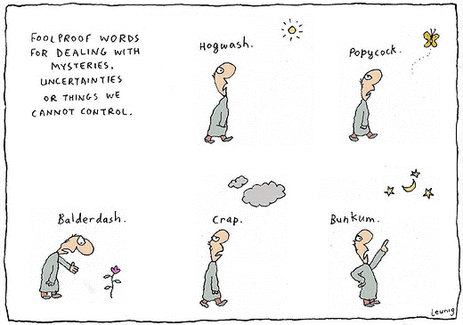
Thank you for including Leunig's guide to being an interest.co.nz commenter. As always a vintage crop of cartoons. Good work, David
Priceless. And why is steven wearing a dress ?
Well your weird fanatasy is, um yours, please dont share.
Besides that whats wrong with kilts?
Maybe take that point up with a few 1/2 cut scotsmen in a bar late one night....let us know how you get on.
regards
The great thing about you taking the opposite side is, the other gets to take the cash and run, so Im all for you doing so.
Yes I'll bet with her, longer term, like Ive said elsewhere short term, human behavior can cause anything to happen.
Interesting, and they say markets are rational, yet we have 2 sides to a transaction, one cannot be rational / correct.
"90%" yes thats correct. Though interestingly the numbers she seems to be mentioning in the above sounded more like 95%.
"A little knowledge" of course the Q is who has the little. I wouldnt say it was her, good luck with your gamble(s).
regards
Mkts have never been rational... :)
She is completely wrong about the 90% house price decline....
That was a "alice in wonderland" call on her part... which is a shame , because some of the stuff she talks about is relevant and important...
What is longer term Steven ???.... it is easy to fudge and hedge any forecast ...by simply saying longer term....
Nicole talks like she is an expert... talks like she "knows".... but she doesn't.
I'd have to agree Roelof, Nicole did a piece here a coupla three years back and I thought she had some pretty relevant things to say about the Global outlook, but unfortunately her headline grabbers tend to dilute some of her, what I felt was commonsense long term outlooks .
Funny enough, in terms of how adamant he was , I'd have to put Bernard in the same category, I fact I think having Nicole here was like Bernard mixing with an econo pop star.
But to be fair about it the commonsense approach to anything doesn't put bums on seats,that is an economic reality.
Overstate , sensationalise, if you need their attention or your wallpaper.
It isnt over til the fat lady sings as they say. Looking at the logic on her side v the prayer on yours, well you have to wonder (well I dont).
If you agree that housing is already in a x2 bubble then there is 50% loss right off. Then work out the effects of no more oil (and its decline) and then debt overhang. 2 more large impacts. BBs, another....high taxes, another.
Longer term is hard to quantify, with no oil by 2050 that has to set the longest point...decline starts in at most 5 years the panic from that?
Its easy to fudge of course and say it hasnt happened yet so never will. I dont see that as rational.
Like I said place your bets...
regards
It's not a dress ! It's a nightie. Steven finds it a comfort to wear, as he struggles with our group denial.
LOL, Um, Im not sure whose fantasy is, um the most weird here, yours or snoggy's.
regards
No its a "onesie"..........he's struggling to get out of it.........
Well I can definitely assist here, not with stevens attire of course, but the 'getting out of it' bit.
I don't find that a struggle at all! HaHa.
#1 https://soundcloud.com/doomstead-diner/monsta-of-doom-nicole-foss
what are you going to do?
or ignore it like a good little Lemming.
regards
Here, the 'anti-foreigner' attitudes tend to come from the 'redneck left'........where was that in the article..?
Senator Penny Wong has conditions, of course, but she is backing more investment from offshore. Policies like this line up curiously different in Australia; the 'left'/Labor is for FDI, whereas the 'right'/Coalition is instinctively anti - especially when it comes to agriculture. Here, the 'anti-foreigner' attitudes tend to come from the 'redneck left....
Excuse me Penny Wong, but I think your Wong about that ,and I can't imagine why you pushing the barrow for more Foreign investment into Australian Agriculture to become to foodbowl for Asia...?
Why would you make the assumption they want to be Asia's foodbowl, unless it's because you see the foreign investment coming from Asia....like investment in Africa ?, that's working out for trhe locals...not.
The race card is the cheap shot, so let's move away from race and percieve Australia as becoming the foodbowl for the largest Communist Country on earth....does that not sound better ?,and certainly not race based.
I might remind you Stephen Joyce thinks Labour/Greens a Communist outfit and it would appear they are of mixed ethnicity .....so ,no racism there then.
I might remind you Stephen Joyce drools at the prospect of Communist investment into N.Z. Agriculture but abhors the thought of them running this Country through their local coalition parties.
While dickheadery through blind greed rules out the commonsense of what do they (the Communists ,real ones) want big picture wise we will continue to kick down doors to let them in ,until the day we can't show them the door.
CHINESE investors may own less than 1 per cent of Australian farmland, but the true level is not known because it is hidden behind a corporate veil, according to a new report that offers support to the establishment of a formal register of foreign land ownership in Australia.
A joint report by accountants KPMG and the University of Sydney says Chinese investment in Australian agricultural land totalled more than $1 billion between 2006 and 2012, or just 3 per cent of that country's investment in Australia over the period.
While there is anecdotal evidence of Chinese investors buying agricultural properties worth less than $US5 million ($5.2m), "detailed public information on such deals is nearly impossible to obtain", the report, Demystifying Chinese Investment in Australian Agribusiness, says.
The true identities of the landowners were not known as deals were made through through individual, corporate or trust structures.
"Until we have a national record of foreign ownership of Australian land that looks through the corporate veil, it will be difficult to establish the extent of Chinese ownership below $US5m," the report says.
http://farmlandgrab.org/post/view/22745-china-land-grab-hidden-by-corporate-veil
The Power of Monsanto
Monsanto is one of the world’s largest food production companies. It was Monsanto’s genetically modified RoundupReady soy (RR) that was approved by Menem in 1996. The RR technology allowed for soy to grow in arid areas, and in so doing greatly reduced the need for manual labour. Monsanto dominates the current soybean market in Argentina and is the driving force behind the corporate wave that is destroying peasant farming. Kneen offers a scathing verdict: “the clear and present danger is the corporate control of food, which is what Monsanto is clearly after. On this account, and because I despise its ruthless tactics, I do not hesitate to describe it as an evil company”.
The power that is held by the world’s largest food producers cannot be underestimated. Boy describes Monsanto as “a multinational that is capable of all types of corruption” whilst Neimann says that “it acts without any restrictions”.
Despite these traits, the Argentine government relentlessly pursue bigger and longer lasting deals with Monsanto and other big agribusiness companies. As recently as June of this year, president Cristina Fernández de Kirchner announced a new agreement with Monsanto. As part of her Agribusiness Strategic Plan (PEA), the president hopes to increase grain production by 60% to 160 million tonnes by 2020, 20% of which will be soy. Following the accord, president Fernández announced that she was “very happy because Argentina is now at the forefront of biotechnology”.
Land grabs—whether initiated by multinational corporations and private investment firms emanating from the capitalist core, sovereign wealth funds in the Middle East, or state entities such as China and India—are now in the news constantly.1 For example, in July 2013 the Colombian ambassador to the United States resigned over his participation in a legally questionable effort to help the U.S. corporation Cargill use shell companies to amass 130,000 acres of land. This land was supposed to be used for agricultural production, but there is also land being grabbed for other purposes—such as mining or to construct roads, buildings, and dams. In human terms, land grabs mean real people and families are dispossessed. When people lose access to their land, they also lose their means to obtain food, their communities, and their cultures.
http://farmlandgrab.org/post/view/22759-agribusiness-as-usual-the-death-of-peasant-farming
Thanks A.J. the practice is much the same here through OIO land sale reports I furnished the other day at 160 thousand hectares between Jan and June and only 43,800 accounted for...leaving 116,000 HA to anonymous buyers
When applied for , non publication of applicants who are successful can be deemed sensitive by The OIO.
Democracy at work....... mmm.
Thanks Christov, I didn't realise it was that big a problem. It starts with one farmer wanting to buy the neighbor, he has no money,the bank provides leverage, he thinks what a clever man am I, the farmer begins to value his land yearly, accesses his equity and borrows against it to buy more land, when he is the size of Crafar then no local farmers can buy him out if he 'goes 'tits up'.
So it has to be a corporate or a foreign buyer. There is no doubt in my mind this being done, with National party approval.
Keeps land values high and out of the reach of young farmers, lets corporates into the game and stops banks making huge losses on a deflated land bubble.
We end up with 50 Billion+ of rural debt and most of the income from farming finding its way into banks pockets and not our local communities.
My question to you is, How do we stop it?
AJ: asks
Q: "how do we stop it"
A: "not sure you can"
It's too late
Here's a question for you
Try and define a "First Home Buyer" (think carefully about that)
And when you have done that
Try and define a "Foreign Investor"
At the moment, idiots.
Lobby Cunny & Labour that the parasitic usurious banks are making too much out of loyal Kiwis , and repatriating it all back to Australia .. ...
... then whisper " introduce-a-super-profits-bank-tax ... " in his Cunny lugs ...
Give a Labour government enough time , and credit should dry up completely in NZ ..... problem solved !
By introducing what any current Administration would call Draconian laws in a Global economy A.J....protectionist policy that one of our biggest investors have enshrined in their laws.
The process carries on out of sight of the public consciousness, and deliberately so by means of preoccupation with internal events, housing, jobs and so forth.
The systematic Corporatisation of the Global economy where the Corporates direct Govt policy rather than just influence has arrived en masse.
Education to the many as to what's happening right under their noses and why the should be concerned is the best initial action to take.
The problem is you have to remove race based argument from the equation beforehand, because the many don't want to be called xenophobes, they'd rather just watch T.V. and complain about what's on.
I totally agree with you Christov.
Not just about protecting our assets ... but policies that remedy what Bretton woods was supposed to do... ie. balance trade.
Warren Buffett wrote about the idea of "import credits" back in 2003.
http://www.pbs.org/wsw/news/fortunearticle_20031026_03.html
I agree Christov. But maybe that is up to us to start referring to NZ Nationals which would encompass NZ citizens and residents. Off-shore based Investors shoulb be called foreign national investors or something similar..... It will help remove the xenophobic label that is thrown around.
The biggest problem NZ Inc has with all these off-shore based investors is that our tax system favours them. I have named this TAXATION APARTHEID as current tax laws severely discriminate against NZ nationals. The way the tax laws are applied we are segregated just by being NZ nationals.
AJ
On a slightly different tack, think about the politics, and the "long game"
In recent weeks there has been some goings-on in auckland involving 3 players
On the face of it it has been presented in the media as an unseemly scandal of human foibles, involving a mayor, a subordinate, and a party political hack.
What hasnt been noticed by the media is that 2 of the players are not of new zealand origin, are recent arrivals, both seeking political influence, and surprisinlgy both have achieved that enviable state, in a very short space of time, one only being here 2 years.
We are being so easily infiltrated. Or, is that losing control of our own destiny.
Perks of the job, on the job, for the jobs, for the boys.
Some people are easily led. (and not by the scruff of the neck).
Most Aucklanders and most kiwis have not the brains they were born with, voting with their apathy for an easy ride and hopefully a decrease in debt with easy imports.
But then, what does one expect when relying on the amalgamation of resources and a desire of a quicker public service at the ratepayers expense.
First Home Buyer....imperfect description of the intention by the dissaffected.
Foreign Investor....Person or Persons not of local residence in the usual sense of the word to be in resident status, seeking to supply monies for reason of gain to either reinvest to seek even further gains or expatriate monies gained to Origin of investment or desired location of investor.
A person who wishes to avoid the mantle of the second part, can, beforehand, adopt the disguise of the first part . So easy to get around.
Well here is a reverse application of the Nigerian Scam. Home grown.
It fuels the problems for some who live in dire poverty, makes billions for others.
http://www.thisdaylive.com/articles/the-kero-subsidy-scamij/163360/
Could be why a lot of the World is poor and a lot rich.
Now who do you think could be involved in such a caper?.
Maybe this might provide a clue, reading between the lines.
http://www.thisdaylive.com/articles/police-disrupt-g7-governors-meeting/163377/
Maybe this is why our own fuel is so far beyond the reach of many, but some can claim it as a tax deduction, visiting their houses, of ill-repute, flitting around the world at the taxpayers expense.
On 2, and asset bubbles, as noted previously, the "markets" seem to be playing chicken with the central banks.
There seems to me to be three scenarios of medium term interest rates and resulting asset values:
1) Central banks maintain modest inflation, and very low interest rates for many years, such that a discount or return rate that most investors will look for in a safeish asset is say 5-7% vs say 10-15% 5 years ago. (Hence the doubling of asset values).
2) Central banks let inflation go to 5% plus for a few years to allow incomes and consumeable prices catch up with asset prices; and to let the highly indebted deleverage, before they get back to more conventional policies.
3) Central Banks nip any inflation shoots in the bud by raising interest rates quickly and aggressively, whacking the indebted; and collapsing asset prices. By the maths in 1) above, all else being equal, a 2-3% rise in interest rates should see a 30% decline in asset prices. All else probably wouldn't be equal, but still, the effects could easily be severe.
Current asset price multiples are betting on 1) or 2); and that 3) will be politically unacceptable. I suspect the markets are correct in that bet.
#11. Vote Labour /Green in 2014 and our economic ills will be solved.
Where are the good news stories such as http://www.nzherald.co.nz/business/news/article.cfm?c_id=3&objectid=111…?
Commodity prices up again, near new record
Or are articles on this site biased and only posted when Russ Norman or Silent T approve posting?
This is becoming a totally politically biased website.
I could be led to believe a somewhat modified #11
#11. Vote Labour /Green in 2014 and our economic ills will be less worse and maybe even solved.
The jaundiced eye will always find what it wants to when the topic is especially politics or religion. Thankfully we do not venture into the latter here.
God is great!
;o))
We featured this data update in our Economic Calendar.
However, when you look at our chart, you can see that in light of the previous month's stories we ran on this, October commodity prices were nothing special. Yes, the standard media featured the rise in 'global prices' but what affects us here is the change in NZ$ and that was not a rise. The other reports you noted somewhat over-egged the story. Our chart tells more about what happened in October than those other stories.
Most posters certianly are highly right/libertarian.
Not sure what you mean by biased....its actually less baised than most...and has a broader posting base.
regards
David Chaston..'redneck left'.... that is classic.....reminds me of Midnight Oils 'Redneck Wonderland'. Speaking of which, wonder what Labours Peter Garricks take on foreign investment in agriculture is, last time I looked he was advocating the return of land to the Aboriginal people...heaven forbid. How does the term 'dipstick in an ivory tower' sound to you?
What is the purpose of foreign investment/capital in Australian agriculture? What does it bring in terms of knowledge, innovation and development, that does not already exist. What return does it provide for those working in the agriculture sector?
I recall Steve Keen commenting on GM 'investing' capital into the Australian automotive industry claiming that the innovation they brought was transfering the steering wheel from the left to the right. Can progress of a similar magnitude be expected from increased foreign capital introduced into Australian agriculture?
We welcome your comments below. If you are not already registered, please register to comment
Remember we welcome robust, respectful and insightful debate. We don't welcome abusive or defamatory comments and will de-register those repeatedly making such comments. Our current comment policy is here.