

Today's Top 10 is a guest post from Eric Crampton, who is a Senior Lecturer in Economics at the University of Canterbury. He blogs at the ever-popular Offsetting Behaviour.
As always, we welcome your additions in the comments below or via email to david.chaston@interest.co.nz.
And if you're interested in contributing the occasional Top 10 yourself, contact gareth.vaughan@interest.co.nz.
See all previous Top 10s here.

1. Number One on today’s list: the leaked draft copyright chapter of the Trans-Pacific Partnership negotiations.
American negotiators, as rather well forecast, are aiming for pretty stringent copyright extensions. American technology website Techdirt builds on the NZ Creative Freedom Foundation’s prior warnings, writing:
What the country's TPP negotiators are effectively doing here is to surrender key rights that belong to all New Zealanders, for the sake of some minor, and probably temporary, financial gains for a single industry with powerful lobbyists. That's a terrible bargain for the country's future. If these concessions are made, it will not only impoverish artists and the general public, who will suddenly be prevented from using and building on vast swathes of the digital past, it will also make it far harder to set up 21st-century companies that are based on creativity, not cows.
I’m less pessimistic. While American demands were pretty well known, the draft document suggests pretty broad opposition within the TPP to the sorts of provisions that have raised concerns here.
On many of the more restrictive proposals, America enjoys support only from either Australia or Japan. New Zealand’s negotiators reportedly stand alone with the United States on one measure: forfeiture of assets deemed proceeds of copyright infringement. I wonder whether Kim DotCom’s mansion is looking attractive.
It’s worth riding the negotiations out to see whether we might yet wind up with a deal worth having, so long as we’re happy to walk away if it isn’t.
2. Worried about genetically-modified foods?
Maybe worry a little bit less.
Forbes reports on new work published in Nature Biotechnology showing that microRNA from GMO plants cannot really pass into people - results from a paper published last year suggesting otherwise failed to be replicated in the new work.
Highlighting the importance of the new study by Dickenson et al., Nature Biotechnology editors wrote an extraordinary opinion piece underscoring the importance of not falling for ‘single study syndrome’ as anti-GMO alarmists are wont to do. “When an initial report prompts this level of concern and involves a considerable investment of time, effort and resources from both researchers and regulators in evaluating its findings and understanding its implications, then a carefully controlled and executed replication study clearly warrants publication,” the editors wrote.
Earlier this year, Food Standards Australia New Zealand were pretty heavily criticised for not having jumped to respond to the scare stories around microRNA; we should perhaps thank them for being a bit more level-headed.

3. GST on everything?
Lance Wiggs puts up what seems the most sensible way of imposing GST on lower-valued imports, if you want to: leave it up to customers to report and to comply.
The big change here will creating the burden for individuals of collating receipts and paying GST where it is not collected by the seller. (Businesses already do this). However the nice thing is that electronic purchases do create a lovely electronic track record, and tools such as bank online systems and Pocketsmith will help.
But the easy parts are for businesses to start paying GST on everything, for Customs to release all goods before GST invoices are paid and for big foreign sellers to collect GST at source. Those simple moves will capture the lions share of the tax, and the IRD can take a soft line on individual compliance for lessor cases.
I still worry that some foreign retailers would prefer to drop the New Zealand market than to have to deal with IRD.
While it’s true that saving the 15% GST might affect some shoppers’ decisions to purchase from abroad rather than domestically, the price gap is usually well in excess of the GST difference.
Where domestic retail markets tend to be dominated by a small number of competitors, discouraging consumer imports by adding paperwork or tax filing requirements makes New Zealand markets all the less competitive.
4. Bryce Wilkinson critiques Treasury’s “living standards” framework.
Even if the Treasury could assess outcomes along the five proposed dimensions with worthwhile accuracy, no overall advice would be possible without some over-riding criterion, usually drawn from welfare economics, for assessing trade-offs.
The absence of such a criterion seems to be a black hole in the framework. If so, any Treasury recommendation drawn from contending policy options is formally arbitrary. That makes purposeful decision-making impossible.
In the best case, Treasury’s incorporation of sustainability, equity, social capital and risk management alongside economic growth in its policy analysis drives out less rigorous applications of the same criteria by others. In the worst case, Ministries can use the framework to highlight how their pet projects do a great job on a couple of the criteria and, in the absence of some way of weighing the criteria against each other, leave Ministers with little rigorous basis for choosing among competing projects.
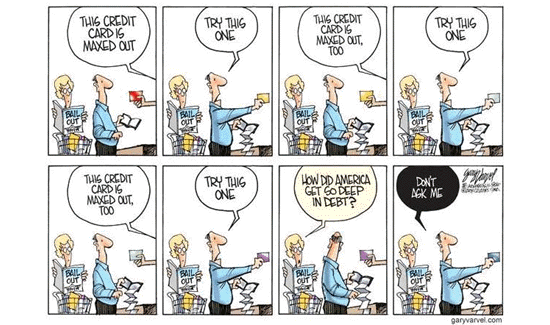
5. Economics is all wrong because of rational expectations? Not if the alternative assumptions are even worse!
Here’s Simon Wren-Lewis:
Most of the references I make to rational expectations in posts are in the context of the history of macroeconomic thought. I suspect the problem some people have is that they associate rational expectations with the New Classical critique of Keynesian economics, and therefore think rational expectations must be anti-Keynesian. This confuses who fought wars with the weapons they used. I see it quite differently. Before rational expectations, mainstream Keynesian theory that incorporated the Phillips curve depended on a rather fragile story of why economic booms (downturns) could occur, which was that workers kept under (over) estimating inflation. New Keynesian theories based on rational expectations are more compelling, and can include the fact that information is both costly and incomplete.
... rational expectations will remain the starting point for macro analysis, because it is better than the only practical alternative.
The choice really matters. An economy where agents form their expectations in a naive adaptive way is like an elaborate machine which takes no account of what policymakers are doing. In reality the economy appears more intelligent than this: policy is difficult because people in the economy take actions which anticipate what policymakers might do. This makes designing good policy difficult, but the concept of rational expectations has allowed macroeconomists to tackle this problem. To throw all that away by abandoning rational expectations would not improve macroeconomics, it would impoverish it.
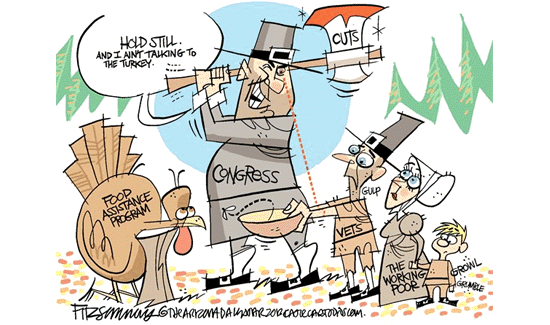
6. My rational expectation on hearing of this boondoggle was to wonder why on earth governments claiming to care about reducing the incentive to poach elephants for their ivory would want to boost ivory prices.
NZ’s expert on illegal trade in animal parts Brendan Moyle had similar thoughts.
Will the US destruction of its paltry ivory stocks make a difference to any of this? It seems unlikely. Chinese incomes aren’t going to be slowed by this. The guy shooting elephants on the savannahs won’t even be aware of it. Kenya did another big destruction effort in 2011. Poaching kept going up afterwards.
There are two risks though attached to these gestures. The first is it signals that ivory is becoming even more scarce. The signal may not be what the US intends. By signalling to criminal organisations ivory is becoming scarcer, the race to accumulate more in stockpiles may accelerate. I don’t know. It seems like an important question though to have settled before making these gestures.
The second risk is well, the ban could be the wrong strategy. Something devised to counter the black market of the 1980s may in fact, be redundant. A regulated trade may be the way forward.
7. We move from trade in ivory to buying kidneys.
New Zealand has some of the world’s worst organ donor rates. Maybe we should consider paying donors. HuffingtonPost reports on American research:
In the study, researchers found that assuming a payment of $10,000 and an increase of kidneys available for transplantation by 5 percent, a strategy of paying living donors would save the health system $340 over the lifetime of each patient, compared with the current organ donation system. The study was published today (Oct. 24) in the Clinical Journal of the American Society of Nephrology.
The savings come from lower costs and improved health outcomes over the recipient's life. "Transplant has a higher upfront cost, but the yearly maintenance cost is lower than dialysis," said study author Lianne Barnieh, a researcher at the University of Calgary.
A 5-percent increase in donations would mean an additional 5 kidneys transplanted yearly for every 100 transplants currently performed, and would improve patients' net health by gaining 0.11 quality-adjusted life years on average over a patient's lifetime.
The problem is at least as bad in New Zealand.

8. If the last one made you squeamish, you might blame your genes.
Heredity seems to explain a substantial portion of individuals’ ideological preferences.
...a new international study shows that our genes can explain up to 60 percent of our political actions: our political commitment, who we vote for and what ideology we support.
The findings come from a gigantic study of 12,000 pairs of twins. The study turns upside down the prevalent scientific understanding of what influences our voting behaviour, according to one of the Danish researchers behind the study.
The reporting here overstates the novelty somewhat: research on heredity and policy preferences goes back a ways.
If our political preferences are pretty strongly influenced by our genetic background, we should all somewhat weaken our confidence in our own beliefs.
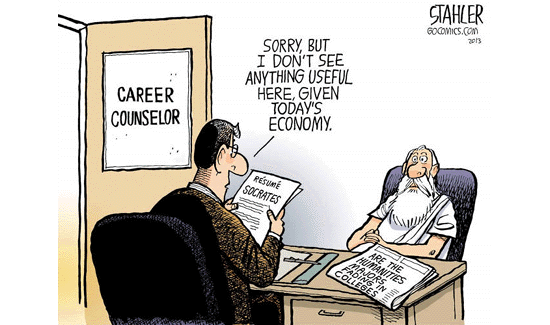
9. Economists complain a lot about policies that seem pretty ineffective or even counterproductive.
But, when we take proper account of just how badly voters understand policy, we wind up not only grateful that policy isn’t even worse, but also with a powerful argument in favour of limited government.
Ilya Somin leads off a Cato Unbound forum on his new book, Democracy and Political Ignorance.
Democracy is supposed to be rule of the people, by the people, and for the people. But in order to rule effectively, the people need political knowledge. If they know little or nothing about government, it becomes difficult to hold political leaders accountable for their performance. Unfortunately, public knowledge about politics is disturbingly low. In addition, the public also often does a poor job of evaluating the political information they do know. This state of affairs has persisted despite rising education levels, increased availability of information thanks to modern technology, and even rising IQ scores. It is mostly the result of rational behavior, not stupidity. Such widespread and persistent political ignorance and irrationality strengthens the case for limiting and decentralizing the power of government.
Every year, I have great fun showing my undergraduate students the evidence around Americans’ political ignorance. I wait until after they’ve had a good laugh at the Americans’ expense before showing them the New Zealand data suggesting things here are no better.

10. Want to help poor people in distant lands?
Why not give them money? The Economist reports on development assistance giving cash to poor families, with and without strings attached. The conditional transfers sometimes did better in improving outcomes, but straight cash transfers without any conditions also worked rather well.
When Give Directly’s founder, Michael Faye, went to traditional aid donors with his free-money idea, he remembers, “They thought I was smoking crack.” Silicon Valley, though, liked the proposal - perhaps because Give Directly is a bit like a technology start-up challenging traditional ways of doing things (in this case, aid). Google contributed $2.4m; Facebook, $600,000.
It’s too rare that programmes meant to help the poor by providing free school breakfasts or other in-kind assistance are evaluated against an alternative that simply gives families the same cash equivalent.
We welcome your comments below. If you are not already registered, please register to comment
Remember we welcome robust, respectful and insightful debate. We don't welcome abusive or defamatory comments and will de-register those repeatedly making such comments. Our current comment policy is here.