

Here's my edition of Top 10 links from around the Internet at 10:00 am today. We now have a Monday-Wednesday-Friday schedule for Top 10.
Especially, check #4 today.
Bernard will be back with his version this Wednesday. We will have another guest posting on Friday.
As always, we welcome your additions in the comments below or via email to david.chaston@interest.co.nz.
See all previous Top 10s here.
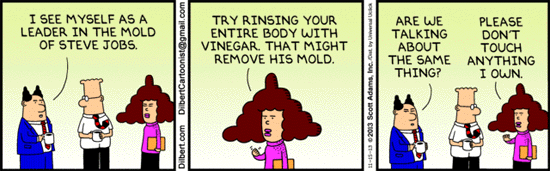
1. The [coming] global war on trusts
Kiwis love their trusts. While there are legitimate uses, many are set up by the middle class to rort the means-testing systems for taxpayer handouts. While this is on a relatively small scale in the global scheme of things, it is typical of the international use of trusts - hiding assets from governments, so that 'fair shares' aren't paid.
International money-laundering efforts are now ubiquitous - even impacting how customers engage with New Zealand banks.
Now the international effort it turning to 'trusts' and 'foundations'. Singapore is the real target, and there are new links here with the Singapore 'financial industry' - so that means our laws that make it very easy to set up trust-type structures in New Zealand are undoubtedly going to get a tune-up.
Given how the big global players easily forced New Zealand to adopt their AML laws, there will be nowhere to hide with trusts soon. More from The Economist:
Only a fool holds dirty money in his own name these days. Anyone in the know tries to conceal ownership through labyrinthine combinations of anonymous shell companies and arrangements such as trusts and foundations. Campaigners have worked hard to expose the extent of this “layering”, helping to push corporate transparency up political agendas. G8 countries backed mandatory registration of real, or “beneficial”, owners at their summit in Northern Ireland in June. Now Britain has become the first country to announce that its register would be open to the public.
The misuse of trusts, foundations and the like has drawn less interest - though some view such vehicles as a vault-sized loophole.
Some countries have begun to take a harder line. France has changed its law to treat all potential trust beneficiaries as owners for tax purposes - even if they never receive a penny. Under America’s Foreign Account Tax Compliance Act (FATCA), which is to take effect next year, trusts will face many of the same Draconian reporting obligations as banks. The European Commission has proposed several amendments to its savings-tax directive, in a bid to close the loopholes that Mr Morris and others have identified. These could become part of the cross-border framework for exchange of tax information emerging under the aegis of the OECD, a rich-country think-tank.
The new EU regime would reject the idea of ownerless assets, at least for trusts managed in the EU and dependent territories (which make up most such arrangements worldwide). In effect, until the beneficiary has received money, the original owner will be deemed to have retained them and be liable for tax. The trustee will be obliged to help enforce this. So far Luxembourg has been a sticking point. Its financial industry thrives on tax-friendliness and secrecy. It says it will sign up only when Switzerland, Monaco and other non-EU European states agree to exchange information automatically. The Swiss are loath to do so unless Singapore (home to a booming trust industry) and other wealth-management centres sign up too.
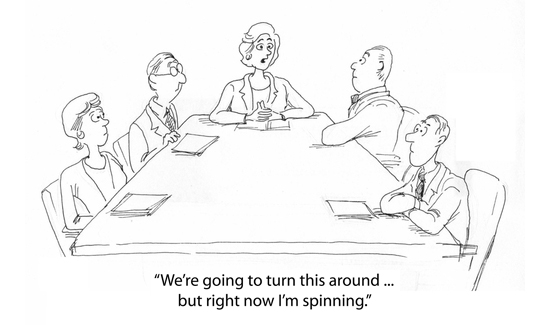
2. 'Physics envy'
Mark Buchanan (who is a physicist) says that 'actually, economists can predict financial crises' - and many did. It's just that regulators weren't listening. Apparently it depends on using the standards physicists use. He finds economics has to deal with far more complex issues than in the physical world. He explains:
The challenge for economists is to find those indicators that can provide regulators with reliable early warnings of trouble. It’s a complicated task. Can we construct measures of asset bubbles, or devise ways to identify “too big to fail” or “too interconnected to fail” institutions? Can we identify the architectural features of financial networks that make them prone to cascades of distress? Can we strike the right balance between the transparency needed to make risks evident, and the privacy required for markets to function?
Work is racing ahead. In the U.S., the newly formed Office of Financial Research has published various papers on topics such as stress tests and data gaps -- including one that reviews a list of some 31 proposed systemic-risk measures. The economists John Geanakoplos and Lasse Pedersen have offered specific proposals on measuring the extent to which markets are driven by leverage, which tends to make the whole system more fragile.
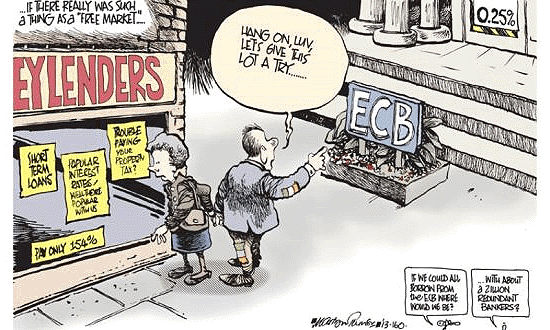
3. Bipartisan agreement?
Talk about the Guaranteed Minimum Income is making a comeback. Surprisingly, it is attractive to thinkers on the right as on the left.
The latest effort to get a system like this in place is in Switzerland - you would qualify, just by being alive. The AEI conservative approach in the US would have three additional criteria: be a citizen, be over 21, and be out of jail - hardly onerous.
So its not really a 'minimum income' - its an unconditional minimum income. You wouldn't have to work for it (It it's ok for TBTF banks to get free money, why not people?)
It is rare that big policy ideas are agreed like this. Maybe it is time to try it here? There are some very big vested interests to overcome, however (like some political parties). Here's Anne Lowry at the NYT:
The case from the right is one of expediency and efficacy. Let’s say that Congress decided to provide a basic income through the tax code or by expanding the Social Security program. Such a system might work better and be fairer than the current patchwork of programs, including welfare, food stamps and housing vouchers. A single father with two jobs and two children would no longer have to worry about the hassle of visiting a bunch of offices to receive benefits. And giving him a single lump sum might help him use his federal dollars better. Housing vouchers have to be spent on housing, food stamps on food. Those dollars would be more valuable — both to the recipient and the economy at large — if they were fungible.
The left is more concerned with the power of a minimum or basic income as an anti-poverty and pro-mobility tool. There happens to be some hard evidence to bolster the policy’s case. In the mid-1970s, the tiny Canadian town of Dauphin ( the “garden capital of Manitoba” ) acted as guinea pig for a grand experiment in social policy called “Mincome.” For a short period of time, all the residents of the town received a guaranteed minimum income. About 1,000 poor families got monthly checks to supplement their earnings.
Evelyn Forget, a health economist at the University of Manitoba, has done some of the best research on the results. Some of her findings were obvious: Poverty disappeared. But others were more surprising: High-school completion rates went up; hospitalization rates went down. “If you have a social program like this, community values themselves start to change,” Forget said.
4. The difference between 'ideal', 'fair', 'perception' - and 'reality'
This video is a fantastic example of the power of good graphics. Impossible to watch without being captivated by the argument.
5. Why uncertainty is needed
It's an odd but widespread viewpoint; the present is uncertain and wrong, we need certainty in the future, the type of certainty we had in the past. It's rubbish of course. Uncertainty is what Allison Schrager is interested in and she thinks it is crucial to the drive that societies need. To her, certainty is stagnation.
[If] there’s one thing, the right and left agree on it’s that uncertainty is bad for the economy. According to progressives, certainty spurs growth by strengthening demand, thus it’s the job of the government to guarantee a certain living standard for everyone. Conservatives argue that government programs create uncertainty, because it introduces human unpredictability, and this discourages business from expansion and hiring. Both of these arguments are true to an extent- but it’s also true that the economy depends on uncertainty.
Not only does uncertainty drive motivation, entire industries exist because of it. Some people or institutions are better positioned to tolerate uncertainty either because they are well-diversified financially or personal disposition. The purpose of insurance and financial markets is to redistribute uncertainty to people better equipped to handle it (or so you hope). Redistributing uncertainty based on people’s needs and desires is presumed to enhance efficiency and it makes up more than 8% of GDP in America. Perhaps that’s too large a share of the economy, but the business of uncertainty is an important part of the economy.
6. Our public service
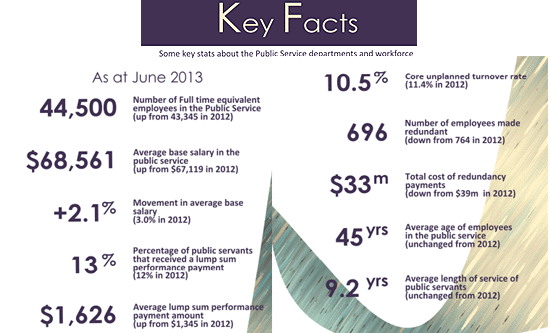
Public service staffing numbers have increased by +2.7% in the last year, and now stand at 44,500. That's an increase of 1,155 in a year. Pay has risen 2.1% to an average base pay of $68,561 per year. Full Report here:
7. Powering down
A closely watched indicator of China's growth is its consumption of electricity. Recently its been on a tear, but in the past few moths the pace has been slackening. For the full year, authorities there expect an annual growth rate of 'only' about 7% and the final quarter in China is expected to slow considerably from the start of the three months - mainly because officials are following directives to cut back on excess production capacity in some big key industries - steel, cement, electrolytic aluminum, sheet glass and shipping, which are all gigantic power users.
If China can still grow at the pace needed to absorb the huge demographic shift to urban living that is underway, without commensurate growth in electricity use, it will not only be a huge achievement, it might also be a modern miracle.
| Electricity produced, growth |
month-vs-month last year |
qtr-vs-qtr last year |
| % | % | |
| Dec-13 | 6.0 E | |
| Nov-13 | 5.5 E | 7.0 E |
| Oct-13 | 9.6 A | |
| Sep-13 | 10.4 A | |
| Aug-13 | 13.7 A | 10.9 A |
| Jul-13 | 8.6 A | |
| Jun-13 | 6.3 A | |
| Calendar 2013 | 7.0 E |
8. What we think is important
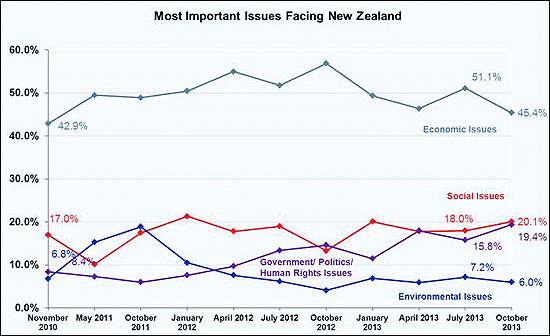
Perhaps the biggest surprise in the latest survey of our attitudes to 'important issues' is how low 'environmental issues' rates - 94% of us don't think it is the most important issue - at least we didn't in October.
This Roy Morgan survey asked what we though was most important to New Zealand, and what was most important to The World. This is how they compare:
| October 2013 compared with July 2013 | New Zealand | The World |
| % | % | |
| Economic issues | 45, down 5.7 | 44, down 0.6 |
| - gap between rich and poor | 13, down 2 | 16, down 1 |
| - economy/inflation/GFC/high dollar | 11, down 2 | 17, up 2 |
| - unemployment/job security | 11, down 2 | 3, down 1 |
| - cost of living/prices/debt | 6, down 1 | 3, no change |
| Social issues | 20, up 2 | 14, down 2 |
| Govt/politics/human rights | 19, up 4 | 5, no change |
| Environmental issues | 6, down 1 | 14, up 1 |
| Terrorism, wars, security | 16, up 2 |
9. Supply and demand
The recent stream of data about US oil production continues to confound the critics - especially those who grew up with the 'peak oil' argument. The latest data shows that for the first time since February 1995, the US produced more crude oil than it imported: 7.7 million barrels per day in October, versus 7.6 million of imports. American imports have been falling fast.
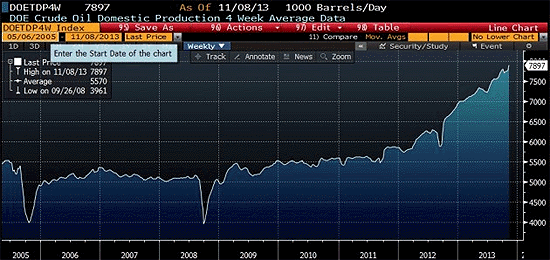
In fact, as Econ 101 would suggest, the sharp rise in production is raising the 'risk' of sharp price falls. Some analysts are saying that the circa. US$100/barrel current price could fall to US$70-80 range. And that may be low enough to shut some drilling platforms. More from BusinessWeek on where the action currently is:
The Permian lies beneath Texas and New Mexico and sprawls over 86,000 square miles, an area almost twice the size of Pennsylvania. While traditional wells have been drilled there since the 1920s, producers are giddy over the potential of the region’s vast overlapping layers of oil-soaked shale rock. Pioneer Natural Resources , an exploration and production company, estimates the remaining yield at the equivalent of 50 billion barrels, more than any field on earth except Saudi Arabia’s Ghawar.
The varied geology, though, makes it costly to explore and develop. “That’s the double-edged sword,” says Benjamin Shattuck, an analyst at Wood Mackenzie in Houston. Multiple oil zones layered one atop another provide ample potential for riches, “but you also have to be a knowledgeable and good operator in order to drill economic wells out there.”
10. Today's quote
"Money is not the most important thing in the world. Love is. Fortunately, I love money." - Jackie Mason
We welcome your comments below. If you are not already registered, please register to comment
Remember we welcome robust, respectful and insightful debate. We don't welcome abusive or defamatory comments and will de-register those repeatedly making such comments. Our current comment policy is here.