

Here's my edition of Top 10 links from around the Internet at 10:00 am today. We now have a Monday-Wednesday-Friday schedule for Top 10.
Bernard will be back with his version this Wednesday. We will have another guest posting on Friday.
As always, we welcome your additions in the comments below or via email to david.chaston@interest.co.nz.
See all previous Top 10s here.

1. Will Asiaphoria end with a bump?
With the top leaders of China’s Communist Party having released their economic strategy for the coming decade, they would do well to consider the warning of former US Treasury Secretary Lawrence Summers: Don’t count on fast growth to continue, and don’t get seduced by what he and fellow economist Lant Pritchett dub “Asiaphoria.”
The two economists don’t claim to have found specific roadblocks that will halt either country’s progress. Rather, they argue that the growth patterns of wealthy and developing countries over the last century or so suggest that “episodes of super-rapid growth tend to be of short duration and end in decelerations back to the world average growth rate.” Since China and India are already on extended rolls – though India’s has slowed recently – that would put them in danger of a bad fall.
They presented a semi-geeky paper at a San Francisco Fed conference about a week ago, and it's worth a full read:
India and even more so China are into essentially historically unprecedented episodes of growth. China’s super-rapid growth has already lasted three times longer than a typical episode and is the longest ever. The ends of episodes tend to see full regression to the mean, abruptly.
It is impossible to argue that either China or India have the kinds of “quality institutions” that have been associated with the steady dynamic of growth in the currently high productivity countries. The risks of “sudden stops” are much higher with weak institutions and organizations for policy implementation. China and India have very different modalities of this risk, but both have tricky paths to continued prosperity.
2. A problem but 'not a crisis'
There is world-wide angst about youth unemployment levels. Those rates fall very quickly when the 'youth' become 'young adults'. The elimination of youth minimum wage rates will have a lot to do with this, and because we are now going through a five year transition since 2008 and the biting of the GFC, we will soon get a good picture of what really is happening.
In addition, Zachary Karabell, a Bloomberg columnist, has another perspective. It is one that may help explain a lot about one important part of this problem:
The larger point is that many college-educated young people are choosing not to take low-paying service-level jobs if they don’t absolutely have to. Because they can live with their parents (and as many as 45 percent of recent grads do) and because they rarely have much in the way of fixed costs such as homes and children, they can hold out for a job that matches their ambitions. They can also retool their skills as they discover that their college degree in marketing and communications may not leave them in the best position to get the type of job that they want.
This type of unemployment is one of choice - rational, legitimate choice - not of systemic failure. It is a challenge to find a meaningful job, but that hasn’t stopped people from trying. A youth cohort determined to create meaningful work should not be seen as lazy, lost or in dire straits. Instead it could be exactly the type who might actually lead the transition of our economy away from the making-stuff economy of the 20th century to an ideas economy of the 21st.
The employment picture for young people without a college degree is different. They’re being left further behind. According to the BLS, more than 30 percent of recent high school graduates who aren’t in college are unemployed, and the number is worse for those who dropped out of high school. African-Americans without a college degree, especially under the age of 20, have an unemployment rate that approaches 40 percent. African-Americans also have higher incarceration rates, especially males, and most states and companies enact punitive regulations that make employment for those with a prison record extremely challenging.
The Hispanic population faces similar, albeit slightly less acute, stats. But these are not indications of a breakdown of labor markets. They’re proof that social policies and a shift in labor markets towards rewarding different and newer skills sets are hitting these populations, especially young men without college degrees, extremely hard.
In the United States, youth unemployment is not quite what it seems. It is not a simple sign of how bad the economy is. Youth unemployment is actually a sign of ambition and expectation. Young people aren’t part of a generation of despair, but rather a generation determined not to settle. That may not always be realistic, but it is a vital fuel to propel our society forward.

3. 'The Fed's the problem'
The debate about the underlying causes of the GFC and the stagnation that followed is not only the stuff of online news services like ours, blogs, and book authors. Filmmakers have also pitched in with some fine contributions. A new one is out focused on the US Fed. Here is what Kirk Kardashian at the New Yorker says, and the movie trailer.
The news about Yellen comes as a well-timed film about the Fed has been making the rounds. “Money For Nothing: Inside the Federal Reserve,” a documentary written, directed, and produced by Jim Bruce, examines the Fed since its creation in 1913 through interviews with financial historians, economists, investors, and current and former Fed personnel, and largely blames the Fed for the 2008 financial crisis.
Bruce, thirty-nine years old, is an L.A.-based filmmaker who played professional hockey in Europe. During the tech bubble of the late nineties, he invested his savings, about ten thousand dollars, in stocks; the value rose five-fold, then the bubble burst, and he walked away with barely more than his initial investment. When the next bull market came around, in 2007, he shorted stocks of firms in the banking and real-estate industries. The profits he made from those investments covered most of the budget for “Money For Nothing.”
“My motivation for making the film is that I felt the Fed did not learn the correct lessons from the 2008 financial crisis,” Bruce said. “I think they thought too much about the crisis being the problem. A different way of thinking about it is all the behaviors leading up to the crisis were the problems.”
Indeed, the film blames the Fed not only for ineffectively responding to crises but for helping to cause some of them in the first place.
4. Growth resumes
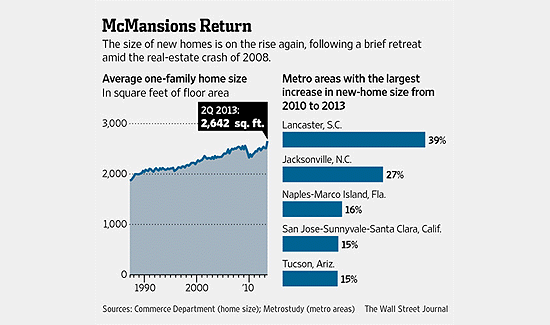
Readers of this website will know that median priced homes are far cheaper in the US than here. The New Zealand median is NZ$407,825 whereas the previously-owned US median is NZ$240,000 and the median new-build home is NZ$406,000. What doesn't usually show up in the discussion is how large US median homes are. And they are getting bigger. Before they started shrinking after the GFC we called them McMansions - now they are even bigger, we will need a new name. Any suggestions?
Yet the economy remains weak. How can Americans keep buying bigger and more expensive homes? It turns out, of course, that not everyone can.
“It’s all about access to credit,” said Rose Quint, an economist at the National Association of Home Builders. “People who are less affluent and have less robust employment histories have been shut out of the new home market. As a result, the characteristics of new homes are being skewed to people who can obtain credit and put down large down payments, typically wealthier buyers.”
It’s another sign that in today’s economy, prosperity is not universally shared.

5. Stellar returns
It's been a very good quarter for KiwiSavers. Not only have contributions grown strongly, up $1.362 billion in the three months to September 30 from June 30 ( and embellished in this quarter because the Government paid in its $490 million Member Tax Credit), but also because fund managers have picked up their performance.
They earned a record after-tax, after fees $483 million in just 90 days. (We worked this out by deducting the RBNZ September valuations from the IRD's disclosure of the contributions they paid to fund managers.)
That's more than 11% pa. and a real win for KiwiSavers (although not quite up to NZ Super Fund's ~19% pa over the same period).
We have given this industry some stick over what were some pretty average performances in the past - and so whatever the reason, it is great to see these outcomes. Let's hope they continue.

6. How the Simpsons have secretly been teaching you maths
I love The Simpsons although to be frank, I can't really tell you why. It seems savvy comedy to me. But maybe there is a secret allure - as this MotherJones story explains:
So what draws math geeks to the seemingly frivolous world of TV comedic writing in the first place? Singh argues that the, er, correlation between The Simpsons and math is no accident. Rather, it's a harmonious and natural relationship in many ways.
For one thing, animation these days requires fairly advanced programming skills, with knowledge of trigonometry, geometry, and calculus. "There is indeed a lot of mathematics behind the scenes," opined Pixar computer scientist Tony DeRose in a recent talk at the Mathematical Association of America. So it makes sense for today's hi-tech animators to have degrees in physics, computer science and math. But what about comedy writers?
Singh reports that one of the mathematicians on the Simpsons writing team, J. Stewart Burns, draws a parallel between puzzles, which represent the very essence of math, and jokes. "Both have carefully constructed setups, both rely on a surprise twist, and both effectively have punch lines. Indeed, the best puzzles and jokes make you think and smile at the moment of realization," Singh writes.
And there's another reason, Singh speculates, behind the preponderance of mathematicians on the writing team of The Simpsons (compared with other successful sitcoms like 30 Rock or Modern Family). Unlike scientists who might be more comfortable with uncertainty and the messiness inherent in experimentation, Singh notes that mathematicians prefer to be in complete control. He quotes Al Jean, another Simpsons writer with a BS in math from Harvard: "Live-action TV is like experimental science, because actors do it the way they want to do it and you have to stick within those takes. By contrast, animation is more like pure mathematics, because you have real control over exactly the nuance of the line, how the lines are delivered and so on…animation is a mathematician's universe."
7. A century in the slammer
A milestone went unnoticed this past week with the sentencing of David Ross to 10 year and 10 months jail.
By our count, that makes the total jail time handed out by the courts for finance industry failures from our Deep Freeze list companies now exceeds 100 years. Plus there is Home Detention (another 16 years), Community Service (minor) and Reparations (very minor). You can see all of the details in our Porridge List.
| Total jail time ... | 100 years & 11 months |
| Total home detention ... | 16 years & 0 months |
| Total community service time ... | 166.9 days (0.46 years) |
| Total $ reparation and fines ... | $3.3 million |
8. 'It's not unintended'
An assistant governor or the RBA spelled it out this week. The point of central bank intervention in banking markets is to raise the costs for banks. That is, higher costs are intended. It is up to the banks to decide whether to pass these on to customers. This is what Guy Debelle said: (my emphasis)
A number of the regulatory changes in financial markets have increased the price of financial intermediation and the provision of financial services generally. This has very much been the intent, and not, to re-use one of the most overused expressions around at the moment, an unintended consequence.
The price of intermediation was too low before the crisis; now it is higher. It was too low in the sense that risks were underpriced. These risks include liquidity risk and counterparty risk. Reforms such as the Basel III liquidity reforms or the OTC reforms are aimed at ensuring these risks are more appropriately priced. As financial institutions are adapting to these reforms, they are repricing many of the services they are providing to take fuller account of these risks. This repricing is gradually occurring only now in many cases and there is more to come. Hence end users of these services are only now starting to see the impact of these reforms in the form of higher prices.
As in many markets, when a price goes up, the quantity tends to go down. Again, this is to be expected, and desired. It is not unintended.

9. Getting dry - again
Enjoy the beautiful weather this weekend? Hope it doesn't continue. This year, our rural soils have less moisture in them than at the same time last year, and we know how that turned out. Soil moisture is way less than 'normal'. We will be watching these NIWA indicators closely.

10. Today's quote
"It frees you from doing things you dislike. Since I dislike doing nearly everything, money is handy." - Groucho Marx
We welcome your comments below. If you are not already registered, please register to comment
Remember we welcome robust, respectful and insightful debate. We don't welcome abusive or defamatory comments and will de-register those repeatedly making such comments. Our current comment policy is here.