

Here's a holiday edition of Top 10 links from around the Internet at 10:00 am today.
The next one will be on January 6, 2014, with normal service resuming January 13.
As always, we welcome your additions in the comments below or via email to david.chaston@interest.co.nz.
See all previous Top 10s here.
1. Follow the money
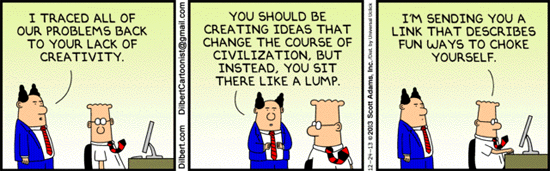
The influence of academics on policy makers is strong. Making sure their advice is independent is important - because there are plenty of examples where it is not.
New Zealand's business schools have increasing numbers of sponsored professorships. That is a good way for them to build their institutions with skills that might be lost overseas, but it comes with obvious risks to the independence of research and advice. New Zealand banks feature prominently in supporting business school positions.
On the flip side so-called independent, tenured professors drawing public moneys can find it very easy to pursue their own pet politics in a self-indulgent way - without any effective oversight or balance. Academia is a sinecure for left-wing politicians, essential for the survival of the Green and Labour parties.
It's hard to know how to get a proper balance. Maybe we need both for that balance?
But I doubt two wrongs make it right. Industry paid professors who don't declare their paymasters are just plain wrong.
The New York Times has uncovered another of these; Houston professors using their research as lobbying for commodities traders.
Do financial speculators and commodity index funds drive up prices of oil and other essentials, ultimately costing consumers? Since 2006, Mr. Pirrong has written a flurry of influential letters to federal agencies arguing that the answer to that question is an emphatic no. He has testified before Congress to that effect, hosted seminars with traders and government regulators, and given countless interviews for financial publications absolving Wall Street speculation of any appreciable role in the price spikes.
What Mr. Pirrong has routinely left out of most of his public pronouncements in favor of speculation is that he has reaped financial benefits from speculators and some of the largest players in the commodities business, The New York Times has found.
2. Raising minimum wages as 'stimulus'? Maybe not much
I've always been persuaded that rising wages - including raising the minimum wage - increases demand and is 'good' for the economy. But not everyone is convinced; some economists concede the effect may only be temporary. The issue is debt. If the low paid use their higher income to take on more debt, the effect can run out of steam pretty quickly. Here is Jordan Weissmann in The Atlantic on the expected effects in the US:
Still, some economists believe that when it all is said and done, upping the minimum gives the economy a quick pop. According to the EPI's math, raising it to $10.10 an hour should increase wages by $35 billion and boost economic activity by $22 billion—which by their account is enough to create those 85,000 jobs. If you assume some teenagers and adults will be laid off when the wage floor rises, then the job gains shrink.
The thing to remember, though, is that even if the minimum-wage-as-stimulus theory is correct, its impact is probably fleeting. In August, Federal Reserve Bank of Chicago economists Daniel Aaronson and Eric French produced their own estimate of what would happen if the minimum wage was raised to $10. Even if you factored in price increases and job losses, they found the increase would add $28 billion in spending to the economy. But after about a year, they predict the effect would dissipate.
Why? Part of the answer: debt. One reason increasing the minimum wage would plump up spending so much, they find, is that it would give workers the ability to put down payments on big-ticket items like cars. Later on, their spending would fall as they begin making loan payments.
"Thus," the researchers conclude, "a minimum wage hike provides stimulus for a year or so, but serves as a drag on the economy beyond that."
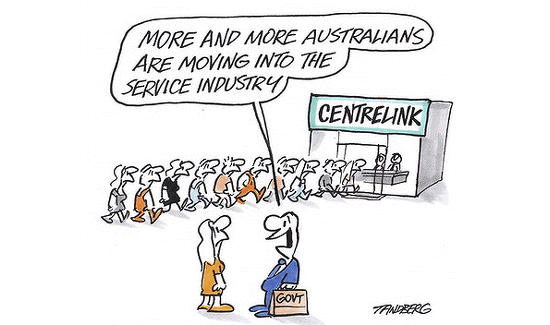
3. Why do optimists generate hostility?
We are a nation of conservatives - we dislike change. Too many of us see the past as bucolic. It wasn't. The problem is, fixing things requires change. Unless we benefit personality, it seems, we will be against it.
Or is it, we get livid if we think others may benefit more than us? (In some way, it's a bit like greed.)
But that is no reason to resist change. The truth is, we are in much better shape in 2013 than we have even been - because of change. That is not only true for New Zealand, but the world as well. There will always be whiners, but they must not win.
Zachary Karabell at Reuters has been thinking about why people - especially white middle class people - reject change.
The problem is that in a country of 300 million people, let alone a world of 7 billion, any statement about an economic or societal trend is likely to differ from the actual experience of a great many people. While there may be upsides to the changing mechanisms of our economic system, there are unequivocally winners and losers and many shades between. Any suggestion that the struggles of one group may be juxtaposed against, though not offset by, the flourishing of another group can seem disrespectful and even indifferent to the challenges faced by many people.
The answer, however, is not to focus relentlessly on what isn’t working. Every society must find some balance between addressing real shortcomings and building on real strengths. The United States in particular oscillates between excessive self-congratulation (“the indispensable nation,” “the freest nation on Earth”) and extreme self-criticism.
We can be making a transition from a manufacturing economy to an idea economy that sees millions finding a new way, and millions suffering. We can be educating millions brilliantly while failing to educate millions at all. We can see thriving urban centers even as suburban sprawl melts under too much debt and overpriced homes.
4. Inadequate and ineffective
Earlier in the month we reported the ECB supremo was unhappy with the limp proposals by the EU about banking rescue reform.
Now the European Parliament is also very sceptical. Here's an update from the BBC:
EU leaders have finished two days of summit talks in Brussels amid doubts about an agreed banking union plan.
Earlier new rules were agreed for bailing out or closing problem eurozone banks. The industry itself will set up a 55bn-euro ($75bn; £46bn) fund.
But the European Parliament is sceptical about the plan as it stands.
The parliament's president, Martin Schulz, tweeted that the "system for rescuing or liquidating failing banks needs to be simpler, more effective". In another tweet he said "European Parliament cannot accept the single resolution mechanism for failing banks as agreed [by EU leaders]".
The deal is aimed at building an EU banking union that should minimise the need for taxpayer-funded bailouts.
But it can only be implemented after negotiations with the parliament and European Commission.
The proposed pot of €55 bln is less than the amount that was used to bail out Ireland's banks, or Royal Bank of Scotland.

5. Money markets on edge
We may be on vacation, but it would be wise to keep one eye on the big new experiment the Chinese are running with their financial system. At the Third Plenum they committed to shifting to using market signals to set interest rates. But in two instances since then, when they tried they didn't like what the market did - pushing up rates sharply. Some folks think they don't have the right situation in place to allow such 'freedom'.
This is important for us because a miscalculation in Beijing could cause a reaction that would flow right over us.
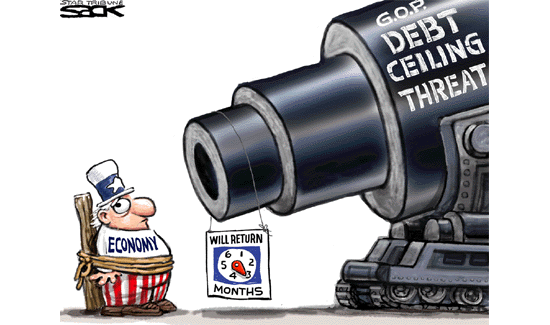
A complex and loosely regulated network of financial go-betweens has sprung up to profit from repackaging and reselling China’s new mountains of debt, turning loans into investment products. Such products have become popular among ordinary investors in China because they pay much higher interest rates than deposits in savings accounts, where rates are capped by the government to protect the state-owned banking system from competition.
But loosely regulated financial businesses can make a dicey business model, as Wall Street learned in 2008. And they pose a particular threat in an economy where growth is slowing, as it has been in China for the last three years.
“The final users of the money will not be able to earn returns high enough to repay the money and promised interest,” said Yu Yongding, a senior fellow at the Institute of World Economics and Politics of the Chinese Academy of Social Sciences and a former member of the monetary policy committee at China’s central bank. “The chains of lending and borrowing can be long, just like the securitized subprime mortgages. The result can be devastating.”
6. The time bomb that isn't?
Here's a novel idea: we actually don't have a demographic problem. In fact, New Zealand is in a much better position to cope with the 'aging population' issue than most major developed countries.
Two Scottish professors have taken a fresh look at the concept of the dependency ratio. Until now, that has been the relationship between those over 65 and the working population.
As at the end of 2010 (when these academics did their international comparisons), New Zealand had 3.8 workers under 65 for every personal over 65.
Their innovation is to recognise many people are living longer and working longer. They have developed the REDR, the real elderly dependency ratio. This figures out the number of people in a population of a remaining life expectancy of 15 years, and relates that to the total number of people in employment (regardless of their age). Seems sensible to me.
Statistics NZ has all the elements available to calculate the NZ REDR - and that works out at 8.5 workers, a far cry from the standard 3.8. (Or looked at the other way, our ratio of dependent-old to working is 11.7% at 2010.)
As we work on, and as life expectancy grows, the number of people in paid employment (paying taxes) will be higher than assumed, and the number of people with 15 or less in average remaining life expectancy will be those who are actually 'dependent'.
Our ratio is 11.7%; the USA is 17% and rising slowly, and the UK is 22% and falling - according to the chart in their summary.
This concept may have a significant implication for how we plan aging services - and (gulp) it does sort of underscore PM John Key's point that we can actually afford our current system for quite some time yet.
7. Can we trust climate predictions?
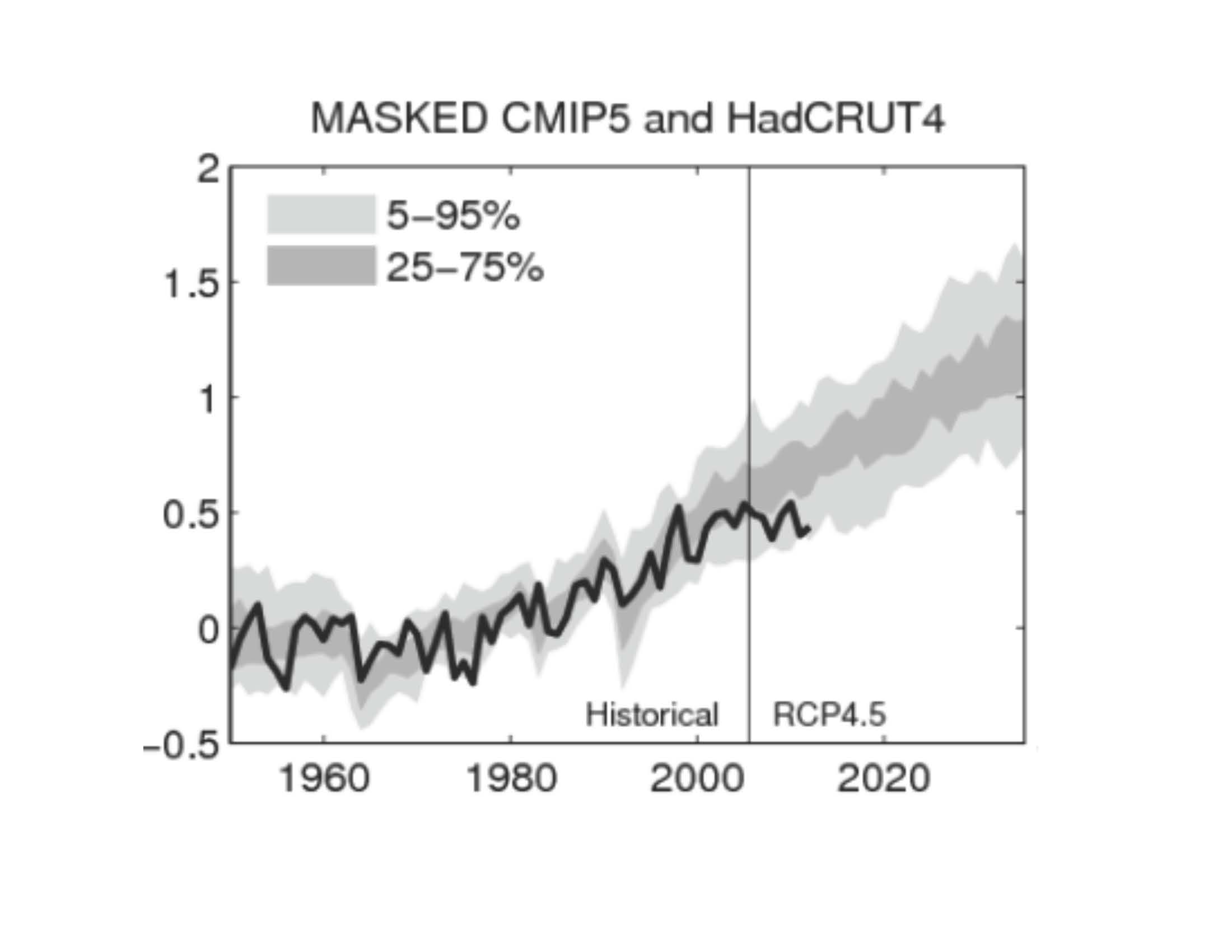
Climate sceptics know all about increasing Antarctic ice, and the apparent stabilisation of the earths temperature, even the inability of weather forecasters to predict tomorrows weather. How can climate scientists 'predict' the situation in 2100?
Perhaps we observe what is going on around us from the 'wrong' hemisphere. Predictions in the Southern Hemisphere are much less reliable than those in the north. But the math gurus say the reliability is improving, fast. Here are two pointy-heads reviewing climate model misgivings. Probably best to read their whole piece, but if you are short for time, this is their conclusion:
As the late American astronomer Harlow Shapley once said, “No one trusts a model except the man who wrote it; everyone trusts an observation, except the man who made it.” In model-data fusion, computer algorithms and observations are combined in a way that allows climate scientists to quantify the uncertainties in each, and assess the impact of those uncertainties on their predictions.
Does this mean that climate predictions can be trusted? In a word, yes.
The Earth system is so complicated, and governed by so many subtle feedbacks, that it is an astonishing feat to be able to make realistic predictions at all. Yet many important climate predictions have been confirmed. Dismissing climate models – or the complex weather-forecasting techniques on which they are based – as “fundamentally flawed” for failing to predict the slower increase in global temperatures over the last decade would be foolish.
We may not be inclined to trust politicians, but we do need to take the output of these well-honed algorithms seriously. Unlike many of us, our climate models are increasingly able to learn from their mistakes.

8. A double penalty
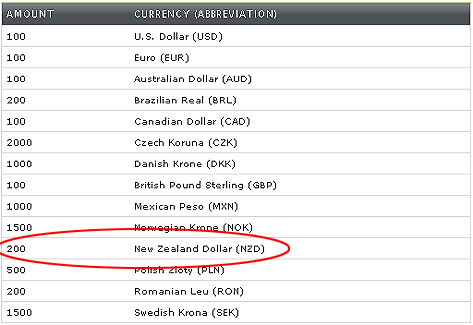
Hopefully you have not been the victim of the latest malware which encripts your files, locking them up unless you pay a ransom within a limited time period. Victims lose everything unless they pay. Fortunately, it appears very few New Zealand users seem to be victimised, according to the Dell website. (There does not appear to be any way to get around the lock, other than paying.)
But if you do, don't try and pay in New Zealand dollars - that will cost you almost double. Theses cyber crims haven't yet noticed our currency has appreciated a long way from the time it was 2:1 NZ:US.
9. What (your?) money can buy
With its recent purchase of Boston Dynamics, it looks like Google is rounding out its 'search' capability, by adding a 'destroy' option (!) Boston Dynamics makes military robots.
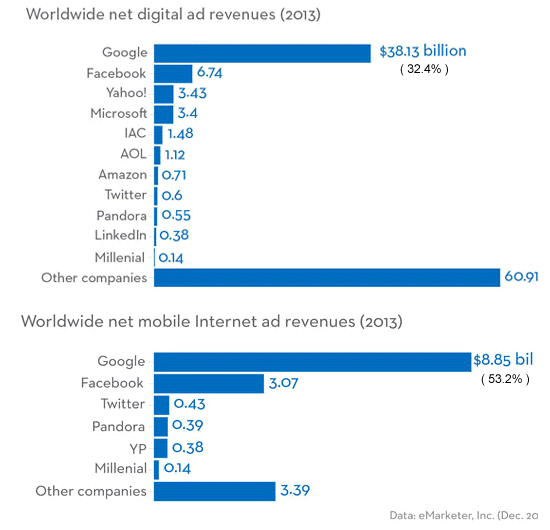
What allows Google to fund these 'moonshot' projects is its grip on online advertising. They have won an impressive one third of all online advertising and a remarkable one half of all mobile advertising.
10. Today's quote
"Cocaine is God’s way of saying you’re making too much money." - Robin Williams

We welcome your comments below. If you are not already registered, please register to comment
Remember we welcome robust, respectful and insightful debate. We don't welcome abusive or defamatory comments and will de-register those repeatedly making such comments. Our current comment policy is here.