
Today's Top 10 is a guest post from Murray Grimwood, who comments on this website as powerdownkiwi. He also has his own blog.
As always, we welcome your additions in the comment stream below or via email to david.chaston@interest.co.nz.
And if you're interested in contributing the occasional Top 10 yourself, contact gareth.vaughan@interest.co.nz.
See all previous Top 10s here.

1. Ahead of the play.
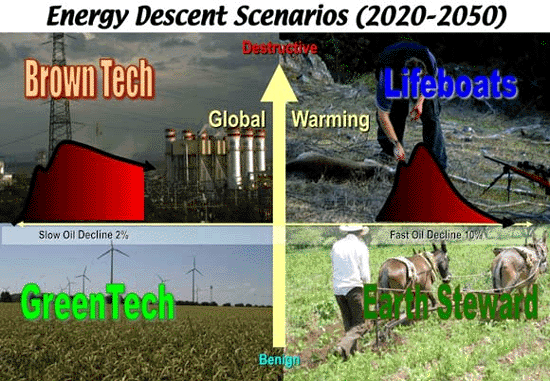
There are always a few ahead of the play, a few who get permanently left behind, and the mass in the middle. This is about the few who are ahead. It started with Permaculture icon David Holmgren, updating his ‘Future Scenarios’.
David’s argument is essentially that radical, but achievable, behaviour change from dependent consumers to responsible self-reliant producers (by some relatively small minority of the global middle class) has a chance of stopping the juggernaut of consumer capitalism from driving the world over the climate change cliff. It may be a slim chance, but a better bet than current herculean efforts to get the elites to pull the right policy levers; whether by sweet promises of green tech profits or alternatively threats from mass movements shouting for less consumption.
…without radical behavioral and organizational change that would threaten the foundations of our growth economy, greenhouse gas emissions along with other environmental impacts will not decline. Economic recession is the only proven mechanism for a rapid reduction of greenhouse gas emissions and may now be the only real hope for maintaining the earth in a habitable state.
He opines that if 10% stopped consuming, the whole edifice would fall over.
2. An enormous overhang
Nicole Foss replies, thoughtfully as always:
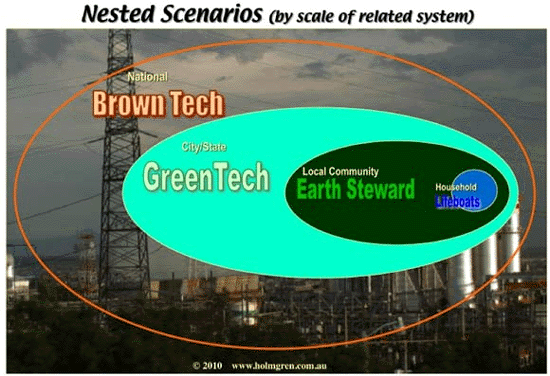
The situation we find ourselves in is at such an extreme in terms of comparing the enormous overhang of virtual wealth in the form of IOUs with the actual underlying collateral that the reset could be both rapid and devastating. This could produce a number of cascading impacts on supply chains in a short space of time, as Holmgren acknowledges in citing David Korowicz’s excellent essay on the subject – Trade Off. This is likely to make governments choose to take control, but also likely to make that very difficult, and therefore very unpleasant. In some places control may win out, leading to a Brown Tech type of outcome after the dust has settled, and in others a more chaotic state may dominate, leading to more of a Lifeboat scenario. The difference may not hinge on energy supply alone, although this may well be a significant factor in some places.
And a wee excerpt just for David Chaston:
Decoupling is nothing but an illusion. There has always been a very close correlation between energy use in particular and economic growth. In the era of globalization we claim to have reduced the energy intensity of our developed economies, but we have in fact merely displaced the energy used to the new manufacturing centres. We import goods manufactured on some other economy’s energy budget (and water budget and other resources as well).
I have met Foss three times now, and spent an enjoyable evening debating the big picture with her. She is no slouch, and should not to be lightly dismissed. (Here's a video interview Foss did at interest.co.nz in 2012).
3. Be careful what you wish for.
Different folk get uncomfortable at different points in the narrative. Some don’t want to know that their ‘Clean and Green’ nation lives at the expense of folk working for a pittance, in appalling conditions, in countries which accumulate ‘our’ pollution.
Others know we need to change, but don’t want to really change if it involves too radical a departure from their comfort-zone.
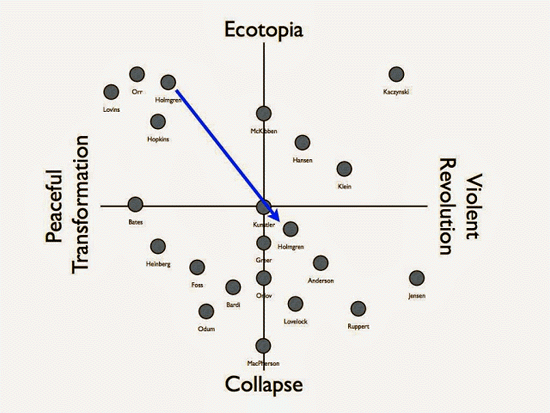
One looking like that is Rob Hopkins of the Transition Towns movement. By its very name, the intention of Transition Towns is obviously a managed morph. Which is at odds with the Holmgren piece.
There is a progression of thinking in this paper, and a point at which I part company with Holmgren. Economic growth and the current financial system means we are on course for a 6 degree rise in global temperatures. Yes, get that. Current approaches aren't working. Yes, fine. We need, with great urgency, to move beyond the growth paradigm to a different approach built on local economies and so on. Yes, I'm with you. And as Naomi Klein sets out in her recent New Statesman article, there are grounds for building a popular movement around that. But then to state that we need to deliberately, and explicitly, crash the global economy feels to me naive and dangerous, especially as nothing in between growth and collapse is explored at all.

4. Science is telling us to revolt.
So let’s have a wee look at the Naomi Klein piece. She reminds me of me back in the ‘Seventies; thinking you could change the mass mind-set by bringing-issues-to-public-attention by protesting. I reckon the public mind-set hasn’t moved, is overwhelmingly influenced by propaganda (sorry, advertising) and that time has run out for her approach but – and it’s a crucial ‘but’ - not for her message.
But it was Werner’s own session that was attracting much of the buzz. It was titled “Is Earth F**ked?” (full title: “Is Earth F**ked? Dynamical Futility of Global Environmental Management and Possibilities for Sustainability via Direct Action Activism”).
Standing at the front of the conference room, the geophysicist from the University of California, San Diego walked the crowd through the advanced computer model he was using to answer that question. He talked about system boundaries, perturbations, dissipation, attractors, bifurcations and a whole bunch of other stuff largely incomprehensible to those of us uninitiated in complex systems theory. But the bottom line was clear enough: global capitalism has made the depletion of resources so rapid, convenient and barrier-free that “earth-human systems” are becoming dangerously unstable in response. When pressed by a journalist for a clear answer on the “are we f**ked” question, Werner set the jargon aside and replied, “More or less.”
And her final comment includes this:
In July 2012, a couple thousand scientists and supporters held a mock-funeral on Parliament Hill in Ottawa, mourning “the death of evidence”. Their placards said, “No Science, No Evidence, No Truth”.
But the truth is getting out anyway. The fact that the business-as-usual pursuit of profits and growth is destabilising life on earth is no longer something we need to read about in scientific journals. The early signs are unfolding before our eyes.

5. Earth's population to decrease by at least 50%.
Which brings us to the inimitable Dimitri Orlov.
Surely, they broke the mould producing this far-seeing, cynical Russian émigré who lives on a boat in Boston Harbour and writes so compellingly.
The cynicism starts about here:
If, like Holmgren says, 10% of the population boycotted global finance, and global finance crashed, Brown Tech would probably just shut down, because its activities are very capital-intensive. Now, since our voices - Holmgren's and mine and those of other people who may be consonant with Holmgren's message - are mainly projected through blogs, I can do some math and figure out how many me-equivalents it would take to bring about the required change in global sentiment.
This particular blog gets around 14k unique visitors a month. Let's assume a sky-high conversion rate of 50%, where half of my readers pledge to support Homgren's boycott. That's 7k people. Global population is 7 billion, 10% of that is 700 million. Dividing one into the other, we get our result: it would take on the order of 100,000 me-equivalent activists/bloggers to bring about the required change of consciousness. Next question: how many me-equivalent (give or take) bloggers are there out there? ... we still get a 99.98% shortfall in the required number of activists/bloggers. La-de-da. But don't let that stop you from trying because, regardless of results (if any) it's a good thing to be trying to do.
His own take – and sadly I’m with him on this – is expressed thus:
My hunch is that those alive today will live to see the Earth's population decrease by at least 50% through famine, disease and war—if they live to see it, that is. How can you tell if you are extinct if you happen to be extinct?
6. Infinite money printing.
Since we’re with him, here are his predictions for the coming year:
So, my prediction is that this will continue happening until something breaks. Nobody knows when it will break, or why, because printing money and using it to prop up the price of stocks is a brilliant business plan that can continue working forever. Yes, I know that some people are pointing out that nothing goes up forever. Look at the housing bubble circa 2008, they say, or the internet stock bubble circa 2000. Bubbles always pop, they say. Naysayers! Well, what I want to say to these naysayers is this: This Time It’s Different. This is a new and amazing breakthrough: infinite wealth creation is now achievable through infinite money printing. It’s like the Singularity! (Remember, you heard it here first.)
7. Propping up the lie.
Yes, Orlov has a sense of humour. Another who does the cynicism/humour bit is the irrepressible Kunstler. Here’s his take for the coming year:
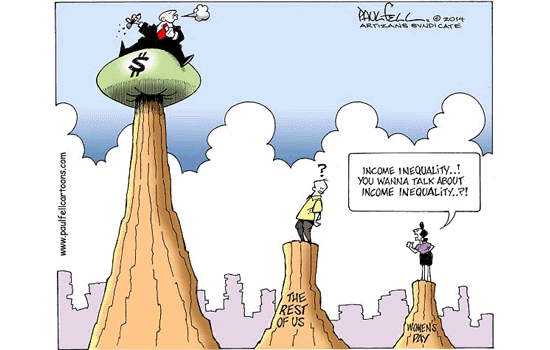
... accounting fraud pervades public and private enterprise, everything is mis-priced, all official statistics are lies of one kind or another, the regulating authorities sit on their hands, lost in raptures of online pornography (or dreams of future employment at Goldman Sachs), the news media sprinkles wishful-thinking propaganda about a mythical “recovery” and the “shale gas miracle” on a credulous public desperate to believe, the routine swindles of medicine get more cruel and blatant each month, a tiny cohort of financial vampire squids suck in all the nominal wealth of society, and everybody else is left whirling down the drain of posterity in a vortex of diminishing returns and scuttled expectations.
Wish I could sling words together like that! He goes on:
Now, a number of stories have been employed lately to keep all these rackets going — or, at least, keep up the morale of the swindled masses. They issue from the corporations, government agencies, and a lazy, wishful media. Their purpose is to prop up the lie that the dying economy of yesteryear is alive and well, and can continue “normal” operation indefinitely.
Agreed.
8. From the camel’s mouth.
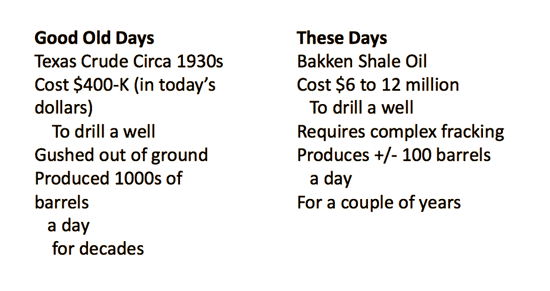
Back to what underwrites every good, and every service, ever proffered; fossil fuels. More specifically, the most essential one. What of it for 2014, from the experts? Here’s an interview with someone who knows more than most.
Q: In the larger context, how has your view of future world oil production supply evolved over the last four or five years? As a benchmark, I reference your slides from the 2009 Oil & Money Conference.
“In 2009 I highlighted several factors that inhibit production expansion including: decline rates (more extreme than ever with shale oil and deep offshore), limited investments (quadrupled capex/barrel in the last few years) and economic growth (still recovering). In the long term, reserves depletion remains very high with totally inadequate reserves replacements regularly obscured by resorting to claiming “resources” as reserves.”
Does that remind you of someone with a low profile round here? Nah….. J
The realities of the 2009 O&M forecast of a limited plateau of oil supplies have been pretty much vindicated since then. The oil plateau may now be inflated by about 1 - 2 Mbd of high cost unconventional oils but all major forecasters see this as pretty much transitional. The plateau itself remains a reality and unfortunately its duration is still unlikely to extend beyond the end of this decade.
There you have it, from the camel’s mouth.
9. A Red Queen situation.
Someone – I think it was Jeremy Leggett – stated that half of the non –FSU, non-China oil rigs are involved in just two plays; the Eagle Ford and the Bakken, just to keep production abreast of the steep depletion-rates. It’s best described as a ‘Red Queen’ situation; running hard just to stay on the same spot. Here’s one take:
Formations in North Dakota’s booming Bakken Shale, by contrast, decline 6 percent every month, said Lynn Westfall, director of energy markets and financial analysis for the Energy Information Administration — the U.S. Energy Department’s independent analytic arm.
“With swift declines like that, you need much more timely data,” Westfall said. For every 100 barrels of oil produced in the Bakken, he said, 70 barrels simply replace declining production from old wells.
“You’re having to run faster to stay in place,” Westfall said.
And yet:
In his presentation at Columbia University last month, Sieminski, of the Energy Information Administration, said the agency believes that U.S. natural gas production can grow until at least 2040, and while oil production may plateau in the next decade, it will increase to “levels significantly higher than where we are now.”
As a younger generation say so eloquently: ‘Whatever’.

10. History compressed.
There had to be a vid-clip. Goes without sayin’. I could have just slipped this into the ‘Top 10’ thread once a day for the last few years, and gone fishing (except that I don’t fish any more, having noted the emptying of the ocean from personal experience). Here it is; history compressed.
11. Bonus issue for those capable of original thought.
There is one more new-year prediction I’d like to share. There are folk hereabouts who don’t think, won’t think, who need to believe, who chant mantra – but there are some (Waymad comes to mind, Christov, Iconoclast and others) who are capable of original thought. This is for them. It requires a few minutes to read, so save it for one of those ‘feet-up, just poured a cuppa’ moments. I’ve seldom seen the big picture better put.
an excerpt;
Today almost everybody still believes that economic growth is the great salvation of humanity. If we could just get back on track with growth everything would work out.
There are only a handful of people in this world, who like me, have thought through the consequences of this logic. I think a proportion of that handful are reading this blog! This group constitutes a vanishingly small percentage of the world population. Either we are complete fools or there is mass delusion at work. I will unashamedly declare I am no fool. Yet I see no way to combat the delusion. The promise of endlessly increasing wealth is just too seductive for people. They are either too stupid, or too ignorant of how the universe works to work out the results. They are blind to the reality of overshoot and assured collapse for the simple reason that those are scary thoughts whereas growth of the economy promises comfort and a good life.
Makes you think, dunnit?


We welcome your comments below. If you are not already registered, please register to comment
Remember we welcome robust, respectful and insightful debate. We don't welcome abusive or defamatory comments and will de-register those repeatedly making such comments. Our current comment policy is here.