
Today's Top 10 is another guest post from Carlos Chambers who is a member and spokesperson for Generation Zero.
Generation Zero is an "organisation of young New Zealanders working to cut carbon pollution through smarter transport, liveable cities and independence from fossil fuels". He is active on Twitter via @CarlosChambers1. His first Top 10 is here.
As always, we welcome your additions in the comments below or via email to david.chaston@interest.co.nz. And if you're interested in contributing the occasional Top 10 yourself, contact gareth.vaughan@interest.co.nz.
See all previous Top 10s here.

1. What Google thinks
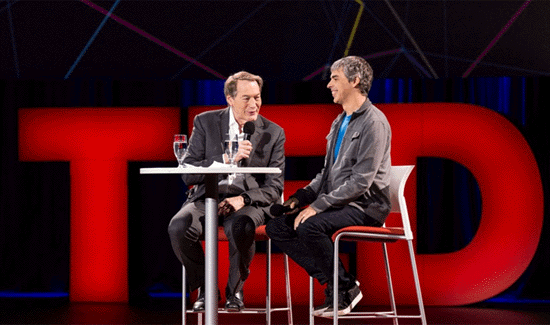
Co-founder of Google, Larry Page last week spoke out in a TED talk in Vancouver, about the company’s future, and why he would consider leaving his billions to Elon Musk (founder of PayPal, Solar City, Telsa Motors and SpaceX).
Felix Salmon (Reuters) examines the ethics and logic of the claim. He argues - better a small chance of creating a permanent and positive change to the way the world works, than giving yourself a larger chance of making a more limited intervention.
Page had words that sounded harsh even in his soft voice for businesses that lacked the same lofty goals of an Elon Musk or a Google. “Most people think companies are basically evil. They get a bad rap. And I think that’s somewhat correct,” Page said. “Companies are doing the same incremental thing that they did 50 years ago, 20 years ago. That’s not really what we need. Especially in technology, we need revolutionary change, not incremental change.”
I hugely admire and revere Elon Musk and much of what he has done, by looking hard into the future, spotting trends and problems and building impact driven companies - in the e-commerce, solar and now space travel areas in savvy ways.
But ultimately, I think the Bill Gates, through he and his wife’s foundation would have a better ROI for Page, and a better chance at enabling him to make a deeper positive impact than Musk.
2. A (Kiwi ?) clean tech benchmark
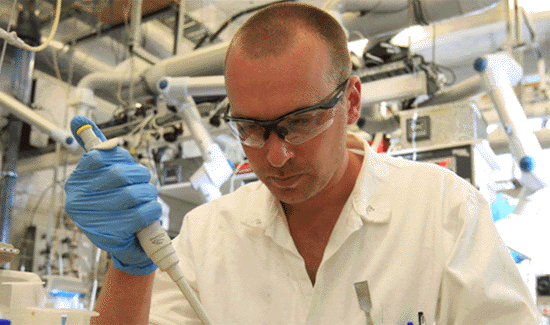
Kiwi clean tech darling LanzaTech last week grew its investment purse by $60 million, with series D funding coming from a handful of smart international investors. Stephen Tindall’s clean tech investment fund K1W1 was joined in the round by German, Japanese, Malaysian and Chinese finance.
The award winning business is a stellar example of what New Zealand could do. Economically, clean technology just makes sense. I know there are other New Zealand clean tech success stories are out there (notably Carbonscape who are greening the steel making process) - seek and support!
Kiwi tech companies have been doing well on the capital raises recently, with Vend raising a further $25 million (in series C) to boost international expansion.
New Zealand-founded bio-fuels innovator LanzaTech has attracted US$60 million in its latest capital-raising round, including a US$20 million commitment from Japanese industrial conglomerate Mitsui, which will join the LanzaTech board.
Mitsui said in a statement it would actively contribute to "developing next-generation biofuels and chemicals made from waste gases."
"Through this investment, Mitusui is going to be involved in marketing of LanzaTech's technology, business development and product take-off worldwide."
3. Fashion knows best ?
Intelligent, hipster, fashion, party magazine Vice hosts an interesting response to an attack on one of it’s journalists by Forbes writer, John Tamny. Tamny calls Shane Smith a global warming alarmist.
Smith sensibly outlines the flaws in the statement, backing these up with examples (some of which I am sceptical about attributing to anthropogenic climate change).
While concerning that Forbes is publishing content denying climate change is human-induced, perhaps most interesting is that Vice, and Forbes magazine are now having discussions about the topic.
Magazine’s I usually reach about for fashion, party, hipster and startups news are having the climate discussions. This is heartening - and shows the gravity and depth of the IPCC’s latest report.
Did the markets predict Hurricane Katrina? ($125 billion in damages/costs)
Did they predict Hurricane Sandy? ($71 billion in damages/costs)
How about the Fukushima disaster? ($58 billion clean-up)
Typhoon Haiyan? (7,500 dead or missing and $12.5 billion in cleanup costs)
The drought in California? ($5 billion estimated loss in 2014 revenue alone)
No.
Market analysts anticipated none of these because their focus is the economy, NOT the environment. Those guys are looking to make money, while scientists are overwhelmingly in agreement that not only is global warming happening, but that the worst is yet to come.

4. Decreased production, increased cost
Suzanne Goldenberg writes on the effect of climate change on the world’s food, arguing that countries’ governments’ are paying more notice to the most recent report by the IPCC, due to the direct impact on humans’ food system. The report finds climate change will decrease food production and increase its cost. It’s true that we humans don’t tend to realise and appreciate things until we properly feel it.
Think global, eat local.
In that time, climate change has ceased to be a distant threat and made an impact much closer to home, the report's authors say. "It's about people now," said Virginia Burkett, the chief scientist for global change at the US geological survey and one of the report's authors. "It's more relevant to the man on the street. It's more relevant to communities because the impacts are directly affecting people – not just butterflies and sea ice."

5. The flaws of purely rational thinking
A thorough summary of the fifth assessment report by the Economist on how the climate is affecting the Earth's ecosystems, the economy and peoples' livelihoods.
The author JP spells out the consequences in the IPCC report in clear terms, along with high level comparisons to the last report of the same kind, in 2007.
The author argues that GDP is an inadequate measure of the effects of climate change and points out the flaws that arise from the purely rational economic thinking that the measure is premised on. He also points out the vagaries of using any model to assess a challenge which is the size and breadth of climate change.
So how much might all these influences affect the world economy? The IPCC's surprising answer to that is: hardly at all. A 2°C rise in temperature, it says, could result in worldwide economic losses of only 0.2% to 2% of GDP a year. The trouble is, as the IPCC also says, this figure is misleading. GDP is a bad measure of climate impacts and the economic models used are hopeless ("completely made up", said one recent critic). GDP does not account for catastrophic losses, which may be the most important kind. As an income measure, it gives less weight to the poor—but the poor are more vulnerable to climate change than the rich. That is true both between countries (Bangladesh is more vulnerable to floods than the Netherlands) and within them (richer Bangladeshis live in safer areas). The models do not take account of things like "tipping points"; do not care if carbon concentrations go sky-high and assume that if an economy were ravaged by drought or floods, it would suddenly have lots of "spare capacity" that could be redeployed.
6. Tech and transport demand
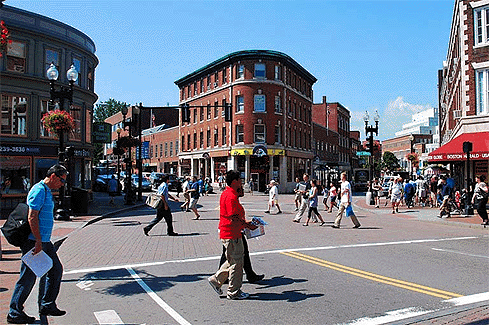
The wave of technology is doubling up with the wave of increased demand for transport choice. Interestingly, the later wave is not limited just to the tech-star’s Generation Y, but includes baby boomers and empty nesters, argues the article.
The product: a mind shift and a Tsunami of apps and other walkability innovations in cities around the world.
This is not to say that New Zealand’s fair cities don’t face their own unique issues and challenges around walkability, not necessarily addressed - but some of the innovations in this article are a great starting point.
I can’t wait to see how things like the HACKAKL: Transport “hackathon” style weekend - Auckland’s first “civic hacking” event spawn Kiwi transport solutions for that city. A city with it’s own plethora of transport issues.
Fueled by a fundamental shift in the way people move about communities, cities, and regions, new innovative technologies are being introduced to the masses. These tech tools facilitate the ability to walk to places and use forms of urban mobility other than cars. Technology-based solutions and information platforms include such apps as RideScout, Walkscore, Walkonomics, and Transit Screen. They’ve emerged in response to interest from both Millennials and Baby Boomers wanting information-rich mobility options to guide them to where they need to go.
7. Insurance innovation in Africa
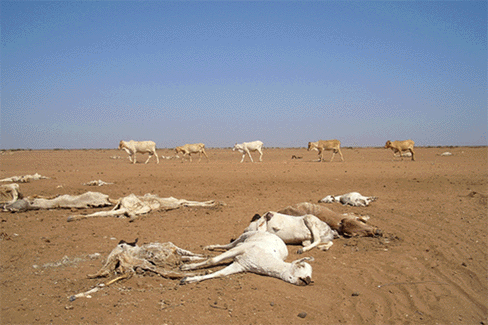
James Kariuki from the Business Daily Africa writes on the first successful iteration of a smart new insurance offering for East Africa - with the first successful claim in Wajir Kenya.
The insurer, Takaful Insurance of Africa insured with an index based livestock insurance product. The product offering complies with Islamic practice, and uses satellite imagery to calculate and compensate policyholders.
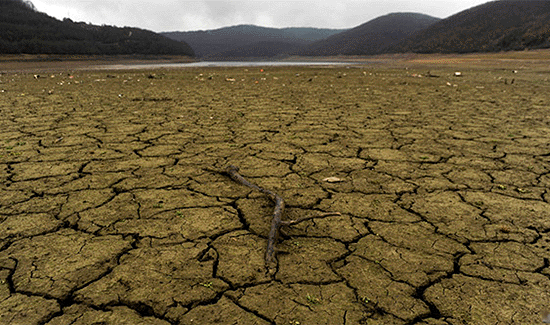
Are financial institutions stepping up in places that need it, and will continue to as large tracts of East Africa dry out over time? Insurers seem to be moving with the times and joining the innovation party.
Who said insurance is a stale industry?
Takaful Insurance CEO Hassan Bashir said the index-based Livestock Insurance product (IBLI) is aimed at giving pastoralists a fallback plan during natural hazards.
“Our goal is to show pastoralists that they can use a fair and ethical business model to protect their assets from a natural hazard in East Africa,” said Mr Bashir.
The livestock insurance conforms to the Islamic concept of takaful in which risks are shared among group members, who, through a contract called tabbaru (donation) contribute to a risk fund. It is paid out according to a member’s contribution.
More fulsome coverage on the insurance providers site.
8. Trust us, we're doctors
A collection of medical practitioners co-author this editorial in the British Medical Journal, providing a health professional's perspective on the issue of climate change, and calling for urgent action on the same to ensure human survival.
As is typical of doctors, they cite sensible, respected research sources and also look at the suite of health and human benefits reducing some of the current emissions heavy patterns would result in. A nice even expression of the global picture and a call for personal responsibility for health professionals.
This was written in the week leading up to the IPCC’s report - we can only guess how the views expressed could and would have been strengthened after the authors read that report.
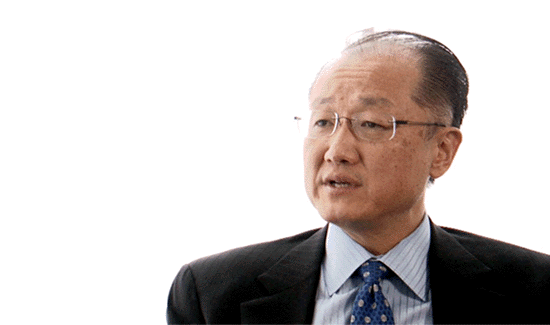
What we all do matters, not least in how it influences others. Those who profess to care for the health of people perhaps have the greatest responsibility to act. And there are signs of action being taken. Within the health system, organisations and health facilities are reducing their carbon footprint. Barts Health NHS Trust has, for example, reduced its energy bill by 43% since 2009. The president of the World Bank, Jim Yong Kim, himself a public health physician, has called for divestment from fossil fuels and investment in green energy. We should all respond.
9. SuperFund investment choices
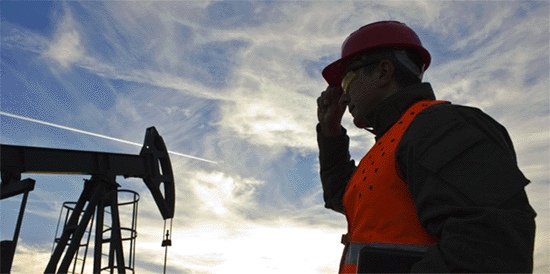
You might have missed the NZ Super Fund dropping $292 million into US oil and gas investments, alongside private equity giant Kohlberg Kravis Roberts, which overall has $94.3 billion in assets under management, and just under $10 million in energy in resources.
This seems part of a strategy to create a diverse investment portfolio and expertise in energy sectors. Last year the fund invested in Waltham, Massachusetts-based wind energy start-up Ogin to help grow it’s capital before going public.
The fund’s manager admits that the oil and gas investment is open to a continual passive exposure to the energy sector, but doesn’t let this stop him. Personally, I can think of better ways to invest my money than into US oil and gas.
Looking at LanzaTech would be one smart start.
The NZ Super Fund is committing up to $US250 million to invest in North American oil and gas assets alongside private equity giant KKR.
10. 'New Zealand has great potential'
The Royal Society of New Zealand released a new report on the benefits to New Zealand in pursuing a greener economic direction.
The report, Facing the future: towards a green economy for New Zealand, "presents evidence from local and global trends suggesting that New Zealand should carefully review its development direction, and discusses the potential for the country to move towards a green economy."
If a picture paints a thousand words, this accompanying infographic produced by the Royal Society must rack up a few more.
Picking up on the report, NZ Herald reporter Jamie Morton had this great feature article taking a look at whether we’re currently doing enough to get there, and what can be done.
The overall verdict? Plenty of potential but a looong way to go.

We welcome your comments below. If you are not already registered, please register to comment
Remember we welcome robust, respectful and insightful debate. We don't welcome abusive or defamatory comments and will de-register those repeatedly making such comments. Our current comment policy is here.