

Here's my edition of Top 10 links from around the Internet at 10:00 am today. We now have a Monday-Wednesday-Friday schedule for Top 10.
Bernard will be back with his version this Wednesday. We will have another guest posting on Friday.
As always, we welcome your additions in the comments below or via email to david.chaston@interest.co.nz.
See all previous Top 10s here.
1. Out of ammo?
Michael Sauga and Anne Seith have written a long and fascinating piece in Spiegel Online about the eroding power of central banks.
They look at the contrasting views of Richard Fisher (of the Dallas Fed), Mark Carney (of the Bank of Canada and lately the Bank of England), and the ECB's Mario Draghi.
But they also take a close look at the influence of Claudio Borio who is the chief economist of the Bank for International Settlements.
It is Borio who is the most interesting and influential. He is the one those senior central bankers take notice of.
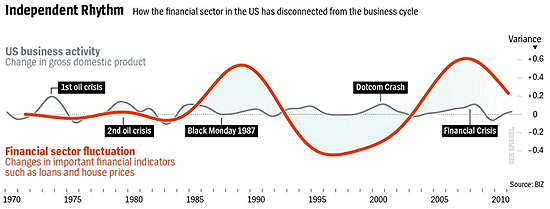
He has identified and tracked the 'financial cycle', something that is operating independently of the 'business cycle'.
The US Fed bought up trillions in treasury bonds, but it cannot force politicians in Washington to reach an agreement in the budget fight. The ECB has flooded the banks with liquidity, but is unable to restructure the EU institutions. In the UK, the Bank of England has pledged to keep interest rates low for the foreseeable future, but it is unable to create jobs by itself.
"Monetary policy is overburdened," says Borio.
No matter what central bankers do, the pendulum swings of an unfettered credit sector either render their impulses ineffective or amplify them to such an extent that they become a threat. "Policy has to make sure that the financial cycle is not disruptive," says Borio.
For this reason, he explains, governments must exert tighter control over banks and financial institutions, but monetary policy experts also have a role to play. They shouldn't just focus on the economy, but also pay attention to the financial cycle. This means raising interest rates when a recovery threatens to become overheated, and otherwise to remind themselves of a virtue they once practiced more assiduously: doing nothing -- and urging those to take action who can truly bring about change, such as policymakers, bankers and business owners.
Central bankers are familiar with Borio's analysis, and many agree with him. But a larger number know that it isn't popular at the moment. "Central bankers have started to acknowledge that financial cycles are important," says the economist. "But how far they are prepared to take action is another question."
2. Not optimistic
China has just completed a comprehensive survey of its soils and the results are alarming.
The survey conducted between 2005-2013, it found that 16.1% of its soil and 19.4% of its arable land showed contamination. China surveyed 6.3 million square kilometers and that 16.1% represents more than 1 million km2 that is contaminated - an area four times as large as the whole of New Zealand, or equal to about all of Egypt, or twice the size of France.
The report had previously been classified as a state secret because of its sensitivity, but it how available at this link. You will need to use Google Translate to read it, but even with that process's flaws, it is clear the Chinese leadership is shocked.
Survey results show that the overall national soil environment is not optimistic, heavy soil pollution in some areas, cultivated soil environmental quality worrying, mining and industrial wasteland soil environmental issues outstanding. The point of the total soil exceeding the rate of 16.1%, of which a slight, mild, moderate and severe pollution point ratio was 11.2%, 2.3%, 1.5% and 1.1%. From land-use types, farmland, woodland, grassland soils point exceeded rates were 19.4%, 10.0%, 10.4%. From pollution types, with no model-based, there are models, followed by a smaller proportion of complex pollution, inorganic contaminants exceeding the median point of the point total exceeded 82.8%. Situation from excessive pollutants, cadmium, mercury, arsenic, copper, lead, chromium, zinc, nickel eight kinds of inorganic contaminants point exceeding rates were 7.0%, 1.6%, 2.7%, 2.1%, 1.5%, 1.1% , 0.9%, 4.8%; BHC, DDT, polycyclic aromatic organic pollutants in point 3 exceeded the rate of 0.5%, 1.9%, 1.4%, respectively.
3. 'We are different'
Yu Yongding is the sterotypical insider of China's elite. He says, don't worry, they have it all under control.
The market is always in search of a story, and investors, it seems, think they have found a new one this year in China. The country’s growth slowdown and mounting financial risks have spurred a growing wave of pessimism, with economists worldwide warning of an impending crash.
But dire predictions for China have abounded for the last 30 years, and not one has materialized. Are today’s really so different?
The short answer is no. Like the predictions of the past, today’s warnings are based on historical precedents and universal indicators against which China, with its unique economic features, simply cannot be judged accurately.
The bottom line is that the complexity and distinctiveness of China’s economy mean that assessing its current state and performance requires a detail-oriented analysis that accounts for as many offsetting factors as possible. Predictions are largely pointless, given that the assumptions underpinning them will invariably change.
4. 'Yes we can'
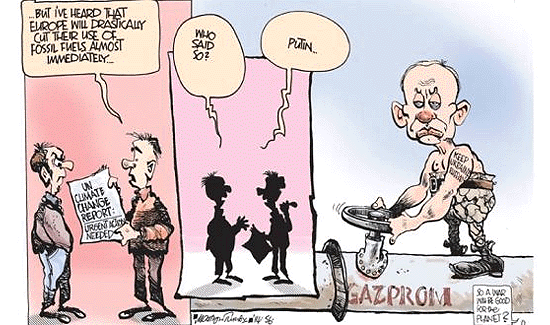
In a post sure to annoy some of our readers, and brighten up others, Paul Krugman likes what he reads in the latest IPCC updates, especially the 'mitigation' volumes.
He thinks we are yet to cotton on to some stunning changes; he says too many of us are looking at the problem though backwards-facing lenses.
There’s no necessary one-to-one relationship between growth and pollution.
People on both the left and the right often fail to understand this point. (I hate it when pundits try to make every issue into a case of “both sides are wrong,” but, in this case, it happens to be true.) On the left, you sometimes find environmentalists asserting that to save the planet we must give up on the idea of an ever-growing economy; on the right, you often find assertions that any attempt to limit pollution will have devastating impacts on growth. But there’s no reason we can’t become richer while reducing our impact on the environment.
5. A monumental distortion
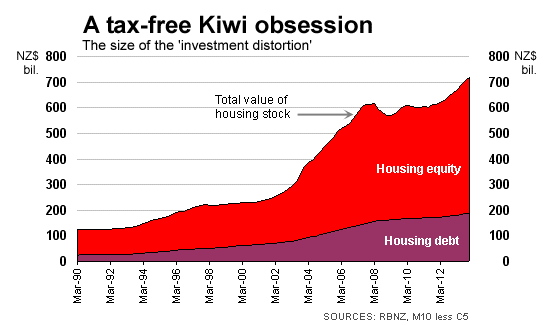
Last week the RBNZ updated its M10 data series to complete the 2013 information. That showed that their valuation of all New Zealand housing is now almost a staggering $720 billion. Their companion C5 series shows that at the same year-end data we owed $188 billion to banks and non-bank institutions for housing loans.
That means overall there is a massive NZ$½ trillion in housing equity.
As an economy we truly are a 'housing market with a few minor bits tacked on'. No other industry comes anywhere near close.
It is a monumental economic distortion - all brought about over a long period because these $530 billion in 'value gains' are untaxed, unlike almost all other investment gains.
6. A crocodile in the river
Trade Me is huge in New Zealand, eBay enormous in many other countries, but the true giant of e-commerce is Alibaba out of China. It proved itself by beating eBay in China.
We'll be hearing more of the company because it is floating in New York soon - and it is choosing New York because that way it can get around some annoying governance restrictions Hong Kong has in place.
Business Insider has the 'origin story', because a film is about to be released on Alibaba's rise. See this 58 slide sequence.
"eBay is a shark in the ocean.
"We are a crocodile in the Yangtze River.
"If we fight in the ocean, we will lose. But if we fight in the river, we will win."
If you haven't seen the Alibaba website before, take a look now. You can forget any ideas of trying to fortress New Zealand. Globalisation has won. Local is so far second, it's a tiny quaint afterthought, possibly unsustainable except as a cottage industry.
btw, Alibaba is keeping Yahoo in business.

7. Off the radar
Aquila Capital is a large German-based alternative asset manager. They have a NZ country manager and have been active in investing in NZ farms, dairy in particular. Now they aren't so sure it still makes sense.
The appeal of New Zealand as an investment target "has changed in the last 12 months", said Andrew Sliper, senior manager farm investments at Aquila – and a New Zealander.
"As a result of the interest in New Zealand, land prices have gone up incredibly high," Mr Sliper told Agrimoney.com.
New Zealand farm prices were worth a 20% premium to those in Australia thanks to factors including a lack of stamp duty and capital gains tax.
"But at the moment we are seeing prices in New Zealand more than double those in Australia."
We keep detailed per hectare records of farm sales by type, based on what REINZ reports. And these records definitely don't show rising per hectare prices, even in dairy - except for irrigated Canterbury farms and those certainly have shown steep recent increases. Elsewhere though, nada. Perhaps Aquila is sensing that even the old, stable prices are too rich for them if soft commodity prices fall. Or they are finding cheaper (better) deals in Australia.
8. The material of tomorrow
Moore's Law is still valid after 50 years, which if you think about it is absolutely stunning given that it involves a doubling every two years. You would think such exponential growth couldn't continue, and even Gordon Moore himself doubted his 'law' would last as long.
But it might go a while yet, a long while.
Some people think we are about to move away from silicon as a semiconductor base to graphene, a one-atom thick layer of graphite. A core property of graphene is that it is cheap and abundant compared to just about all alternatives. It's light, transparent, conductive and flexible. What's not to like?
Nick Bilton has been fawning over its possibilities:
If you think of something in today's electronics industry, it can most likely be made better, smaller and cheaper with graphene.
Scientists at the University of California, Berkeley made graphene speakers last year that delivered sound at quality equal to or better than a pair of commercial Sennheiser earphones. And they were much smaller.
Another fascinating aspect of graphene is its ability to be submerged in liquids without oxidizing, unlike other conductive materials.
As a result, Vijayaraghavan said, graphene research is leading to experiments where electronics can integrate with biological systems. In other words, you could have a graphene gadget implanted in you that could read your nervous system or talk to your cells.
9. Rising US rents threaten middle class
Regular readers will know that not only do we keep monthly tabs on home loan affordability, we also review rent affordability each month too. And we compare the two after adjusting for rates, insurance and maintenance. Our reviews to date show that for a couple renting a house, things have been very stable for some time now, and that there are significantly lower costs for renters than home owners.
But will it last?
Apparently the situation for renters in the US is getting pretty tough. Part of that is simple economics. Between 2007 and 2013 the United States added, on net, about 6.2 million tenants, compared with 208,000 homeowners. That stat comes from a review of the growing costs of renting in a recent NY Times article:
The problem threatens to get worse before it gets better. Apartment builders have raced to build more units, creating a wave of supply that is beginning to crest. Miami added 2,500 rental apartments last year, and 7,500 more are expected in the next two years, according to the CoStar Group, a real estate research firm.
But demand has shown no signs of slackening. And as long as there are plenty of upper-income renters looking for apartments, there is little incentive to build anything other than expensive units. As a result, there are in effect two separate rental markets that are so far apart in price that they have little impact on each other. In one extreme case, a glut of new luxury apartments in Washington has pushed high-end rents down, even while midrange rents continue to rise.
“Increasing the supply is not going to increase the number of affordable units; that is a complete and utter fallacy,” said Jaimie Ross, the president of the Florida Housing Coalition. “People say if there really was a great need, the market would provide it; the market would correct itself. Well, the market has never corrected itself and it’s only getting worse.”
The Economist reckons their problem is all about supply constraints.

10. Today's quote
"I spent a lot of money on booze, birds, and fast cars. The rest I just squandered." - George Best
We welcome your comments below. If you are not already registered, please register to comment
Remember we welcome robust, respectful and insightful debate. We don't welcome abusive or defamatory comments and will de-register those repeatedly making such comments. Our current comment policy is here.