

By Bernard Hickey
This week's budget was notable for its carefully telegraphed surpluses and the relatively moderate election sweeteners included within its slightly looser fiscal outlook.
The Government can credibly argue it is not pushing down too hard on the accelerator of the economy, which means the Reserve Bank won't have to tap any harder on the interest rate brake as we swerve into the inflationary corner over the next year.
But buried in the mountain of Treasury papers this year was an elephant of a forecast that could shift both the political and economic landscape of the budget and the country if it happened.
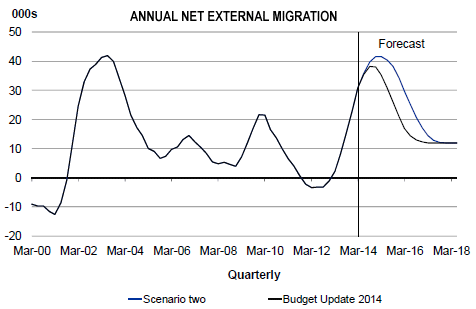
Treasury likes to paint both an upside scenario and a downside scenario into its forecasts to keep economy watchers on their toes. This week's upside scenario that suggested annual net migration could surge to 41,500 by the end of this year was a doozy.
That's the equivalent of almost 1% of New Zealand's population and just under the May 2003 record high of 42,500.
The Treasury's central forecast was that annual net migration would rise to 38,000 in the September quarter of this year from 31,900 in the March quarter and nil net migration as recently as beginning of 2012.
So the Treasury's forecast is only for an extra 3,500 people more over the next six to nine months than is its central forecast. But the impact is massive.
Treasury forecast private consumption growth would spurt to 5.3% from its main forecast of 4.2%.
The extra migration would drive employment up and unemployment down to almost 4% by 2018.
That sounds fantastic, but there's a down side.
"With the economy already growing faster than potential, the further boost to domestic demand sees any spare capacity in the economy used up more quickly than in the main forecast," Treasury said.
That is code for inflationary pressure and higher interest rates.
It forecast short term interest rates would jump by a full one percentage point more than already forecast to almost 6% by early 2016.
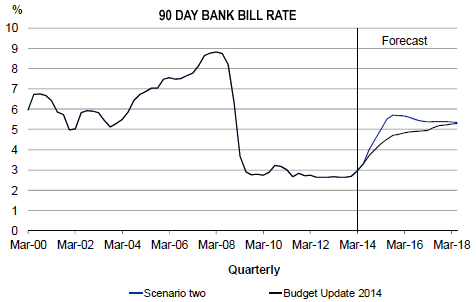
That would see floating mortgage rates hit 9% and the current account deficit would jump to 6.8% from 6.3%.
There is good news for the Government's budget though, as all the extra income created by the extra workers would increase taxes from wages, GST and profits.
Higher interest rates also help the government through higher taxes on term deposits.
All this would increase the budget surplus for 2014/15 by almost NZ$1 billion. All this feeds into a growing political and economic debate around migration.
It used to be seen as an un-alloyed positive for the economy that boosted economic activity, entrepreneurial vigor and social diversity.
But there are economic downsides too, including increased pressure on resources when the economy is running hot and a surge in house prices.
This is, of course, mostly an Auckland story and is set to become an election issue. Labour has already raised the idea of limits on migration to help the Reserve Bank control interest rates and house price inflation.
New Zealand First Leader Winston Peters has a wider objection that he looks set to wave about with bells on in the months leading up to September 20. The irony and the opportunity will not be lost on Mr Peters.
The last time net migration was this high was around the July 2002 election, when New Zealand First campaigned hard against migration and got over 10% of the vote and 13 seats in Parliament.
There may be an elephant in the forecast, but there's now a frisky old war horse hot on the trail to September 20.
We welcome your comments below. If you are not already registered, please register to comment
Remember we welcome robust, respectful and insightful debate. We don't welcome abusive or defamatory comments and will de-register those repeatedly making such comments. Our current comment policy is here.