
By Bernard Hickey
We've all heard and thought about what 'Peak Oil' might mean for the global environment and our economy.
We can understand the idea that resources such as fossil fuels or rare earths or clean water could 'run out' and restrict our ability to grow and consume.
But what would 'Peak People' mean?
New Zealand hasn't had to think much about depopulation before.
New Zealand's population has grown relatively strongly in recent years. We could easily grow by 1% from net migration alone this year and we have a high birth rate and young population when compared to many parts of Western and Southern Europe, and Japan.
We have gotten used collectively to a never-ending growth bandwagon.
Young, growing populations need feeding, housing, educating and pairing off. They are economic growth machines.
But it becomes much harder when populations start getting older, and ultimately, start falling.
Japan's economy has been in a multi-decade slump since the early 1990s, largely due to its first ageing and now falling population. Its birthrate collapsed from just over the replacement rate of 2.1 in the early 1970s to 1.3 in 2005. Japan's population stopped growing in the early 1990s and has now started falling because it also allows very little migration.
It's no coincidence that its economy contracted over the last 20 years and it endured chronic deflation that it is only now addressing with massive money printing.
Look a little closer at Japan and the problem of depopulation is even more corrosive. Its population is forecast to fall 30% by 2060.
Councils in rural areas of Japan are already closing bridges and roads that they can no longer afford to maintain as their base of ratepayers either leave, or can't afford the rates.
This is a spectre now facing some district and town councils in remoter areas of New Zealand.
This week's Royal Society report on the implications of the latest census made that clear.
"Some territorial local authorities will have increasing difficulty in maintaining service levels for an ageing and possibly dwindling population, not to mention burgeoning numbers of visitors and tourists," it said.
NZIER Economist Shamubeel Eaqub has also talked about the issue of "zombie towns" in regional New Zealand.
Councils will have to make difficult decisions to return tarseal roads to gravel roads, to turn off town water supplies and to let parks return to bush.
They will have to keep ramping up rates to a falling base of ratepayers, while also paying for facilities for more visitors.
That may force them to levy more visitor charges.
Anyone buying property in places such as Wanganui, Gisborne, Whangarei and Greymouth should have a good look at their area's population projections before they plonk down their deposits on houses or office buildings and gear themselves up to a depreciating asset.
There are no easy solutions, but depopulation will increasingly become a topic for town planners, investors, real estate agents, economists, home buyers and voters.
In the even longer run it will something to think about globally.
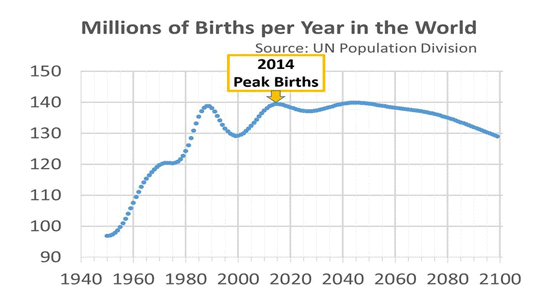
The UN's Population Division said this week that 2014 looks like being the year for 'Peak Births' in the world with 139 million.
The global population may start falling as early as 2070.
Our economies would then have to find other new ways to grow.
--------------------------------------------------------------------
A version of this article first appeared in the Herald on Sunday. It is here with permission.
We welcome your comments below. If you are not already registered, please register to comment
Remember we welcome robust, respectful and insightful debate. We don't welcome abusive or defamatory comments and will de-register those repeatedly making such comments. Our current comment policy is here.