

Here's my Top 10 items from around the Internet over the last week or so. As always, we welcome your additions in the comments below or via email to bernard.hickey@interest.co.nz.
See all previous Top 10s here.
My must read is #9 on a genuinely new idea to take some of the risks of big swings in property prices out of the global financial system. It would also reduce some of the incentives for people to chase leveraged capital gains on residential property. (Wash your mouth out!)

1. Turning Japanese - I went to an excellent presentation recently by economic demographer David Bloom about the demographic dividend that helped boost economic growth rates in the developed world from the 1950s to the 2000s, and which is now helping drive economic growth in the developing world.
Here's the column I wrote on it, which talked specifically about the risks this demographic dividend would reverse into a drag in New Zealand.
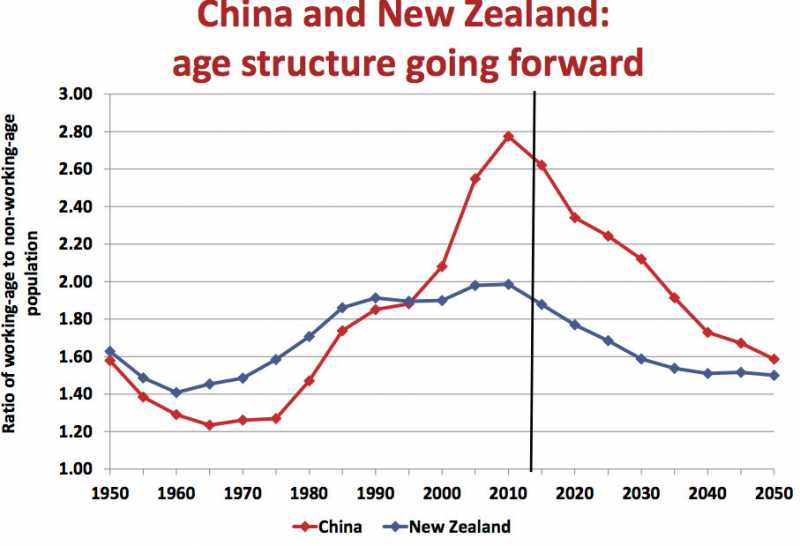
But the most striking part of his presentation was about China, which benefited from an even bigger demographic dividend than most because of its one child policy, and which is set to have an even bigger demographic drag because of that same policy.
Last year, China's working age population fell for the first time and the chart below showing the ratio of working age to non-working age in New Zealand and Australia.
The rise to a peak over the last 30 years helped boost growth. New Zealand's slides off in the coming 20 years, but not as dramatically as China.
Obviously, this has meant New Zealand has gotten a 'second wind' of sorts as we benefited from China's dividend.
There'll no doubt be plenty of growth in China in the years to come, but it may not be fueled by its demographics.
2. Everything you think you know is wrong - This Ipsos-Mori poll of public perceptions in 14 countries (unfortunately not New Zealand) found that people are usually wrong with their perceptions on issues such as teen pregnancy, unemployment, migration and murder rates.
And not just a little bit wrong.
A lot wrong.

I may have put this video below into a previous Top 10. It's worth a second look.
Although to be fair, Britain was only the 10th least informed population in the 'Index of Ignorance' mentioned above. Italy and America were worst. Thereform, I blame Silvo Berlusconi and Roger Ailes (Fox News).

4. The Power of Price - The NZIER's Chris Parker has written good note on Auckland Council's congestion charging idea. He likes the power of price and I have to say I agree with him. Although I do live in Wellington and commute to work on a bike, so I would :)
Rates and fuel tax rises are largely revenue gathering tools and would do little to reduce the excessive volumes of cars on the road. They also provide no location-specific signalling at all to alleviate particular bottlenecks. The user charge option is better for the public interest. Pricing – through its daily salience – will make people question why the projects to be funded are being done in the first place.
Yes, people don’t want to pay for roads that they have already paid for. But they already do that every day when they pay a lot of tax to fill up their petrol tank to use existing roads. The problem is that taxes are more out of sight, out of mind.
5. Gender specific - The World Economic Forum has published a gender gap map showing those with the biggest gap between the genders in things like health, income and educational achievement. New Zealand is among the worst overall and for pay equity in particular. We do very well on education though.
It's all very topical given last week's court decision. We rank 13th out of 142 countries and that's down from 5th in 2010. See our country profile on page 284.
New Zealand ranks 67th for gender equity for income.

6. Pick your poison - The worlds of inflation, interest rates, central banking and house prices appear to have gone mad. Interest rates have been virtually nil for six years in most of the developed world because inflation has been so low, even though their economies have been recovering for most of that time.
The low interest rates have stimulated lots of speculative investment in existing assets such as land and shares, but not the sort of new investment in new productive capacity that would generate lots of jobs and real economic growth.
Central banks face a real conundrum. They have to keep interest rates low because inflation for goods and services is so low, but all this cheap money is blowing up asset bubbles that threaten financial systems.
New Zealand just tried to put up interest rates in the usual way, but quickly found, like other central banks, that the old rules don't apply. To its credit, the Reserve Bank has found other tools such as the high LVR to try to calm down these asset markets, but it's not easy.
Another central bank that tried to put up interest rates -- prematurely as it turned out -- was Sweden's Riksbank. It ended up creating deflation and has just cut its rate back to zero.
Here's Ambrose Evans Pritchard with a good look at the Riksbank's conundrum and its thrashings around for a solution. It is looking at currency intervention, it seems. Sounds familiar.
Sweden’s Riksbank has torn up the rulebook of global central banking, cutting interest rates to zero even though the economy is in the grip of a credit boom.
The extraordinary step is intended to stave off deflation but it comes at a time when the Swedish economy is growing at almost 2pc and property prices are rising briskly. The bank has abandoned earlier efforts to curb asset bubbles by “leaning against the wind”.
The Riksbank cut the deposit rate to -0.75pc in what looks like a preparatory move to drive down the krona. Governor Stefan Ingves said the bank has a toolkit of extreme measures in reserve, including use of the exchange rate. The comment is the first hint that Sweden may follow Switzerland and the Czech Republic in imposing a currency floor through unlimited purchases of foreign bonds.
The Riksbank faces an acute dilemma, forced to pick between the competing poisons of deflation or an asset boom. It is a variant of the Morton's Fork faced by a growing number of central banks around the world.
7. Why stop at Zero? - There's a lot of talk that central banks have done as much as they possibly can and now they've hit the 'zero lower bound' for interest rates and they should just throw their arms up in the air and call on the politicians to use their fiscal tools to pump up growth.
Here's Martin Sandbu at the FT saying central banks could do a lot more, particularly to drag long term bond yields down towards zero. As Karen Carpenter might have sung if she was a central bankers and still alive: 'We've only just begun'.
It is wrong to think interest rates cannot fall below zero. The rate most immediately under central banks’ control – the deposit rate on reserves – can be made as negative as one wishes. There are technical questions involving incentives to hoard physical cash, but these are solvable. And with the rate on reserves sufficiently negative, the rate on other assets can be made negative as well. The only zero lower bound is one central banks impose on themselves.
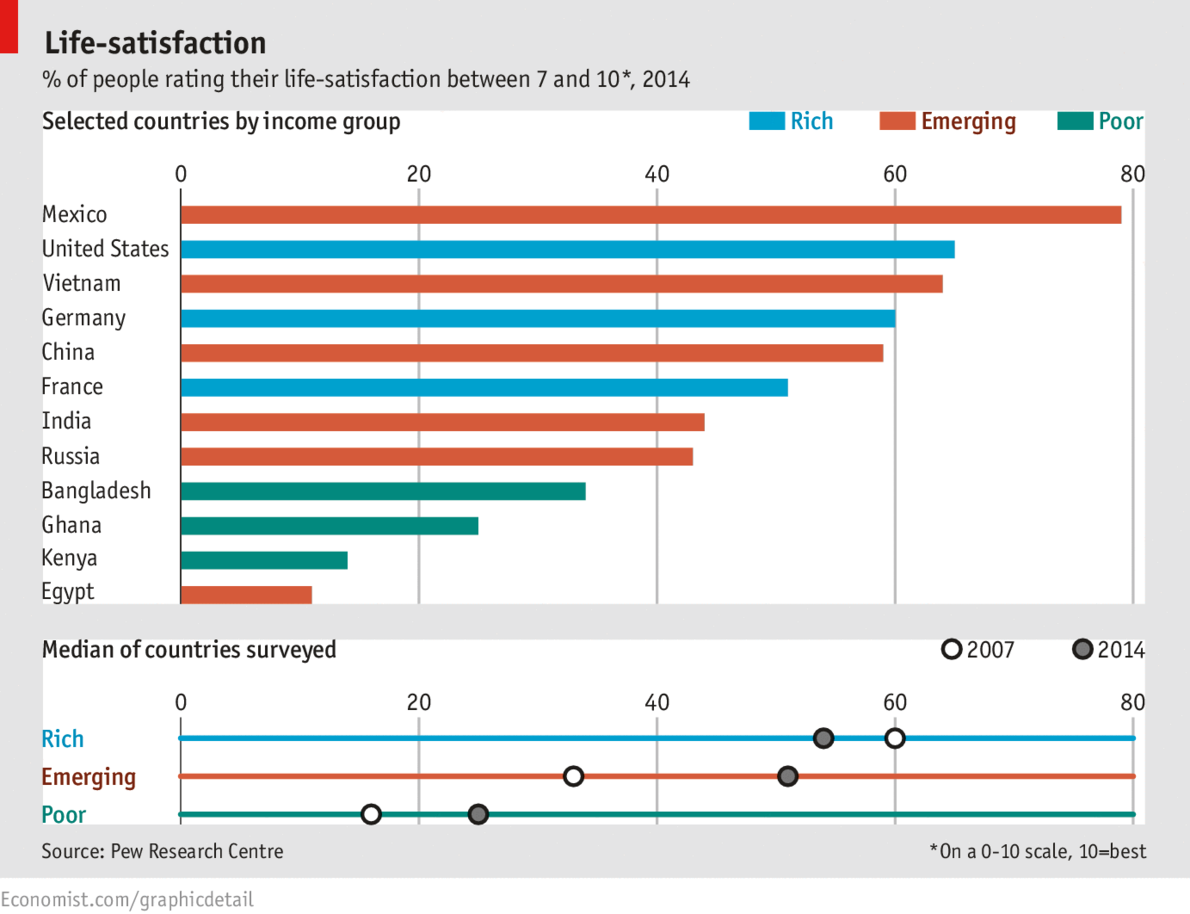
8. What's with the Mexicans? - This Economist chart shows that richer countries are not necessarily happier, but that poorer countries are catching up as they get richer.
9. 'Just regulate the banks back into a lowly leveraged box' - LSE monetary policy big wig Charles Goodhart has written an excellent piece at VoxEU that ties together the rise of debt-financed property and the rise in income inequality. He proposes a 'Chicago plan' type move to 'Shared Responsibility Mortgages', which effectively means banks would share the upside and the downside of house price rises.
It's a fascinating idea developed from the House of Debt book.
There has been a long-term downward trend in labour’s share of national income, depressing both demand and inflation, and thus prompting ever more expansionary monetary policies. This column argues that, while understandable in a short-term business cycle context, this has exacerbated longer-term trends, increasing inequality and financial distortions. Perhaps the most fundamental problem has been over-reliance on debt finance. The authors propose policies to raise the share of equity finance in housing markets; such reforms could be extended to other sectors of the economy.
10. Here's John Oliver ridiculing New Zealand's black flag idea.
And here's an even better one on Sugar.
We welcome your comments below. If you are not already registered, please register to comment
Remember we welcome robust, respectful and insightful debate. We don't welcome abusive or defamatory comments and will de-register those repeatedly making such comments. Our current comment policy is here.