

Here's my edition of Top 10 links from around the Internet today.
We have a Monday-Wednesday-Friday schedule for Top 10. Bernard will be back with his version this Wednesday. We will have another guest posting on Friday.
As always, we welcome your additions in the comments below or via email to david.chaston@interest.co.nz.
See all previous Top 10s here.

1. 'US wage income is accelerating'
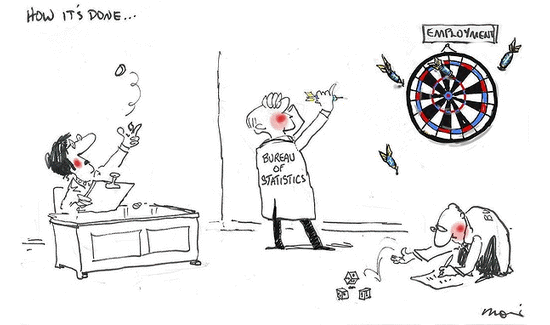
First, it was the Aussies who started to question their official labour force stats.
After an investigation, the ABS had to admit that their survey under-counted the unemployed and undercounted the labour force itself. They have issued a revision that supposedly corrects for the previous deficencies, but actually questions remain.
Now questions are being raised about the American "non-farm payrolls" series and specifically about the income monitoring.
In the American case the analysts think their survey under-estimates wage increases. The evidence is their tax receipts which are showing good gains, which is different to the survey data that shows flatlining.
Here is what Jim O'Sullivan wrote in the FT:
More comprehensive personal income data show wages per hour up more than 3 per cent from a year ago, versus 2 per cent for average hourly earnings. Total wage income, including a 2 per cent rate of growth in hours worked, is up more than 5 percent. The compensation series used to measure unit labor costs is also up more than 3 per cent on a per-hour basis. The employment cost index measure is tamer, but it has accelerated in the last two quarters.
Data on tax receipts add to the evidence that wages are not as stagnant as widely perceived. Employment-based tax receipts have been rising at a 5-6 per cent pace, consistent with the 5-per-cent-plus signal from total wages in the personal income report. Not surprisingly, the budget deficit has been falling rapidly.
The extra strength in the broader measures likely reflects increased variable compensation, including bonuses. That type of pay is less of an inflation threat than basic wages. Even so, the employment report is understating the extent to which tightness in the labor market is putting upward pressure on costs and boosting consumer spending power. Some of the pick-up likely also reflects increased turnover; the quits rate is almost back to its pre-recession level. Changing jobs is typically a prime opportunity for a pay increase.
It is worth noting that the New Zealand 'household labour force survey' and the 'quarterly employment survey' have also come under question by some economists. Their suspicions have been raised by the jerky nature of the results.
Perhaps it is time Stats NZ started ditching their traditional surveys and use 'big data' more. Certainly our use of the LEEDs by the IRD for our Roost home loan affordability research has tended to show higher pay that the QES.
2. A deeper Q4 slowdown
This Saturday report from Reuters caught my eye: bank lending in China in October was down sharply, a situation that underlies their growth problem. While it may not be all it seems (electricity production grew at a faster clip in October), it may portend some worrying economic head winds.
The amount of new loans issued by Chinese banks fell by more than a third in October, adding to signs of faltering demand in the world's second-largest economy which could prompt Beijing to unveil fresh stimulus measures.
The decline came after some banks reported bad loans rose at their fastest clip in two years in the third quarter, while deposits shrank, limiting their ability to lend and highlighting growing strains on the financial system as activity cools.
Chinese banks made 548.3 billion yuan ($89.5 billion) worth of new loans in October, data showed on Friday, missing market expectations of 650 billion yuan and well below 857.2 billion yuan in September.
Taken together with earlier data for October, the credit numbers point to a further loss of momentum in the economy in the fourth quarter, and growing risks that the government will miss its 7.5 percent annual growth target.

3. What Auckland Council can't see
It's not often you read about our problems in a New York academic blog, but our housing affordability issues in Auckland are the subject of a recent piece by Alain Bertaud. He offers some policy suggestions:
What should be done?
There are two ways to compensate for the constraint on land supply imposed by topography:
- increase the amount of land available to developers at the city periphery
- decrease the regulatory constraints which prevent a higher density of utilization in centrally located areas where demand is high
While these two measures should be used simultaneously to increase housing supply, faster and greater impact would come from making more land available to developers. Increasing the housing supply through densification is always slow due to the need to change legislation, NIMBYism, from adjacent residents, the cost of relocating existing land use or occupants, and the increasing demand for floor space per capita.
New Zealanders are rightly concerned about maintaining the natural beauty of their country. However, with urban land only constituting 0.8% of all land in New Zealand, its cities have plenty of room to expand and give residents of all income levels access to the benefits of urban life.
4. Tomorrow's muck-metal?
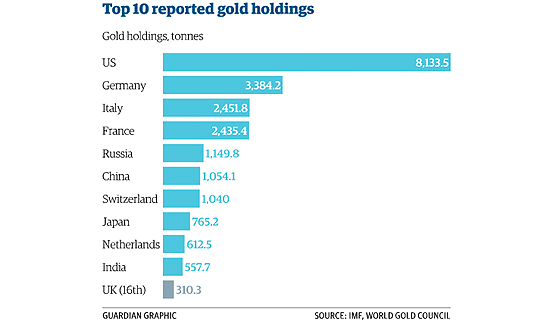
On November 30, Switzerland will hold a popular vote calling for the Swiss National Bank (SNB) to permanently retain at least 20% of its assets in gold, and to store all its gold at home.
About 7% of Swiss reserves are currently held in gold - a near tripling of the current reserves would make Switzerland’s holdings bigger than those of every country in the world except the US and Germany.
Both the SNB and the Swiss government have voiced their opposition to the proposal - but polls show that the vote will be close.
Obviously, the Swiss are ignoring market facts. The Gold Council has just reported their Q3 2014 data and despite their boostering, things are not good for the yellow metal. Nobody but a few renegade governments (including Russia) seem to want it. Jewelry demand is down, industrial demand is going nowhere (except sinking slightly), investors in coin and bars are starting to shun it, and the pro's have been net sellers for quite a while. Mine production is up. If it wasn't for Russian buying, the sinking price would collapse.
That Gold Council data shows that there is about 150 tonnes of excess supply per quarter (despite the Council's shameless headlines). [If you are interested, I will post our updated tracking of the Council's data next week. Let me know.]
A winning Swiss vote might halt the slide for a while. But for something that has little practical use and relies on medieval history to give it its value, the Swiss may end up 'investing' in a pup.
5. How to shift the intellectual debate
Mostly young, mostly American, and mostly at Harvard: Capitalism’s newest critics offer a groundbreaking account of slavery, but does their economic history add up? Their's is a case study in how to shift an intellectual debate, as Timothy Shenk explains in a long read in The Nation.
Historians, as a rule, love to complain about economists.
There are exceptions, but in a field where self-described economic historians make up less than 3 percent of the total population, they are a decided minority. Yet in 2008, most historians were just as baffled by the financial crisis as economists.
In the rush to find the prehistory of a bewildering present, stories of the Rockefellers and their ilk were retold as parables of capitalism overflowing with lessons for the current day: the importance of elites, especially elites with access to massive amounts of capital; the indispensability of finance to more dramatic revolutions in production; the resilience of an economic order that appeared messier than economists allowed, but proved harder to resist than earlier historians had admitted. In a time of recession, nothing stood out more than the stubborn persistence of economic growth - the force that had transformed the son of a small-time charlatan into the commander of powers beyond the imagination of kings a century before. Growth was occasionally checked, but it always revived, and it remade the world along the way.
With memories of the crisis still fresh, a group of academics calling themselves historians of capitalism started to attract increasing attention. Capitalism might seem like a strange topic to require discovery, yet until recently, scholars concerned with the subject tended to style themselves practitioners of economic history, or social history, or labor history, or business history, not the history of capitalism as such. But that is the genius of the label: it names a topic, not a methodology, opening the field to anyone who believes capitalism worth studying.
Mostly young, and mostly specializing in the history of the United States, historians of capitalism are one part of a broader revival in political economy. Yet the success enjoyed by this segment of a larger groundswell remains noteworthy - and surprising. Despite the seeming predictability of the subject’s popularity at a time when economic issues have moved to the forefront of public debate, turning capitalism into the central category of historical analysis requires intellectual sacrifices, pushing some topics into the spotlight and relegating others to the shadows. This has not escaped the capitalism cohort’s peers, many of whom fear that the trend would undo advances made by a generation of cultural historians, while leading to even more scholarship of and by white men. Historians of capitalism vigorously protest those charges, but murmurs of discontent have already begun, and they will grow louder if the field continues to thrive.
Although major intellectual contributions and timely subject matter have boosted capitalism’s newest historians in their ascent, those qualities alone cannot account for their success. They have supplied, as their colleagues in business school would say, a case study in how to shift an intellectual debate. Unlike most case studies, however, tracing the origins of the turn toward capitalism brings into relief a history with profound implications for how we understand the past and the present - and how we envision the future.
The invention of modern economic growth - capitalism, if you like - reshaped the world. But it was part of an ensemble of larger transformations that we are still grappling to understand, and control. If it was possible, in the midst of the Great Depression, for John Maynard Keynes, an economist who hailed from Britain’s elite, to insist that his nation must not “overestimate the importance of the economic problem,” the rest of us have no excuse. The categories we use to make sense of the world - including such basic concepts as ecology, economy and society - have all changed before. The twenty-first century belongs to whoever changes them next.
6. More on Piketty
Bill Gates has read Thomas Piketty. He has also spoken with him. And then he has penned some thoughts which are broadly supportive of the Piketty analysis. But he doesn't agree with it all of course:
I agree that taxation should shift away from taxing labor. It doesn’t make any sense that labor in the United States is taxed so heavily relative to capital. It will make even less sense in the coming years, as robots and other forms of automation come to perform more and more of the skills that human laborers do today.
But rather than move to a progressive tax on capital, as Piketty would like, I think we’d be best off with a progressive tax on consumption. Think about the three wealthy people I described earlier: One investing in companies, one in philanthropy, and one in a lavish lifestyle. There’s nothing wrong with the last guy, but I think he should pay more taxes than the others. As Piketty pointed out when we spoke, it's hard to measure consumption (for example, should political donations count?). But then, almost every tax system—including a wealth tax—has similar challenges.
Like Piketty, I’m also a big believer in the estate tax. Letting inheritors consume or allocate capital disproportionately simply based on the lottery of birth is not a smart or fair way to allocate resources. As Warren Buffett likes to say, that’s like “choosing the 2020 Olympic team by picking the eldest sons of the gold-medal winners in the 2000 Olympics.” I believe we should maintain the estate tax and invest the proceeds in education and research—the best way to strengthen our country for the future.
7. Rotten at the top
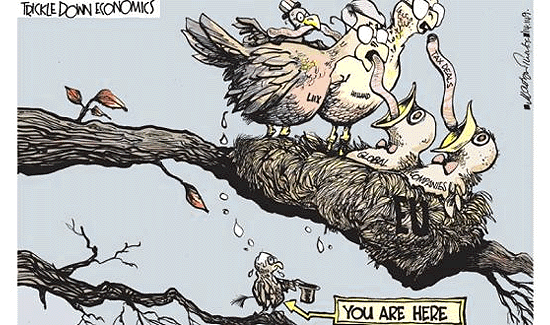
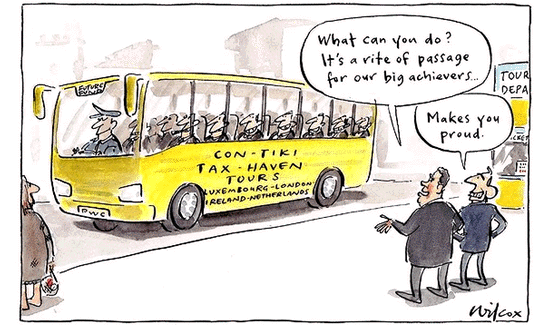
In the face of some opposition, the EU recently 'elected' Jean-Claude Junker as its President. The EU is also about to embark on a high-profile effort to get the large multinational companies to pay more tax in their jurisdictions. However, the ironies involved have not escaped many observers. Junker was previously Prime Minister of Luxembourg, one country that has as its central economic policy encouraging tax breaks for international companies.
Along with Ireland and the Netherlands, it encouraged and sought these companies, changing its tax rules to attract them. In fact, the companies have done not much more than respond to the incentives offered, almost certainly nothing illegal.
Junker is being exposed as two-faced. Some are calling on him to resign already. Der Spiegel for instance:
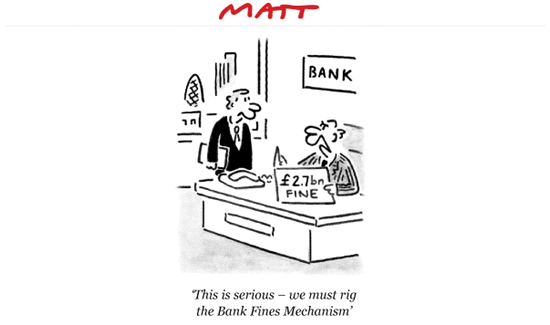
Leaked tax documents released last Wednesday by the International Consortium of Investigative Journalists showed how large corporations have taken advantage of loose policies in Luxembourg to evade paying taxes. At a time of slow economic growth and tight national budgets, sensitivity has grown in large parts of the EU over countries that facilitate legal tax evasion.
Juncker is fond of pointing out proudly that he was Europe's first "leading candidate," and the first to be more-or-less directly elected as president of the European Commission. Across Europe, many celebrated it as the moment when more democracy came to the EU. Unfortunately, optimism blinded people to one salient fact: European politicians themselves never took this newfound democracy particularly seriously.
In contrast to the United States, where getting to know the candidates is a matter of course, the EU never had any intent of truly introducing its leading politicians to the people. This has created a situation in which a person like Juncker can effectively lead two lives. One as an (honest) proponent of the EU and the other as a cunning former leader of an EU member state who promoted Luxembourg's self-interest by blocking treaties that would have forced the country to adopt stricter tax policies.
8. We are different
Watching American household income levels is now a spectator sport for some. I like the amazingly rich data series from the US, but I do scratch my head when some folks assume the US experience means that New Zealand's will be the same.
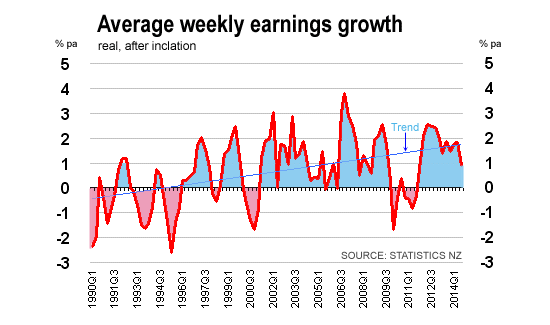
The cause célèbre currently is that household incomes are flatlining*. But is that true for New Zealand? The data I looked at recently suggests not; it suggests we are in a long run sweet spot - interrupted by the GFC, true, but that real earnings are back continuing their long-term rise.
This chart is from two Stats NZ quarterly series. Starting with the Quarterly Employment Survey (QES), we have deducted the quarterly CPI. What you get is the real change in earnings. Since 2001, only the GFC had this less than inflation. Since the end of 2012 we have had one of the longest, 'fattest' periods of weekly earnings growth. Yes, there will be winners and losers within the working population (and it is easy to hear the tales of those not at the average, but the trend since 1997 is clearly positive and increasingly so.
WDKHLWA.
(* It might not even be true for the US either; see #1 above.)
9. Why Key won and Obama struggles?
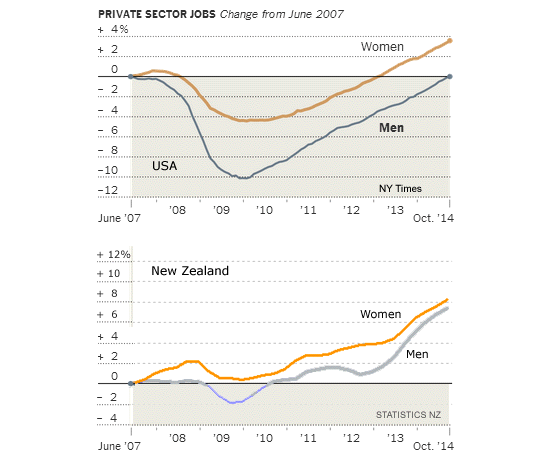
And here's another. The US is noting that finally, jobs for men are now higher than before the start of the GFC. So we built an equivalent chart for New Zealand, and that reveals how much better we have fared on that front as well. More evidence that narratives out of Europe or North America don't always translate well here.
10. Of that you can be certain
Abe and Esther are flying to Australia for a two week vacation to celebrate their 40th anniversary. Suddenly, over the public address system, the Captain announces, "Ladies and Gentlemen, I am afraid I have some very bad news. Our engines have ceased functioning and we will attempt an emergency landing. Luckily, I see an uncharted island below us and we should be able to land on the beach. However, the odds are that we may never be rescued and will have to live on the island for the rest of our lives!" Thanks to the skill of the flight crew, the plane lands safely on the island. An hour later Abe turns to his wife and asks, "Esther, did we pay our $5,000 PBS pledge check yet?" "No, sweetheart," she responds. Abe, still shaken from the crash landing, then asks, "Esther, did we pay our American Express card yet?" "Oh, no! I’m sorry. I forgot to send the check," she says. "One last thing, Esther. Did you remember to send checks for the Visa and MasterCard this month?" he asks. "Oh, forgive me, Abie," begged Esther. "I didn’t send that one, either." Abe grabs her and gives her the biggest kiss in 40 years. Esther pulls away and asks him, "What was that for?" Abe answers, "They’ll find us!"
We welcome your comments below. If you are not already registered, please register to comment
Remember we welcome robust, respectful and insightful debate. We don't welcome abusive or defamatory comments and will de-register those repeatedly making such comments. Our current comment policy is here.