

Here's my Top 10 items from around the Internet over the last week or so. As always, we welcome your additions in the comments below or via email to bernard.hickey@interest.co.nz.
See all previous Top 10s here.
My must reads are #1 and #2 on how the baby boomers of the western world pulled up the ladder on the generations behind them, and how the young don't seemed bothered enough to revolt. This is my final Top 10 for the year. Have a great Summer.

1. Winners and losers - Columbia History Professor Mark Mazower has written this FT Op-Ed ranging through a broad sweep of economic history and concluding that the heirs of a golden age run the show and the young face blighted futures.
Mazower is referring of course mostly to the awful rates of youth unemployment in Europe and the United States, but many of the same themes resonate here.
A generation that benefitted from free tertiary education and much higher youth employment rates early in their careers are now in charge. They bought houses cheaply through the 1990s and early 2000s, winning huge leveraged (and tax free) capital gains into the 2000s. That generation then pulled up the ladder by imposing fees on students and restricting land development, which increased education and housing costs for the generations to follow. They have also pre-cooked the rules so they receive generous pensions that rise much faster than benefits for the young.
The Global Financial Crisis rammed home the yawning gap between the generations and now a second round of slumping inflation is delivering yet more windfall gains to the owners of all sorts of assets, including bonds, stocks and property. Those (mostly young) people who are without a job, who don't have savings and who don't have property are left behind. The lucky generation (accidentally on purpose) pulled up the ladder and now appear determined to hold onto what they've got.
They can rely on their much higher voting rates and their disproportionate size to vote down policies such as a later retirement age, a capital gains tax, easier land policies and any talk of lower tertiary fees.
Mazower offers a bleak assessment of the future, given the young appear disinterested in the democratic process and unaware of what is happening beneath their noses. He is mystified at the lack of a revolt.
Here's Mazower's conclusion:
Heirs of the Golden Age still run the show, and septuagenarian rock stars hog the limelight. Meanwhile the young face dismal employment prospects, insecurity if they do land a job, and soaring bills for their housing and education. Their plight is an extraordinary generational triumph for their parents’ cohort.
In the US, escalating college tuition fees have prompted little protest. Occupy Wall Street was supposed to spur a larger social revolt on the debt question but it failed. In countries on the front line of the eurozone crisis, a doomed generation – facing something in the region of 65 per cent youth unemployment – backs neither the existing parties nor any of the radical alternatives, seeing in all of them, indeed in politics itself, the expressions of the era that got them into this mess.
Understandable as this attitude might be, it is also self-defeating. For until the grievances of the young can assume a political expression more threatening to the established order, the sad truth is that nothing much will change. Modern warfare requires few soldiers. There is no ideology of youth any more, and it is not just the unemployed under-25s who have lost faith in the future. From the point of view of the modern state and its politicians, who needs the young?
2. The wealth of generations - Even in Australia, the Grattan Institute is looking at similar issues.
The housing boom plus rapid increases in government payments on pensions and services for older people risks creating a generation of young Australians with a lower standard of living than that of their parents at a similar age. The generational bargain, under which each generation of working Australians supports retirees while still improving its own standard of living, is under threat.
The report finds that most age groups are richer than they were in 2003. An average 55 to 64-year old household was $173,000 richer in real terms in 2011-12 than was a household of that age in 2003-04. The average 65 to 74-year old household was $215,000 better off over the same period.
However, the average 35 to 44-year old household was only $80,000 richer. Worst affected were 25 to 34-year olds who had less wealth than people of the same age eight years before – even though they saved more than did people of that age in the past.

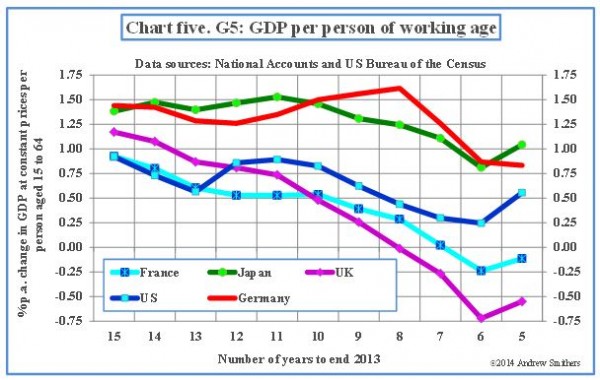
3. It's structural, not cyclical – The biggest debate in the world of economics and markets at the moment is whether the surprisingly low inflation we're seeing all around the world is permanent or just a (downward) blip. Renowned British economist and fund manager Andrew Smithers argues here in this FT blog that it's structural.
He points in particular to the role of aging populations and this chart below showing GDP per working age person is truly devastating.
"As the origin of such changes lies largely in changes in birth rates dating back many decades, a major part of the post-recession slowdown must be attributed to secular rather than cyclical changes."
4. The price of a name – I had no idea, but there's a branch of science called Systematics that is all about the naming of organisms.
Landcare's Systematics Team Leader Dr Peter Buchanan takes a look via sciblogs at the implications identified in the Dean report on the botulism scare of getting the names Clostridium sporogenes and Clostridium botulinum mixed up. The cost was about NZ$100 million.
Ouch.

5. Black swans and fragility – Ambrose Evans Pritchard has picked up on a BIS report that warns about the dangers of a jump in the US dollar given offshore lending in US dollars has surged to US$9 trillion in recent years.
The rouble slump and the drop in the Indonesia rupiah in recent days reinforces the fragility of the system. See 8 below for an idea of what happens when petro-dollar exporters who borrowed heavily in US dollars are hit by a currency slump and a rise in in interest rates at the same time as an oil price slump. The chart below tells the story.
Cross-border lending in dollars has tripled to $9 trillion in a decade. Some $7 trillion of this is entirely outside the American regulatory sphere.
"Neither a borrower nor a lender is a US resident. The role that the US dollar plays in debt contracts is very important. It is a global currency, and no other currency has this role," he said. The implication is that there is no lender-of-last resort standing behind trillions of off-shore dollar bank transactions. This increases the risks of a chain-reaction if it ever goes wrong. China's central bank has ample dollar reserves to bail out its companies - should it wish to do so - but the jury is out on Brazil, Russia, and other countries.
This flaw in the global system may be tested as the Fed prepares to raise interest rates for the first time in seven years.

6. Ghost cities and bridges to nowhere – Jamil Anderlini has a cracking account of the US$6.8 trillion that China estimates it wasted during its credit-fuelled construction binge from 2008 to 2012. And remember, this is what the Chinese Government is saying about China…. And our second largest trading partner, Australia, depends on sales of iron ore and coal to China to fuel that construction...
In 2009 and 2013 alone, “ineffective investment” came to nearly half the total invested in the Chinese economy in those years, according to research by Xu Ce of the National Development and Reform Commission, the state planning agency, and Wang Yuan from the Academy of Macroeconomic Research, a former arm of the NDRC. The bulk of wasted investment went directly into industries such as steel and automobile production that received the most support from the government following the 2008 global crisis, according to the report.
Mr Xu and Ms Wang said ultra-loose monetary policy, little or no oversight over government investment plans and distorted incentive structures for officials were largely to blame for the waste. “Investment efficiency has fallen dramatically [in recent years],” they say in the report.
“It has become far more obvious in the wake of the global financial crisis and has caused a lot of over-investment and waste.”

7. Wellington is a dying city – Full disclosure. I moved to Wellington at the beginning of last year for family and work reasons and I have enjoyed it. We bought a house in Wellington and have enjoyed it. But Wellington's economy has kept diverging sharply from Auckland over that period, and it's expressing itself in all sorts of interesting ways, including in house prices. But also in attendance at expensive events. John Key famously said Wellington was a dying city, and it looks like he's right.
Here's another sign.
Steve Tew and the NZRU quietly bailed out the Wellington Rugby Union over the last week to ensure it wasn't slammed by poor sales for the Sevens next year, the DomPost reported.
Here's Tew wondering what's wrong with Wellington:
"It's challenging in Wellington at the moment and it's not just the sevens, it's everybody. "Go and talk to the Phoenix," he said.
"We are not unlike other promoters in the city in that we are nervous. The appetite of Wellingtonians to go to events has changed, hopefully not permanently, but certainly significantly and it's going to put some things at risk, it really is."
NZ Rugby's current agreement with World Rugby (previously the International Rugby Union) to keep the tournament in Wellington was not set in concrete post 2016. "Is the city losing its appetite for events? It appears to be. We've sold as many tickets to people outside of Wellington as we always have, so the people who haven't bought them are Wellingtonians.
"At some point, if that's the case, events will go elsewhere."
8. The rubble of the rouble - Ambrose has scary story to tell about the latest plunge in the value of the rouble and the desperate attempts by Putin's cronies to protect themselves. This may not end well.
Here's Ambrose saying Russia is at risk of a Soviet style collapse. Crikey.
Neil Shearing, from Capital Economics, said the spectacular failure of the rate shock may bring matters to a head. “If a rise of 650 basis points won’t do the job, we are near the end. That means stringent capital controls,” he said.
Michal Dybula, from BNP Paribas, said the rouble's plunge risks setting off a systemic bank run. “A large-scale run on deposits, once under way, would make capital controls pretty much unavoidable,” he said, adding that the authorities may start by forcing state-controlled companies to sell foreign assets and repatriate funds.

9. Woop woop - The billion prices project in the United States is a fascinating real-time measure of inflation and it is flashing red in a dis-inflationary way, thanks it seems to the plunging oil price.
It's all very topical given the Fed's latest murmurings about maybe, patiently raising interest rates. It's not going to happen if inflation keeps headed in this direction.
Here's the WSJ with the detail. Again, the chart tells the story.

10. Totally Clarke and Dawe on growth creation. It's all about growth. One of my favourites of the year.
We welcome your comments below. If you are not already registered, please register to comment
Remember we welcome robust, respectful and insightful debate. We don't welcome abusive or defamatory comments and will de-register those repeatedly making such comments. Our current comment policy is here.