

Here's my Top 10 items from around the Internet over the last week or so. As always, we welcome your additions in the comments below or via email to bernard.hickey@interest.co.nz.
See all previous Top 10s here.
My must read is #2. It explains #1 and should blow your mind if you're interested in how technology changes economies and history. And I quite like Dilbert ;)

1. Negative bond yields - It is extraordinary that more than US$2 trillion worth of bonds are now trading in negative yielding territory. That means the investor is effectively paying another investor, a bank or a Government money to look after their money.
The numbers, as detailed in this FT explainer, are amazing.
More than 60% of German bonds are now negative yielding.
The German Government was able to issue a five year bond with a negative yield last week.
And the ECB hasn't even started printing money to buy bonds yet.
So why on earth would any investor ever buy a negative yielding bond?
The same reason anyone buys anything these days: the capital gain when they yields go even more negative.
There is another more unsettling view: that the really smart money in the deepest markets in the world are moving in some 'wisdom of the crowds' way to the conclusion that we face an epic age of deflation (see the links below for more on that).
Hence there is a very good chance bond yields will fall further into negative territory as the ECB and other central banks buy up huge amounts of debt. That will push prices higher and means investors will reap a capital gain that offsets a negative yield.
While negative bond yields are a compelling sign of a serious dysfunction, bond investors see an opportunity for capital gains or what is known as a positive total return. That is what makes bond investors very happy.

2. 'The referee would stop the fight' - John Lanchester has written a joint book review for the London Review of Books of 'The Second Machine Age' and 'Average is Over'. Both look at the impact of new technology on the nature of work, incomes and the economy. He takes a Luddite-ish view. #9 below takes the opposite view.
Lanchester points to the divergence evident in recent years between productivity and wages. He rightly points to the Apple example.
The amount of work done per worker has gone up, but pay hasn’t. This means that the proceeds of increased profitability are accruing to capital rather than to labour. The culprit is not clear, but Brynjolfsson and McAfee argue, persuasively, that the force to blame is increased automation.
That is a worrying trend. Imagine an economy in which the 0.1 per cent own the machines, the rest of the 1 per cent manage their operation, and the 99 per cent either do the remaining scraps of unautomatable work, or are unemployed. That is the world implied by developments in productivity and automation. It is Pikettyworld, in which capital is increasingly triumphant over labour. We get a glimpse of it in those quarterly numbers from Apple, about which my robot colleague wrote so evocatively. Apple’s quarter was the most profitable of any company in history: $74.6 billion in turnover, and $18 billion in profit. Tim Cook, the boss of Apple, said that these numbers are ‘hard to comprehend’. He’s right: it’s hard to process the fact that the company sold 34,000 iPhones every hour for three months.
Bravo – though we should think about the trends implied in those figures. For the sake of argument, say that Apple’s achievement is annualised, so their whole year is as much of an improvement on the one before as that quarter was. That would give them $88.9 billion in profits. In 1960, the most profitable company in the world’s biggest economy was General Motors. In today’s money, GM made $7.6 billion that year. It also employed 600,000 people. Today’s most profitable company employs 92,600. So where 600,000 workers would once generate $7.6 billion in profit, now 92,600 generate $89.9 billion, an improvement in profitability per worker of 76.65 times. Remember, this is pure profit for the company’s owners, after all workers have been paid. Capital isn’t just winning against labour: there’s no contest. If it were a boxing match, the referee would stop the fight.
3. The deflationary impact - Lanchester goes on to point out that this brave new Pickettyworld would be riven by deflation.
This world would likely be one which suffered from severe deflation. If jobs are disappearing, then there is less and less money in most people’s pockets, and when that happens, prices fall. This isn’t exactly the kind of deflation we are starting to have today in wide swathes of the developed world; that’s more to do with the oil price falling at the same time as economies stagnate and consumers lose confidence. But the different deflations could easily overlap.
Larry Page, founder and CEO of Google, is sanguine about that, as he recently said in an interview reported in the Financial Times: He sees another boon in the effect that technology will have on the prices of many everyday goods and services. A massive deflation is coming: ‘Even if there’s going to be a disruption in people’s jobs, in the short term that’s likely to be made up by the decreasing cost of things we need, which I think is really important and not being talked about.’
4. He said what! - Larry Page of Google fame has a strong view that new technology will drive prices lower, and not just for goods and services. He's one of those libertarians who think the inevitable freeing up of land supply will also drive down house prices. Here's his view in this October 31, 2014 interview with the FT, which I missed at the time.
It raises some deep questions about what happens to the people replaced by the robots. How do they earn a living? Should there be a universal basic income?
Here's Page:
New technologies will make businesses not 10 per cent, but 10 times more efficient, he says. Provided that flows through into lower prices: “I think the things you want to live a comfortable life could get much, much, much cheaper.”
Collapsing house prices could be another part of this equation. Even more than technology, he puts this down to policy changes needed to make land more readily available for construction. Rather than exceeding $1m, there’s no reason why the median home in Palo Alto, in the heart of Silicon Valley, shouldn’t cost $50,000, he says.
For many, the thought of upheavals like this in their personal economics might seem pie in the sky – not to mention highly disturbing. The prospect of millions of jobs being rendered obsolete, private-home values collapsing and the prices of everyday goods going into a deflationary spiral hardly sounds like a recipe for nirvana. But in a capitalist system, he suggests, the elimination of inefficiency through technology has to be pursued to its logical conclusion.
“You can’t wish away these things from happening, they are going to happen,” says Page. “You’re going to have some very amazing capabilities in the economy. When we have computers that can do more and more jobs, it’s going to change how we think about work. There’s no way around that. You can’t wish it away.”
5. And the societal response? - Lanchester then goes on to look at the speed of the changes involved and the likely societal response. Those jobs and incomes are not going to go away easily or without consequence.
These chilling views aren’t unusual in Silicon Valley and the upper reaches of the overlord class. The tone is inevitabilist, deterministic and triumphalist. There’s no point feeling sad about it, this is just what’s going to happen. Yes, robots will eat the jobs – all the little people jobs, anyway.
There is a missing piece here. A great deal of modern economic discourse takes it as axiomatic that economic forces are the only ones that matter. This idea has bled into politics too, at least in the Western world: economic forces have been awarded the status of inexorable truths. The idea that a wave of economic change is so disruptive to the social order that a society might rebel against it – that has, it seems, disappeared from the realms of the possible. But the disappearance of 47 per cent of jobs in two decades (as per Frey and Osborne) must be right on the edge of what a society can bear, not so much because of that 47 per cent, as because of the timeframe. Jobs do go away; it’s happened many times.
For jobs to go away with that speed, however, is a new thing, and the search for historical precedents, for examples from which we can learn, won’t take us far. How would this speed of job disappearance, combined with extensive deflation, play out? The truth is nobody knows. In the absence of any template or precedent, the idea that the economic process will just roll ahead like a juggernaut, unopposed by any social or political counter-forces, is a stretch. The robots will only eat all the jobs if we decide to let them.
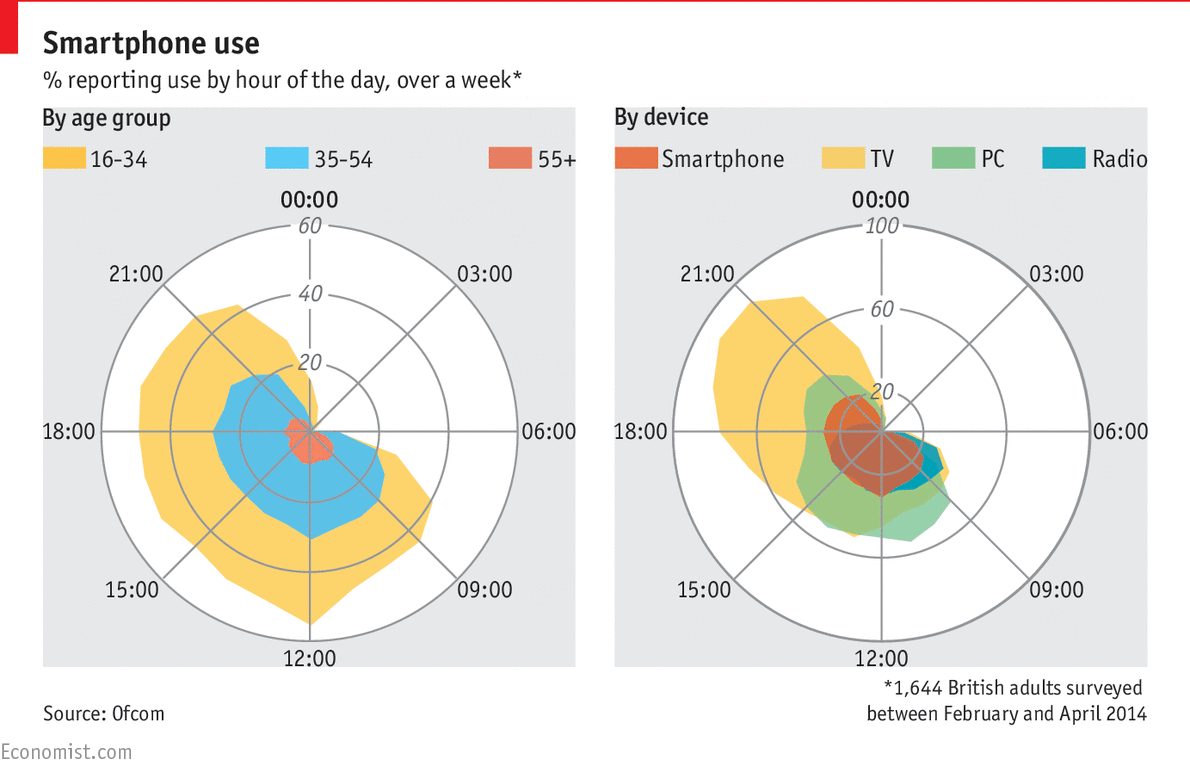
6. It's only just begun - The Economist has done a big production number on the meaning for the global economy of the smart phone. It has collated some amazing facts and figures.
Have a look at the graphic below showing how much time 16-34 year olds are spending on their phones during waking hours (the yellow blob showing up to 60%).
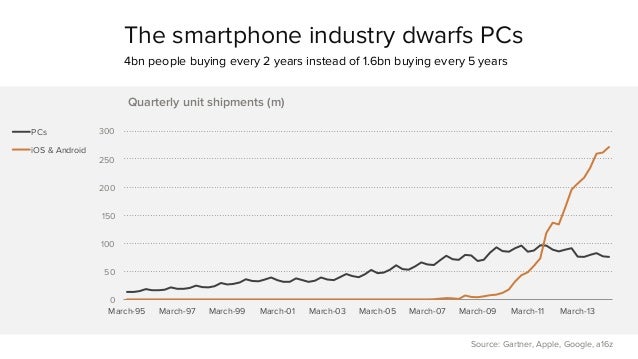
The third windfall is economic. Some studies find that in developing countries every ten extra mobile phones per 100 people increase the rate of growth of GDP-per-person by more than one percentage point—by, say, drawing people into the banking system. Smartphones will remake entire industries, at unheard-of speed. Uber is a household name, operating in 55 countries, but has yet to celebrate its fifth birthday. WhatsApp was founded in 2009, and already handles 10 billion more messages a day than the SMS global text-messaging system. The phone is a platform, so startups can cheaply create an app to test an idea—and then rapidly go global if people like it. That is why it will unleash creativity on a planetary scale.
8. Couldn't have said it better myself - Here's The Economist with an opinion piece on the intergenerational wealth transfer going on in Britain. Something similar is happening here too.
Buoyed by generous pensions and decades of soaring house prices, the wealthiest fifth of pensioner households enjoy average incomes well over twice the British average: for such lucky wrinklies, the winter-fuel allowance is less an inducement to turn on the radiator than an invitation to chambrer some decent wine. And as more British home-owners approach retirement, the numbers of rich pensioners will grow. The truth is Mr Cameron is motivated less by a desire to uphold the dignity of age than to bribe pensioners—the Britons most likely to vote Tory.
Contrast their treatment with that of younger Britons, whose taxes are paying for their pampered elders. Unlike state pensions, working-age handouts have been squeezed. Child benefit, previously a universal payment to parents, is now means-tested. The Tories have promised the young even more austerity, by making them work for unemployment benefits—which are already 21% less generous for the under-25s—and denying them housing benefit.
Transfers from young to old can be justified, both because many of the old cannot work and because technological progress means youngsters are likely to end up better off than their grandparents. Yet today’s low-skilled Britons, unlike their grandparents, have seen their incomes serially squeezed. At 14%, youth unemployment is high. And for those without property to inherit, exorbitant rents and house prices—the result of decades of failed planning—have dashed the dream of home-ownership to which Britons aspire.

9. 'The Luddites are wrong' - Walter Isaacson, who wrote the book on Steve Jobs, has written this FT Op-Ed pushing back at the 'Second Machine Age' guys and others suggesting the rise of the robots could create mass technological unemployment.
If new technologies reduced the total number of jobs, we would all be out of work by now. But times of technological advance have been times of job creation. Last year, as whole new waves of robotic systems were introduced, the US added 3m jobs. The unemployment rate hit a six-year low, and average hourly earnings for private sector workers rose.
Be wary of those who lament the demise of jobs for checkout clerks and meter readers, as if preserving such jobs will lead to a healthier economy. This Luddite fallacy is based on a presumption that there is only a set amount of goods and services people want. If technology permits those things to be produced more efficiently, Luddites argue, there will be less work to do. In reality, technology leads to an increase in productivity and wealth. That in turn leads to increased demand for goods and services and thus more jobs, including ones in fields we can barely imagine.

10. Totally Clarke and Dawe on the NBN rollout and Democracy in Greece and Australia.
We welcome your comments below. If you are not already registered, please register to comment
Remember we welcome robust, respectful and insightful debate. We don't welcome abusive or defamatory comments and will de-register those repeatedly making such comments. Our current comment policy is here.