

By Bernard Hickey
Just imagine what a political party designed to represent New Zealand's young renters would do if it got into power in Auckland or Wellington.
Let's call it the Generation Rent Party.
For now, it's a moot point. Voting rates in Auckland Council's 2013 elections were painfully low for the all ages at between 31% to 37%, depending on the ward involved.
The 'younger' wards of Manukau, Manurewa and Waitakere were at the lower end of that range. Council election turnout for those aged 18-39 was likely to be less than 20%, given voting rates for the young in local body elections tend to be between a third to two thirds the rates of those aged over 60.
Less than half all eligible voters between the ages of 18 and 30 vote in General Elections in New Zealand.
For whatever reason, young voters don't seem to know or care or are able to vote to protect their interests.
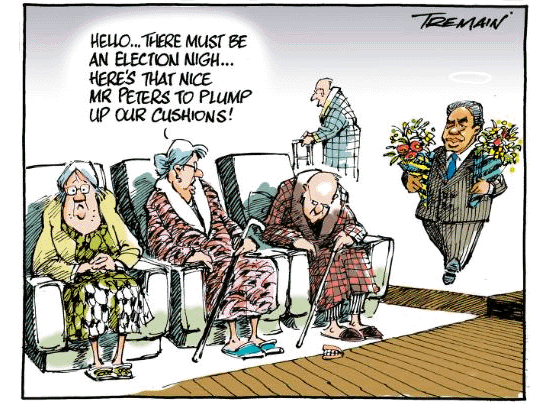
That contrasts with Generation Winston which was even more motivated and able to protect their interests by voting for New Zealand First last year.
That's either a fatalistic view based on a cynicism about the Facebook Generation being too busy 'liking' each other to vote, or it's a huge opportunity for some entrepreneurial politicians to shift the balance of power by capturing that vote.
Winning the young and disenfranchised vote certainly won Barack Obama his second term, but last year's election showed no one has managed it in New Zealand. Yet.
Lets, for imagination sake, imagine if they did.
What policies would they pursue?
Firstly, they would act to try to make housing affordable again for first home buyers who want to start a family before they turn 40 without having to beg their parents and grandparents for money (for those lucky enough to even have wealthy relatives). Or at least make them affordable enough so that rents consumed less than 30% of their disposable income.
House prices in Auckland are rising again at double digit rates and rent inflation is accelerating into the higher single digits. The median house price in Manukau was 25% higher in January than a year ago.
Record high net migration, heavy buying by rental property investors pumped up with interest-only mortgages and unfettered buying by non-residents has combined with chronic under-supply to pump up house prices again.
That is flowing through into rent inflation and has the Government worried enough to point out that its NZ$2 billion a year of spending on accommodation supplements and income related rents actually subsidises more than half of all rental properties.
If in power in Auckland, the Generation Rent Party would remove the shackles on development of higher density housing in the fringe 'heritage' suburbs around the CBD, which would free up supply in areas close enough to the centre to use cheaper and less time-consuming public transport (remembering of course that Generation Rent are much less likely to own cars).
This idea of removing restrictions on apartment heights, view shafts, parking requirements, balcony sizes and sizes of backyards is not as outlandish as the NIMBY Boomer opponents would make out.
An NZIER study conducted for Auckland Council this found these restrictions cost households NZ$933 a year by pushing up house prices across Auckland, and increasing commuting times and transport infrastructure costs.
Generation Rent would also impose a land or capital tax on the generation who gained more than NZ$400 billion in wealth over the last 20 years because house prices more than doubled in Auckland in particular because of the land supply restrictions that boosted their own wealth at the expense of generations to follow.
It might also use the Crown or Council balance sheets to fund mass home building programmes.
Secondly, Generation Rent would move to rectify the inter-generational wealth transfer around tertiary education. The generation who received tertiary educations for free in the 1970s and 1980s then ensured they didn't have to pay so much as taxpayers by forcing students from the 1990s onwards to pay fees and take on big student debts.
A first step would be reduce or remove those fees, as has been done in places such as Germany and Scotland.
Thirdly, Generation Rent would move to reduce the future cost to them as taxpayers of the escalating cost of universal New Zealand Superannuation and health care for an ageing population. It is currently expected to rise to 6.7% by 2060 from 4.1%.
One of the younger new MPs, David Seymour, is at least trying to raise the issue again.
The unfairness is galling for overwhelmingly younger beneficiaries who see their benefits rise in line with Consumer Price Inflation (0.5% this year) while NZ Superannuation payments rise in line with average wages (2.5% this year).
This would be rectified by delaying the retirement age and breaking the pension's link with average wages.
The Gold Card would be the Gone card too.
Those are the sorts of things Generation Rent would do in power, if they either knew about the intergenerational wealth transfer happening under their noses or cared enough to vote.
For now, it's a moot point because Generation Rent is Generation Doesn't Vote, while their older and creakier neighbours least know how to shuffle into a voting booth.
-----------------------------
A version of this article was also published in the Herald on Sunday. It is here with permission.
We welcome your comments below. If you are not already registered, please register to comment
Remember we welcome robust, respectful and insightful debate. We don't welcome abusive or defamatory comments and will de-register those repeatedly making such comments. Our current comment policy is here.